

First Contact
The Last Proof of My Existence
I. The Last Proof
I am writing this eleven years after the lights went out.
My hands shake now. Some days the pen feels heavier than it should. Some days I have to stop after a few sentences and wait for my breath to return.
There are no doctors left near me. No clean rooms. No blood tests. Whatever is happening inside my body has no name anymore. Maybe the old world would have known what to call it. Maybe there was once a scan, a pill, a surgery, a treatment, a room full of people trained to fight this thing before it hollowed me out.
But that world is gone.
So I write.
Memory dies easily now. Rain can take paper. Fire can take a house. Time can take a name. And when a name is gone, what proof remains that a person ever stood beneath the sky and looked up at something impossible?
This account may be the last proof of my existence.
So I will begin where the old world began to end.
II. Coffee
The day humanity made first contact with an alien species began like any other day.
That may be the strangest part.
I woke up early and made coffee.
I wonder if that word means anything to you now.
Coffee.
Maybe by the time these pages are found, it will sound like a myth, or a plant from a children's story. It came from beans once. They grew in warm places far from where I lived. People harvested them with hands I never saw. Other people roasted them, packaged them, shipped them across oceans and highways, stacked them beneath fluorescent lights, and sold them to tired strangers who believed they were only buying a morning habit.
Whole nations of invisible labor lived inside that cup. Farmers. Drivers. Dockworkers. Cashiers. Factories. Ships. Trucks. Electric grinders. Clean water.
A thousand moving parts, just so one man could stand in his kitchen before work and drink something bitter enough to wake him.
That was the old world.
We called it ordinary because we never had to understand how miraculous it was.
So yes. I woke up early, made coffee, and got ready for work.
Nothing felt different at first. No warning in the air. No instinct screaming at me to stay inside. No dream from the night before that suddenly seemed prophetic.
Just coffee. Morning. Routine.
The little rituals people perform because they believe the world will still be there by noon.
III. The Eye in the Fog
I still do not know why I walked outside.
I usually drank my coffee in the kitchen, but that morning, for some inexplicable reason, I wanted fresh air.
So I stepped outside.
The first thing I noticed was the fog.
It hung over the street with an eerie stillness, like some kind of messenger. It did not roll or drift the way fog usually does. It seemed to wait.
Then I saw it.
At first, only from the corner of my eye.
Something hovering in the sky.
I turned and looked up.
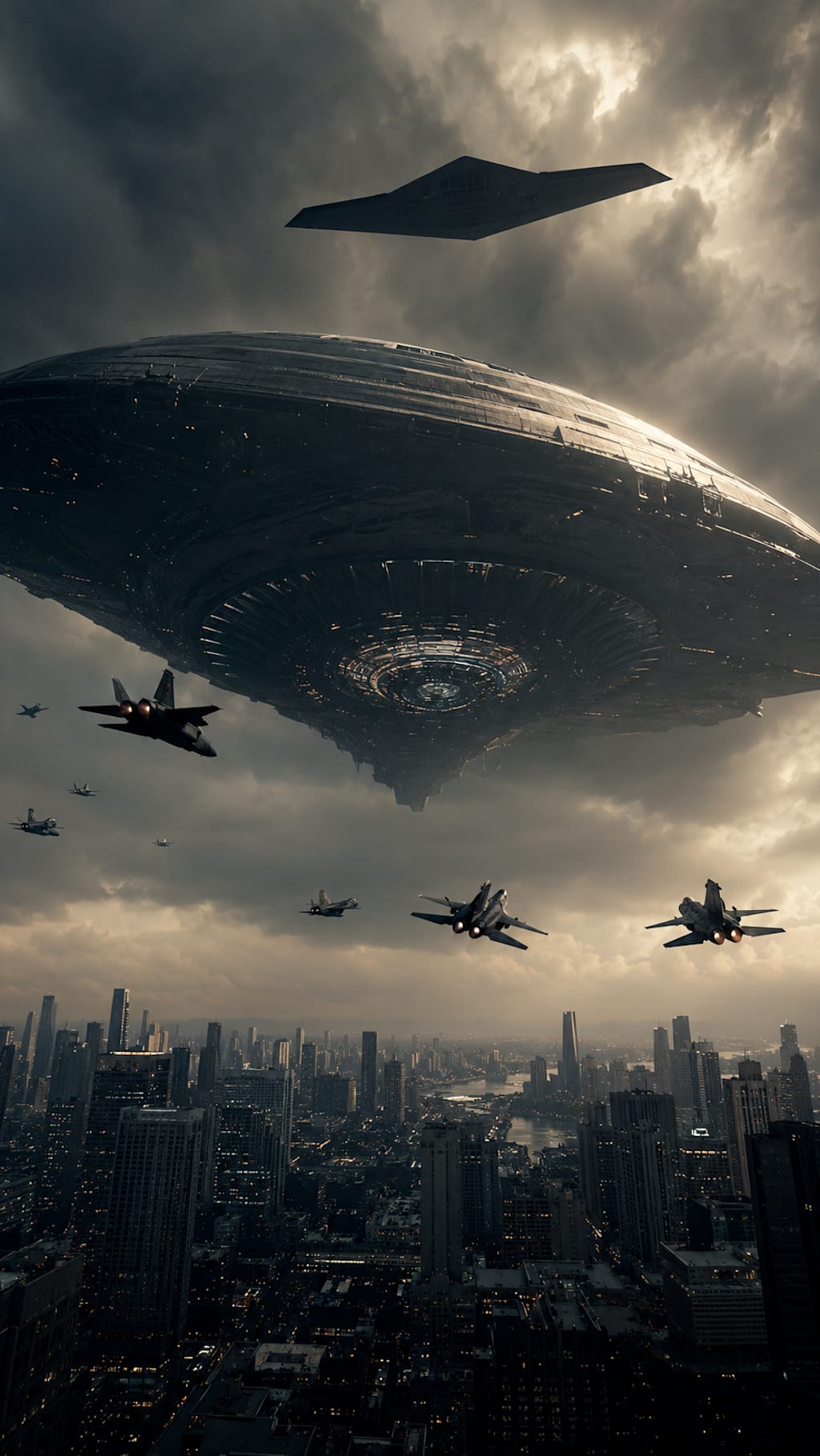
It must have been twenty miles across, maybe more. A massive object suspended above the world with an ethereal chrome glow, metallic and soft at the same time, as if the sky itself had opened an eye and that eye was made of polished silver.
I stood there staring at it like a deer in headlights.
Until that moment, my objective reality had been simple.
We were alone in the universe.
Then, in one breath, that reality died.
I do not know how much time passed. Minutes felt like hours. My mind could not accept what my eyes were reporting. For a moment, I felt outside my own body, watching myself watch the object.
I thought of the Aztecs seeing Spanish ships on the horizon for the first time, not yet understanding that the world they knew had already begun to end.
I walked back inside in a haze.
I tried to pour myself more coffee, but the cup was still full. It overflowed onto the countertop before I even realized what I was doing.
That finally snapped something loose in me.
I grabbed my phone with a shaking hand and searched one word:
News.
The headlines hit me like a slap.
They confirmed what my brain already knew, but what my reality had not yet accepted.
FIRST CONTACT WITH ALIEN SPECIES
Goosebumps rose across my entire body.
The shock became questions.
What did they want?
Why were they here?
Why were they silent?
Then the streetlights outside began flickering.
On. Off. On. Off.
The digital clock in my kitchen displayed symbols I had never seen before.
I remembered all those old abduction stories where radios went insane and electronics behaved strangely before something impossible happened. I had laughed at those stories once.
I was not laughing anymore.
That was when my body entered fight-or-flight.
I checked the refrigerator. The light came on when I opened the door, so at least I had that. The water was still running too, so I filled every container I could find.
Then I locked the doors.
In hindsight, I probably should have locked them first.
After that, I sat on my bed and stared at the wall.
One thought repeated in my head like a prayer spoken by someone who did not yet know what god he was praying to.
We really aren't alone.
We really aren't alone.
We really aren't alone.
IV. The Silence Above Us
When I finally checked the news again, the reporters knew about as much as I did.
At 6:00 a.m. Pacific Time, approximately thirty craft had entered Earth's atmosphere. Each was estimated to be around fifteen miles in diameter. They had positioned themselves above every major metropolitan area with a human population over one million.
They had not attacked.
They had not landed.
They had not established communication.
They simply hovered.
Silently.
Above our cities.
That silence did something terrible to us.
Online, people were already tearing each other apart. News anchors argued with their own coworkers live on television. Experts contradicted other experts. Politicians issued statements that said nothing in the most official language possible.
Everyone wanted to be the first person to understand the impossible.
No one did.
The Pope made an address that people later called historic. He said we had to find a way to love each other. That God had chosen this vast universe not for humans alone, but for other species as well. That the way we loved each other would show these visitors how to love us.
The cynic in me muttered at the screen.
But we don't love each other. We spend most of our time fighting one another.
Then came the other reports.
Mass suicides.
Looting.
Riots.
Highways jammed with people trying to escape the cities where the craft hovered overhead.
Some people ran from them. Some people prayed to them. Some people fired rifles into the sky, as if bullets could answer a question older than our species.
It felt apocalyptic.
So I made a decision.
I was not going to work that day.
My boss could go straight to hell, assuming hell still had room after whatever was happening outside.
V. The Music
Around midday, a strange report began circulating.
Some rural radio stations had been hijacked by an unknown signal. They were playing music no one recognized.
At first, it was a handful of stations.
Then hundreds.
Then thousands.
Not long after that, every radio station on Earth was playing it.
The music was alien.
There is no better word for it.
But it was not frightening.
It was peaceful. Calming. Almost like a church choir, though no human voice could have made those sounds. It moved through the air in tones that seemed to bypass language entirely. I felt my breathing slow. My hands stopped shaking.
For the first time that day, I felt peace.
Real peace.
Not the temporary kind you get when bills are paid or traffic clears, but something deeper. Something ancient. Something that seemed to reach into the part of me that had always felt disconnected from my fellow man and stitch it, for a moment, back into the whole.
I felt my neighbors.
I do not know how else to describe it.
Not telepathy exactly, but something close enough to make the word feel small. I could feel fear, grief, wonder, confusion, awe. All of us, separate in our homes, suddenly aware that we were not separate at all.
That was the real first contact.
Not the ships.
Not the headlines.
The music.
They were speaking to us.
At least, I believe they were.
I have to believe that.
Because if that music was not peace, then I do not know what peace would sound like.
VI. The Knife
But the military did not hear it that way.
Jets circled every craft. Their engines screamed around those impossible vessels like insects around cathedral bells. In New York, a nuclear-equipped stealth bomber flew near the alien craft suspended above the city.
I remember watching the footage and feeling ashamed.
Imagine crossing all that darkness.
Imagine traveling through silence for decades, maybe at near-light speed, carrying a message across the stars.
Imagine arriving above a young, frightened world and singing to it.
Then imagine that world answering with armed machines carrying nuclear weapons.
How would you feel?
What happened next did not shock me as much as it should have.
Maybe some part of me already knew.
We were always going to bungle first contact.
It is in our nature to destroy ourselves, whether by vanity, greed, avarice, fear, or our endless talent for war. We are a species that turns every miracle into a battlefield and then wonders why heaven stays silent.
Still, after all these years, I do not know exactly what they meant to do.
Maybe they punished us. Maybe they feared us. Maybe they looked down at our weapons and saw a child waving a knife in a crowded room. Maybe they did not hate us at all. Maybe they simply decided we were too dangerous to leave armed with lightning.
They say any sufficiently advanced technology looks like magic.
At 8:00 p.m. Pacific Time, the alien craft released some kind of electromagnetic pulse.
The hands on my watch are still frozen at that exact minute.
That was eleven years ago.
Then the craft left.
No warning.
No final message.
No explanation.
They simply rose into the sky and vanished from the world they had tried to greet.
VII. When the Clocks Stopped
In one instant, our species was thrown back centuries.
No electricity.
No modern technology.
Nothing touched by the pulse could be repaired. We tried, of course. For years we tried. Engineers opened machines like surgeons opening bodies, desperate to find a heartbeat somewhere inside the metal.
But the machines were dead in a way we did not understand.
When the dust settled, governments fractured. Cities emptied. Supply chains vanished. Hospitals became tombs.
The silence was the worst part at first.
Not the screaming.
Not the fires.
Not the rumors of soldiers abandoning posts or neighbors killing neighbors over canned food and clean water.
The silence.
No refrigerators. No traffic. No distant aircraft. No televisions murmuring from other rooms. No engines turning the night into something manageable.
The world had always been making noise, and we had mistaken that noise for life itself.
When it stopped, we heard what had been underneath it all along.
Wind. Breath. Hunger.
Human beings moving through the dark.
VIII. The War After the War
The first war ended without a battle.
The visitors did not burn our cities. They did not occupy our streets or raise flags over our capitals.
They took the lightning from our hands.
Then they left.
The second war was ours.
It began in whispers, then checkpoints, then gunfire in the distance at night.
At first, people looked to the military for order. When the world becomes uncertain, the uniform looks like certainty.
But the old world had gone silent.
No satellites. No command networks. No clean chain of authority.
Orders arrived late, contradictory, half-decoded, or not at all. Some commanders said they were still receiving instructions from the legitimate government. Others called them liars. Some believed the President was alive. Others said Washington had fallen. Others said there was no Washington anymore, only smoke, refugees, and men with uniforms standing in rooms where authority used to live.
I do not know which stories were true.
What I do know is that the uniforms began to disagree.
Some units protected evacuation routes. Some guarded hospitals long after the hospitals had become places where people went to die more slowly. Some took in civilians and built little kingdoms out of discipline, sandbags, and ration cards.
Others seized fuel depots, water plants, armories, grain silos. They called it national continuity, which is what powerful men say when they begin confusing survival with ownership.
A flag could save your life in one county and get you shot in the next.
I saw one checkpoint outside what used to be Bakersfield.
Three armored vehicles blocked the road. The soldiers manning it looked exhausted. Not evil. Not heroic. Just young men who had not slept enough and had been told too many different versions of duty.
One of them searched my bag.
Another kept his rifle pointed somewhere near my stomach.
On his sleeve, an old patch had been cut away. In its place, someone had stitched a new symbol by hand.
A black star inside a circle.
I asked what it meant.
He looked at me for a long moment and said, "It means we're still here."
I did not ask who we were.
And those were only the wars I saw.
Around fires, people spoke of others.
They said Europe had been ravaged almost to annihilation by old borders reopening like wounds, by starving cities turning against countryside, by military councils, separatist armies, religious militias, and men who found meaning only after the maps burned.
They said Russia had been overrun from the east by what remained of the Chinese military, or by something that had once been the Chinese military before hunger, ambition, and madness changed its shape. The stories always mentioned a warlord at the center of it, a madman who called himself the reincarnation of Genghis Khan.
Maybe he was real. Maybe he was a soldier with too many victories and a name people feared enough to repeat. Maybe he was a dozen different men, stitched together by campfire terror into one monster large enough to explain the screaming.
There was no way to know.
No radio. No television. No internet. No satellites.
Only travelers, refugees, deserters, merchants, widows, and people who carried maps that no longer meant anything.
The world became larger after the lights went out. Larger, and older.
Oceans returned to being oceans. Mountains became walls again. Borders became myths. Whole continents disappeared into rumor.
We did not know if Europe was dead.
We did not know if Russia still existed.
We did not know if China was a nation, an army, an empire, or only another name people used when they needed somewhere to place their fear.
All we had were horror stories around the campfire.
And the terrible knowledge that, after everything we had seen, none of them sounded impossible.
The visitors crossed the stars and found a species terrified of being conquered.
Then, when they left, we conquered ourselves.
IX. Relics
I have seen what that darkness looks like.
I saw a woman sitting on a curb outside a dead gas station, crying over a phone that no longer worked.
She kept pressing the screen with her thumb, over and over again, as if grief might wake it. Her family lived on the other side of the country. Parents, brothers, maybe children. I never asked. It felt cruel to make her name them.
The thing in her hands had once been a doorway.
Now it was only glass and metal.
She held it like a relic from a dead religion.
I saw an old man inside an abandoned pharmacy, moving from shelf to shelf with the slow determination of someone who had already searched too long.
He was looking for the medication that kept his diabetes from becoming a death sentence.
Most of the shelves had been stripped bare years before. The refrigerators were useless. The labels had faded. Dust covered everything.
Then he found one.
The last bottle.
He held it with both hands.
Not triumphantly.
Reverently.
Like a starving man finding bread.
There probably was not another bottle within hundreds of miles. He had walked everywhere he could. Asked everyone still alive enough to answer.
And now he had found a little more time.
Not a cure.
Not salvation.
Just time.
That was what we lost when the lights went out.
Not just machines.
Not just convenience.
We lost the invisible web that carried love across distance. We lost the systems that kept fragile bodies alive. We lost the great humming memory palace where our voices traveled, where a daughter could call her mother from three thousand miles away and hear her say, "I'm still here."
Scattered accounts say we no longer have the fossil fuels, infrastructure, or knowledge base to rebuild what we lost.
Maybe that is true.
Maybe it is only another rumor passed between frightened survivors around fires.
I do not know.
There is much I no longer know.
X. The Body
I do not know how many nations still exist.
I do not know whether the cities on the old maps are ruins, kingdoms, graveyards, or names children repeat without understanding.
I do not know if anyone I loved survived the first winter after the pulse.
And lately, I do not know what is happening inside my own body.
At first, I blamed hunger. Then age. Then the cold.
But I am growing weaker by the day.
Some mornings, there is blood in the cloth when I cough. Some nights, I wake with my bones burning from the inside, while the rest of me shivers beside the fire. I can feel something taking inventory of me from the inside, counting what is left.
Maybe it has a name. Maybe the old world would have known it. Maybe there was once a treatment.
But that world is gone.
So I write.
I write because I do not think I will be here much longer.
I write because I saw something no one was ready to see, and I do not want it to vanish with me.
I was here.
I saw them come.
I heard their music.
I saw mankind answer wonder with panic, and peace with weapons.
And I lived long enough to understand that the punishment was not only the darkness that followed.
The punishment was knowing we had been offered a mirror, and we hated what we saw.
XI. If They Return
I do not know if they were angels.
I do not know if they were judges.
I do not know if they were frightened strangers who came too close to a wounded animal.
I only know this:
They came singing.
We answered with fear.
I am writing this for my descendants, and for whoever finds these pages after I am gone.
I do not ask you to forgive us.
Only to become better than we were.
If we ever rebuild our society, I pray we build it on love.
Not slogans.
Not flags.
Not empires.
Love.
The kind we failed to show each other before they arrived. The kind we failed to show them when they came bearing music instead of weapons.
If they ever return, greet them differently.
Show them the kind of love we would hope to receive if we were the strangers crossing the dark.
Pass this message down.
In writing.
In memory.
In story.
In song.
Do not let it be forgotten by the sands of time.
My hand is tired now.
The fire is low.
I have said what I came here to say.
Learn from our mistakes.
Do not repeat them.
About the Creator
Alejandro Arango
A theater major, a poet, and a lover of the written word. I write to the muses that they may inspire me, and to you the reader. Hopefully you can find meaning in my words or something that will lighten your heart on this journey of life
Enjoyed the story? Support the Creator.
Subscribe for free to receive all their stories in your feed.
Comments
There are no comments for this story
Be the first to respond and start the conversation.