
“I like how they look,” the old man said when I first asked about his empty flowerpots.
I was seven at the time, just old enough to see the faeries, just young enough not to forget them. I didn’t understand the beauty in pots of bare soil. Not yet.
The empty flowerpots dotted the old man’s ivy-carpeted yard––terra-cotta, glazed ceramic, faded plastic. They’d been there long enough to meld with the live oaks hunched around the small house, Spanish moss dripping shadows down the old man’s back as he watered the fruitless soil every day.
The faeries swarmed among those empty pots, little insectile creatures that seemed plucked from a field book, all sharp angles and imperfection. They often pulled spiderwebs from my hair and stole lashes from my eyes.
“For their wood nests,” the old man once explained of the faeries’ actions, lighting one of his sweet-smelling blunts. “But don’t go in the wood. You’re not old enough.”
The old man and I hadn’t known each other long. He’d found me fighting off faeries down by the lilypond, beneath the birches hung with silver moss. I had just learned that not everyone saw the faeries. Not everyone saw the tiny creatures hurl themselves against classroom windows and car windshields in spatters of green blood and iridescent wings. They slipped through the air vents at night, their sticky fingers pinching me awake, their pointed teeth sinking into my skin. I could never explain the red welts to my mother—she didn’t have the sight or the patience anymore and only sprayed me down with citronella.
But that day at the pond, the old man drove me back to his property in his ’93 Eurovan, lifted me onto one of those empty pots, and fed me candy. My mother said to never go anywhere with strange men, but he was no stranger than the rest of the world. Not quite a grandfather, not quite a friend. But he understood what I saw, and that was enough for me.
“I like how they look,” he repeated as he rearranged the empty pots beneath the oaks. He watched me smear chocolate across my rosacea-red cheeks. Smoke from his blunt billowed out his nose like he was a dragon, and the faeries stayed away.
I was nine when I again asked the old man about his empty flowerpots: “But why?”
Why empty pots?
He sighed, blew smoke, and with shears of plated silver and tiger teeth, snipped off a lock of my black hair.
“Bury it,” he said, pointing to one of the empty flowerpots dotting his yard, and I did.
My fingers crusted with dirt, faeries humming around my head, I wondered how many people had obeyed him before me. How many more pots crumbled beneath the English ivy and the carpet moss. How much hair lay matted with dead roots and insect parts.
It poured that night, watering my hair planted in that little ceramic pot, and the whispers woke in my head. Faint voices, like those of children, tickled my thoughts. They were from the wood, the old man explained over turnip soup the next day. The same voices the faeries heard.
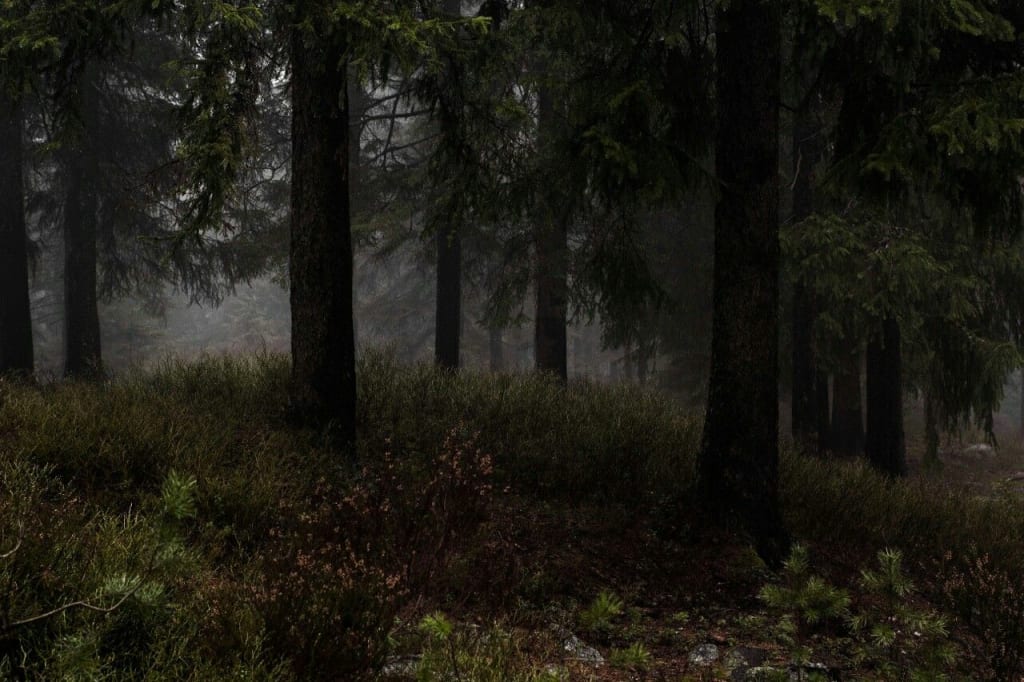
As the weeks passed, the whispers swelled in my head. I found them delightful. They giggled about shiny beetle shells and shooting stars, and they woke eyes in the trees behind the old man’s house, reptilian irises that blinked beyond ivy-hung branches.
No one else heard the whispers.
“Because they’ve forgotten,” the old man said as we yanked weeds from the hundred pots planted with hair. He then splashed my face with something from his watering can, and I sputtered. It stank of earthworms and crabapples. “Now you won’t forget.”
The hair he cut never grew back.
The drizzly winter I turned eleven, the old man showed me his faerie garden.
He invited me into his crooked house for the first time. It smelled of twilight––damp pine, fresh shadows––and my skin prickled with the cool that settles at dusk. The place was spiderwebbed in a dark nostalgia that wasn’t mine, as though I’d entered the old man’s memories. People oozed in and out of the shadows. People with long braids and pointed ears and serpentine teeth. I wondered how many had buried strands of their beautiful hair out back.
The old man first made hot chocolate and fed me candy, then grabbed a ring of keys from inside an unstrung piano and opened the end door of a drafty hallway.
The dusky room stank. An acrid burn crept down my throat. The whispers in my head told me no, no, no, but I shut my eyes against them.
Dust coated my bare feet as I followed the old man over to the glass-drawered apothecary cabinets shoved against the room’s only window. The stench grew, and I pinched my nose.
The old man yanked open a row of glass drawers. My stomach twisted.
Dead faeries filled the cabinets, broken bodies with blackened faces and bulging eyes, wings stripped from their arched backs. He’d lined them up like specimens, their heads lolling to one side, their eyelashes collecting gray dust.
“My faerie garden,” the old man said, pulling out more drawers, something between pride and humor in his voice.
I stared at the rotting creatures as he told me long stories of longer journeys around the world. How he collected fairies from jungle rivers and Himalayan temples and brought them back, wingless, to his apothecary cabinets.
When I asked why, the old man just said, “I like how they look.”
Then he pulled a jar from his coat. A young, fresh faerie ricocheted against the glass.
His arthritic fingers became nimble as he snatched the faerie from the jar, grasped its fluttering wings, and pinched one from the creature’s back. The iridescent wing fluttered to the wood floor.
I half-gasped a scream, the sweet candy in my mouth turned sour. But he turned my head back to the insectile creature crushed in his hand.
“Watch.”
And so I watched him rip off the second wing. I watched the faerie die in his calloused palm and watched him drop it in an unlabeled drawer.
I threw up my hot chocolate on the walk back home.
The following day the old man caught a faerie with milkweed wings. He didn’t have to make me watch this time. Horror and curiosity are sisters, and what sickened me one day fascinated me the next. I even helped him lay the dead faerie in a cabinet and snacked on candy as he pestled the wings to dust.
When I was sixteen, the old man invited me to smoke with his front porch suit of armor.
The blunt he handed me was bitter and sweet—earthworm and crabapples. I coughed smoke like a fledgling dragon, and the old man laughed. But I learned to breathe through the burn, and the whispers in my head disappeared for the first time in seven years. He said the smoke’s effect wouldn’t last long but to enjoy the silence.
“Where did you get it?” I asked of the armor rusting between us. The old man and I still hardly spoke, even after the years I’d spent in and out of his twilight house, but whatever blunt he’d given me had smoked the voices from my head. I felt myself. Briefly.
He shrugged, eyes on the pond across the street. “An estate sale somewhere in France.”
But I knew no French breastplate had velvet-lined slits for wings. He passed me a fermented drink I haven’t tasted since, and we said nothing else.
The whispers in the wood returned the next day, howling after their absence from my mind. They gurgled and spat and clawed at my thoughts. Under a scalding shower, I screamed at the whispers, at the pain in my head, a washcloth clenched between my teeth.
I trapped a faerie in a jar that night, and the old man handed me another blunt as payment. I smoked the whispers away as I watched him de-wing the creature. And so I began collecting faeries for him to silence the voices. To finish school. To survive my mind.
But a day came when the old man demanded more than faeries for his blunts.
“My fingers are growing old,” he said. “Just bring the wings.”
He handed me my latest catch for practice, and I nearly caved.
But I shoved the faerie against his chest and stormed out of that shadowed house.
I found myself kneeling before the little pot I’d planted so long ago. I scrabbled through the damp dirt, searching, searching, searching for my hair. Maybe I could bury it elsewhere. Maybe I could burn it. How could he have sentenced such a young child to this insanity? My mind burned with the whispers, their anger, and my own.
The old man shouted something from the porch, from amid his hundred empty flowerpots, but I clenched my teeth against his voice. My hair was gone. Gone like the wings he plucked from faeries’ backs, like the humanity he’d plucked from my mind.
“I don’t want to remember,” I screamed when he said something else. Aloud or in my head, I don’t remember, but earthworm and crabapples were on my tongue. My memories stank of his dark room and his rotting faeries.
With a kick, I smashed my flowerpot. And the one beside it. And another. And another.
Maybe I would break every curse.
Beautiful people with beautiful hair watched from the windows.
The old man died the next week.
The front porch armor was donated to a local museum that never displayed it. The empty flowerpots cracked to pieces in a dumpster. He left me the Eurovan, but I would never learn stick. Or what he packed into those magic blunts.
I burned his dead faeries out back. No one could smell them like I did, but watching the smoke curl into the Spanish moss felt more final than burial.
When I asked everyone how he’d died, they said, “A heart attack.”
But the whispers in the wood murmured of blood and gouged skin and tears in his back that matched the ones on his dead faeries. Like a wild creature had ripped off something.
I believed the whispers and the carpet stains.
The humid summer I was leaving for college, I plucked the wings from my first faerie.
We were chugging cheap beer down by the old locks, wind rushing through our hair and alcohol through our veins, the world a kaleidoscope of bad decisions. I remember laughing. Laughing away the whispers in the wood. Laughing away the eyes blinking back at me from the trees. The others laughed too, but they wouldn’t have if they had known my secret.
Hot jealousy burned my lungs, and I craved one of the old man’s blunts.
I found the faerie caught in fishing line. Its monarch wings were deep clementine in the afternoon sun. The others didn’t notice as I untangled the creature and trapped its sharp body in my palm’s soft folds.
I’d watched the old man so many times. I knew to feel for the little nub, the setaceous separation of flesh and wing.
Maybe it was the beer. Maybe it was the whispers. But I found my nail-bitten fingers grasping those wings. I set my jaw against that first rip of sinew and muscle.
But I was messy. Clumsy.
The faerie bled green down my hand, and the whispers laughed.
The river rushed behind me, blood in my ears, and the thing faded in my hand. Shiny monarch wings limp between my trembling fingers, unshed tears burning my eyes.
The whispers in the wood followed me out of town.
Still, I took the dead faerie to college and propped it on my bookshelf between Kipling and Sartre. Under my bunk I kept concrete planters filled with soil. I would plant random hairs I’d find, and somewhere on campus someone woke hearing voices. I found solace in knowing I wasn’t alone.
All four years no one noticed as I grew my collection: a mothy faerie half-drowned in jungle juice, a longwing locked in a study room, a mayfly sprite caught in a volleyball net. They rotted on my shelf, blackening like the ones in the old man’s cabinets.
When the whispers in the wood asked why, I said, “I like how they look.”
About the Creator
Enjoyed the story? Support the Creator.
Subscribe for free to receive all their stories in your feed.
Comments
There are no comments for this story
Be the first to respond and start the conversation.