
Esoteric Naples: Between Mystery, Alchemy and Ancient Legends
Beneath the streets of one of Italy's oldest cities lies a mysterious world of ancient symbols, alchemy, ghost stories and legends that blur the boundary between history and imagination.
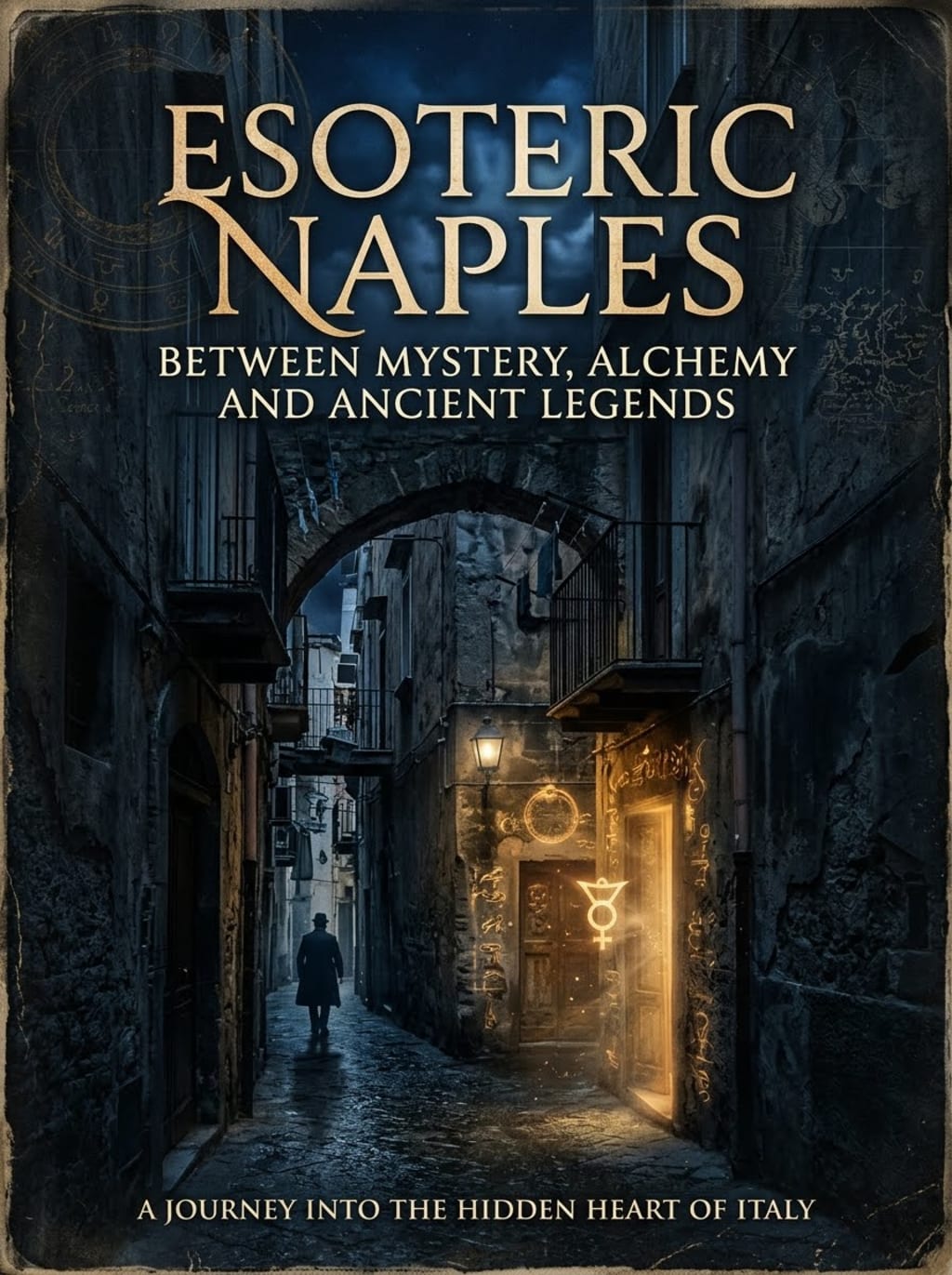
Naples is a city of extraordinary contrasts. Its narrow streets, historic churches, ancient palaces and underground passages tell stories that have survived for centuries.
But beyond its artistic beauty and historical heritage, Naples hides another identity: a mysterious world shaped by esoteric traditions, popular beliefs, forgotten rituals and supernatural legends.
Here, history and folklore often intertwine. A sculpture becomes the subject of an alchemical legend, an ancient cemetery inspires stories of restless souls, and a shadowy figure becomes part of everyday life.
Welcome to Esoteric Naples, where every stone seems to remember something.
1. The Veiled Christ and the Mystery of the Sansevero Chapel
In the heart of Naples stands one of the city's most extraordinary artistic treasures: the Sansevero Chapel.
Inside is the famous Veiled Christ, a marble sculpture created by Giuseppe Sanmartino in 1753. It depicts the lifeless body of Christ covered by a remarkably delicate veil.
The marble appears almost transparent, revealing the shape of the body beneath it.
The sculpture's extraordinary realism has inspired countless stories.
Much of the mystery surrounding the chapel is connected to Raimondo di Sangro, Prince of Sansevero, an eighteenth-century nobleman fascinated by science, experimentation and alchemy.
According to a popular legend, the prince possessed secret knowledge that allowed him to transform a real fabric veil into marble.
The story is fascinating, but the veil is actually the result of Sanmartino's exceptional sculptural skill.
Nevertheless, standing before the sculpture, visitors can understand why the legend has survived for generations.
Some works of art seem almost too extraordinary to be explained.
2. Raimondo di Sangro: The Alchemist Prince
Few historical figures are as fascinating as Raimondo di Sangro, the seventh Prince of Sansevero.
Born in 1710, he was an inventor, intellectual and experimental scientist. His interests included physics, chemistry, mechanics and printing techniques.
However, his reputation became surrounded by stories of alchemy, secret experiments and forbidden knowledge.
His personality inspired generations of writers, historians and curious visitors.
Among the most mysterious objects associated with his name are the famous Anatomical Machines, two human skeletons displaying remarkably detailed networks of blood vessels.
For centuries, these anatomical models have attracted attention and inspired speculation about the methods used to create them.
Popular legends suggested that the prince had discovered extraordinary secrets about the human body.
Although these stories belong largely to folklore, the Anatomical Machines remain fascinating examples of the intersection between science, art and eighteenth-century curiosity.
Raimondo di Sangro continues to be remembered as a man who seemed to live between the world of scientific discovery and the mysteries of the unknown.
3. Maria d'Avalos: A Tragic Love Story and a Ghostly Legend
Naples is also a city of tragic love stories, and few are as haunting as that of Maria d'Avalos.
A Neapolitan noblewoman of the sixteenth century, Maria became involved in a relationship with Fabrizio Carafa, Duke of Andria.
Her husband, Carlo Gesualdo, Prince of Venosa, discovered the affair.
In 1590, Maria and Fabrizio were murdered in a crime that shocked aristocratic society.
The tragedy became one of the most notorious stories in Neapolitan history.
Over time, the events inspired tales of supernatural appearances and restless spirits.
According to local legends, Maria's ghost still wanders through places associated with her tragic story.
Whether believed or not, the legend has transformed her into a haunting figure in Naples' cultural imagination.
Her story reminds us that some mysteries are born not from magic, but from the darkest corners of human nature.
4. The Munaciello: The Mysterious Spirit of Naples
Among the most famous creatures in Neapolitan folklore is the Munaciello.
Described as a small figure wearing a monk-like robe and hood, this mysterious spirit is believed to inhabit houses and appear unexpectedly.
Sometimes mischievous, sometimes generous, the Munaciello is said to hide objects, make strange noises and disturb household routines.
But not all encounters are considered unlucky.
According to popular tradition, the spirit may also leave coins or bring good fortune.
The origins of the legend remain uncertain. Some interpretations connect it to historical figures and customs from the past, although no single explanation has been conclusively established.
The Munaciello represents an important part of Neapolitan folklore, where superstition, humour and fear often coexist.
In Naples, even an invisible house spirit can become part of everyday conversation.
5. The Fontanelle Cemetery and the Cult of the Forgotten Souls
In the Sanità district lies one of Naples' most atmospheric places: the Fontanelle Cemetery.
This ancient ossuary contains thousands of human remains, many collected following epidemics and periods of severe hardship.
For generations, the site became associated with a unique religious and popular tradition known as the cult of the anime pezzentelle, or poor souls.
People would symbolically adopt anonymous skulls, known as capuzzelle, clean them, pray for the souls they represented and sometimes ask for protection or assistance in return.
This practice created a remarkable relationship between the living and the dead.
The skulls were no longer anonymous remains. They became objects of devotion, memory and personal hope.
The Fontanelle Cemetery reveals a deeply rooted aspect of Neapolitan culture: the belief that the relationship between life and death does not necessarily end with the grave.
It is a place where history, spirituality and popular imagination meet in an unforgettable atmosphere.
6. Underground Naples: The Secrets Beneath the Streets
There is another Naples hidden beneath the city we see every day.
It is a world of tunnels, ancient quarries, underground chambers and enormous cisterns.
Some of these spaces date back to Greek and Roman times, when volcanic tuff was extracted to construct buildings and infrastructure.
Over the centuries, the underground network acquired different purposes, including water storage and, during the Second World War, shelter from aerial bombardments.
The darkness of these underground passages has inspired countless stories.
Walking through them is like travelling through different layers of time.
Ancient architecture, archaeological remains and historical memories coexist in a subterranean world that seems almost disconnected from modern Naples.
Perhaps this is why the underground city has such a powerful atmosphere: it reminds visitors that the history of Naples is not only written on its buildings, but also hidden beneath its foundations.
Conclusion: A City Between Reality and Mystery
Naples has always been a city of stories.
Its esoteric traditions, mysterious figures, ancient beliefs and supernatural legends are an essential part of its cultural identity.
Behind every legend lies something deeper: a historical event, a collective fear, a religious tradition or an attempt to understand what cannot easily be explained.
The mysterious side of Naples exists in its sculptures, underground passages, historic buildings and popular traditions.
Perhaps the greatest secret of this city is that it never offers just one interpretation of its past.
And when night falls over its ancient streets, it is easy to imagine that some stories are still waiting to be told.
Because in Naples, even the shadows have a history.
About the Creator
Enjoyed the story? Support the Creator.
Subscribe for free to receive all their stories in your feed.
Comments
There are no comments for this story
Be the first to respond and start the conversation.