
Engineers are now attempting to replicate the ability of ghostly fish to swim without bending.
Steering control and stability

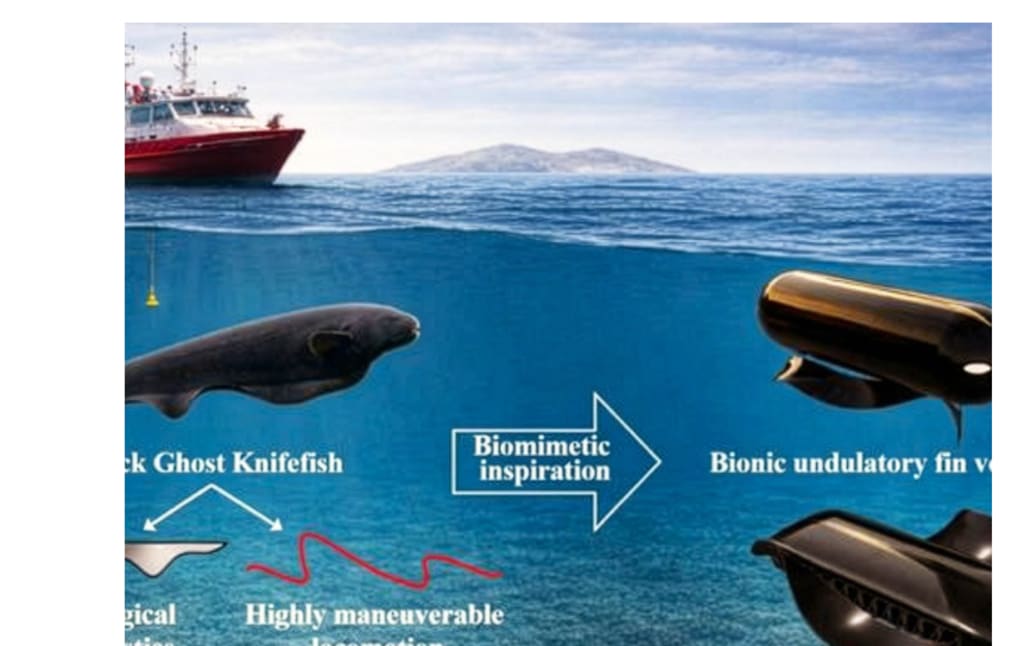
According to recent study, the black ghost knifefish can use one long underneath fin to swim forward, backward, and hover while maintaining a rigid body. The finding paves the way for a new type of undersea vehicle that might replace propellers with more precise control in areas where movement is crucial.
Black ghost knifefish with long fins
The black ghost knifefish's trunk remained nearly still throughout high-speed recordings, while the long fin beneath its belly created undulating ripples. Ze-Jun Liang, a researcher at Northwestern Polytechnical University (NPU), recorded how the waves generated propulsion and steering without requiring the fish to bend.
Because the fish's movement altered the wave's direction and behaviour, the same fin did not depend on a single set pattern. This raises the deeper question of what precisely in the fin allows for that control and elevates the discovery beyond a mere curiosity about animal motion.
Steering control and stability
Ripples began close to the head and moved along the long fin along the abdomen toward the tail during forward swimming. The pattern reversed for reversal motion, causing thrust to point in the opposite direction while the body hardly flexed.
Waves formed a point where opposing forces partially cancelled out as they approached and collided. Previous robot research indicates that a similar force-canceling technique can enhance both turning control and stability.
Why rigidity was important
This species used electricity to sense adjacent things, therefore maintaining a straight trunk was important for more than just swimming smoothly. It detected items in dark water by using electrolocation, which senses aberrations in its self-generated field, just like other weakly electric fish.
One reason engineers are equally interested in this species as biologists is because its stiff body aids in stabilising those signals. The fish are particularly helpful for robots carrying cameras, probes, or other fragile electronics because of this overlap between sensing and swimming.
Cruising speed of black ghost knifefish
When the fin beat more quickly, speed varied more clearly than when the wave's general form changed significantly. Wave height or the number of waves on the fin did not track cruising speed as well as wave frequency in the current research.
That timing signal remained the most reliable indicator of speed over 32 acceptable swimming sequences and about 2,000 recorded seconds. Because a controller can adjust tempo more readily than it can rebuild a fin in the middle of a swim, robots might profit.
Complex biological systems
Because the fin was tallest close to the center rather than maintaining a single, flat height, shape also mattered. Its maximal height, which was roughly 24% of body height, was sufficient to transfer water while maintaining the body's streamlining.
According to Liang, "our findings demonstrate that real biological systems are far more sophisticated." This discrepancy contributes to the explanation of why many prototype fins still have a nice appearance on paper but behave less like real fish.
Why propellers have trouble
In open runs, conventional propellers are excellent at pushing water backward, but in slow, confined places, they become less graceful. According to Peng Xu, a corresponding author and researcher at NPU's Ocean Institute, "traditional propeller-based systems struggle with low-speed manoeuvrability and stability in complex environments."
Because minor waves can reroute force without requiring the hull to swing wide, robots with long, flexible fins approach the problem in a different way. This could be important in situations when propellers become clumsy due to shocks, noise, and tight turns, such as pipes, reefs, wrecks, or rescue sites.
In murky water, robots
This species' body plan allows for onboard sensors, thus engineers chose it for more reasons than just speed. Robots might sense and move in murky water with the aid of rigid bodies and long fin propulsion, according to earlier review study.
This combination is important because a robot with stable sensors can map a crowded area and yet make precise adjustments. When water becomes contaminated or crowded, search teams and inspection workers are concerned about precisely that balance of knowledge and control.
Study limitations
Despite the dataset's richness, it was still derived from fish moving independently in calm water. The forces on any fin, including one constructed with this design, can be altered by turbulence, walls, and abrupt impediments.
Additionally, the researchers only used a small number of motion cases—enough for patterns but not all real-world situations. Testing in currents, confined spaces, and untidy underwater environments will still be necessary for any robot that is modelled after the fish.
From fish to code
Translating the fin's movement patterns into control software and hardware is now necessary to turn biology into a vehicle. Future prototypes will require algorithms that alternate between one-wave and two-wave motion, flexible materials, and precisely timed motors.
The team's objective to create wave-driven robots for limited areas and turbulent water is closely related to that effort. Future submersibles could examine difficult areas without disturbing as much water or running the risk of a propeller hit if those components operate together.
The new image of the black ghost knifefish integrates steering control, wave timing, body shape, and sensory requirements into a single practical design narrative. Although not every propeller will be replaced by that tale, it provides engineers with a better foundation for vehicles that need to move cautiously underwater.
About the Creator
Enjoyed the story? Support the Creator.
Subscribe for free to receive all their stories in your feed.
Comments
There are no comments for this story
Be the first to respond and start the conversation.