

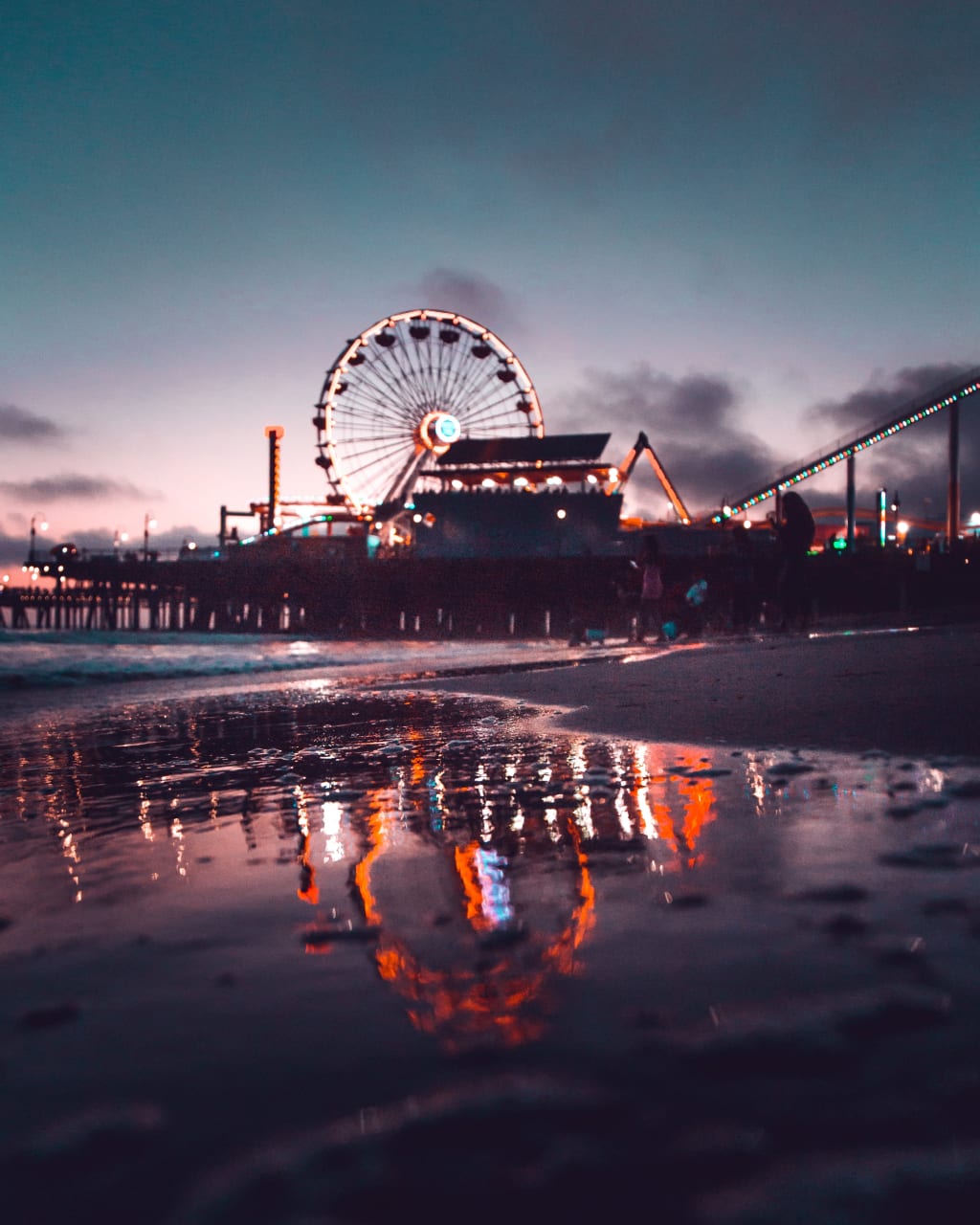
The sun dipped below the horizon, casting Venice Beach in a warm, orange glow. As the gentle waves kissed the shore, a peculiar unease settled within me. I stood alone on the creaking wooden pier, the salty breeze tousling my long brown hair. That's when I first noticed him—a young boy with piercing green eyes. Despite our significant age difference, his demeanour exuded an uncanny maturity that instantly commanded my attention.
He stood before me, clutching something tightly in his tiny fist, his unkempt dark hair and olive skin contrasting vividly with his violet T-shirt. His words, delivered with the gravitas of a sage, caught me off guard.
"Are you lying when you tell today's kids that everything will be fine?"
His question hung in the air, unsettling and profound. He extended his arm, placing a folded piece of paper into my right hand. Before I could react, he disappeared behind the towering Ferris wheel, leaving me speechless and standing still.
I glanced around, half-expecting the bizarre encounter to have attracted the attention of others. Yet, the world around me remained blissfully ignorant, continuing its cheerful reverie. A shiver coursed down my spine, a stark contrast to the idyllic scene of the pink-streaked sky reflecting on the rhythmic crashing of waves.
Mechanically, I opened my palm, revealing a Post-It note bearing four digits: 2029. It wasn't just any year; it was a date, a specific point in the future. My heart raced as I fumbled to tuck it away in my back pocket.
A bone-chilling sensation gripped me as I observed my surroundings once more, my mind wrestling with the inexplicable sensation that I was experiencing a shift in reality. The warm hues of the sky had transformed into an ominous gray, and people scurried about wearing gas masks, their muffled voices echoing with an eerie tension. Lifeless seagulls littered the beach, their once-graceful forms now tragic and still. The cheerful music that usually emanated from the ferry had been replaced by an automated voice, its instructions delivered with robotic indifference.
"May 2029, day 13. Under no circumstances should you remove your gas masks. The CO2 emissions have reached a peak of 460 ppm today. The air is toxic. Once again, do not remove your gas masks."
Terror gripped my throat, and I attempted to scream, but my voice felt futile, swallowed by the thick fabric of my own mask. With trembling legs, I took a hesitant step forward, only for my vision to distort, like the world itself rejecting this nightmarish existence. Panic coursed through my veins as I realized that I was trapped, an unwilling participant in this horrific reality.
"No, no, no," I muttered, my voice a desperate plea to awaken from this nightmare.
And then it happened—all at once. My body gave way, and everything faded to black.
When consciousness finally returned, I was drenched in sweat, lying on crisp white sheets. I blinked at the familiar ceiling, my gaze tracing the intricate patterns of the stucco. The room was bathed in the soft glow of morning light, and the wind softly rustled palm leaves outside the window, whispering promises of a sunny day ahead.
Suddenly, I could sense my partner shuffling next to me. His presence was a comforting return to the reality I knew, contrasting sharply with the ominous grayness of the nightmare. He turned towards me, suddenly wide awake at the sight of my void gaze. His tender blue eyes were filled with concern and a glimpse of confusion as he stared at me. His fingers traced the outline of my face.
"Are you alright?" he asked, his voice a gentle whisper. Etched lines of worry were imprinted on his face, mirroring my own traces of anxiety that still lingered in my thoughts.
"It was just a bad dream," I assured him, my voice carrying the dichotomy of both relief and lingering unease. He drew me close, wrapping me in his protective embrace. His lips brushed gently against my forehead, a silent promise that I was safe within the sanctuary of his love.
Yet, as I lay in his arms, the haunting remnants of the dream refused to fade. It clung to my thoughts like a specter, casting a shadow over the intimacy we shared. My mind replayed the vivid scenes—the young boy's solemn presence, the eerie transformation of the sky, the ominous voice of the automated warning. It all felt like a cryptic message, a puzzle I needed to decipher—the impending threat, our collective inaction, and the pressing need for change. The chilling question echoed in my mind:
"When you tell today's kids that everything will be fine, are you lying? Don't you realize that you could have done more?"
END
More about the story
As of May 2023, carbon dioxide hit 424 ppm—a new record, and our global CO2 emissions have been steadily increasing over the past years. The genesis of this story was strongly influenced by groundbreaking research conducted by esteemed institutions such as Harvard University, the University of Birmingham, the University of Leicester, and University College London. Their findings, released with chilling clarity, reported that in 2018, more than 8 million lives were prematurely extinguished due to the insidious grasp of fossil fuel pollution—a staggering statistic that surpassed previous estimations (1). These dire revelations underscore the grim reality that air pollution, born from the burning of fossil fuels like coal and diesel, is exacting an unforgiving toll, contributing to approximately one in five deaths worldwide. It is crucial that we pause and contemplate the gravity of this situation, irrespective of our stance on climate change. Our lives stand threatened by the pervasive spectre of air pollution, and we teeter on the precipice of a darker future unless we take decisive, systemic actions to revolutionize our energy production methods.
This research yields some compelling insights:
Within the United States, 350,000 lives are claimed prematurely each year by fossil fuel pollution. Notably, states such as PA, OH, MI, IN, KY, WV, IL, NJ, and WI are the hardest hit, bearing the highest number of deaths per capita.
Transitioning away from fossil fuels to embrace renewable energy sources not only fosters environmental health but also has immediate and profound benefits, preventing untimely deaths attributed to fossil fuel pollution.
The exposure to particulate matter emanating from fossil fuels contributed to 21.5% of total deaths in 2012, a figure that dropped to 18% in 2018, primarily due to more stringent air quality measures in China.
India, grappling with its own set of challenges, witnessed fossil fuel pollution claiming the lives of nearly 2.5 million individuals aged over 14 in 2018, accounting for over 30% of all deaths among this demographic.
Perhaps the most heart-wrenching revelation is that thousands of children under the age of 5 succumb to respiratory infections every year, their tiny lives snuffed out prematurely, all casualties of the relentless assault of fossil fuel pollution (1).
These stark realities cast a haunting pall over the narrative, compelling us to reflect on the urgent need for change.
(1) Vohra, Karn, et al. “Fossil Fuel Air Pollution Responsible for 1 in 5 Deaths Worldwide.” C-CHANGE | Harvard T.H. Chan School of Public Health, 9 Feb. 2021. Access to research summary here.
Disclaimer: The first-person perspective employed in this story serves solely to enhance its narrative richness, and it is important to note that this narrative is a work of fiction.
About the Creator
M
Bridging the gap between fiction and reality with fiction stories revolving around one of the most pressing issues of our time: climate degradation. One of my dreams is to turn these stories into music videos, TV series and motion pictures.
Enjoyed the story? Support the Creator.
Subscribe for free to receive all their stories in your feed.
Comments
There are no comments for this story
Be the first to respond and start the conversation.