
My name becomes a siren, and I hear its call even in sleep.
It echoes through the thin walls of the apartment. I jolt awake at the folding table I fashioned into a dining space, my hands buried in a catalog of local grocery coupons. I peel my thumb and forefinger from the old craft scissors looped around my hand, the ribbed, rubbery rings leaving imprints on my skin. They’re barely functional, I realize, but I keep them. I pulled them from a box the previous owners left in the bedroom closet—one of many gifts. I couldn’t bear to throw it out. As I flash an absent glance at the marker drawings pinned to the refrigerator, I’m glad I didn’t, and I silently thank the ones who came before us, whoever and wherever they are.
To my left, the clock on the stove blinks 11:56 to midnight, the fluorescent green glow illuminating the rust stains on the frontmost burner. Opposite of me, on the other side of the table, a sink of dirty dishes soak in water gone cold. I notice a few crumbs of something scattered near the microwave. I think to grab a towel to wipe it clean—but I’m reminded of the pile of laundry waiting to be washed. Stop to consider if I have any clean shirts to wear tomorrow. I scan the room as if looking for the answers on the walls, and my eye catches the empty pizza box resting precariously atop a stack of plates. They’re far from the counter’s edge, but the sound of ceramic shattering against the tile floor rings between my ears. Can’t have that. In a hurry, I stand from my chair, cringing at the way it shrieks when my thighs push it backward, the noise like long nails clawing down my spine. Panicked, I turn to pick it up, as if picking it up will restore the quiet of the kitchen, but before my hands can reach it, I bash my leg into the metal hinge of the folding table. It lifts off the floor and clatters even louder than the chair. When it settles, a dozen small squares of paper scatter to the floor.
I want to scream—more for the mess than the sharp pain radiating in my shin—but I hear my name again and suddenly recall what woke me.
“Mama.” There’s a brief pause. A muffled cough. Then again, hoarser, “Mama?”
Grinding my teeth, I will myself away from the mess and rush across the hall to the bedroom. Sitting up in bed, his bare feet dangling over the edge, my son clutches at the blankets and watches the doorway, waiting for me to appear.
He’s eleven and has my eyes. Shades of blue sink and encircle those pools of hickory brown, his pupils glossed over and hazy—but when he looks at me, they’re as big and bright as they always were. That should comfort me. It doesn’t, and when I see them, I feel a pit form and drop in my stomach.
“What is it, baby?” I ask him, biting the inside of my cheek to conceal my frustration.
He doesn’t seem to notice. Lifting one bony finger, he points to the window. “Can we move the bed over there?”
Six months ago, I decided I wouldn’t deny him anything anymore. I cross the short distance from the door to the bed and scoop him up into my arms, carrying him out to the couch. Back in the bedroom, I push the bed against the windowsill, then press my palms to the mattress to test its comfortability. Springs bulge from beneath the thin cushion and poke at my hands, so I fold a thick blanket and place it on his side of the bed, cursing myself for not noticing sooner.
When I carry him back to the bedroom, I keep him sitting up. I struggle to hide the way I flinch as he looses a raspy sigh. My hands unconsciously curl away from him each time my fingers brush the bones protruding beneath the skin. He’s silent as I lift his shirt and examine—less like a doctor, and more like a jeweler, my every move deliberate and taken with extreme caution lest my son crack and shatter in my grasp.
I find a small purple bruise on his ribs. Tracing the bumpy ridges of his spine with my gaze, I spot the blotch of bluish-yellow that paints the pale skin of his shoulder. A current of nausea nearly pulls me under.
“Why didn’t you tell me the mattress was hurting your back?” The softness in my voice sounds false, even to my ears.
A beat of silence takes the room. Then, his hand trembling, my son reaches up and tugs his shirt down. He sighs, purely out of exhaustion, and the bed groans in protest as he scoots back to flop down on his pillow, his eyes fluttering closed.
“It’s alright, Mama,” he replies.
In place of grief, rage—red, hot, and burning—ignites in my chest, not because he didn’t tell me about the bruises, but because I know what he means.
It’s alright.
It won’t be long now, anyway.
***
My mother died two weeks before my twenty-first birthday. Instead of drinking—or mourning—I took an extra shift at the Italian place paying my bills. One less thing to worry about. We saw it coming, I said. Nodded along when receiving condolences, ignored questions about my grief that were either invasive or oblivious to the simple complexities of death. There’s nothing more permanent, yet most interactions that followed began and ended with thinly veiled suggestions to accept what was and move on.
Four days after my mother’s death, I worked thirteen hours on a granola bar and no sleep. Afterward, I sat cross-legged on the pavement in the parking lot with a pack of menthols I’d bought despite an old promise to my mother I’d never smoke. Crushing the loose plastic in my fist, I ripped it open and placed a cigarette between my teeth, sucking the pungent taste of tar into my lungs.
Marie, an older waitress who claimed to like me, squatted at my side. “You got a light?”
I slid my lighter across the pavement, the plastic tip clicking against her boot. Her long, red acrylics scraped the ground when she picked it up. The sound sent blood to the vein in my forehead, an itch of annoyance tingling at the side of my neck. Marie flashed me a sidelong glance, frowning, and I refused to look at her—in part because I didn’t feel like looking, but mostly because something rumbled low in my belly, and I hated to be a bitch to someone who didn’t deserve it.
Tucking her frizzy hair beneath a baseball cap, Marie took a few long drags and waited until I was near the end of my cigarette to speak again.
“Are you gonna get tested?”
My gaze trained on a pebble a few feet from me. I knew what she meant. “No.”
“Don’t you wanna know? Even if you’re at risk, they say if you catch it early—“
“They did,” I snapped, and given the frown that stretched across her face, she knew what I meant, too. The doctors diagnosed my mother in the early stages. Piles of paperwork and pamphlets with smiling, elderly patients were accompanied with promises of effective treatment, of remission, of “bouncing back.” Her chances of survival were great, they’d said. She would make a full recovery. With persistence, the disease would be eradicated, and she would go on with only bi-annual check-ups to worry about, the days of nearly dying left behind her.
I guessed, despite all their knowledge and diligence, they hadn’t considered it would all come back.
With a snap of my wrist, I chucked the cigarette butt at the pavement like the impact could hurt it. When it rolled and came to rest by the pebble I’d been staring at, I stood up, stomped forward, and crushed it beneath the heel of my boot, grinding it into the ground with a vengeance.
Marie stayed where she was. “If you catch it early,” she repeated, “you can usually end up alright.”
The thought of being diagnosed at all, of ending up like my mother, sent my heart rocketing into my stomach. “Or I’ll die.”
“Or you won’t. Maybe you’ll never get it. Maybe you’ll be fine and live your life. Have kids, and a dog, and the white picket fence. All that.”
A cramp seized my neck at how quickly I twisted around to face her. She didn’t startle. Her cherry red lips settled into a thin line, her gaze lingering on mine to gauge my reaction, and I had to resist the urge to blow up. The vein in my temple pulsed, ticking like a timer on a bomb. The comment was innocuous, and I knew it, but rage simmered through my chest, down my arms, to the tips of my fingers. My cheeks burned as if she’d struck me. Was I so selfish to have a child knowing I might leave them behind? Would she tell me it’s worth it in the end, that the years my future child would have with me could soothe their inevitable grief? Did she think I, too, should be grateful for the time I got, and not furious for all the time that was ripped away from me?
Marie’s voice floated through the haze of my thoughts. “Sola?”
A self-destructive part of me considered yelling at her, weighed the cons of lashing out and blaming the grief as people do—but I needed to go back to work the next day. I needed the job to be easier than going home, so I took a moment to shut my mouth and breathe. Then, my eyes trained on the night sky, I said,
“You can keep the lighter.”
***
Anemia. Chronic fatigue. Vertigo. Hypoglycemia. Possible diagnoses hurtled through my mind like a hurricane, the storm picking up the knowledge I’d learned while my mother was ill and spitting out what little I knew about the inner workings of the body. What I didn’t know, I supplemented with Google searches and endless scrolling through medical journals. Typing in symptoms and blocking out the parts of the results I didn’t want to read, the parts that suggested that what was wrong with my son was anything other than temporary. Small. Innocuous.
Treatable.
Ultimately, we ended up in the hospital, where people who actually knew what they were doing could perform labs, x-rays, scans—none of which I wanted my son to ever endure. A needle in the vein was bad enough. Soon it was an MRI, his little head locked in place by a plastic cage, his tiny, skinny knuckles stark white around the emergency call button they’d placed in his left hand. His entire body jolted with the terror of moving deeper into the tube. It was narrow and metal and massive, a few thousand pounds of machinery all closing in. I swore, despite having to wait outside with the nurse and watch through a glass window, I could hear his little heart pounding through the walls.
He did not press the emergency call button, but when he was returned to me, his knees shook with every step.
It was months that felt like years. Endless doctors and testing and appointments and watching my son struggle to answer questions about his own body. Struggle to cope with seeing more doctors than friends. Struggle to grasp that something was terribly wrong, something for which I had no remedy.
Never, never had I been unable to fix things.
In October of his tenth year, we found ourselves in a small examination room at the far west side of the hospital. To our left, a window overlooked the city from five stories high. Above, wide, dual-panel fluorescents flickered garish white light on the tile floor. White linoleum with black, fuzzy-looking specks. The walls around us were beige. Directly across from our seats, a photo of a woman in a white coat with an arm around the shoulders of a skinny, hairless child stared at me, its silver frame propped up against the wall atop the counter where tongue compressors and gauze and bandages waited in shiny glass jars.
The room remains perfectly intact in my memory. I remember how cold it was in the room, how I mimicked the photo by wrapping my arm around my son, my palm rubbing heat into his shoulder. How it was colder still when the door came open, and the woman in the photo appeared before us. Pink, ruffled blouse tucked neatly into the waist of her straight-legged trousers. A silver ring on her right hand. Her shoes gleamed in the light and squeaked against the floor as she took a seat across from me. She smiled, friendly and warm with a row of straight, white teeth, and I suddenly felt less like Sola, mother of my son, and more like a nameless, bleeding body floating in open waters.
Already, I was drowning.
Beside me, my son was silent. He slipped his hand into mine and squeezed, doing his best to mirror the stillness he knew I was forcing, our legs trembling with the urge to bounce in place.
“Dylan,” said the woman in the white coat, “are you sure you don’t want to wait out in the playroom while I talk to your mommy?”
She glanced at me. Angled her knees and shoulders in my direction. She was waiting for me to make him go, to make room so that the heaviest blows were delivered to me and later softened for my son’s ears. I imagined that was how things usually went—that parents often served as the messengers. Keepers of scary truths they decided their littles needn’t know.
I could be no such keeper.
My son’s gaze was too keen. He would see it in my face, in the eyes identical to his own. There would be no polite or gentle skirting around the truth. No misrepresenting of reality. My son would want to know, and so together, we held our position, bracing for the stormy, crashing waves.
“No,” Dylan said. Squeezed my hand. Took a deep breath through his nose. “I wanna hear it, too.”
Once more, the doctor stared at me. I clenched my jaw. She bit the inside of her maroon-painted lip. Then, finally, after a silent game of tug-of-war she knew she would not win, she looked directly at my son, her practiced calm wavering as she said, “I’m sorry, Dylan.”
The pages and pages of symptoms and possibilities flashed behind my eyes. I clung to them like my fingers gripped the edge of a cliff, no amount of blood or torn skin enough to break my hold. I couldn’t drop. Couldn’t let go. Couldn’t stomach the idea of the fall or the cold, tempestuous depths that awaited me.
And yet, with a single phrase, I plummeted.
There’s nothing we can do.
The world slipped out from under me. Time stopped altogether.
...make things easier, keep him comfortable—you comfortable, Dylan.
I could feel his pulse against my hand. Warm and beating and alive, as he was supposed to be. He was right there. He was fine.
He’s going to be fine.
I hadn’t realized I’d said it aloud until the fluorescent sheen on the tile before me warped around little blue sneakers, and a hand pulled at my own. There were tears in my eyes, the watery haze blurring the soft edges of my son’s pale face. He blinked once, twice, three times. He held my hand, squeezing as hard as his strength would allow him, for once not worrying about hurting me. I let him. Nothing could hurt like the look on his face as he turned his back to the doctor, pulled at me again, and whispered,
“Mama, can we go home?”
He said nothing on the walk down the hall. At the elevator, he stepped inside the moment the doors slid open despite how much he hated them. In the lobby on the bottom floor, he didn’t peer into the gift shop, or count the balloons, or wave at the security guard on post at the front desk. He marched toward the automatic doors, his gaze trained on the ground. Outside, it was pouring rain, and we ran to the car like we always did, our steps sending sprays of stagnant water across the pavement. It was only when we reached the car and slipped inside that the running seemed silly, the reality that we had far bigger worries than the rain slowly settling in.
It wasn’t until the engine was on, and the heat hummed through the air vents, and the rain battered rhythmically against the windshield that Dylan spoke.
“I’m dying, aren’t I?”
A pit formed in my stomach. Burrowed into my chest, then collapsed like a thousand tons of brick upon my sternum. An endless, gaping hole around my heart.
I knew better than to lie. “I think so.”
A tidal wave formed behind my eyes. Dylan watched a rogue raindrop race down the windshield, his hickory eyes glossy, and distant, and laced with more sorrow than any child should ever carry.
“What do we do now?” he asked.
I moved my seat back by way of a reply. Slowly, but easily, Dylan crawled into my lap, his chest against my chest, his head curled into the crook of my neck. I thought of the elderly patients on the pamphlets my mother received while Dylan’s small body settled in my arms. I thought of how elsewhere, other children were in the classroom or at recess. Playing hooky for a day of warm soup, video games, and ginger ale. How Dylan had never faked sick before, not after seeing the way real sickness rocked through my psyche. I never shared with him the bitter details of my mother’s illness, but he knew that she was dead, and through me learned to fear not death itself, but the immense, indescribable grief that followed.
I wanted him to be familiar with it in case my greatest fears arrived. Instead, I was thirty-four, healthy, and alive, and my son—my only son, the son I swore I wouldn’t have—was dying in my place.
The thought occurred to me then as I cupped the back of his head and smoothed his hair, a thought that sliced a wound in me no medicine or prayer could heal.
My son is dying.
My son is dying, and I am not.
***
Beyond the window, the city is fast asleep, save for the few cars speeding down empty streets. I sit up with an arm on the sill. I watch the headlights flash and fade, my gaze loosely following the glowing dots of red as cars pass and disappear. Sweat slicks the skin of my calf where my son’s head rests, but he pulls the blanket beneath his chin and curls into me.
Starlight illuminates his pale face. “It’s a waning gibbous tonight,” he tells me.
I glance at the hunk of grey rock above us, my fingers tracing circles into his hair. “Is it?”
He tells me about the lunar phases for what might be the twentieth time and describes the moon’s tilted orbit. He hasn’t the strength to sit up and draw in the moisture collecting on the window, so he lifts his hands instead. One fist represents the Earth, and the other, the moon. They hover in front of my chest, and he says,
“You’re the sun, okay?”
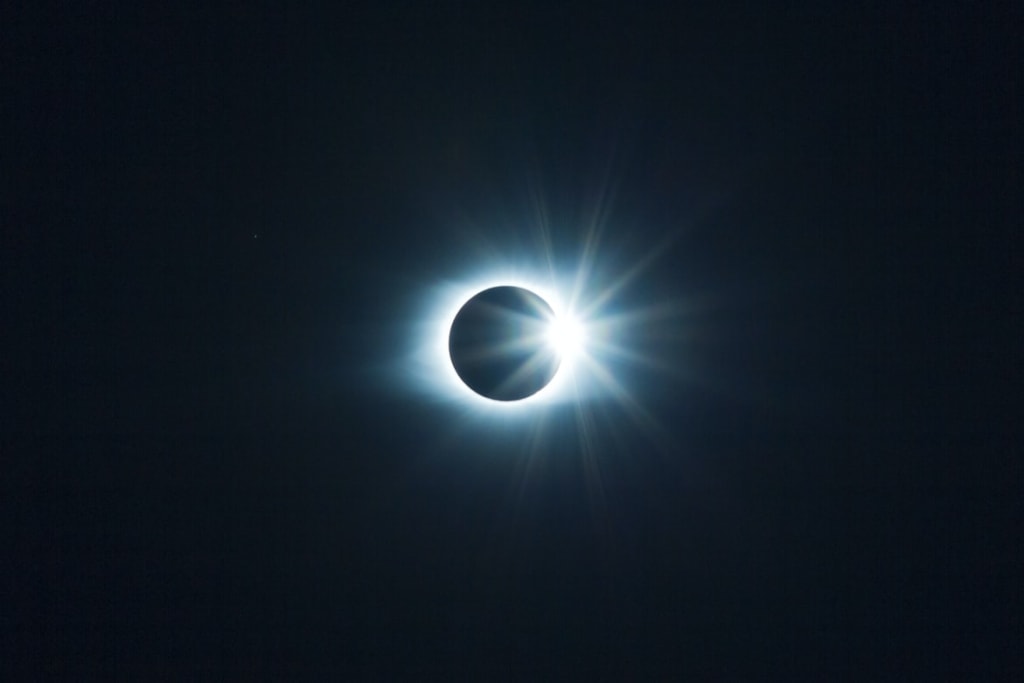
My eyes burn with the threat of tears, like dark clouds gathering before a storm—but I don’t dare interrupt him. Before long, his wrists shake with the effort of holding up his hands. Despite his protests, I wrap my own around them and let him tell me where to move to complete the proper orbit. I spin our hands around each other, careful not to pull his arm from the bed, and he giggles through an explanation about eclipses, how the Earth’s shadow falls over the moon. I see stars reflected in his eyes.
“The Earth protects the moon,” I say.
With what little energy he can muster, my son frowns at me, his thin brows furrowing in confusion. “No. It just blocks the sunlight.”
I use my knuckles to caress his cheek. “Is that a good thing?”
Still frowning, he lowers his fists. “No,” he says again, attempting a shrug. The sharp bone of his shoulder blade presses into the meat of my leg. “It’s not good or bad. It just happens.”
I echo, “It just happens.”
He nods and curls into my touch, his spindly arms burrowing in the folds of my sweater. I place a hand on his back. Cherish the warmth beneath my fingers. Feel his breathing, labored and uneven, and rub my palms over his shoulders. I know it won’t help, but I do it anyway, comforted by the possibility that I can comfort him. My mind briefly wanders to the dishes in the sink, and the pizza box, and the scattered coupons on the floor, and I decide I don’t care about any of it. The apartment could set ablaze, burning from the bottom floor up, and I wouldn’t notice—not if it meant straying from this moment. Soon, this moment will be all that I have, and if I’m damned to lose my son, I’m going to lose him on his terms. At home. By the window. Talking about space and not what I’ll do when he’s gone. His heartbeat thumps through his back and against my hand, and I realize, unceremoniously, that I would burn the entire world down if he asked, because he’s my son, and I’m determined to love him more than I hate his sickness.
From my lap, he mumbles, “Goodnight, Mama.”
I keep my head turned upward. Somewhere on the horizon, a storm is brewing, distant rolls of thunder breaking the silence of the night. I watch the clouds gather and darken. Eventually, they drift closer together and blanket the sky, concealing the light of the waning moon, and I whisper,
“Goodnight.”
About the Creator
Enjoyed the story? Support the Creator.
Subscribe for free to receive all their stories in your feed.
Comments
There are no comments for this story
Be the first to respond and start the conversation.