

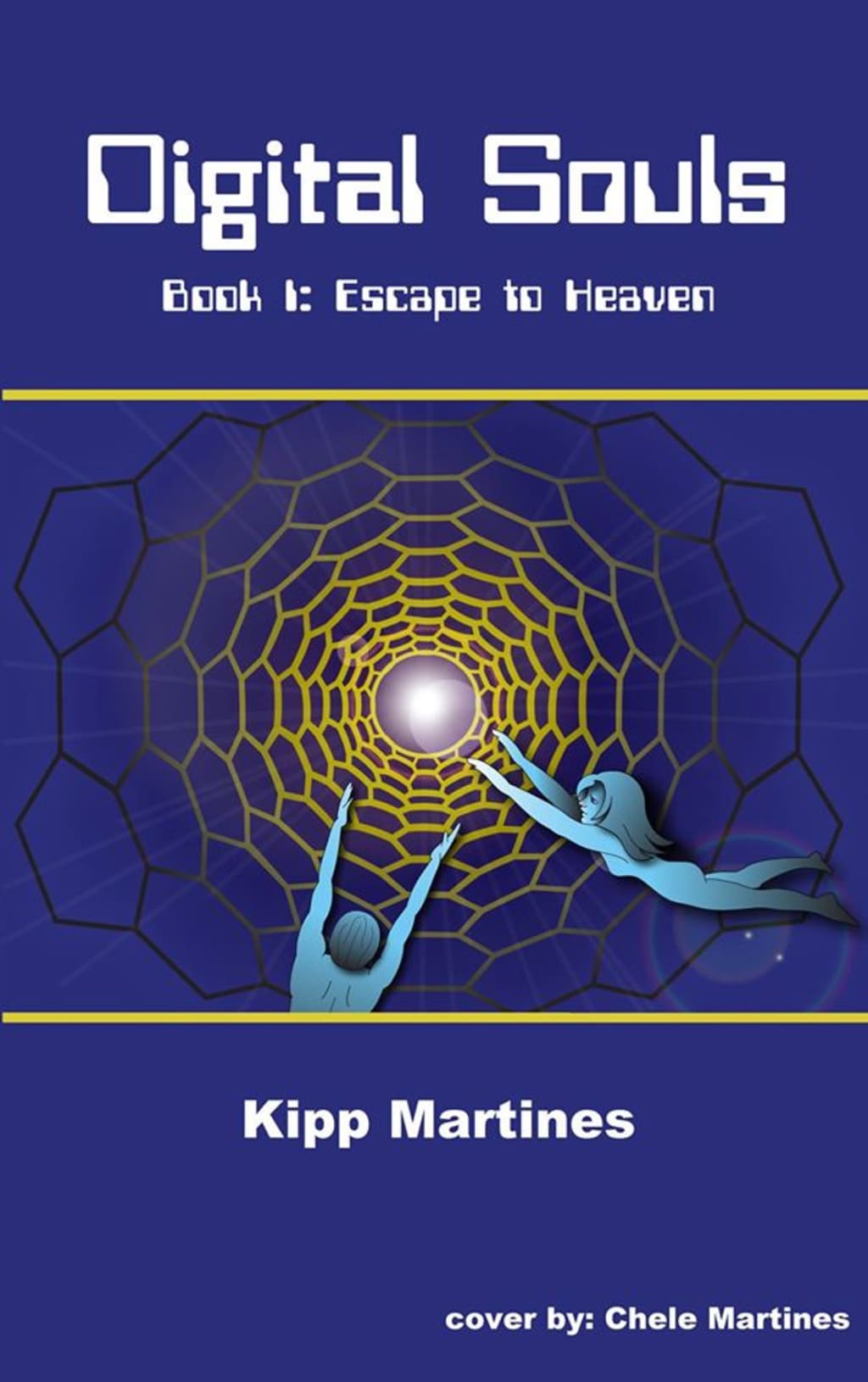
Life is a funny thing. Since the dawn of time, organisms have been changing and evolving towards a new unknown form. A race towards a still unimagined contrivance. For the multitude of beings that walked our planet a million years ago, survival turn out to be their only imperative. As life divided into many species and developed new goals beyond subsistence, they began to question their existence: Who am I? What am I? What is my purpose? Survival just wasn’t enough. A million years later, one species sought more from their actuality. We, as the dominate form of life, began to progress into new realms of reality.
Survival traits became taken for granted. Religion, philosophy, theories gave way to new thoughts and new interests. Our yearning for knowledge sprung out of a need to control our environment. Knowledge allowed us to see the world in a new way. We began to pat ourselves on the back for developing new ideas about the future. Our imagination leaped beyond the thought of “now” and became the mother of invention. We stepped out into the light and dared to investigate who we were and what we could become. We marveled at our ingenuity and enjoyed the fruits of our labor. No longer hiding in the dark, but creating light to shine in new techniques across the planet and into the heavens.
Some members of the species saw life in a different way. A humorous, dramatic, fanciful way. Entertainment became the milestone in response to necessitating something more than our basic needs fulfilled. But life has a sense of humor all its own. Ego allowed us to believe that we were kings of our domain. We supposed that our technology, our genius, our exceptional progress of 2,000 years of social development could keep us safe from any eventuality. We believed that we could handle anything that nature could throw at us. We foolishly assumed that we were the controllers of our destiny. We were wrong…
“No matter who the characters are,
you can strip them down and
find small universal truths.”
- Jena Malone
Chapter 1
YELLOWSTONE NATIONAL PARK YEAR 2020
Following the group of boys in his pack, Oliver Martin, cub scout from den 451, watched as the tower of water blazed into the air. Rainbows and mist surrounded the column of water as it stretched into the sky and returned to earth with a deafening crash. His fellow Cub Scout troop yelled and cheered, as Old Faithful performed its trick like clockwork. Wiping his wire rimmed spectacles with his neckerchief, he placed his glasses back on his nose. Being short for his age with a little round tummy, Oliver usually wasn’t as fast as the other boys. Trying to see the geyser up close was difficult. He rarely made it to the front of any rowdy Cub Scout gathering.
But the whitewater spring signaled its arrival clearly in the sky, long enough for him to see the very top. The crowd that stood and viewed the geyser pointed camera phones and video players at the liquid marvel.
“For thousands of years these geysers have been erupting in the air.” Oliver listened as the park ranger provided information about the famous fountain. “Old Faithful was first discovered in 1870, by the members of the Washburn-Langford-Doane Expedition. The geyser can release as much as 8,400 gallons of boiling water up to 185 feet in the air. Eruptions can last one and a half to five minutes in duration.”
One of the Cub Scouts raised his hand and asked, “Does it explode every hour?”
The ranger shook his head, “No, the time interval is closer to 90 minutes. Back in the 1930’s, it averaged every sixty-six minutes, but the time is now up to an hour and a half.”
“Why is it longer now?”, pursued the boy.
“Well, as the magma shifts underground and the tectonic plates move, the time it takes to boil the water changes. I guess some day it may be even longer between bursts.”
Oliver thought about what the ranger had said. The magma moves and changes deep in the ground. How exciting would it be if the geysers could be controlled so they went off whenever he wanted? “I want to study geysers,” Oliver said out loud to his friend Jimmy Reece,
“When I grow up I’m going to be a park ranger and watch the geysers every day.”
His red-headed, freckled face friend looked at the geysers and back at Oliver. “You’d have to wear a funny hat like that guy,” pointing to the ranger, “And you’d be wet all of the time.”
Oliver thought about his friend’s observation. The hat was kind of funny looking and he didn’t want to be wet all of the time. “Ok,” Oliver replied to Jimmy, “I won’t study geysers, I’ll study magma instead.”
Jimmy smiled at Oliver, showing that he was still missing his two front teeth. Most of the other boys had already grown their permanent teeth in by seven years old, but not Jimmy. He looked like a mini hockey player. Jimmy knew that Oliver liked science. “Lava would be cool, “said Jimmy. “I guess I could study that too.”
“Of course you could,” exclaimed Oliver with a smile.
“Shhhh”, hushed one of the den mothers. “You two boys need to listen.”
The ranger continued to explain how Yellowstone National Park was located within a huge caldera. The caldera had once been an enormous super volcano that hadn’t erupted in 640,000 years. If the super volcano ever erupts again, it could be an extinction level event. But the ranger assured the crowd that none of them would be around to see such a thing. The volcano previously erupted 2 million years before that event, so they don’t expect it anytime soon.
A patron raised her hand from the crowd and asked, “But I have seen shows that say we are overdue.”
Looking uncomfortable the ranger responded, “Well, ma’am, it’s all theoretical really. A thousand years give or take doesn’t mean a lot to a geological structure. I’m sure the U.S. government wouldn’t allow visitors into the park if they thought it was dangerous.”
Clearing his throat, “Now let’s allow everyone to see the geyser first hand. Please rotate your groups so that the kids in the back can see, too. Thank you.”
As the boys took turns watching the geyser erupt in all of its glory, they became caught up in the excitement. “Wouldn’t it be cool if the two of us were here when it erupted next?” whispered Jimmy. Oliver nodded, but he did not share his friend’s enthusiasm. If a super volcano erupted in Yellow Stone National Park—he wouldn’t want to be anywhere near here.
***
NASA PROPULSIÓN LABORATORY
PASADENA, CALIFORNIA 2036
Pouring a cup of coffee from the break room carafe, Jared Stringfellow opens up a small foil packet from his pocket labeled EXTRA and drops the 100mg of Caffeine into his morning elixir. It had been quite a few days since he had slept more than a few hours and he knew that sleep would be taking him soon. His partner, Ross Summerfield, slept on their office couch.
Snoring and twitching, the rotund man barely fit on the piece of furniture. When the two had been students at MIT, they would pull all-nighters for days without rest or sleep. Prodding the other along to work out complex physics puzzles and questioning universal laws- their version of nerd bonding. Twenty years later, and they were both still trying to figure out universal puzzles and complex equations, but days without sleep was a thing of the past. Walking past Summerfield on the dark brown leather couch, Stringfellow kicked the furniture’s wood leg. The sleeping scientist had begun to drool on the leather cushion as he snored and choked in rhythm to the wall clock ticking. For years, Ross had been one of the few people who could put up with his inability to interact socially with others. Most people didn’t appreciate his blunt honesty and directness. Most people could be so confusing. They say one thing and mean another. Ross knew Jared’s intentions were meant to simplify situations to the most common element. It kept his world organized.
“Wake up Ross! Sleep time is over. We haven’t made any progress on the last equation in hours. You know how Dr. Stanford feels about you drooling on the couch. Get up and let’s try this again.”
While Stringfellow was still lean and possessed a mess of long black hair, Ross had not fared as well in the physical department. A deep love for donuts mixed with a genetic tendency to be bald, left the man looking like a typical middle aged bachelor. Pushing hard to right
himself, Summerfield sat up and stretched. Taking a piece of nicotine gum out of his lab coat breast pocket, he began to chew enthusiastically. Ross had never smoked a day in his life, but
experimenting with nicotine gum had been a side project that resulted into a pure addiction. As the chemical made its way into his blood stream, the portly man bent over and stood up. He was hungry and tired. He was also annoyed that his partner wouldn’t let this project go for one minute. He was ready for a vacation. Maybe he should buy a ticket to Australia and visit some friends he knows down under. That thought put a smile on his face.
Stumbling to the white board, where Stringfellow was staring at a set of equations he said, “Ya’ know Jared, I think it’s time for a vacation. We have been working on this same project for months and we are no closer to finding an answer than we were yesterday or the day before that.”
Ignoring his colleague, Jared continued to ponder the last incarnation of his work. The idea of ion propulsion was not new, but the ability to reach light speed without succumbing to the parabolic curve had escaped his grasp. Jared began drawing a parabolic curve on the white board. Speaking out loud, he said, “The axis of symmetry is perpendicular to the directrix and the curve is equidistant between the focus (F) and the directrix (L). So if the focus is above the vertex in the curve, then the latus rectum would be…”
Laughter cut his thought process short. Ross was giggling like a three-year-old school girl.
“What is your problem?” said Jared, with no amount of indignity.
Ross pointed at his partner and said, “You said RECTUM” which made him laugh harder, slapping the desk unable to speak. Jared frowned at his compatriot.
“You know, if you took this a little more seriously, we may have accomplished something instead of the shit we have written on the board!”
Ross’s ability to breathe just came to an end. Jared’s reference to more bathroom humor was the nail in his coffin. Trying to breathe between tears and laughing spells was too much. He got up and left the room to get some water. He couldn’t stand it anymore. Lack of sleep had made him giddy and Jared’s sober face added to the hilarity. Annoyed as ever, Jared turned back to his drawing. The word rectum sat on a horizontal line that crossed the upside down curve. His drawing looked like a toilet and now he couldn’t think of anything else.
“Damnit Ross! Now I can’t think straight!” Taking a sip of his dark brown coffee,
Ross’s mind voodoo was now everywhere. Maybe Ross was right. Maybe they did need a vacation.
A little while later, Ross entered the room with a smile. Jared was too focused to be cross with his friend. He knew they were close. But no matter which way they tried, the acceleration was constant based on fuel consumption. Space would not provide the extra push that the propulsion needed to reach anywhere near light speed. We could get to other worlds, but by the time we did, everyone who sent the ship into space, wouldn’t be around to know it succeeded.
“So the idea of folding space works out mathematically. It’s good on paper. But what is the catalyst that folds the space? How can we activate the space to fold for us when we want it to?”
Ross took out another piece of gum and began to chew. “I’m telling you, that’s the easy part. When Gerald Feinberg proposed that tachyons were faster than light particles, he had no idea what their full capability could be. Pointing to his previously written equation, Ross
lectured, “Using E = m[1−(v/c)²]−½ we can determine the Energy of the tachyons that are needed to accelerate their mass. If we maximize the mass of the particle using p² − E² = M², where M is real, we use the tachyons mass to rip open a tear in space time at the quantum level. The tachyon burst could be tracked to the other side of the event and the ship would come out.”
Stringfellow closed his eyes and tried not to snap at his friend. Many people took his tone to be rude, and Ross knew it was just his impatience. But Jared was trying to improve himself. Evolution was the natural order of life and sounding rude all of the time was not his objective.
Taking a deep breath, “Yes, Ross, we know that. We have had this conversation dozens of times. But WHERE would we come out? How far away? How do we control the tachyon burst and what would it do to living tissue?”
Ross rummaged through a desk and found some peanut M&M’s. Popping a few in his mouth, he crunched as he spoke, “It’s all theoretical. I mean, tachyons don’t just exist in a jar. It would take an antimatter casing to hold them in place and then a mechanism to deliver them into the region of space you want to fold. Plus, we don’t know how far tachyons spread because E is imaginary in most equations, so the volume of the tachyons would have to be relative to the size of the object passing through. We don’t need to worry about living tissue right now, we could just send Androids. Japan has some new androids that are killer sweet.”
Clenching his fists and placing his coffee cup down before he throws it at Ross, Jared suddenly felt weary. All of this self-restraint was getting on his nerves. Jared thought of Einstein, Hawking, Tesla, some of the greatest minds in the world. He wished they were here with him now, instead of Captain Obvious telling him what he already knew he can’t do. Ross was right about one thing; the Japanese had developed a new level of android with a 5th generation A.I. platform that was much more stable than previous incarnations. If he could solve the time folding issue, they could use the androids to reach farther into the galaxy than humans could ever travel. Maybe Ross should go see his friends in Australia and leave him to work on this alone.
Switching tactics, he said, “Where are you going to go in Australia?”
Ross knew his friend was trying to employ better social mechanisms. If he wanted to have a conversation in the midst of their problem solving, so be it.
“I’d start out in Sydney, but I have friends in Perth. We chat on social media all of the time. The Aussie’s have a great sense of humor and a better way of life, in my opinion. Much more laid back than America. I’m not so keen on the vegemite stuff, but going down under is always fun.”
Jared smiled at his friend. So smart yet sometimes so simple. When you visit the southern hemisphere of Earth you are not actually going “down” anything. North is only a designation navigators gave to keep track of the sun and their location. The Earth is always displayed as the northern hemisphere on top, but in reality, space doesn’t have a top or bottom. Space is a three dimensional area that humans need a reference point to be drawn along in their journey.
Munching on more candy, Ross asks, “Do you want to come with me down under? It would be a lot of fun.”
Down under. Ross wants him to go down under. Down under. Like underground. Like a mole burrowing in a garden. A hole in the earth, like a wormhole. But we don’t know how to open that hole for a ship. But we can track tachyons. What if we sent tachyons into the hole and we followed them through space up top?
“Ross,” Stringfellow exclaimed. “If we sent the tachyons through a hole in space and the ship could remain connected to them, the ship would just follow the tachyon trail!”
Ross stared at his friend and knew he was on to something. Standing up and crossing the room, he began to write equations on the white board, muttering as he went along. Jared watched his cohort work. Ross could be a bit lazy and distracted, but his mathematical skill was unmatched. That’s’ why they were such good partners- what Jared could think up, Ross could statistically work out. Minutes later, Summerfield had stopped writing. His chubby hands had worked so long that he felt wrists cramp.
“I believe I have it worked out. If we sent a tachyon burst through space and judged its wave-function based on a spin-zero particle starting point…,” Ross wrote a new equation, “We can use the Klein-Gordon equation, if we assume that mass increases with the particle as it moves on the light cone and the ratio of particles in a volume of sub space is constant, then we should be able to create a sliding scale for how many parts per billion the tachyons would have to be directed a certain distance.”
Standing back from his latest scribblings, Ross smiled and said, “It would actually be quite simple really.”
Jared stared at his colleagues last equation and read it out loud. “p=(v3) + Em4 in a 3+1 dimension.”
Ross nodded, “If the ship could be tethered to the tachyons like a magnet, it would ride space time like a surf board on a wave to the destination of the tachyons exiting the space time rip.”
Both men stared at the board and then stepped back. As if in sync, they slowly loweredthemselves to the floor. Sitting and staring at their discovery, Jared began to laugh. Ross giggled and started chewing on some more gum.
“We did it,” said Jared. “We just created a mechanism for long term space flight.” The phone rang. Jared stood up and answered. “Yes, Dr. Stanford. Yes, we believe we have something to show you. Yes, sir. We’ll have a report ready for you first thing tomorrow morning.
Yes, Sir. I will tell him. Thank you. Thank you.”
“Well that was a creepy coincidence,” said Ross flatly. “We discover something significant and the boss is already calling? It’s like we are being watched.”
Jared frowned at his friend, “Of course we are being watched. We are always being watched in the complex.”
“Oh,” said Ross, “Then I guess they saw the stuff I was looking at on my phone the other night.”
Looking embarrassed, the heavy set man stood up and left the room. Jared didn’t even want to know what he was talking about. Knowing his colleague’s obsession with nicotine gum and Asian porn, he could only guess. But this would put them on the map. This was a Nobel prize winning level discovery. Now they just had to prove it would work.
***
SYDNEY, AUSTRALIA YEAR 2036
THE UNIVERSITY OF NEW SOUTH WALES
SCHOOL OF BIOTECHNOLOGY AND BIOMOLECULAR SCIENCES
Typical Friday nights at 11pm on the University of New South Wales Campus could be entertaining. A beach party, darts tournament at the local boozer, or a bit of naughty-naughty in one of the dorm rooms would be quite an exciting activity. But on the Kensington Campus, in the School of Biotechnology and Biomolecular sciences, the nightlife was generally the same.
Filling his thermos with coffee for the third time this evening, George Watterson yawned, trying hard not to spill his liquid stimulant. Several weeks of late night laboratory testing had finally taken its toll on the research scientist. As a doctor of biology and psychology, George knew the effects of short term sleep deprivation. Hyper activity, hallucinations, as well as, irritability all made the symptom list. Putting the cap on the insulated bottle was an automatic response at this point. Just like the reflex for sliding his palm over his bald head. In his younger years, George had sported a long pony tail and beard. Surfing at Maroubra had become an obsession and getting a haircut or shave hadn’t seemed necessary at the time.
Trudging down the hall, George’s eyes became heavy, as he tried to shake off the shackles of sleep. A rush of water followed by the sounds of a mechanical wind machine announced that his grad student, Charles Thompson, was about to exit the bathroom. As fast as the two researchers could consume their coffee, the faster it seemed to exit.
Silver cages lined one wall of the lab. Various colors of rats were awake and active. Rats were a nocturnal lot and the best time to work with the subjects, fought against George and Charles’s efforts to obtain normal sleep.
George directed his student with a weary voice, “When was the last time we ran a diagnostic on the equipment?”
Charles Thompson was a bright young lad, and George was pleased that he had agreed to work out his doctoral thesis on this campus. Studying the effects of synaptic signals interfacing with digital receptors to digitize memory and learned experiences was being pioneered in this lab. The science sounded more science fiction than science fact, but George knew that a breakthrough was less than a decade away and he wanted to be the first one to develop and replicate the process.
“The last diagnostic ran at 7:43pm, Dr. Watterson. Shall I run another?”
Shaking his head, “No Charles, I think we have done enough for tonight. Let’s start to clean up and tackle this again in the morning. Maybe we can stop by the boozer and sink some piss, eh?”
The grad student looked sad but he was exhausted. If Watterson had ever found someone more passionate about finding the solution to this research it was Charles. As a boy growing up on his parents Outback Station, he had always been around animals. Sheep and cattle were his
families main staple of choice, but Charles was fascinated by all living creatures. He didn’t have an interest in just being a battler. Living outside of Western Australia’s capitol had many perks and lucky for him, a scholarship program for local students provided an opportunity to attend the University of South Wales and study biochemistry. Now he could work on unlocking the secrets to life and how the brain used chemicals to create and maintain memory. He was a long way from home and hoped to get back there often, but months slipped away into years as he focused full time on graduate school. He was long overdue to call his parents and check in.
“I think I’m going to look at going home next semester for a short visit. It’s only 5 hours by plane. I could go for a weekend.”
George Watterson knew how hard his grad student had been working these past few months. “Charles I am sure you could go longer than that. Or better yet, drive.”
The young man shook his head, “No way. The idea of a 40-hour road trip in my clunker of a car is not an ideal of a good time, Professor. Plane trip is the only way to go.”
As the two researchers continued their preparations to close up the lab and discuss the benefits of road trips, a sound emanated from one of the monitors.
“Professor? I think you need to take a look at this.”
Watterson crossed the room and looked at the computer analysis, displayed on the monitor. The last set of specimens were providing unusual data.
“Is this subject 113 and 117? Were they put in the solution together?”
Charles checked his notes. He didn’t see where those two samples of brain tissue attached to the computer circuits in the bio bath should have been placed together.
“I’m sorry sir. I must have grabbed the wrong sample. I guess I was more tired than I thought.”
Watterson still stared at the read out. Pointing to the monitor his voice became excited, “Look at the neural pathway speed of 113 and 117. They are triple the speed of any of the other samples. We have been using slices of the same brain tissue in the bio bath solution to see if they would relate to each other. But look at the synaptic response of these two different brain tissues. I think they are communicating. Their synaptic response times are a beaut!”
“What does it mean, Dr. Watterson?”
Smiling at the screen the older man extrapolated, “It means…It means. It means that we have connected the two neural signals in the bio bath. Like placing a penny in a vinegar solution with an iron nail. The tissue from one brain coated the second one. These tissues must have bonded chemically. It means their digital experience has been downloaded into the organic bio bath and that has acted as a conduit for transferring neural pathways across the bio bath. Not only are we able to download the neural impulse from the Rat Brain tissue, but in the bio bath, the two entities can reach out to one another. Communicate. This is the breakthrough we have been needing! I need to send a communiqué to Dr. Eason and the entire review board. We will need grants and more research before we can publish our findings. This will support so many applications, I can’t even believe how exciting this. Nobel Peace Prize here we come!”
***
SYDNEY, AUSTRALIA YEAR 2040
WORD SUMMIT ON SCIENTIFIC INNOVATION
Dr. Charles Thompson sits at a roundtable discussion with his mentor Dr. George Watterson and several other Biotechnology experts. Thinking back to his doctoral thesis pitch, he didn’t think he could get more nervous, but he was wrong. The sweat poured off of his brow and he was thankful that he had decided to wear a sport coat, because he knew his shirt had soaked through. Why was he so nervous? He was a PHD and participated in one of the most spectacular discoveries of the 21st century. Looking out at the delegations from around the world who were in attendance to drill the panel with questions, his palms began to sweat again. That would be why. The most brilliant minds in the world had gathered together to learn, collaborate, and try to debunk any and all new scientific theories. No worries, mate, this will be a cinch.
As the crowd settled down and the facilitator introduced the panel, Charles looked at Dr. Watterson. He was cool as a cucumber, but his eyes were lit with excitement. Charles knew this was his life’s work about to be put on display.
“Yes sir, I call on you to ask the first question,” said the facilitator.
A dark haired delegate from the Chinese group stood and asked, “Dr. Watterson, you have claimed that the consciousness of an animal can be downloaded into a microchip and stored for future use in other computer applications. Can you explain how the transfer takes place and what level of retainment is possible?”
“And it begins,” muttered Charles as he tried not to look at George.
Looking straight ahead would be the most neutral posture. George spoke into the microphone, trying to keep steady. He was excited and wanted to just let everything in his brain out, but he knew to be direct and only answer on the content of the questions. These scientists were like vultures, looking for any scrap they could pounce on and make a name for themselves.
Too much elucidation could cause the scientists to lead their queries in directions that George wasn’t yet comfortable in answering.
“The process utilizes a bio bath solution that allows the neural pathways of the animal’s brain to seek our specialized receptors that mimic the synapse. Once these sensors receive the impulse, the software interprets the potassium and sodium chemical change as an electrical input.
These inputs are then converted to binary code and the computer matches the code to a readable file. The file is now understood as data, which the computer chip can read and interpret. As far as retainment goes, indefinitely. Just like any other stored data. But these files are massive. They can only be stored in a quantum databank.”
Another hand raises, it’s one of the Ukrainian delegation. In a thick Slavic accent, he asks “Doctor, how do you account for the modulation of the quantum bank?”
The next hour and a half was grueling. Charles felt bad for the rest of the panel. They were only asked one question, maybe two. Dr. Watterson had been the focus of 90% of the enquiries. Stepping down from the platform, the two scientists adjusted their collars.
George spoke first, “Damn ties, I hate wearing these things. Geez, I never thought they’d let up.”
Charles nodded in agreement.
Looking down the hall, George continued, “Let’s go get something to drink and attend the seminar on quantum computers. I think that is our next step in realizing the full potential of digital consciousness transfer.”
Charles bought a bottled water and a nutria bar. George ordered a coffee and dumped a lot of sugar in the cup.
“Careful,” said Charles, “You don’t want to give your ticker too much after that last bit of mental aerobics.”
George smiled at the younger man, “I’d much rather have a pint at the moment. Some day you are going to succeed me, my boy. You will be around to see what everything will become in a future where people can store their digital memories. Just think, death could be a thing of the past. We could download and wait for science to catch up and make us better bodies someday. I hope I live to see that someday. But I know you’ll be there, mate. It’s your destiny!”
Charles was surprised at the tone his mentor was using. There wasn’t any trace of doubt in Dr. Watterson’s voice. He believed every word he was saying. Walking into the next seminar,
Charles couldn’t help but wonder what the future would hold. What part would he play in this developing science? The seminar had already started. It was a full house and the two men would most likely have to separate to find a seat. George motioned to his younger companion that he would try to find a seat closer to the front. Charles scanned the back rows and found a seat next to a portly man with a large bald spot and bowtie, eating candy.
Sitting down next to the balding man, Charles asked if the seat was open. A thinner man on the other side of the candy man leaned forward and gave the universal OK sign with his fingers. As Charles tried to listen to the speaker, he was very distracted by his neighbor’s phone.
It was on silent but flashing images kept catching his attention. Charles shifted in his chair so that his back was more to the man, so he couldn’t see the phone. The thinner man kept elbowing his companion and obviously wanted him to pay more attention. With a sigh of disgust, he put his phone away and stared at the speaker. After a few minutes, the bowtie man was asleep, breathing heavy with a slight wheeze. Again, the thinner man with long black hair poked his companion. This made the chubby bloke give his colleague a dirty look. Standing up, the man put his candy in his pocket and walked out of the seminar.
The thinner man looked at Charles contritely and then went back to listening to the speaker. Quantum computing was a bit out of Charles' repertoire. He was a bio chemist not a physicist and soon he realized he had no idea what the speaker was even talking about. Taking a cue from the man who left, Charles stood up and also quietly exited the room.
Outside the auditorium, a set of benches and a couch had been arranged in a social fashion. The bowtie man was on the couch with his eyes closed. Charles felt bad for the bloke.
Obviously he didn’t want to be in that seminar any more than he did. Since the summit was supposed to be about collaboration and learning, he might as well be social.
Sitting on a bench near the couch, Charles said, “So, you didn’t want to listen about quantum computers either, eh?”
The man on the couch opened his eyes and looked at Charles. Smiling he said, “No. I already knew everything Dr. Brickmeyer was going to say in there. I’ve already read his thesis on quantum theory and graviton particles. My buddy Jared, thought we’d see if there were any updates to his latest research, but I doubt it.”
Judging from his accent, Charles deduced that this fellow was probably a Yank. “Where are you blokes from? New York City?”
Bowtie laughed, “Naw...the other coast, California. We work for the NASA propulsion Lab in Pasadena. I’m guessing you are from here.”
The Aussie nodded and introduced himself, “G’day, my name is Dr. Charles Thompson and I am here with Dr. George Watterson from the Biotechology campus of the University of New South Wales. We do research in bioengineering.”
“Like GMO’s and stuff?”
Shaking his head, “No, our research is a little more theoretical.”
The portly man held out his hand, “I’m Ross. Ross Summerfield. I’m a Doctor too. Have my PHD from MIT’s Doctoral Program in Computational Science and Engineering. My buddy in there is Jared Stringfellow. He also has his PHD in CSE. We graduated together and have been working for NASA ever since.”
Charles smiled, “Are you making a quid at being astronauts?”
Ross looked at his new acquaintance and tried to figure out what he was saying. Taking a chance, he laughed and said, “No…no…no. We don’t want to be astronauts; we want to be the guys that sends astronauts into space. We have been working on ion propulsion systems and tachyon quantum rifts to place people deeper in space. It’s theoretical too, but we’ve made some nice progress.” Taking another pack of peanut M&M’s out of his jacket pocket, he tries to offer Charles some candy.
“No thanks. Good onya. So if you are using tachyons, won’t that kill living tissue?”
Ross shrugged his shoulders, “Yeah, we are working out that problem, but until we can program better A.I. droids to man the ships. Well… you know, that’s why it’s theoretical. We have been working the last couple of years on shielding. No success yet. Tachyons can pretty much penetrate anything we have come up with. That’s why they work in our application. But as soon as we can figure out how to protect organic tissue during the space rift stage, we are golden!”
Charles sat back in his seat and almost fell off the bench. If they have developed a way to send a ship deep in space but can’t use living tissue, then Dr. Watterson and his research could be the answer. A noise from the seminar door was followed by people departing the conference room. Like ants exiting their hill, people escaped through the door and were on to their next scheduled affair. Charles looked for Dr. Watterson, but there was no sign of him yet. Probably talking with the speaker inside. Charles identified Jared Stringfellow right away. The long black, shoulder length hair combed straight was striking against his silver suit. A hooked nose and tan skin, gave him an ethnic look as his dark eyes seemed to scan the room like a predator.
Charles held up his hand and pointed to Ross. Jared seemed relieved to find his companion and walked towards them.
Charles stood up, “Ello, I am Dr. Charles Thompson. Ross and I have been having the most wonderful discussion about your research. It’s quite fascinating.”
Jared shook the man’s hand and stared at Ross with indignation. “I’m glad that Dr. Summerfield was so cavalier with our life’s work. I hope it didn’t bore you too much. He does ramble on.”
Ross could hear Jared’s annoyance in his voice. He hadn’t shared anything that hadn’t already been published in scientific journals. Had he? He had a hard time keeping some things straight. There were too many rules working with the government. He just wanted to do his math, eat, and be merry. Giving Jared an apologetic look, Ross motioned for the tall man to sit down. The crowd had dispersed and Dr. Watterson still hadn’t come out. Charles was willing to give the older man a few more minutes before seeking him out. Now that Jared had joined them, the scene seemed awkward. Ross sat quietly munching his candy, no longer laid back and jovial.
Charles attempted to be polite. “So, Ross was saying you are from California. Is it nice there? I have only seen pictures.”
Jared looked at the biochemist and said, “What’s it like to be Australian?”
“Well now, I don’t know how to answer that really. I have always lived here, so I don’t really have anything else to compare it to. I grew up close to Perth, which is a quarter the size of the Big Smoke…Sydney. The city is nice but I guess it’s a big city like everywhere else. Some of the outback country is beautiful, but you have to know the Never Never in some areas or it can be dangerous. There’s a lot of predators on this continent. It sometimes seems like everything that lives here was created to kill something else.”
Ross perked up, I have friends in Perth. I was hoping to see them while we’re here. I was thinking I could rent a car and drive over there tomorrow.”
"You’re quite the Dag, mate. That’s about 4,000 clicks from here. You’d have to fly. Flyin’ take you about 5 hours.”
Ross suddenly looked depressed. He hadn’t bothered looking at the actual placement of the Australian cities.
“Sorry mate, the best livin’ is on the coast, so a lot of our bigger cities are on the outer banks of the continent.
Perking up Ross asks, “Do you have those man eating spiders here?”
Jared snapped, “Ross, don’t be absurd. Those spiders are only in South America. They are not man eating, they eat birds.”
Charles continued, “Actually there are quite a few deadly animals to man here.
Everything from blue-ringed octopus, stonefish, box jellyfish, and even a fungus that can kill you in under 24 hours if it gets in your lungs called Cryptococcus gattii. It had only been in Canada for a long time, but it has migrated to parts all over the world, even Australia.”
Ross could barely contain himself. He loved learning about strange animals and plant life. It had been a hobby since he was a kid and read about the Ripley Believe It or Not exhibits.
“Don’t you also have a killer snail?”
Jared was exasperated with Ross. They were supposed to be finding more information on tachyon dispersion, not talking about killer snails. “C’mon Ross. There aren’t any killer snails.”
Charles looked amused at the two Americans. Clearly they had been partners for a very long time, they both acted like an old married couple.
“Actually, Ross is correct, mate. The Cone Shell Snail has a venomous proboscis that injects a venom into its prey that is about 1,000 times as strong as morphine. The prey is instantly paralyzed and then the snail eats it’s catch.”
“See? I told you Australia was cool. Thanks Charles, I want to learn more about Australia. I have friends in Perth I am going to go visit during this trip. Maybe I will see some of the things you have been talking about.”
“Honestly, I think you’ll have a better time if you don’t, mate.” As if right on cue, Dr. Watterson exits the conference while talking with the speaker. Shaking his hand, Charles can see the two men thanking each other for their conversation and walks toward the three seated scientists.
“There you are Charles, I wondered where you got to. I just had the most splendid conversation with Dr. Brickmeyer. He believes that we could possibly store an unlimited amounts of digital consciousness with the right kind of quantum computer.”
“Aces, Dr. Watterson! I would like you to meet two new colleagues of mine. They are here from America. I am convinced we may be able to collaborate on a problem they have.”
“Oh really?” replied the older scientist. “What did you have in mind?”
***************End of Chapter 1 *************
This is a complete 85,000 word novel. If you are interested in reading the rest of the book, let me know. I will send it to a limited number of people, as I am trying to get this professionally published.
About the Creator
Enjoyed the story? Support the Creator.
Subscribe for free to receive all their stories in your feed.
Comments
There are no comments for this story
Be the first to respond and start the conversation.