
die Ringelblume
The memory of a secret joy breathes life back into an orphaned soldier.
They were dead by the time he limped back into the village.
As he slowly made his final ascent through the Bavarian high hills, he was met with the strange quiet that only happens when a land that was once brimming with life now had none save the wind in the trees. He had come across this scene again and again during his years at war. It had been a never ending and silent nightmare. They came across villages that were intact but empty, and some that were razed and burned. He saw corpses that were twisted by the slow cruelty of starvation, and those that were tangled messes left behind by soldiers with weapons far greater than the farmer tools of the peasants . But however death had come, there was always the strange quiet. As he drew nearer to his own village, his eyes confirmed what his heart already knew. No smoke rose from the chimney on his father’s blacksmith shed, no chickens ran circles around their home, no stems of carrots and potatoes poked through the now overgrown plot which they rented from the king.
They had always assumed the money went to the king, and so this way of life had gone unquestioned. It robbed them of their health and happiness as they toiled away to keep up with payments, sacrificing and starving and laboring their short lives directly six feet into the ground. But just like the edict for war was passed down many ranks from the distant ruler, he now knew there was an hierarchy of hands through which the payment must pass up before it made its way to the king. Orders flow down, money flows up, then more orders to make more money. There would never be enough of either until they were all dead. Cruelty, greed, and corruption ran wild in both directions.
His time away had brought the gift of clarity, and he could finally see that the peasantry was like the stream of ants he would watch as a child- working and hurrying in an orderly chaos to deliver something to a queen they would never see, absolutely meaningless in the world aside from their duty and sacrifice for her greater good and that of the sycophant drones at her side. Ashes, ashes, they all fall down, like the song that began during the great sickness that had torn through their lands. His parents were the only survivors in their entire village during that plague. Just children they had been, but afterwards they were fated to be together for the rest of the days of their harsh lives. And now they, too, were dead.
He stood for some time on the edge of the village and simply watched. He was somewhere around the age of 15, already both an orphan and a veteran of some perpetual, ceaseless war between royal families that would never have their fill. Grief knocked around the hollow shell he had become. Nature itself seemed to be in sympathetic mourning, as it stirred softly around the stone structures of the village that had once teemed with life but now sat quiet and still.
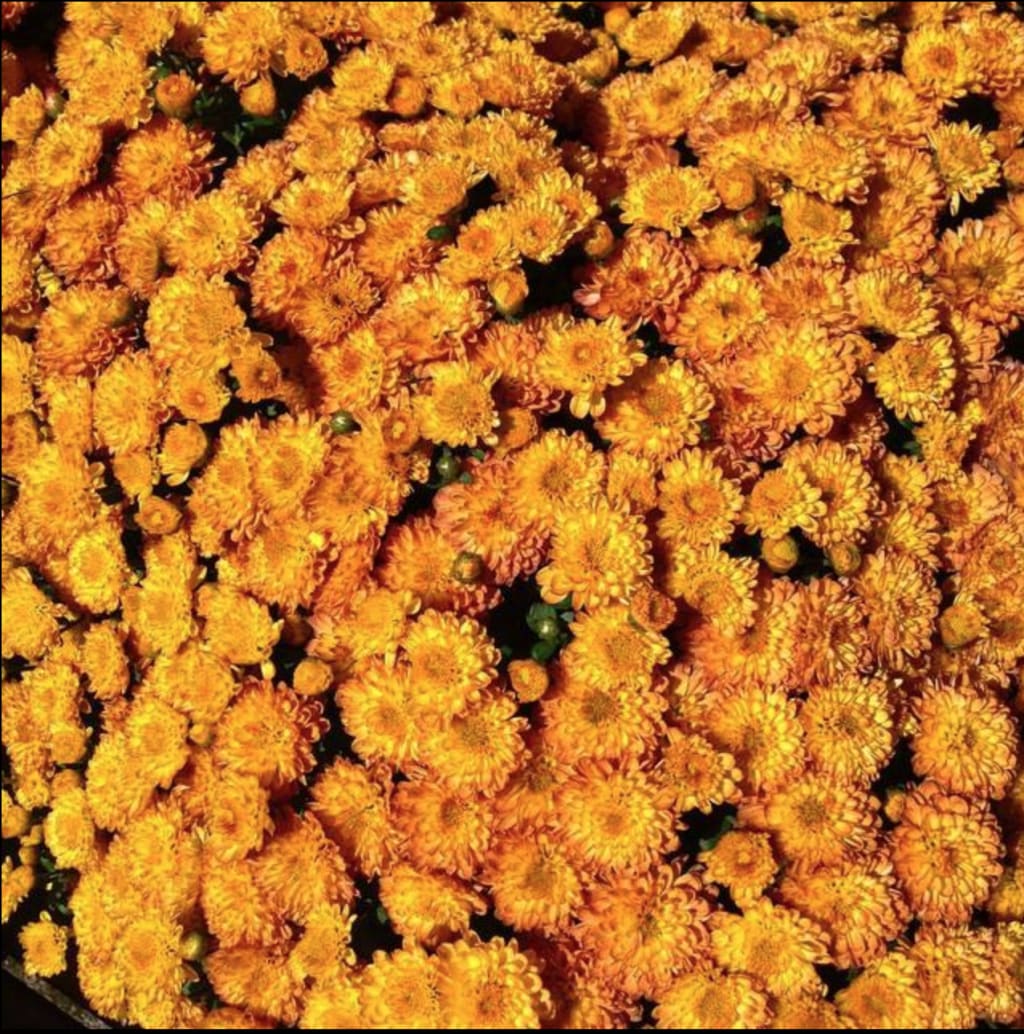
He looked down at the golden flowers surrounding his ragged shoes. Their petals brushed against his chafed, exposed skin as the breeze swayed them in a gentle dance. They were his mother’s marigolds. They blanketed this side of their hill as far as the eye could see, turning the land into a golden sea every spring. Once, when he was a small child, he went out in search of a wayward lamb and happened upon his mother sitting amongst her marigolds. She had not seen him, and he hid behind a tree to watch as her calloused fingers swiftly, tenderly made a crown out of their blossoms. She was barely more than a child herself then, and the tight bud of her mouth had opened into a hushed smile. Joy was quiet, sparse, and fleeting for them; it was found in solitude and protected with secrecy, like the most precious of hidden treasure. He left her alone that day and never spoke of it. He had understood then that it was hers, but the memory of seeing her in a moment of happiness was his; he carried it through both the battlefields of war and those in his head that drenched him in fear and anguish. As he looked down at her marigolds, the memory of his mother rattled something loose inside of him. He began to stir.
Without thinking, his hand reached into his threadbare coat and searched for the jagged piece of charcoal that rested deep in the corner of the pocket- a hand that was rough from war and caked with blood and dirt, nails torn, stories of horror and shame held within its palm. But how tenderly his fingers felt for that black rock.
Once his hand found it, he took from within his inner breast pocket something worth more than the holiest of grails- pieces of paper absconded from a Latin prayer manual. When he came across that book amongst the charred remnants of a church, he had wondered if it was a sign meant for his soul. There were rumblings that some heretics were translating these foreign words into the tongue of the people, so that all may hear that the meek shall inherit the earth and that whoever oppresses the poor shows contempt for God. But how could those in power raise an army if that army heard the words ``Blessed are the peacemakers?” One day the sacred words in that prayer book he had held in his hands might make his way to him in German, but for now the pages themselves were more important than what was printed on them. The priests may damn him, but what of it? He had already seen hell those last three years, and so he had felt no fear or guilt when he had ripped out the pages to fulfill his one joy on this forsaken earth- to draw.
He sat down amongst his mother’s marigolds. While he could still remember the faces of his parents, he drew every wrinkle, every muscle, every crease, every eyelash, her lips that had blossomed during those few minutes of secret joy all those years ago. He began to fill the margins of the paper, but his portraits grew larger with every stroke of charcoal until suddenly and unintentionally they covered the latin prayers that were printed on the sheets. These psalms to his parents replaced the ones to a god he had never understood and no longer needed. Alone in the bleak world, he felt fullness of spirit when he drew. It was like a strike of lightning, running from his heart to his fingers and through the charcoal to the paper. It was all that he had left, but it was enough to carry him through the rest of his days in this harsh life. It would have to be.
About the Creator
Enjoyed the story? Support the Creator.
Subscribe for free to receive all their stories in your feed.
Comments
There are no comments for this story
Be the first to respond and start the conversation.