
Daddy Getting Old
A Short Story

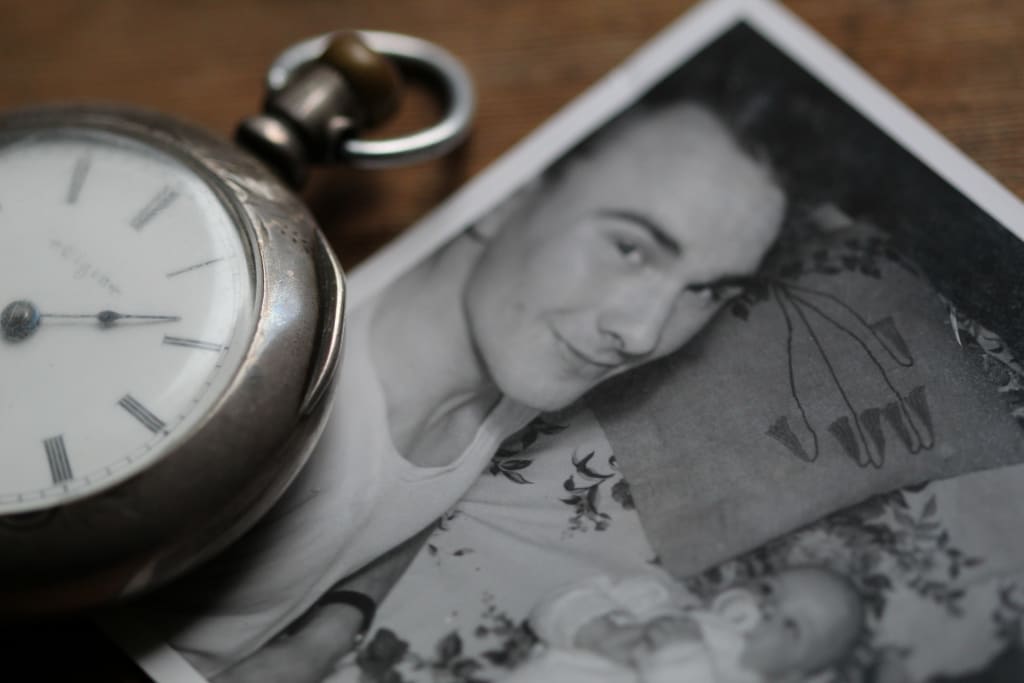
It was Daddy’s birthday and talk of death was everywhere. I caught a morning report on CNN – over 3500 American soldiers dead in Iraq. And then yesterday some demented kid shot down more than thirty people at Virginia Tech. Everyone was talking about it -- on T.V., at work, on the bus to the hospital -- it’s all I heard.
I walked into the room and said, “Happy Birthday, Daddy.”
It came out all wrong.
Daddy grunted and pulled himself to a sitting position on the hospital bed. He held a shaky Styrofoam cup to his mouth. Most of the water missed its mark. I put my bags down as fast as I could, along with the oversized birthday balloon, and rushed across the room too late to help. I didn’t say anything. I never know what to say to him when Mom’s not in the room.
After I settled onto the sofa, Daddy took a deep breath and forced his legs over the side of the bed using the momentum of his body, helping them along with wiry arms. He checked his pulse placing two fingers over his upturned wrist. He wanted to be sure the synthetic heart valve was still opening and closing. His slight frame seemed almost skeletal beneath the thin blue hospital gown. He slid his feet to the ground. Half-sitting, half-standing, he grimaced and stood upright.
“Time to do my walking,” he said to no one in particular. He shuffled toward the door and waved me off as I moved toward him.
It’s hard to see Daddy this way. His heart’s taken him so far – from an itinerant farm worker to a small-business owner in the big city – and now it’s failing him.
Ten years ago, he could climb a scaffold, monkey-like, and walk without wavering on the edge of a two by ten ceiling joist, perched three stories up. Hell, a year ago he could carry a stack of two-by-fours piled six high on one shoulder. Now he can’t lift a Styrofoam cup.
I blink and he’s an old man. Forty years of framing houses weathered his once clear, pale skin.
When I was a kid Daddy’s emerald green eyes, his pencil mustache expertly trimmed over thin lips, his light brown, wavy hair made him look like a 1940’s movie star, a Latin Errol Flynn. Even his less-than-perfect nose – broken in a boyhood fight when a bigger kid called him a lazy Mexican – only added to his movie star persona.
My uncles told me, “Tu papa got his nose broke, pero you shoulda’ seen the other kid’s face.”
Daddy would smile and say, “Te digo, quel pinche bolillo never called us lazy Mexicans again.”
All those years ago and I still remember that story ‘cause Daddy never talked much about his childhood, and though he laughed from time to time, he rarely smiled.
Daddy shuffled back into the room, a little short of breath, checking his pulse again. He complained that the nurses were lazy, and gave me his back-off look when I reached out to help him onto the bed.
“Why are you so stubborn?” I asked.
He shook his head and turned up the TV volume. It was CNN on the war, replaying yesterday’s presidential news conference. I was just glad it wasn’t Virginia Tech. Bush’s face filled the screen.
“He doesn’t care about the poor,” Daddy said.
“Daddy, don’t get yourself worked up.” I fixed his covers as he slid into bed.
“Who do ya think’s fightin’ this war?” He said.
I rolled my eyes knowing what was coming.
“The Mexicans and the Blacks. That’s who.” He said it as if he’d just read it in an official Pentagon report.
“There are others in the military too,” I said.
He shook his head. “The Mexicans and the Blacks. That’s who’s fightin’ the war.”
“They fight with technology now, Daddy. They fire missiles from miles away.”
“Your cousin’s over there gettin’ shot at right now,” he said pointing at the screen, “And this cabron doesn’t care.”
“Didn’t you vote for Nixon?” I said.
He looked at me like I’d just punched him in the stomach, bringing up, he-who-shall-not-be-mentioned. I shouldn’t have said it. I know.
“Get some rest,” I said, “You don’t want your new valve to shut down, do you?” His fingers were quick to move to his wrist.
Honestly, I felt a little guilty ‘cause I’d forgotten my cousin was fighting over there. The men in our family have a history as grunts in the military. Daddy didn’t serve ‘cause he was the youngest and there weren’t any brothers left to stay home and take care of the farm, but his oldest brother was at Normandy. Two other brothers in Korea. His sister’s firstborn died in a helicopter crash in ‘Nam. And now my cousin Chris was a Marine stackin’ body bags in Baghdad.
I turned off the TV after Daddy slipped into the beginnings of a quiet snore. The room swelled with a familiar silence. Daddy and me alone together with nothing to say. Me reaching out clumsily and Daddy slipping away like a golden gloves boxer, weaving and dodging.
The beep of his heart monitor taunted me, daring me to catch him before it took him away. Daring me to say something. Anything. Before it was too late.
I closed my eyes and caught the distant murmur of a freeway. It reminded me that there was still a world out there with people in it. People who talk to each other while they drive home from work, or to the mall, or soccer practice.
When I was away at college I’d call home and Daddy was always the first to pick up.
“Hello,” he’d say.
“Hey Daddy, how’s it goin’?”
“Good,” he’d say, “How’s school?”
“Fine,” I’d say. And before I could say anything else, “Wanna’ talk to your mom?”
“Yeah. Sure, Daddy. Is she there?”
By the time I spit the words out Mom was on the line chattering away, and Daddy faded away into some dimly lit room at the back of the house.
It’s not that Daddy didn’t want to talk. Back in the day, when he thought I was out of earshot, he bragged about his son, the college student.
“He’s going to be an engineer,” he interjected into any conversation, whether it fits or not. He always said it as if I’d landed on the moon. He stopped when I switched to journalism.
Daddy himself only got to the ninth grade. The war had just ended and all his brothers were coming back to wives, ready to jump-start the baby boom. His own Daddy was crippled in a work accident at the Lone Star Cement plant, so Daddy quit school to take care of the farm.
School couldnt’ve been easy for him anyway. He couldn’t shake his Spanish accent. Today, on the tongue of a twenty-something, it might be considered sexy. But in the time and place Daddy grew up it was a signal of the ignorant.
Daddy was paddled for speaking Spanish on the school playground; punished when he mispronounced words in class. The beautiful sound of him mixing his “i’s” with his “e’s” and the exotic way he emphasized the wrong syllable became to him a scarlet letter that screamed immigrant. Foreigner. Uneducated one.
He was also plagued with a slight stutter. I never noticed it till I was much older. Mom says it’s because he was born left-handed. Back in the old country, they believed it was evil to be left-handed so they tied Daddy’s left hand behind his back and forced him into right-handedness. Mom says she read somewhere that that can cause a slight stutter. So he learned to be silent. He learned the fine art of survival by becoming invisible.
I don’t know. Maybe Daddy always preferred action to words. Maybe I make too much of it. Some people are just born that way. He could solve any do-it-yourself problem in a flash. He always put things together without reading the instructions.
The symbol-based language of blueprints and schematics came easy to him. He could see things before they were built, and knew how to put them together – like Mozart with the black and white keys of his harpsichord – they just made sense to him. When it came to the three-dimensional world, Daddy never stuttered.
For instance, Daddy built shelves in every room of our house and filled them with books. Mom, who had one year of college before quitting to help her parents, told him what to buy. The Time-Life Old West series, The Hardy Boys for me, Nancy Drew for my sister, the Encyclopedia Britannica, Sandburg’s Lincoln, the Harvard Classics. I never saw him read the books. I guess it was his way to make up for a ninth-grade education. His way of saying to the pharisaical demons in his mind, I have books, and I can read them if I want to.
Or maybe he just wanted to surround his children with what he never had. Books filled with words. Not his own Spanglish words, but better words. Proper words.
So now my sister’s a librarian, and I’m a writer. It was all those damn books Daddy surrounded us with – Innocuous, they stood on shelves to guard each room. Filled with the grandest words in the English language they watched over us – Subliminal missiles bombarding us as we slept and ate and played. Word fairies dancing in our dreams. Daddy could never get the right words to form on his tongue, so he made sure there were others present to deliver them. Dickens and Twain, Austen and Tolkien, he must’ve thought, would speak in his stead.
I leaned over the bed rail to kiss Daddy on the forehead – something I’d never do if he were awake. I could see the tiny purple veins on his nose, the small bald spot where his thick hair once lived, the faint smell of Old Spice. I felt like crying. I don’t know what it was. The war, Virginia Tech, my cousin stacking body bags, the silence, Daddy getting old.
I knew if I let myself, I would cry. But the men in my family don’t cry. At least not where anyone can see. Tears are a flood of words that stream down your face. They’re too gossipy.
I only saw Daddy cry twice. Once, when his brother died suddenly of a heart attack, leaving a wife and six kids. And once when he took me to the El Rey Movie Theater on Harrisburg Street to watch the Mexican cowboy movies. Twenty-five cents for a double feature. Daddy loved a good value, and he adored the singing cowboys. Roy Rogers, Gene Autry, and Tex Ritter were okay. But nothing compared to the Mexican singing cowboys like Antonio Aguilar, Vincente Fernandez, and his favorite of all time, Pedro Infante, who died in an airplane crash the same year Daddy’s momma died. In his heart, Pedro Infante would forever be attached to his momma, as if they’d gone down in the plane together.
It was an old Pedro Infante movie we saw that day, in grainy black and white. Three men in a saloon drowned their sorrows at the bottom of a Tequila bottle. Pedro Infante sang with a six-shooter on his hip and his arm around his best friend’s neck.
As the beautiful baritone belted out his lament, the dark mustachioed friend let out a long, hard HAI – AI – AI – EEEEEEEEE. The piercing scream of the Mexican male resonating with the words of the song because he has no words of his own to describe his peculiar pain.
In Mexican cowboy movies, everyone always dies at the end. The hero, the heroine, the villain. They all died that day. And Daddy’s eyes were shiny when we left the theater. He said it was his allergies.
About the Creator
Eleazar Orozco
Dr. Orozco has advanced degrees in biblical studies and is a seasoned pastor, writer, and blogger.
Enjoyed the story? Support the Creator.
Subscribe for free to receive all their stories in your feed.
Comments
There are no comments for this story
Be the first to respond and start the conversation.