

The emergency lighting brightens as the ship reallocates power. You look up at it with an anger so clear that for a second it steadies you. The system has made an adjustment. You are still holding someone's blood against him.
You ease his hand from your wrist and secure the dressing beneath his own palm, performing the movement with a care that can no longer help. You wish you had heard the rest of his name. You wish this were the only thing about him you would carry away. Then you turn toward the suit.
Its instructions assume a trained operator standing on a floor, two things the present emergency has neglected to provide. You hook an elbow through a locker handle and work your legs into the lining, dragging the stiff material past your boots. Each time you push, the rest of the suit moves away, obliging you to retrieve it with the patience of someone trying to dress an uncooperative piece of furniture.
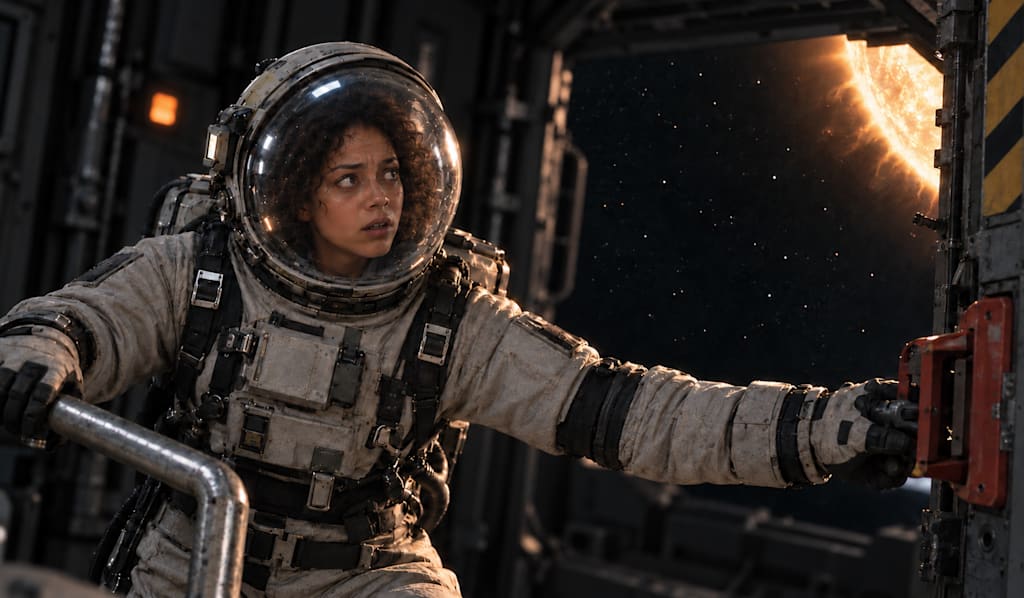
The waist seal refuses to engage. A warning repeats in your ear while you check the fasteners, and only when you slow down do you find a fold of your shirt caught in the ring. You tug it free, close the seal, and lower the helmet over your head.
Cool air touches your face causing you to close your eyes. The relief reaches you so suddenly that you have to grip the locker to keep from abandoning all further effort. You remember standing in front of Mabel's open refrigerator one hot morning, allowing yourself a few seconds before closing the door because the compressor was temperamental. You had no idea how much happiness could be contained in air arriving at the right temperature.
“Pressure stable,” a recorded woman says. “Oxygen reserve seventy minutes.”
You begin to thank her. “Projected cooling endurance: eleven minutes at current solar distance.”
You leave the sentence unfinished while you examine the display more carefully. A diagram shows the reflective outer hood and the heat reservoir built into the pack. Its contents absorb energy as they change phase, buying time for workers carrying out brief repairs under intense radiation. You have used insulated containers often enough to understand a thermal budget. Heat keeps arriving; the reservoir has a finite amount of room for it.
The suit can keep you alive beyond the hull for a few minutes. You hold on to those minutes with a gratitude that seems almost indecently large for such a small quantity. You fasten the hood, activate the emergency beacon, and open the radio.
“Mayday. Civilian aboard the Valiant. One survivor. Requesting rescue.”
The words one survivor leaves your mouth with surprising difficulty. Saying them makes the empty bay feel occupied by everybody who has failed to qualify.
Static scratches inside your helmet. You remember pursuit markers on the loading bay monitor after the hijacking. Patrol vessels had followed you out of dock. Perhaps one tracked the jump; perhaps someone is already searching the region where the Valiant emerged. You repeat the coordinates from the suit display, speaking slowly because another person may have to build your location from what they can hear.
“Attitude jets unavailable,” the suit announces.
You check the propellant gauge. Critically low. A recharge hose hangs beside the locker, disconnected from its supply. The inspection tag carries a signature, a date, and a box confirming that the inspection tag has been inspected.
You look toward the airlock, and guesses it's about twelve meters across the bay. A mechanic once told you that much of space travel consisted of arranging to move at the same speed as something useful. At the time, you had been asking him to reduce the labor charge on an invoice. You understand his observation more fully now, including the discouraging implications of leaving a spacecraft with no means of changing your own course.
A violent shudder interrupts the thought. Gas venting from a rupture pushes the hull sideways, sending loose equipment across the bay. You catch a rail while a locker tears free of its mountings and strikes the far wall hard enough to dent it. Your trolley restraints hold, but one of the blue crates shifts, and its loosened strap snakes into the open space.
SHIELD INTEGRITY 3 PERCENT
The time estimate disappears. You find yourself wishing it would return, prepared to forgive almost any inaccuracy in exchange for a number.
You pull along the rail toward the airlock. Its inner hatch opens halfway and stops, leaving a gap just wide enough to negotiate if you turn the cooling pack sideways. You ease through with one hand on the frame, acutely conscious that the machinery keeping you alive is also the part most likely to get you stuck.
Inside, you catch a handle and press CLOSE. The hatch trembles, advances a few centimeters, and stops again.
You press the control harder, drawing on a relationship with technology that has survived four years of professional spaceflight largely unchanged.
Beyond the opening, something flashes in the bay. The suit's outer temperature climbs. You reach for the emergency wheel, brace one boot against the frame, and turn until the muscles in your shoulders begin to shake. The hatch scrapes forward, then catches on a blue strip of webbing.
Your cargo strap runs across the sill, its far end trapped beneath the shifted crate. You bought that brand because the guarantee promised exceptional performance under extreme conditions. Watching it resist a closing pressure door, you feel that the manufacturer has made its point.
An emergency cutter sits beneath a safety cover beside the wheel. Your glove slips from the release twice. Panic begins narrowing the world to the size of that little catch, and you have to make yourself look directly at it, find the hinge, and press where the molded arrow indicates. You resent how much survival depends on reading instructions while frightened.
A bulkhead ruptures beyond the bay. You feel the impact through your braced foot, followed by a surge of air that pulls at your arm. Bright fragments strike the hatch frame. You grip the cutter, hook the blade around the webbing, and pull until the fibers part.
The loose end lashes away. You wrench the wheel through its final turn and feel the locking pins engage.
For several seconds you rest your helmet against the closed door. Your breathing fills the small volume around your face, accompanied by the cooling pump and the beacon transmitting its steady request into space. You try to imagine the signal arriving somewhere, making a light appear on a console, causing another person to lift their head.
Then you turn toward the outer window. The visor darkens automatically, and beyond it the sun fills a portion of the black with a scale your mind is slow to accept. Through the filters you can see structure within the glare, vast loops rising above the limb along magnetic fields that remain invisible. Matter moves through those curves in volumes that could swallow worlds, and the warship carrying you seems suddenly as slight as a shaving of metal held near a furnace. For a moment you forget to be afraid.
You have seen photographs of this star all your life. At school you drew it in the corner of a page, supplying rays and occasionally a cheerful face. Even the better pictures had lived inside books you could close. Here it continues beyond the window with an existence so complete that you feel your own thoughts becoming small beside it.
Light reaches the visor, the hull, the little photograph waiting in Mabel's cabin. The connection is simple enough to understand and too large to feel all at once. Somewhere far behind you, your mother is living beneath an ordinary afternoon, moving through warmth from the same star without knowing that you are here. A cooling warning returns you to the chamber.
The hull has soaked up heat faster than its failing systems can reject it. The suit, with its fresh reservoir and reflective layers, can buy time outside the wreckage, provided you leave while it still has that capacity. You make yourself read the endurance figure and then the projected escape path. A second thin curve appears beside the Valiant's course, continuing sunward.
Leaving the ship will give you its velocity as a parting gift. The airlock can push you clear of the breaking hull, and after that you will need someone else to supply the acceleration. You wish there were a version of the calculation in which courage contributed a measurable quantity.
Your hand settles over the emergency release. The normal outer hatch mechanism has failed, leaving explosive separation available beneath a guarded control. A notice asks whether you wish to proceed and warns that using this function may cause severe body harm.
You consider the people who insisted on including that sentence and briefly hope that they enjoy a long life containing a reasonable amount of inconvenience. Still, your thumb remains above the control.
The chamber feels like the last room in the universe. Beyond its window there are distances your imagination cannot cross, and you know that once you leave, your hands will find nothing to hold. You have spent the entire escape looking for the next rail, the next hatch, the next surface against which to brace yourself. The plan has run out of surfaces.
You think of your jacket hanging in dispatch. Someone will empty its pockets, finding a receipt you meant to claim and the folding knife security made you leave behind. Someone will locate your emergency contact and call your mother while she is searching for her keys.
You can picture her stopping at the door. You know the small movement she makes when she hears something she cannot immediately understand, drawing her free hand toward her chest as though feeling for a button. Your imagination supplies the gesture with a cruelty you cannot bear.
“Mayday,” you say. “This is Chriselle. Civilian courier. I'm coming out of the port cargo airlock.”
You add the ship's name and repeat your position, making yourself finish each number. If somebody is listening, you want to leave them as little work as possible. Then you brace both boots against the inner door and press the release.
The outer hatch separates. Expanding air catches you, drives you through the opening, and spills into vacuum around you. For an instant there is noise and acceleration and the violent sensation of the ship letting go.
The roar ends so abruptly that you think you have gone deaf. Inside your helmet, you can still hear your own startled breath and the patient hum of the pump as you tumble into silence.
The Valiant passes across your visor, followed by blackness, stars, and the edge of the Sun. You reach for a handhold and feel your fingers close on nothing. The motion continues, carrying the ship out of sight while every instinct insists that you must stop before you fall any farther.
You spread your arms, recalling the training diagram in which extending your limbs slowed a rotation. The instructor’s illustrated astronaut had looked considerably more composed. Your turning eases, though the Sun continues passing across your visor with a regularity you would prefer to interrupt. Then the attitude jets fire in a brief, uneven sequence, nudging against the spin before a warning announces that the propellant is exhausted. The stars drift more slowly now. You keep your limbs extended, fighting the urge to curl into a ball, while the suit displays its empty fuel gauge with the satisfaction of a machine that has identified the problem. When the Valiant returns to view, its spine is breaking. Compartments open along the hull, and escaping gas blooms into sunlight, thinning as it expands. A panel turns away with a flash, briefly bright enough to resemble a signal. You watch for the violence to become audible before remembering why it never will.
Somewhere inside are the ensign and the young man whose name you failed to hear. The ship turns, concealing the bay, and you have the absurd impulse to apologize for leaving before you could cover them with something. There had been sheets in the shaft. The thought arrives fully formed, an impossible errand your mind offers because it has no acceptable way to finish with the dead.
You let yourself say sorry once. The radio transmits it into the dark along with your position.
The cooling figure declines. Each turn brings the sun across part of your visor, and you try to keep the reflective hood drawn around the pack as the instructions advised. Your hands shake inside the gloves. You concentrate on extending your fingers, on taking the next breath slowly enough to finish it.
You would like to live long enough to complain about this. The thought is so ordinary that it steadies you. You want to stand at a counter somewhere, with gravity holding your boots down, and explain to a person who has misplaced the correct form that this delivery has involved circumstances beyond the original agreement.
Beyond the wreck, the stars shine steadily, their light reaching you through vacuum without the atmospheric tremor you remember from Earth. You look for movement among them until bright points gather in the moisture at the edges of your eyes.
Then a faint crackle enters your helmet. “Do... u... re... me. Come in.”
You stop breathing to listen, frightened that the sound may have come from something inside the failing suit. The carrier breaks, returns, and carries the end of another word. There is a voice in it, a person somewhere having difficulty reaching you. You find the transmitter control with your thumb.
“Yes. I read you. I'm here.”
Static fills the channel. You keep the control pressed until you remember that you must release it to hear an answer, then lift your thumb with an effort that feels dangerously like letting go.
The ship turns out of view again. For a few seconds you have only stars and the steady expenditure of the cooling system, and you begin preparing to call once more.
“Keep talking,” the voice says.
You have no idea what to tell them first. There is so much you need another person to know that for one terrible moment you cannot make a sentence. Then you remember how conversations begin and tell them your name.
About the Creator
William Saint Val
I write about anything that interests me, and I hope whatever I write will be of interest to you too.
Enjoyed the story? Support the Creator.
Subscribe for free to receive all their stories in your feed. You could also become a paid subscriber, letting them know you appreciate their work.
Comments
There are no comments for this story
Be the first to respond and start the conversation.