

My editing style in this chapter leans into the kind of nonlinear rhythm you see in shows like Fringe or Lost, where time bends, memory bleeds, and the emotional truth hits harder than the timeline.
The back and forth between the soft, intimate phone calls and the explosive street chaos isn’t just structure; it’s the tension of two people trying to stay connected while the world claws at them from every angle.
That’s why the “Peace Picnic” lands with weight. You’ve seen the storm they walked through. You’ve felt the fracture. And when the calm finally arrives, it feels earned.
Pulling this off with AI actors is wild, but that’s the challenge I love making a TV drama heartbeat inside a digital world.
I WROTE THIS! I CREATED THIS! IT IS COPYRIGHTED TRUSSELLI ART 2026
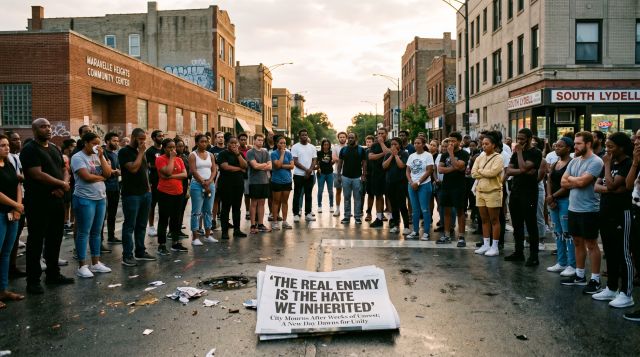
The real enemy is the hate we inherited
Mirabella’s Breakdown — The Night Everything Falls Apart
Mirabella didn’t walk to her room.
She ran.
She slammed the door, locked it, and threw herself face down onto her bed. The sobs came fast hot, shaking, uncontrollable. She was nineteen, a first year college student, still learning how to breathe in a world that suddenly felt too sharp.
Her phone buzzed in her hand.
Kaden.
She wiped her face with the back of her sleeve and answered.
“Hey—”
But before she could speak, his voice came through tightly, angry, wounded.
“My mom was right about you.”
Mirabella froze.
“What?”
“She said you were prissy. A know it all. Someone who thinks she’s better than us.”
Mirabella sat up, breath catching.
“Kaden, I never—”
“You walked into my house like you were scared to touch anything. Like you were doing me a favor just by being there.”
Her voice cracked.
“I was nervous! Your mom—”
“My mom said you were the type to play with a boy’s heart and then run back to your perfect little world.”
Mirabella felt the words like knives.
“She called me a hussy, Kaden. I heard her.”
Silence.
Then:
“She didn’t mean—”
“YES, SHE DID!” Mirabella screamed, voice breaking.
“And now you’re repeating it!”
Her sobs grew louder, shaking her whole body.
“You think I’m prissy? You think I’m above you? You think I’m—”
“I think you’re exactly what she warned me about.”
That did it.
Mirabella pressed the phone to her ear and screamed through tears:
“You slimy little boy!”
The words came out raw, childish, and desperate, the kind of thing someone says when they’re drowning in hurt.
Immediately, she gasped.
“I’m sorry I didn’t I didn’t mean—”
But Kaden had gone quiet.
Too quiet.
“Yeah,” he said finally.
“Maybe we should stop talking for a while.”
Her heart dropped.
“Kaden… please…”
But he didn’t answer.
The line went dead.
Mirabella curled into herself, sobbing until her pillow was soaked.
On the other side of the river, Kaden sat on his bed, staring at the wall, fists clenched, chest tight, replaying every word.
Two kids.
Two wounds.
Two families speaking through them.
They hung up.
And the silence between them felt like a funeral.
The Bridge — One Week Later
Neither planned to be there.
Neither expected the other.
But fate doesn’t care about timing.
Mirabella walked onto the bridge first, eyes swollen from a week of crying.
Kaden stepped onto it from the opposite side, shoulders heavy from a week of regret.
They saw each other at the same moment.
They stopped.
They stared.
And then without thinking they ran.
When they collided, it wasn’t gentle.
It was desperate.
Arms around each other.
Faces buried in shoulders.
Tears mixing with the river wind.
Kaden cupped her face.
“I’m sorry.”
Mirabella shook her head.
“I’m sorry too.”
And then they kissed, the kind of kiss that feels like coming up for air after almost drowning.
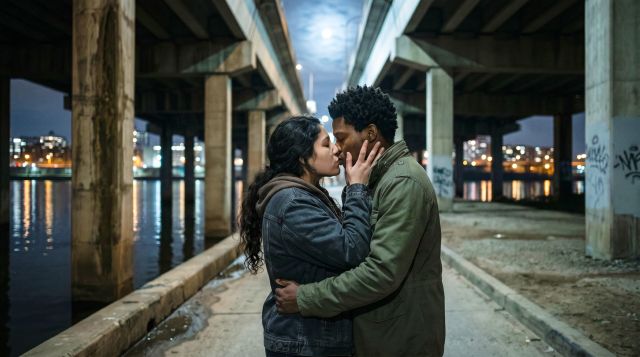
Gossip The Spark That Lights the City
A car slowed on the Heights side of the bridge.
Mrs. Larrin, a well known gossip, always on her way to the market, always watching saw them.
Her eyes widened.
Her mouth fell open.
Her hand flew to her chest.
“Oh, my Lord…”
She didn’t even wait to get home.
She told the cashier at the market.
She told the woman in line behind her.
She told her neighbor.
She told her sister.
She told her maid who happened to be from South Lydell.
By sundown, the entire city knew:
A Heights girl and a South Lydell boy were kissing on the bridge.
The divide had been crossed.
The unspoken rule had been broken.
The story had spread like wildfire.
And nothing absolutely nothing would ever be the same.
THE CITY ERUPTS — THE DIVIDE IGNITES
South Lydell Reacts First
Word spread fast, faster than truth, faster than reason.
A Heights girl kissing a South Lydell boy on the bridge.
The men in Kaden’s neighborhood reacted the only way they’d been taught to survive:
with fists.
Not thrown but ready.
Knuckles cracking.
Jaws clenched.
Eyes scanning for anyone from the Heights who dared to look at them wrong.
They weren’t angry at Mirabella.
They were angry at the story:
“A Heights girl? She’ll break him.”
“They always do.”
“They think we’re trash.”
“He’s setting himself up to be humiliated.”
The old wounds woke up.
The old bitterness resurfaced.
The divide breathed fire.
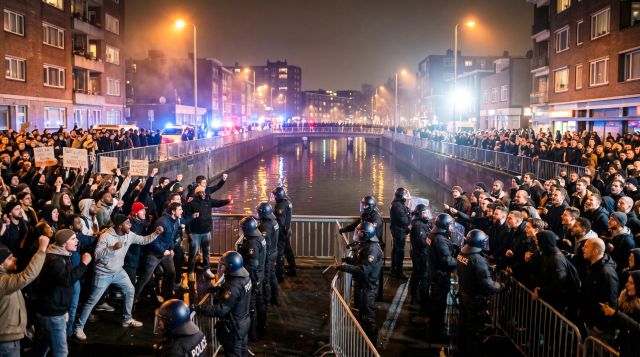
The city had chosen sides
not political sides,
but cultural, class, and color sides.
The divide was awake.
THE MOTHERS MEET — SPARKS, FIRE, AND TRUTH
It happened in the parking lot of the only neutral grocery store in the city the one on the edge of the river, where both neighborhoods shopped but never spoke.
Mirabella’s mother, Dr. Solis, Registered Nurse Practitioner, PhD, walked out with a bag of produce and a calm, professional posture.
Kaden’s mother, Marla Monroe, fourth grade education, lifelong laborer, five kids raised alone, walked in with a scowl and a storm brewing behind her eyes.
They locked eyes.
The air tightened.
Dr. Solis forced a polite smile.
“Mrs. Monroe. I think we should talk.”
Marla snorted.
“Talk? About what? Your daughter is slumming it with my boy?”
Dr. Solis inhaled slowly the way medical professionals do when they’re trying not to escalate a situation.
“Our children are young. They’re confused. Maybe if we—”
“Confused?” Marla barked.
“Your girl knows exactly what she’s doing. Playing with him. Making him think he’s good enough for her world.”
Dr. Solis kept her voice steady.
“This isn’t about worlds. It’s about culture. Differences. Expectations. Maybe if we centered the conversation around something neutral—”
“Neutral?” Marla scoffed.
“Lady, nothing about this is neutral.”
Dr. Solis tried again, shifting to a softer topic, food, something universal.
“Maybe we could talk over a meal. I make a very good—”
Marla cut her off with a laugh that wasn’t a laugh at all.
“Food? You think I’m here to swap recipes with you? You slime bag dumb bitch.”
The words hit like a slap.
Dr. Solis stepped back, stunned.
Not because she’d never been insulted but because she had forgotten how raw, unfiltered, and unapologetic pain can sound when it’s been passed down for generations.
Marla wasn’t just angry.
She was wounded.
She was tired.
She was terrified of losing her son to a world that had always rejected her.
Dr. Solis steadied herself.
She could have argued.
She could have defended herself.
She could have thrown her own insults back.
But she didn’t.
She simply lifted her chin and said:
“Good day to you too.”
Then she walked to her car, placed her groceries in the back seat, and drove away — hands trembling on the wheel.
Behind her, Marla stood in the parking lot, chest heaving, eyes burning, the weight of her own history pressing down on her like a storm cloud.
THE CITY TAKES SIDES — THE DIVIDE IS NO LONGER QUIET
By nightfall, everyone knew:
• The Heights blamed South Lydell.
• South Lydell blamed the Heights.
• The mothers had clashed.
• The families were under siege.
• The love story had become a symbol.
Not political.
Not ideological.
Not partisan.
Bigotry.
Class.
Color.
Fear.
History.
Hate.
The city wasn’t divided by parties.
It was divided by wounds.
And Mirabella and Kaden were standing right in the middle of the fault line.
CHAPTER: The Night the City Broke
Texting in the Dark
For days, Mirabella and Kaden didn’t dare meet in person.
The city was too hot.
The neighborhoods too loud.
The families were too raw.
But they couldn’t stay away from each other completely.
So, they texted.
Late at night.
Under blankets.
Phones dimmed.
Hearts aching.
Kaden: I miss you.
Mirabella: I miss you too.
Kaden: I keep thinking about the way you laughed on the bridge.
Mirabella: I keep thinking about your hands. They felt warm. Safe.
They remembered the warm fuzzy feeling, the spark, the softness, the way the world had felt right for one brief moment.
But outside their screens, the world was falling apart.
The City Turns Dangerous
The gossip had spread like wildfire.
Now it was gasoline.
South Lydell boys walked in groups, fists clenched, ready to defend their own.
Maravelle Heights residents hurled insults from porches, muttering about “those people” and “that girl’s disgrace.”
Threats flew across the river.
Warnings.
Rumors.
Fear.
The police, overwhelmed, underprepared, and terrified of a riot announced a citywide curfew.
“For safety,” they said.
But everyone knew the truth.
The divide was cracking.
Under the Bridge — The Forbidden Meeting
Mirabella couldn’t take it anymore.
She texted him:
Mirabella: Meet me under the bridge. Please.
Kaden: It’s dangerous.
Mirabella: I don’t care. I need to see you.
He came.
They met in the shadow of the bridge, the only place that belonged to neither city.
The river whispered below them.
The night air was thick with tension.
But when they saw each other, everything else fell away.
They ran into each other’s arms.
They kissed desperately, relieved, trembling.
For a moment, the world was soft again.
The Attack
Then a voice cut through the dark.
“HEY! What the hell is this?!”
A group of boys from Maravilla Heights older, angry, fueled by gossip and pride stepped out from behind the concrete pillars.
“Get away from her!”
“You think you can touch a Heights girl?”
“Go back to your side!”
They shoved Kaden.
Hard.
Mirabella screamed.
End of part two of part two
-------------------------------------------------------------------------------------
Kaden stumbled but didn’t fall.
He stood his ground, but he was outnumbered.
Then from the shadows came the sound of running feet.
His brothers.
Three of them.
Big.
Protective.
Raised in a world where fists were the only language anyone listened to.
They saw Kaden being shoved.
They saw Mirabella crying.
They saw Height’s boys circling.
And they charged.
The fight exploded with fists, shouts, bodies slamming into concrete.
Not a brawl.
A riot in miniature.
Mirabella tried to pull them apart, screaming for them to stop, but no one heard her.
The divide was fighting through them.
The Police Arrive
Sirens.
Lights.
Shouts.
Police from both sides of the river swarmed the bridge.
They didn’t ask questions.
They didn’t separate sides.
They didn’t care who started it.
They arrested everyone.
Even Mirabella.
Even Kaden.
Handcuffs.
Cold metal.
Tears.
Fear.
They were shoved into separate cars, hearts pounding, eyes locked on each other through the windows as the cars pulled away.
At the Station
The officers quickly realized the two weren’t fighters, just kids caught in the middle.
They were questioned.
Scolded.
Warned.
Then released.
Mirabella walked out of the station with her mother gripping her arm like a lifeline.
Kaden walked out with his brothers behind him, bruised and silent.
They didn’t speak.
They didn’t touch.
They didn’t even look at each other.
But they felt the same thing:
This wasn’t just a love story anymore.
This was a war.
CHAPTER: The Lockdown of Love
B. The Families Clamp Down
After the arrests, both families snapped shut like traps.
Mirabella’s home
Her mother took her phone.
Her father locked the windows.
Her siblings whispered behind doors.
“You’re grounded until further notice.”
“You will NOT see that boy again.”
“You almost ruined this family.”
Mirabella felt like she was suffocating.
Kaden’s home
His mother didn’t take his phone she didn’t need to.
Her voice was enough.
“You embarrassed us.”
“You brought trouble to this house.”
“You’re done with that Heights girl.”
His brothers watched him with a mix of pity and frustration.
The divide wasn’t just outside anymore.
It was inside their homes.
A. The City Cracks Down
The fight under the bridge had shaken the whole city.
The mayor declared a mandatory curfew.
Police patrolled the river.
Drones scanned the bridge.
Neighborhood watch groups formed on both sides.
People weren’t just angry
they were afraid.
Afraid of each other.
Afraid of the unknown.
Afraid of what this love represented.
The divide wasn’t a rumor anymore.
It was a living thing.
C. The Lovers’ Plan to Break the Rules
Despite everything, Mirabella and Kaden still texted quietly, secretly, hearts pounding with every buzz.
Mirabella: I can’t breathe without you.
Kaden: I’ll meet you. Anywhere. Anytime.
Mirabella: Under the bridge again?
Kaden: Yes. I’ll be there.
They knew it was dangerous.
They knew the city was watching.
They knew their families would explode.
But love makes rebels out of the gentle.
D. The City Chooses Sides — Hate Awakens
When they met under the bridge again, it wasn’t soft or sweet.
It was desperate.
They kissed like they were trying to hold the world together.
But someone saw them.
A group of Heights boys, angry, restless, fueled by gossip and racial resentment stepped out of the shadows.
“There she is.”
“Look at her with him again.”
“She’s humiliating us.”
“Get him away from her.”
They shoved Kaden.
Hard.
Mirabella screamed.
And then from the other side came Kaden’s brothers.
They saw the Heights boys touching their brother.
They saw Mirabella crying.
They saw the divide attacking again.
They charged.
Fists flew.
Bodies slammed.
Shouts echoed under the bridge.
This wasn’t a fight.
This was history reenacting itself through children.
The hate wasn’t new.
It was inherited.
E. Arrests and the Aftermath
Police from both sides swarmed the scene.
They didn’t separate the groups.
They didn’t ask who started it.
They didn’t care.
They arrested everyone.
Even Mirabella.
Even Kaden.
Handcuffs.
Cold metal.
Tears.
Fear.
At the station, the officers realized the two weren’t fighters, just kids caught in the middle of a racialized city war.
They were released.
But the damage was done.
The Mothers Meet — Again
This time, it wasn’t in a grocery store.
It was at the police station.
Mirabella’s mother stood tall, polished, educated a Registered Nurse Practitioner, PhD, a woman who believed in science, order, and boundaries.
Kaden’s mother stood tense, exhausted, hardened by life — a woman who left school in fourth grade to work, who raised five kids alone, who had learned to survive by striking first.
They locked eyes.
The air turned electric.
Dr. Solis tried to speak calmly.
“Our children need guidance. Not—”
Marla Monroe cut her off.
“Your daughter is ruining my son’s life.”
Dr. Solis inhaled.
“They’re young. They’re confused. They—”
“Confused?” Marla snapped.
“Your girl is playing with him. Using him. Making him think he belongs in your world.”
End of part three of part two
--------------------------------------------------------------------------------------------------
Dr. Solis kept her voice steady.
“This isn’t about worlds. It’s about—”
“Don’t you dare talk down to me,” Marla hissed.
“I know your type. Fancy degrees. Fancy words. Acting like you’re better than us.”
Dr. Solis swallowed.
“I’m not”
“Yes, you are,” Marla said.
“And your daughter is just like you.”
The words were sharp.
Ugly.
Loaded with racial resentment and class bitterness.
Dr. Solis stepped back, realizing she should record this but didn’t.
She simply said:
“Good day to you.”
And walked away.
Behind her, Marla muttered curses under her breath not because she hated Mirabella’s mother, but because she hated the world that made her feel small.
The City Splits in Two
By morning, the story had spread everywhere.
• Height’s residents blamed South Lydell.
• South Lydell blamed Heights.
• People shouted across the river.
• Threats were made.
• Lines were drawn.
This wasn’t politics.
This wasn’t ideology.
This was racially motivated hate.
On both sides.
Old wounds.
Old fears.
Old stories.
And two young lovers caught in the middle.
CHAPTER: The Night the City Tore Itself Apart
The Riot Begins
The city had been simmering for weeks whispers, threats, stares, curfews, patrols.
But on this night, the simmer turned into a boil.
Maravelle Heights residents gathered on one side of the river, shouting about “protecting their daughters,” “keeping their neighborhood safe,” “stopping the influence from South Lydell.”
South Lydell residents gathered on the other side, shouting about “respect,” “dignity,” “not being treated like trash,” “not letting the Heights control everything.”
It wasn’t political.
It was racial, cultural, class based, and generational.
The police tried to hold the line.
But the line was already broken.
The Lovers’ Plan
Inside her house, Mirabella packed a small bag of clothes, a toothbrush, her grandmother’s necklace, and a photo of her and Kaden on the bridge.
Her hands shook.
Her heart raced.
But she was determined.
She texted him:
Mirabella: I’m coming. I’m ready.
Kaden: Meet me behind your alley. We’ll leave tonight.
He was waiting in the shadows, hoodie up, backpack slung over his shoulder.
When she slipped out the back door, he grabbed her hand.
They didn’t speak.
They just ran.
Not toward the bridge that was suicide.
They ran toward the outskirts, the industrial roads, the places no one cared about.
They thought they were escaping.
They didn’t know the riot had already spilled into the streets.
Caught in the Crossfire
As they reached the end of the alley behind Mirabella’s residence, they heard shouting — loud, angry, chaotic.
Two groups.
Two sides.
Two histories colliding.
Mirabella froze.
“Kaden… what is that?”
Before he could answer, a gunshot cracked through the air.
A Heights boy barely older than them held a pistol with shaking hands, pointing it at a South Lydell man who had his own gun raised.
The lovers were behind the crowd, hidden by darkness, hoodies pulled low, bags on their backs.
No one noticed them.
They were ghosts in chaos.
But hate doesn’t aim.
Hate doesn’t think.
Hate doesn’t care who it hits.
Another gunshot.
The bullet swayed left wild, uncontrolled and struck Mirabella in the shoulder.
She screamed, collapsing into Kaden’s arms.
He caught her, hands trembling, eyes wide with terror.
“Mira! Mira, stay with me!”
Blood soaked her hoodie.
Her breath came in sharp, panicked gasps.
Before he could move her, another shot rang out this time from the South Lydell side.
The bullet hit Kaden in the neck as he leaned over her.
He choked, eyes wide, collapsing beside her.
Mirabella screamed his name, reaching for him with her uninjured arm.
The crowd didn’t even notice.
They were too busy fighting each other.
Two kids, one from each side, were shot by their own people.
The price of hate.
The Hospital
Sirens.
Paramedics.
Blood.
Chaos.
Mirabella was rushed into surgery the bullet had missed her heart by inches.
She would survive.
Kaden was not so lucky.
The bullet had torn through his neck, barely missing the main artery.
He was unconscious, pale, barely breathing.
He was taken to the OR.
And fate, cruel, ironic fate placed Dr. Solis, Mirabella’s mother, in the operating room as the assisting nurse practitioner.
She saw his face.
She froze.
Then she whispered:
“Oh God… it’s him.”
She worked for hours beside the surgeon, hands steady, heart breaking.
Kaden survived the surgery.
But the damage was severe.
He woke up in ICU, unable to move his legs.
Partially paralyzed.
Nineteen years old.
Life changed forever.
The Mothers in the Hospital Room
Kaden’s mother sat beside his bed, sobbing, clutching his hand.
When Dr. Solis entered the room, Marla Monroe’s grief turned into rage.
“This is your fault! Your daughter ruined my boy’s life!”
Dr. Solis didn’t flinch.
“Your son was shot by someone from your own neighborhood.”
Marla froze.
The truth hit her like a blow.
“And my daughter,” Dr. Solis continued softly,
“was shot by someone from ours.”
Silence.
Two mothers.
Two wounds.
Two truths.
The hate had eaten its own children.
The Offer
Later, when Marla had calmed enough to listen, Dr. Solis spoke gently.
“There’s a new treatment. Nanotechnology. It could help Kaden walk again. No charge. I’ll oversee it myself.”
Marla wiped her eyes.
“Why would you help us?”
Dr. Solis looked at her son lying in the bed, tubes and monitors everywhere.
“Because hate did this.
And I won’t let hate finish the job.”
Marla swallowed hard.
“Fine,” she whispered.
“Help him.”
The City Faces Itself
News spread fast.
Two kids, one from each side shot by their own people.
The city couldn’t blame the other side anymore.
The mirror was too clear.
Protests stopped.
Shouting quieted.
People stood in stunned silence.
For the first time, Maravelle Heights and South Lydell looked at each other and saw the truth:
The real enemy wasn’t each other.
It was the hate they inherited.
CHAPTER: The Bridge That Tried to Heal
Recovery Begins
Mirabella woke in her hospital bed with her shoulder wrapped, her arm stiff, her breath shallow but alive.
Kaden was alive too, though barely.
The city had nearly lost them both.
And suddenly, the hate didn’t feel righteous anymore.
It felt stupid, small, deadly.
The families on both sides were shaken to their core.
Mrs. Larrin — The Gossip Who Started It All
Mrs. Larrin, the woman who first saw them kissing on the bridge, the one who spread the gossip like wildfire, the one who whispered poison into the city’s ears…
…was now the one organizing a peace picnic.
Guilt had eaten her alive.
Her own son, the one who fired the shot that hit Mirabella, had confessed in tears.
He hadn’t meant to hit her.
He hadn’t meant to hit anyone.
He was scared, angry, swept up in the crowd.
But the truth was undeniable:
Her gossip helped light the match.
Her son pulled the trigger.
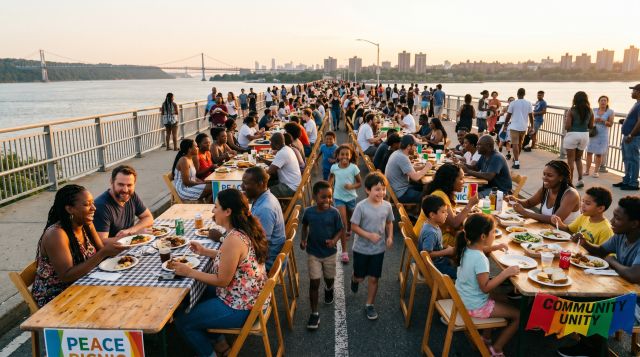
So, she stood on the bridge the same bridge where the love story began and set up long tables covered in tablecloths, food from both neighborhoods, folding chairs, lanterns, and a big handwritten sign:
“BRIDGE PICNIC — NO SIDES. JUST PEOPLE.”
She invited everyone.
She begged them to come.
And they did.
About the Creator
Vicki Lawana Trusselli
I am 76 year old California mythic storyteller blending lived truth, technology, and sovereign survival into multimedia art.
Enjoyed the story? Support the Creator.
Subscribe for free to receive all their stories in your feed. You could also become a paid subscriber, letting them know you appreciate their work.
Comments
There are no comments for this story
Be the first to respond and start the conversation.