
Close Call
Sam takes her last call at the Distress Center, only to discover it's someone who knows her darkest secret

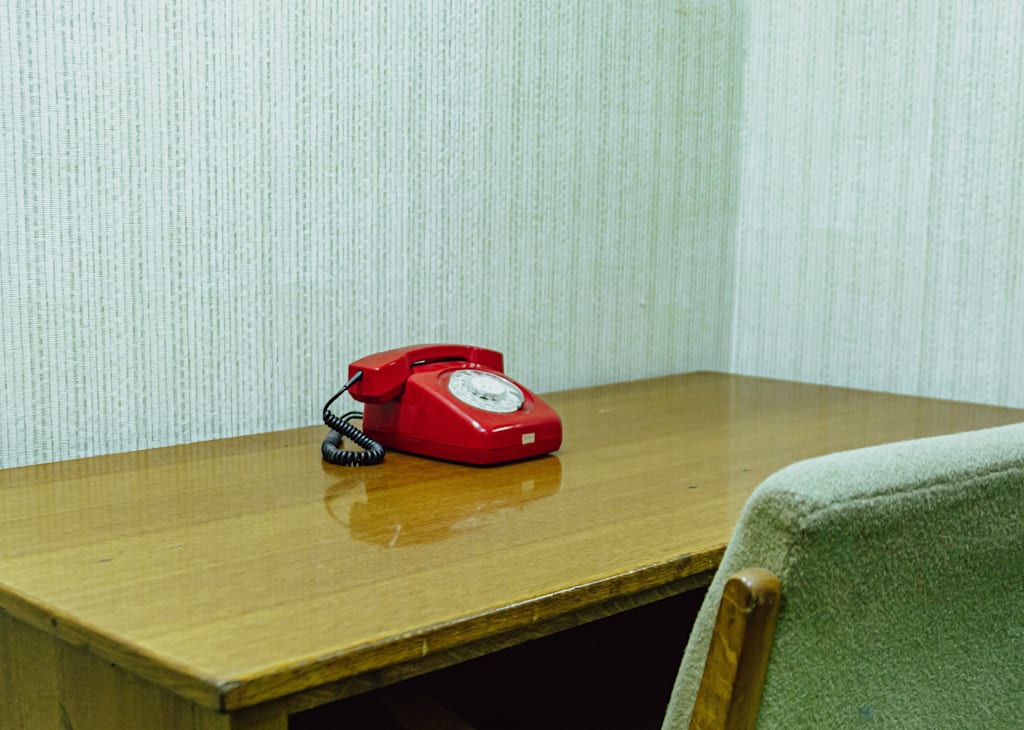
“Last call,” Mimi commands. She grabs my arm that's halfway into my coat sleeve and tries to force me back into my seat. She points to the blinking red light on the phone’s console.
“But my shift is over,” I protest. “I’m finally done!”
Mimi smirks, tapping her wristwatch with her finger. Her fingernails are long, painted black to match her all-black ensemble and, I believe, her cold black heart. “According to my Timex, you have 29 seconds left.”
It will do no good to argue. The last thing I need is for Mimi to write me up on my last day of community service. She’s never believed I’m innocent of the crime I was convicted of, and I wouldn’t put it past her to try to get my sentence prolonged.
Still, my own heart stays light. This is it. My very last call. Ending a year of prison, followed by 200 hours of community service.
In 15 or 20 minutes, this call will be over. I’ll finally get my life back—and that bitch Mimi won’t be in it.
So I sit down, not even bothering to take off my coat. I pick up the receiver and press the flashing red call button. “Good evening, Mission Lakes Distress Center. How can I help you tonight?”
“Oh, thank the fucking hand of fate!” says a deep male voice. “You have no idea how many distress hotlines I’ve called, Sam, hoping you would pick up.”
I feel a bead of icy sweat form between my shoulder blades, and slowly trickle down my back.
This is not how these calls are supposed to work. Our names and personal information are not shared with clients.
I glance at Mimi, who is leaning against a desk several yards away. Asking the caller, “Who is this?” is against the rules. I have to play by the scripts the distress center provides to us.
“Do you think you might have made a wrong assumption?” I ask, using one of our approved prompts.
“Are you kidding? I’d recognize your voice anywhere!” the man scoffs. “I heard you on the news, pleading your innocence. I recorded it and listened to it over and over. I followed your case. Read about your sentencing in the news. I knew with community service, there would only be so many places you could be. I knew if I just kept calling, I’d find you. And now, you're going to pay up.”
How close.
How close I had come to ending all of this shit. If this call had come even two minutes later, even one minute later, I would have been out the door.
But now I might be heading to an even more frightening prison than the one that kept me trapped behind bars and locks.
Unless I can figure a way out. Outsmart whoever has tracked me down. And first, I’ll need to figure out exactly who “they” are.
“Tell me a little more about yourself,” I say, using another one of our approved prompts.
“Tell you a little…? What the fuck, Sammy?” His voice drops to a hiss. “I know you have the money.”
I breathe in through my mouth and out through my nose. Slowly. I pretend, for Mimi’s sake, that I’m listening intently to my caller.
“Sam? Are you still there?” It’s more of a demand than a question.
“It sounds like you’ve been bothered by this for a long time,” I respond.
“Damn right! I’m not going to let you get away with it.”
I glance up. I see my replacement for the next shift has arrived, making a pot of black coffee in the kitchenette.
“We’ve talked quite a lot. What are you going to do when we hang up?”
“We’re going to meet, and you’re going to tell me where the money is,” he says. Again, not a question.
“It’s after midnight.”
“Like that matters. We’re meeting at your place. Give me the address.”
“No,” I reply in a soothing voice. “Tell me what you can see, hear and touch around you.”
He hesitates. “Oh, I get it. You gotta pretend I’m a distressed caller. Can’t give out your address. Okay, I’m…outside the Brass Knuckles Bar at 25th and 53rd. Meet me inside. And don’t try to ghost me; you’ll regret it.” He hangs up.
I rise from my chair, a little unsteady, but Mimi doesn’t notice.
“Aw, we’ll miss you, sweetheart,” she says, the sarcasm almost dripping down her chin. “Try not to be the getaway driver, so we don’t see your ugly mug here again.”
I refuse to take the bait. “I was innocent, Mimi. But thank you for all of your help.”
A cold winter blast of wind hits me as I leave the distress center for the last time, Mimi’s scornful laughter echoing into the night. It’s snowing, and according to Google Maps, it will take 27 minutes to walk to the Brass Knuckles.
Hopefully, enough to figure out what this stranger wants and come up with a plan.

Working at the Distress Center hasn’t been all bad. It’s taught me how to think fast, to know there's always someone worse off than me (except maybe for tonight), and most importantly, to understand the human psyche.
I know what makes people tick. And if I'm honest, how to manipulate them.
This new-found wisdom has made me stronger. I’m not the scared young woman I was two years ago. The one who couldn’t pay her rent or her water bill, who had to take on a side hustle as a driver.
Not with a respectable firm like Uber or Lyft or a local taxi company. No, this was with a guy my second cousin knew who knew a guy who knew a guy who knew a guy.
His name was Manny, or at least that's what he told me. I never met him face-to-face. He had a list of people who needed rides with no questions asked and no electronic record of where they’d been. When someone needed a car, he texted one of his underground drivers and we'd do the pick-up. When they paid me—cash only—I’d put Manny's cut aside to be left in a brown paper bag hidden at a different location each week.
It paid well, and it was under the table so I didn't have to pay income tax.
My customers were the usual suspects. People having extramarital affairs. Thugs who'd been permanently banned from legal ride services. High-functioning addicts checking into rehab.
And once, a man dressed in a full-size panda costume, who shed fake fur all over my back seat.
Most passengers never wanted to talk. The fewer details they gave away, the better. But some told me their troubles. Sharing my car, even for a little while, later helped me to put a face to the people I talked to at the distress center.
I learned to recognize who was dangerous and who wasn't, although Manny would have meted out punishment to anyone who messed with his drivers.
But on the night that changed my life, when I let two strange men into my car—I never saw danger coming.
………
“Last call!” The bartender hollers as I walk into the Brass Knuckles. He nods to me as I shrug out of my snowy winter clothes and hang them on a hook.
“What’ll it be, my lady?”
“Same as me,” says a deep male voice. "Large draft, on tap. Put it on my tab.”
I look at the man, surprised to see he's using a wheelchair. But I know from experience that doesn't mean he's any less dangerous.
“Took you long enough,” he says. He cocks a thumb over his shoulder. “There’s a booth back here.”
I pick up my beer and follow him as he makes his way into the bar’s darkest corner. He pulls himself up with strong arms onto the booth's bench, his back against the wall, and I sit opposite him.
I take him in carefully. A chiseled jaw. A neatly trimmed graying beard, belying his jet black hair. Green eyes, the color of the ocean on a stormy day. I might have found him attractive if he wasn’t so damn terrifying.
I have no idea who he is. But that’s no different than the people I’ve been dealing with.
And I know the secret to controlling sketchy situations is to build trust.
All the worlds I'd inhabited depended on trust. Trust that Manny wouldn't let me get hurt. Manny's trust in me to give him his fair share of the cash. The distressed callers trusting that I would make them feel better. My trust in the callers that they would believe in what I told them, and that I would keep their secrets.
Trust is my superpower. I’ve learned its tricks through every backseat ride, through every distress center phone call.
“What’s your name?” I ask him.
He rolls his eyes and laughs. “Don’t play me for a fool, Sam. No names.”
“All right,” I agree, even though he knows mine. “What would you like to talk about?”
He reaches across the table like a striking snake, grabs my wrist and squeezes hard.
“The money, Sam. Where’s the money?”
I don't flinch at the pain. “No touching,” I tell him. “Let’s keep this professional.”
He glares at me for a moment, but releases my arm.
My first small win. Setting a boundary so he knows I won't be intimidated.
I continue, “You said you followed my trial. If that’s the case, you know I don’t have the money.”
He reaches to grab me again, then thinks better of it.
Instead, he smirks. “You know, I’m the one who turned you in. The one who sent you to prison.”
I feel fury, threatening to boil over. But I remember my training. “Oh, the witness who called in my license plate? As I was speeding away? Well, you were simply being a good citizen. You're a hero, really. In your shoes, I would have done the same.”
His eyebrows knit together, puzzled. He takes a gulp of beer. Clearly this was not the answer he was expecting.
Another win. It's all textbook. Don't get angry. Give them a compliment. Use phrases like in your shoes to plant the suggestion that you're very much alike.
I ask if it's okay for me to flag the waitress down, order some chicken wings and nachos, another draft beer. He nods, and it's another win. Breaking bread together always builds bridges. That's why business executives do it so much.
I remember him now.

On the night of “the incident,” I got a text from Manny to pick up two men in the parking lot of Courtney Park. When I got there, they stepped out of the shadows, wearing long dark coats and hats pulled down low. One was carrying a large suitcase. They could have passed for businessmen leaving a late night meeting, but who discusses marketing plans in a city park? They curtly told me their destination, a low-rise on the other side of town.
The twenty-minute drive was silent. When we arrived, one man handed me my cash, had the courtesy to thank me, and then both opened their doors to step out.
I’d never heard a gunshot before. I thought the deep boom was a firework, someone celebrating New Year’s early. But then the man to my left jolted, flying backwards as blood streamed down his face.
The second man was only halfway out. He tried to scramble back in, but my panicked brain screamed this was way above my pay grade. I stomped on the gas and sped out of the parking lot. The man fell to the ground. More shots rang out.
Just as I veered into the street, I saw him. Standing there in shock. Taking a picture of my rear plate.
I drove for miles in the country, swerving back and forth in an attempt to get my back passenger door to close. But it flapped in and out like a broken bird’s wing. Finally, I pulled over at an abandoned rest stop to close it manually.
And when I reached the rear door, I discovered why it wasn’t closing.
The suitcase.
It was wedged against the drivetrain hump, its wheels hanging out the door. Every time I had swerved, the door had hit it, hammering it back inside.
It had a padlock on it, but for heaven’s sake, it was a suitcase. I had a crowbar in the trunk, and it didn’t take me long to open it.
Cash. Lots and lots of neat stacks of American hundred-dollar bills. I quickly counted the bills in one stack, one hundred of them, and then multiplied that by the number of stacks in the case.
Five hundred stacks.
Five million dollars.
I thought about all the trouble I'd had, working night and day just to make rent, without any hope in sight.
But I had to do the right thing if I was to survive.
..............
Our appetizers arrive, and the man ever so slightly pushes the plate of nachos towards me—another sign trust is building.
I take a bite and sigh. "Oh, this is so good. Thank you. They don't let us eat at the distress center."
Thank them. Make them feel generous. Drum up a little sympathy.
"If you watched my trial, you know the police came to my apartment right after I got home, thanks to your call. They found no suitcase in the car. Or in my apartment," I confirm. "They followed me for months and found no money was ever wired or shipped to another location. They eventually admitted the suitcase must have fallen out on the road as I was swerving. Anyone could have picked it up. But they wanted to punish me for something, so they nailed me as the supposed getaway driver. But I was truly innocent of that.”
I reach across the table and put my hand on his arm. A little human touch does wonders to foster trust.
He glances down at my hand, but doesn’t attempt to remove it.
“You know, I took a bullet in the spine during that shootout. I was just an innocent bystander, too. Doing the right thing. But look at the price I’m paying. Months in the hospital. Bills I can never pay off. I’ll never walk again.”
He looks at me. "You're not the only one who suffered for a crime they weren't involved in."
I feel true sympathy for him, really I do, but if I'm going to get my life restarted, I have to make him believe me.
“So you and I, we’re both victims here,” I say with all the empathy. “We’ve both suffered because of other people’s crimes. We’re not enemies.”
I stroke his arm, feeling the skin grow warmer. He looks at me, his eyes soft. "I really thought you had the money. I thought we could split it."
“I wish I really did have the money, so I could share it with you. That’s what we both want—a sense of justice that we will never get.”
“Rico,” he suddenly says. “My name is Rico.”
And that's when I know I'm truly free.
................
“Last call! Last call for all passengers boarding Flight 824 to Lisbon!” crackles the announcement over the loudspeaker.
I grin. Lisbon! Maria Martinez knew exactly the right place for me to restart my life. And when I get there, my windfall will be waiting for me, already converted into euros.
You see, sometimes even criminals have a crisis of conscience. In Maria’s case, she called the distress center because she didn’t know if she was doing the right thing.
Her husband ran a secret money brokerage with a twist. He’d built up a global network of other underground brokers, but instead of wiring cash electronically or carrying it physically to another location, he would call the broker in another city and say, “So-and-so has given me five million dollars American. When she gets there, give her the equivalent in euros. Minus your 20% commission, of course.”
So the funds were transferred without ever leaving the country. Later, when the heat calmed down, the money would exchange hands in the traditional way. Often, the client didn't even know which country they'd be travelling to to pick up their cash. When the time came, an online order for running shoes will simply show up, with an airline ticket and a passport with a new identity inside.
It was all built on trust.
But when Maria called my distress line, her husband had developed dementia and could no longer run the business. Should she take it over?
I liked Maria. A lot. We developed a friendship. I eventually broke the rules and gave her my personal contact information. When I finally trusted Maria enough to tell her I'd hidden $5 million at the bottom of an outhouse pit at an abandoned rest stop, she was happy to do the dirty work—and the rest is history.
Oh, I know what you're thinking. I said I was innocent, but that was about being the getaway driver. I never said I wasn’t guilty of any crime.
“Last call!” the flight attendant announces again. I roll my suitcase toward first class, and the first step of my new life. But as I sit on the tarmac, I make one last call. Tomorrow, Rico will discover all of his medical bills have been paid by an anonymous donor, and that a lawyer has a cool $2 million in trust for him.
About the Creator
JL Daly
Stories connect us. Ideas change us. I’m here for the ones brave enough to believe in both.
Enjoyed the story? Support the Creator.
Subscribe for free to receive all their stories in your feed. You could also become a paid subscriber, letting them know you appreciate their work.
Comments
There are no comments for this story
Be the first to respond and start the conversation.