
Christmas Came Too Early
Six Kids, Summer Heat, and a Neighborhood That Discovered the Magic of Christmas in July

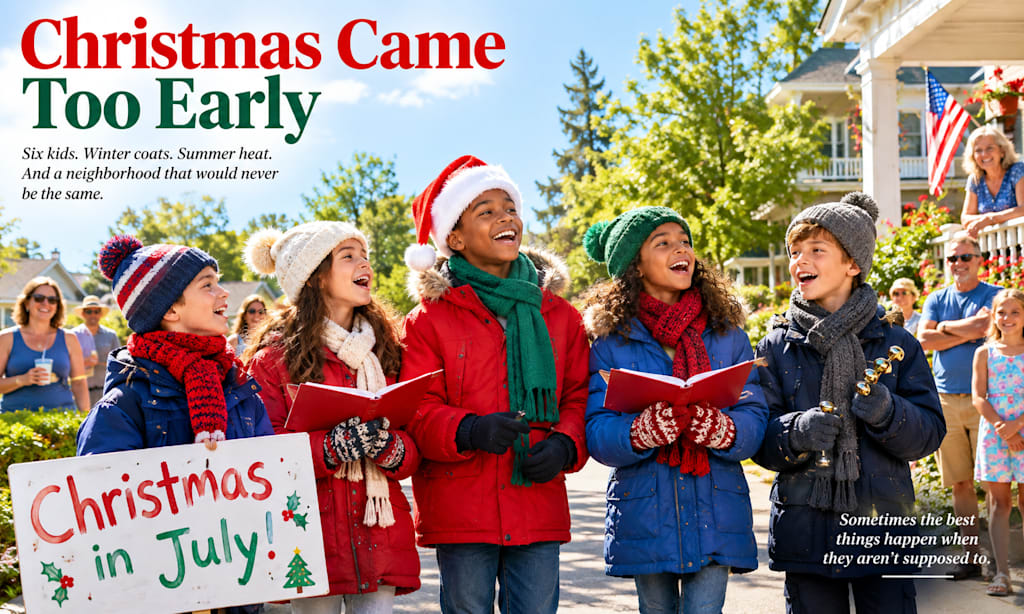
The first sign that something was wrong was the sound of Christmas music drifting in from the street in July. It was not the soft, distant murmur of a radio in someone's living room. It was unmistakable.
Six young voices were singing "Jingle Bells" at the top of their lungs, accompanied by the occasional jingle of a pair of sleigh bells. The only problem was that it was ninety-three degrees outside, the sidewalks were shimmering in the afternoon heat, and nobody in the neighborhood had seen a snowflake in months.
Mrs. Rodriguez was watering the flowers in front of her house when she heard them. She stopped, turned off the hose, and stared down the block. There they were. Six neighborhood kids, marching toward her in winter coats.
One wore a red Santa hat. Another wore a green scarf wrapped three times around his neck. One of the younger boys wore mittens even though sweat ran down his face. They looked less like Christmas carolers and more like six children who had lost a bet.
"What in the world are you doing?" Mrs. Rodriguez shouted.
"Christmas in July!" Marcus yelled back. "Take those coats off before you pass out!"
The children laughed and kept singing.
Nobody knew exactly how the idea had started. Marcus later claimed he suggested it after hearing someone mention Christmas in July. Tasha insisted it had been her idea. Jasmine said they were both lying. The truth was probably somewhere in the middle.
The neighborhood had plenty of problems that summer. It had a reputation for crime, and people had grown accustomed to looking out their windows before walking down the street at night. Parents warned their children about certain corners. Porch conversations had become less common.
The children, however, cared less about crime statistics than about making people laugh. They had decided that Christmas in July needed to be taken seriously.
They found old winter coats, scarves, hats, and mittens. They practiced Christmas carols in the basement of Marcus's apartment building. Then they chose a Saturday afternoon and went outside.
Their first audience was accidental. Their second wasn't.
Mrs. Rodriguez was still standing beside her flower garden when Mr. Alvarez opened his upstairs window and shouted, "Can you come sing that at my sister's house?"
The children stopped. "Why?"
"She's having a terrible week. I want to make her laugh."
"How much?" The children looked at one another. Nobody had thought about money.
"Five dollars?" Marcus finally said.
Mr. Alvarez laughed and said, “Done!”
That was the moment Christmas in July became a business.
The children began accepting small requests. For five dollars, they would show up at a person's house in winter clothes and sing three Christmas songs. For ten dollars, they would add sleigh bells. For fifteen dollars, they would sing beneath an upstairs window. Their most popular service was the surprise package, in which someone hired the children to appear unexpectedly at a friend's front door.
It was harmless mischief, and people loved it.
A woman commissioned them to surprise her husband; a teenager enlisted them to embarrass his older brother; a grandmother employed them to serenade her grandchildren; and a man paid them to sing under his mother's second-floor bedroom window at 7 a.m.
The children didn't mind. They were having fun. And they were making money.
At first, they considered it a summer hobby. But then the requests started coming faster than they could handle. One Saturday, they had four performances.
The following Saturday, they had nine. By the end of the month, they had more requests than there were children in the original group.
That created a problem. They couldn't be in two places at once.
It also created an opportunity.
Instead of turning people away, the children recruited more kids from the neighborhood.
They divided into groups. One group handled the houses on the north side of the neighborhood. Another group handled the apartment buildings. A third group specialized in performances for younger children. They even created a group for senior citizens who preferred traditional Christmas songs.
What had begun as six overheated children in winter coats had become a small-scale entertainment operation. The children also discovered something that their parents found to be a productive use of their time, rather than engaging in mischievous behavior like the other kids in the neighborhood.
The more efficiently they scheduled the performances, the more money they could make.
If six children were already dressed in winter clothes and walking down one block to perform for one family, it made little sense to stop after one house. They could perform for five families on the same block. The cost of each additional performance was relatively low.
Soon, the children were selling what they called "Christmas Blocks."
A family could hire the group for a single performance, but if several neighbors signed up together, everyone received a lower price. The children made more money. The neighbors paid less.
And the streets became filled with Christmas music.
Nobody had planned for that. The neighborhood began changing.
Every Saturday afternoon, people would sit on their porches, waiting for the carolers. Little children would come outside to watch. Grandparents would bring folding chairs. Someone would start selling lemonade. Another neighbor would bring cookies.
People who had barely spoken to each other began talking. "Are you expecting the carolers?"
"Yes, they're coming at three."
"Can my granddaughter sing with them?"
"Of course."
"Did you hear they're doing a Christmas concert next week?"
The strangest thing was that the children had become a reason for adults to come outside.
Before Christmas in July, many people stayed indoors because they didn't feel comfortable sitting outside for long periods. Now there was always something happening.
And when people were outside, they noticed things. They noticed who lived on the block.
They noticed unfamiliar cars.
They noticed when a neighbor's elderly mother hadn't come outside for several days.
They noticed when children were playing somewhere they shouldn't. The neighborhood became more connected simply because people had a reason to be present.
The children noticed it too. One afternoon, Marcus was counting money after a performance when he looked down the street.
"I think we're actually doing something," he said. Tasha laughed.
"We're singing Christmas songs in ninety-degree weather."
"No. I mean something bigger." He pointed toward the sidewalk.
Nearly forty people stood outside. Six months earlier, most of them would never have gathered together on a Saturday afternoon.
Now they were laughing, talking, and waiting for the next performance.
The children began experimenting with other themes.
They offered Halloween in August. Valentine's Day in September, and Thanksgiving in June.
They created birthday serenades, retirement performances, and "just because" surprises.
But Christmas in July remained their most popular attraction.
The business grew so quickly that the children began thinking less like pranksters and more like entrepreneurs.
They realized their biggest advantage wasn't the singing. It was organization.
They could coordinate groups of performers, costumes, routes, and schedules. They could send one group to an apartment building while another performed at houses. They could create specialized packages for different age groups.
The children had discovered economies of scale without knowing it.
The adults knew better. One of the neighborhood fathers, who happened to teach economics in the local High School, explained it to them.
"When you increase the number of performances while spreading your fixed costs over more customers, your average cost can fall."
Marcus stared at him.
"So, we should perform more?"
The father smiled. "That's the basic idea."
"Finally," Marcus said, "an economics lesson I understand."
What had started as a five-dollar joke was now earning some of the children almost as much as their regular summer jobs.
But something else had become serious too.
The neighborhood itself was changing. People began organizing events around the carolers.
A local senior center hired them. A community association booked an entire evening.
Families started holding block parties after performances. The children donated some of their earnings to neighborhood events.
Slowly, almost imperceptibly, the neighborhood developed a new rhythm.
Nobody claimed that Christmas caroling had solved crime. There were still problems. There were still difficult nights. Police cars still drove through the streets.
But the neighborhood no longer felt anonymous.
When people know one another, they tend to notice more.
When people spend time together, they tend to communicate more.
When children have activities that connect them to adults, more people look out for them.
The carolers had not set out to become a crime-prevention program.
They had wanted to make people laugh. Over the next several summers, Christmas in July became an annual tradition.
The original six children had grown older. Some had jobs. Some had graduated from high school. Some had gone away to college. But whenever July arrived, they came back.
And they brought the coats. On the first Saturday of July, the neighborhood waited.
The temperature was ninety-five degrees.
The sun was blazing. There was not a cloud in the sky.
Then, at exactly two o'clock, a familiar sound came from the end of the block.
Jingle bells. People began opening their doors. Children ran outside. Neighbors gathered on porches.
Someone shouted, "Here they come!"
And down the street came the Christmas carolers, wearing heavy coats and Santa hats as though the weather forecast had somehow been replaced by December.
Marcus, now the unofficial manager of the operation, raised his hand.
The singing stopped. He looked around at the people who had gathered.
Years earlier, six kids had walked down the same street expecting nothing more than a few laughs.
Now hundreds of people were waiting for them.
Marcus smiled.
"Ready?" The crowd cheered. The children began singing.
"Jingle bells, jingle bells..."
And as their voices filled the street, something occurred to Mrs. Rodriguez, who had been there from the very beginning.
Christmas had arrived at exactly the wrong time of year.
And somehow, that was exactly what the neighborhood needed.
Sometimes the best things happen when they aren't supposed to. Sometimes the wrong season creates the right moment.
And sometimes, all it takes to bring a neighborhood together is a group of kids foolish enough to wear winter coats in July.
About the Creator
Anthony Chan
Chan Economics LLC, Public Speaker
Chief Global Economist & Public Speaker JPM Chase ('94-'19).
Senior Economist Barclays ('91-'94)
Economist, NY Federal Reserve ('89-'91)
Econ. Prof. (Univ. of Dayton, '86-'89)
Ph.D. Economics
Enjoyed the story? Support the Creator.
Subscribe for free to receive all their stories in your feed. You could also become a paid subscriber, letting them know you appreciate their work.
Comments
There are no comments for this story
Be the first to respond and start the conversation.