
Cathedral of Asphalt
A monument built to a woman. That monument became my own.

When she left, the apartment got louder.
Not with sound. With absence.
The kind that sits in the corners and waits for you to notice it. The kind that turns a coffee cup into evidence and a jacket on a chair into a ghost. For a month I worked and came home and let the evenings happen to me. I took long showers, standing under the hot water until the mirror fogged and the room blurred and I could almost pretend I had no face, no history, no ache following me from room to room.
Sometimes I drank an entire bottle of vodka over the course of a day. Not all at once. That would’ve been dramatic. It was quieter than that. A slow sinking. A man dissolving himself in installments.
One afternoon I sat on the shower floor with my knees pulled up, water beating the back of my neck, and something in me finally got tired of watching myself die by inches.
I remember saying it out loud, like I needed a witness.
“I’ve had enough.”
Not of her.
Not even of heartbreak.
Of paralysis.
Of the apartment.
Of waiting for a version of life that wasn’t coming back.
I sold my car.
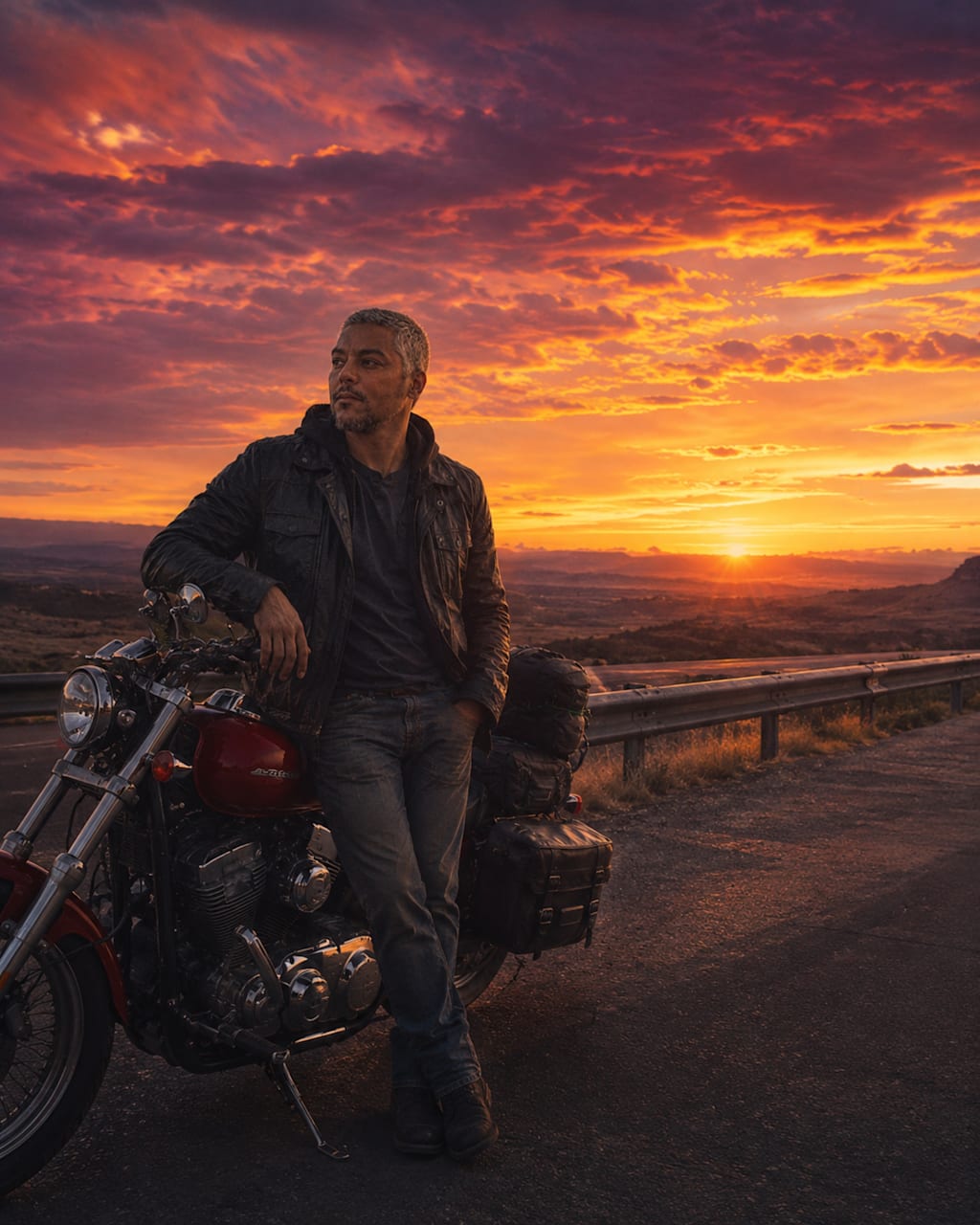
Then I climbed onto Suzanne.
She was a red Honda Shadow 750, low and steady, with enough chrome to catch the morning and enough engine to make distance feel possible. I had named her myself, because at that point I needed something in my life that would answer when I turned the key.
I loved the smell of gasoline.
Not in some pretty, poetic way. I loved it because it meant motion. It meant combustion. It meant the day had started and the machine was alive beneath me.
I packed two backpacks. Threw a leg over the bike and left.
No grand plan. No noble speech. Just a machine, a road, and the old animal instinct to move before grief rooted itself too deep.
I headed west first, then north. Somewhere along the way I got lucky, the kind of luck that doesn’t feel lucky until much later. A yacht contract opened up in Seattle. It wasn’t the reason I left, but it became a destination, a thread to follow through the wilderness of my own life.
Seattle.
Work.
Money.
A horizon with a name.
So I rode toward it.
The first days felt less like freedom than withdrawal. My body still wanted the routines of misery. My mind kept reaching backward, touching the wound to see if it still hurt.
It did.
Every mile proved it.
Some days I rode four hundred miles.
Some days six.
After a while, the road stopped being scenery and became discipline.
Keep the bike upright.
Keep the throttle steady.
Watch the wind.
Watch the trucks.
Watch your thoughts without letting them take the handlebars.
There was a kind of Zen in it.
Balancing Suzanne for hours meant balancing myself. Every mile demanded just enough attention to keep grief from swallowing the whole room. Too much thinking and I drifted. Too little and I became careless. So I learned to live in that narrow strip of consciousness between control and surrender.
The motorcycle carried my body west.
The road carried the rest.
Texas gave me space big enough to put pain in perspective. I watched sunsets that looked like the sky had been cut open and left to bleed itself dry over the plains. Dawn came in pale gold, then fire, and for a few minutes every morning the world looked newly made. I slept where I could, ate when I remembered, and let the road sand the edges off my thoughts.
At Big Bend, the land looked ancient and unsentimental. Stone, distance, silence. It did not care that my heart was broken, and there was something merciful in that. I stood there under that enormous sky and understood how small I was, which is another way of saying I felt relief.
New Mexico gave me Taos, sharp air and mountain light, the strange clean feeling of altitude. Then Shiprock, rising out of the land like the fossil of some buried god. I stopped the bike and stared at it longer than I meant to. Some places do that. They interrupt whatever you think your life is about and remind you the earth has been holding its own stories a lot longer than you’ve been holding yours.
Near Roswell I watched thunderstorms build over the desert.
There is nothing quite like a storm in empty country. The land lies flat and exposed beneath it, and the clouds tower like empires. Lightning stitched the horizon in white veins. Rain fell in curtains miles away, never touching me. I sat on the bike and watched the weather make a religion of itself.
By the time I reached Zion, I was no longer riding away from her.
I was riding into something I didn’t have words for yet.
I hiked Angel’s Landing with my legs burning and my thoughts stripped down to breath, rock, sky, breath, rock, sky. The trail was narrow and merciless in parts, all drop and nerve and chainlink courage. At the top I looked out over that impossible red country and felt something I hadn’t felt in months.
Gratitude.
Not joy. Not yet.
But gratitude.
For the body carrying me.
For the road behind me.
For the fact that grief had not finished the job.
The days blurred into a pattern of gas stations, roadside coffee, motel beds, cheap meals, and sudden beauty. A hawk circling over broken land. A diner waitress calling me honey without meaning anything by it. The way a motorcycle makes you honest because there is no insulating yourself from weather. Cold is cold. Heat is heat. Wind is wind. There is no pretending.
Idaho nearly broke me.
I rode all night through the cold. Real cold. The kind that gets inside your gloves and under your jacket and starts making decisions for you. My hands stiffened. My jaw ached. I was shaking so hard by the time I crossed into town I felt less like a man than a collection of parts still obeying momentum.
There was a girl I’d been talking to on a dating app. Nothing serious. Just messages, a little flirtation, the kind of thin connection people make when they are lonely and geographically inconvenient to one another.
I told her where I was.
She told me to come over.
When she opened the door, I must have looked half-dead. I was shivering so hard I couldn’t hide it. She didn’t ask for a performance. Didn’t ask me to be charming. She just pulled me inside.
That night she held me and kept me warm.
There are moments in a man’s life that don’t belong to romance so much as mercy. That was one of them. No promises. No mythology. Just human warmth offered at the right hour.
I’ve never forgotten it.
I kept going.
Oregon gave me one of the most beautiful sunsets I’ve ever seen, and it happened in the most ordinary place imaginable, just off the highway, nothing sacred about it, no famous overlook, no postcard promise. I pulled over because something in the light told me to. The whole sky opened in layers of gold and violet and ember-red, and for a few minutes the world looked like it was remembering how to forgive itself.
That’s the thing about the road. It doesn’t always give revelation to you where you expect it. Sometimes the holy places are famous. Angel’s Landing. Big Bend. Shiprock. And sometimes holiness is just a shoulder off the highway in Oregon where the sky catches fire and a tired man on a motorcycle suddenly feels less alone.
When I finally rode into Seattle, there was a Subaru on fire on the bridge.
That feels important to say exactly as it happened, because life has a sick sense of timing and style. After all that distance, all that desert, all that cold, all those miles of trying to become someone other than a wounded man circling his own ruin, I entered the city with smoke rising off the roadway and a car burning like a sacrificial offering to the gods of bad arrivals.
I remember thinking:
Of course.
Of course this is how the city greets me.
But I laughed.
Actually laughed.
That was new too.
By then I had already spoken to the captain. I won’t use his name. He deserves his privacy.
He was tall, imposing, soft-spoken, and kind. The kind of man who did not need to raise his voice to make the world arrange itself around him. When I arrived, he welcomed me without ceremony, without interrogation, without asking me to explain every mile that had brought me there.
He took me to Gig Harbor, where the yacht was docked.
Her name was Marlinda.
Gig Harbor felt almost unreal after the road.
All that movement, then still water.
All that isolation, then work.
All that grief, then a boat with a name, a captain with quiet authority, and the strange mercy of being expected to simply begin.
And that was the truth of it.
I was there.
I had crossed the country with two backpacks, a red Honda Shadow named Suzanne, and a heart still shedding old skin. I had watched the sun rise over Texas and storms gather in Roswell. I had climbed Angel’s Landing and stood beneath Shiprock. I had frozen in Idaho and been warmed by a stranger. I had found a sunset in Oregon holy enough to make me pull over and pray without words. I had ridden into Seattle under a sky full of smoke and steel and bad omens and been met, somehow, by work.
By harbor.
By a next chapter.
I did not get her back.
That wasn’t what the road was for, though I might have believed otherwise when I first left. At the beginning, maybe I thought the trip was a monument, proof of growth, a cathedral I was building out of miles so that one day she might turn and see it and understand that I had changed.
But somewhere between Texas and Washington, between vodka and Zion, between desert thunder and Oregon fire, the cathedral stopped being hers.
It became mine.
Not a monument to lost love.
A monument to survival.
To motion.
To the stubborn fact that a man can be shattered and still keep riding north.
About the Creator
Alejandro Arango
A theater major, a poet, and a lover of the written word. I write to the muses that they may inspire me, and to you the reader. Hopefully you can find meaning in my words or something that will lighten your heart on this journey of life
Enjoyed the story? Support the Creator.
Subscribe for free to receive all their stories in your feed.
Comments
There are no comments for this story
Be the first to respond and start the conversation.