
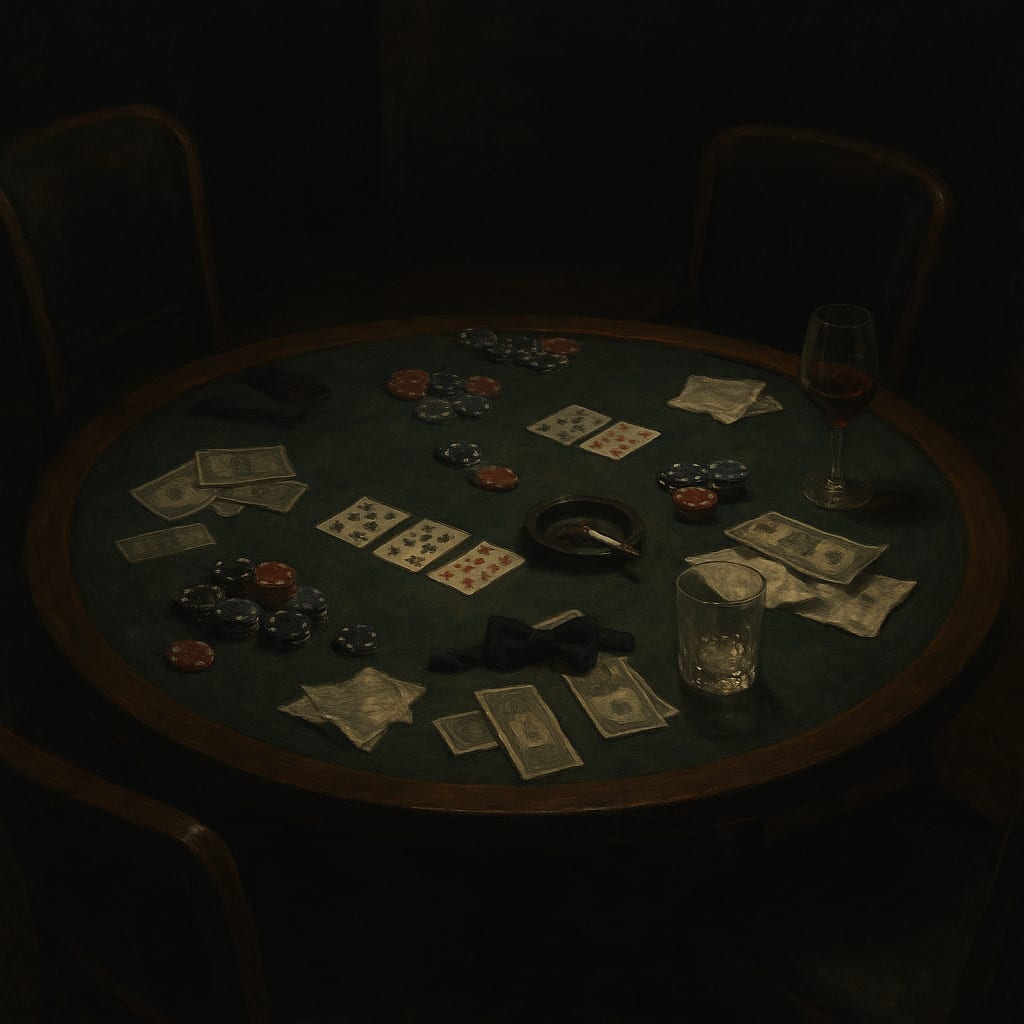
There was a certain casino where people played cards and roulette.
What made it special, you ask? One room. Only one. And not just anyone could enter it.
Sounds like a cliché, doesn’t it? Maybe that’s all this story really aims to be. So if you’re someone who gets disappointed by banality, this might be the sentence you stop reading on.
But for those who choose to stay, let me explain what kind of room this was.
Yes, it had a roulette table. And a poker table too. It had sharply dressed gentlemen and stunning women in cocktail dresses that hinted—without subtlety—at all the raw sexuality their wearers possessed.
But the stakes here were not money. Money had long since bored these people. The thrill, the fear, the trembling palms, the exhale of relief—none of that could be bought anymore with cash. None of them would dare to bet their entire fortune. And even if they did, they all knew exactly how to earn it back.
No—here, it was like the old days. Back when a night at the casino meant something. When the rush of the game left you aching to screw your date in the back of a limousine. When a sip of whiskey didn't dull your senses but shook off the nerves.
Here, the stakes were confessions.
All of this—this room, this game, this story—wouldn’t have existed if not for one man: the only croupier in the world capable of organizing such a game.
Leonid Glussier (or Gluzye, depending on whom you asked) was rumored to be Bulgarian, or maybe Albanian. Some swore he was French. Many believed he was some kind of mystic—or even an empath. There were plenty of theories. The truth, though, no one knew.
And that alone made him the most fascinating secret in high society. The most whispered-about. The most feared.
You see, the people who played in this room were not ordinary. They had dealt with high-ranking intelligence officials, elite con artists, even so-called clairvoyants. These were individuals who built empires, who shaped politics, who literally influenced the lives of thousands. They were used to reading people the way one reads a book.
But no one—no one—could read Leonid Glussier.
He looked about fifty but was in excellent shape. Toned, athletic, not an ounce of excess. Completely bald, he never let even a shadow of stubble grow. His features were calm, symmetrical. A round Eastern European nose, a clean mouth, a long face—and deep-set, ice-blue eyes.
Those eyes were something else. At first, his gaze seemed kind—genuinely kind. Warm, disarming. But after a while, it became… unsettling. It felt like he wasn’t just looking at you. He was looking through you.
He gave you that feeling—something long forgotten—like being five years old again and trying to lie to your father about something that, back then, felt world-shattering.
Only this time, the men in the room actually were dealing with things that could shake the world.
By now, you probably have a sense of how games unfolded in this particular casino—and the role Glussier played in them.
As in any casino, every game ended in one of two ways: The agony of loss, or the euphoria of victory. But here, both outcomes were far more intense.
One particular story, the one I’m about to tell you now, took place under the following circumstances.
It was around four in the morning. Most of the guests had already left. Spectators were never allowed. Only players—and Glussier.
At the table sat three men: An American media tycoon, the prime minister of Egypt, and a retired general who had flown in from Bulgaria.
The American was the youngest of the three. Still alert, though his fingers kept tugging at the black bowtie around his neck. The Egyptian sat with restraint, folding often, staying quiet. The general? He was sweating. Hard. He was on his third glass of whiskey, sleeves rolled up, several buttons undone.
They played one final hand.
The Bulgarian tossed down his two cards, finished his drink, and leaned back in his chair.
This was the American’s first game. His eyes lit up, full of expectation. He only vaguely understood what was about to happen—and only half-believed the rumors his slightly less successful friends had shared with him.
“Game,” Glussier announced with a soft Slavic lisp. He turned to the general. “You’ve lost, Mr. Volkov.”
The general nodded. He exhaled heavily. Despite the sweat and the flushed face, there was a steeliness to him. The kind only years of military service could produce.
His voice rasped, but it was steady: “Ask your question, Leonid.”
Glussier setthe unused deck aside and, for the first time that night, fixed the general with that look. To the American, it felt like being caught in a fire. The blue in Glussier’s eyes was now flame. Cold, burning, impossible to face. The shadows from his brow only made the glow more vivid. More terrifying.
“Two thousand and one,” Leonid said softly. “September. Tell us about it.”
Silence. A heavy, brutal silence.
The American’s eyes darted between the Egyptian and the general, back and forth. But he would not look at Glussier.
The general looked down at his hands, as if seeing them for the first time. Then he began to speak.
...
“It started much earlier,” the general said, his voice now rough, aged. “In ‘96. The intelligence services of two very well-known nations began playing their games on our soil. Maybe it was training. Maybe they really wanted to swap our government for something more convenient. Whatever it was, a large underground group formed around Sofia. They had one goal: revolution.
The world was in crisis then—by 2001 it had only worsened. That group thought the time had come. They began planning terror attacks, political sabotage, cultural rot. And they might’ve succeeded, if not for two things they hadn’t accounted for.
One: the team of counterintelligence officers we had in Sofia. An unusually sharp, patriotic, and educated group. Spycraft wasn’t exactly popular anymore—no prestige, no funding—but somehow, we all came together. And we got obsessed. We were like hunters chasing prey.
We found them before they could act. Caught wind of their plans, their movement, their money. And then, thing two happened: their foreign sponsors cut them off. Maybe it was the economy. Maybe they found a new playground. Either way, the funding stopped. And so did the plan.
That’s when we moved.
September, 2001. We arrested a hundred and fifty people. Leaders. Recruiters. Martial arts instructors, radio hosts. Students turned fanatics. The scariest part wasn’t their loyalty—it was how possessed they looked. Like they didn’t even see themselves as people anymore.
But that wasn’t the worst part.”
He paused.
“The worst part was the order that came after.”
He leaned back and took a deep, shaky breath.
“I arrived at headquarters at nine in the morning, expecting coffee and quiet. The operation was over. We were satisfied. Relaxed. We'd done our job.
My assistant told me I was urgently needed in the war room.”
“Code O,” he added, turning to Glussier.
“What does that mean?” Glussier asked, voice low, firm.
The American shifted uncomfortably in his seat. This wasn’t what he’d imagined when he signed up. This was a truth no one should know. No one should want to know.
“‘O’ means Special Secrecy,” the general said. “No statute of limitations. A document marked ‘O’ can only be declassified with the signature of the Prime Minister, the President, and the head of counterintelligence. And even then—after fifty years, minimum.”
He finished his watered-down whiskey in one gulp and asked for another.
Glussier pressed a button to call staff. Silence settled again.
The Egyptian lit a half-smoked cigar bearing a gold crest. It was his third game. He was a regular. His temples were soaked with sweat—but nothing else in his demeanor betrayed how deeply he was rattled.
The general took a sip of fresh whiskey, grimaced, and continued:
“The meeting was brief. Just three of us—Minister of Defense, head of counterintelligence, and myself. No windows in the room. Dim lights. I still remember how strange it was, stepping out after, into bright sunlight. Birds chirping. A warm September day. It felt… wrong.
Because that day, I was ordered to execute one hundred and fifty people.”
Silence again. A silence heavy enough to crush lungs.
Even Glussier looked down at the floor—though not for long.
“What happened next?” he asked.
The American flinched.
The general’s eyes lit with sudden fury. “You want to know what happened next, Leonid? Are you sure?”
He turned to the Egyptian. “Do you?” Then to the American. “And you?”
“Please continue, Mr. Volkov,” Glussier said softly. “You know the rules of the game.”
“Game…” the general whispered. Then he lowered his head.
When he looked back up, there were tears in his eyes.
From rage? From guilt?
Who could say?
But he kept speaking:
“A standard military truck fits sixteen people. That’s the norm. We transported the prisoners in just five trucks. By the time we arrived at the training grounds, a massive pit had already been dug.
The ones who dug it were gone. Not even the excavator operator remained. I wonder what they were told… what story they were fed.
We were five men. Each of us had thirty to kill. A black sack was pulled over each prisoner’s head. We walked them to the edge. Then we shot them—point blank—in the back of the skull.
I had two pistols. Seventeen rounds each. I didn’t want to waste a single second.
I was already losing my mind before the first shot. But the moment I pulled the trigger… I knew it was gone.
My hand trembled. But I hit my mark. The body collapsed into the pit.
It turned out—I was the first to fire.
The other four… executioners, they called us… They’d been waiting. Hoping I wouldn’t go through with it. Praying I’d stop and say, ‘No. Enough. We can’t do this. Better to defect. Better to betray. Anything but this.
I wish I had. I wish someone had.
But no one did.
We started shooting.
They brought them up, we shot them. They fell. The next group came.
It was like they vanished when they fell. And I wanted to believe that. That they were simply… disappearing.
I told myself—only thirty shots. Just thirty. Make it fast.
But it wasn’t fast.
It felt endless.
I shot, and shot, and shot.
And every time, I felt worse. I vomited, wiped my mouth, and kept shooting. Missed, shot again. Hit one in the neck, another in the spine. I know some of them were still alive when they dropped in.
But those leading them—those handing them to us—they wanted it over too. They told themselves their own stories, their own excuses. They were already too far gone to realize what they were doing.
They held the prisoners by the arms. Heard the shot. Let go. Watched them fall.”
He paused again, breathing shallowly.
His hand trembled as he lifted the whiskey to his lips and finished it in one burning gulp, the ice clinking against his teeth.
He continued immediately, desperate to reach the end. Like back then.
“We reached the last group.
I fired. Dropped my guns.
There were more shots. And more.
When the last of the 150 dropped, I heard it again—bang. And again.
I turned and saw the others… They were shooting themselves.
Each one. One by one.
They raised their guns to their temples. And pulled the trigger.
And somehow… that’s what brought me back. That moment.
Because I realized—I was about to do the same. I wanted to.
But someone had to live. Someone had to carry it. Wake up every night with it. Never smile again. Wait for hell to open its gates.
Someone had to remember. Because if no one remembers… Did it really happen?”
“And when you returned to HQ… alone?”
“They weren’t expecting me,” the general said. “They thought it through. Predicted it. The most likely outcome was that we’d all kill ourselves.”
He smiled. Unexpected. Wide. Almost cheerful.
“They saw me. A dead man walking. A ghost. Their guilt… staring them in the eyes.”
Silence.
The Egyptian tried to puff a cigar that had already gone out. The American slowly untied his bowtie and laid it gently on the table.
No one dared speak.
It was as if guilt itself had descended upon the room.
As if each of them—except perhaps Glussier—now carried the burden of knowing.
About the Creator
Enjoyed the story? Support the Creator.
Subscribe for free to receive all their stories in your feed.
Comments
There are no comments for this story
Be the first to respond and start the conversation.