
But the Door was Unlocked...
Inspired by my unauthorized visit to the Rialto Theater

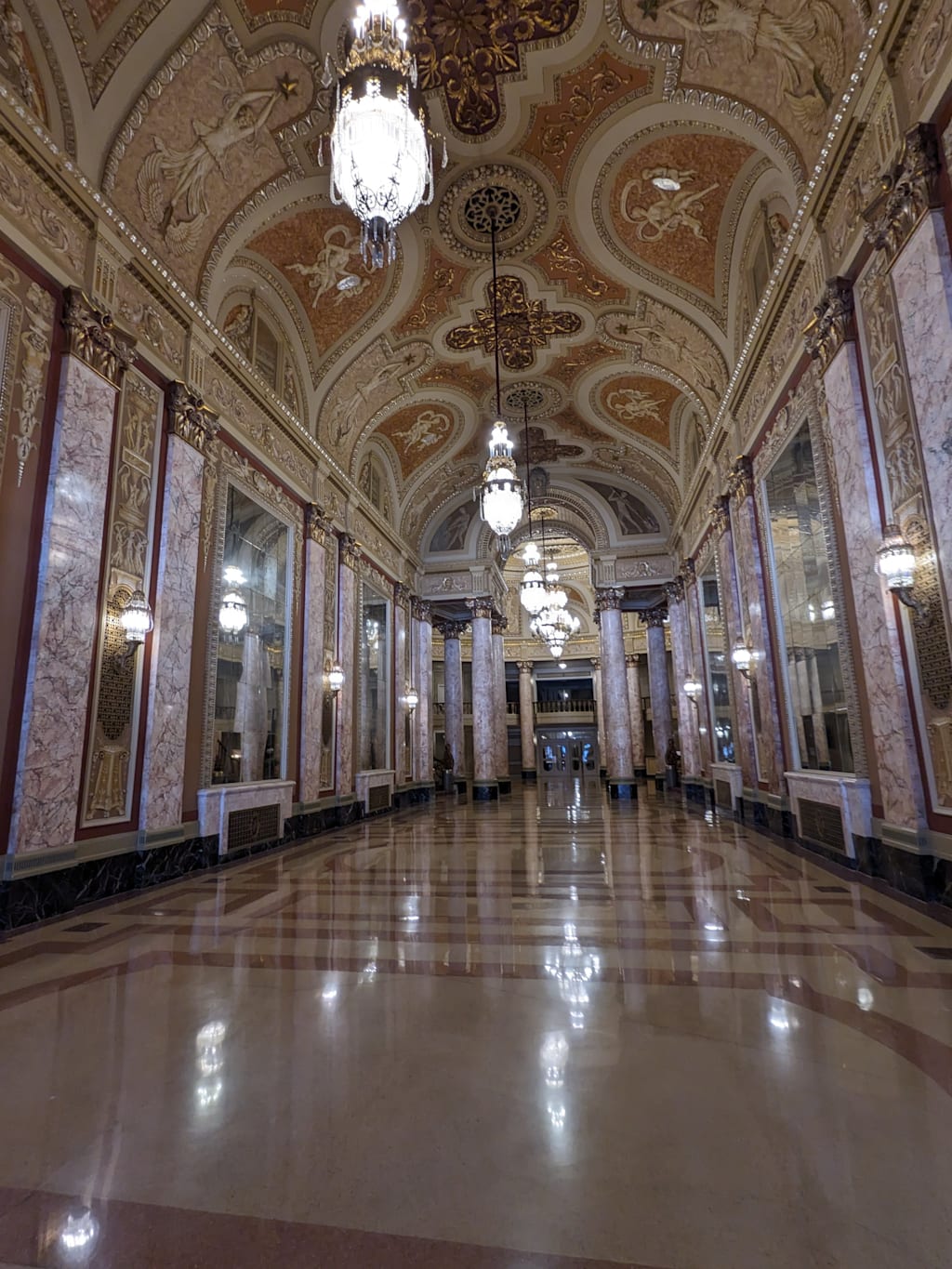
You peer in through the streaked window, shading your eyes to cut the glare. It is dark inside, and filled with shadowy shapes: a box here, a sheet-covered chair there, a dusty velvet curtain with a cobweb-festooned tassel that had once been gold. You peer upward toward the shadowy ceiling, and catch the glint of a chandelier. It is huge, and golden, and not alone, hanging from that high, ornate ceiling. There are at least three, all in a row, all once-beautiful remnants of a grand time gone by. You try to catch a glimpse of the walls, but they are too far off in the gloom.
You take a step back from the grimy window. The Rialto Theater, the golden marquee sign proclaims.
You have heard of this place. You read a story, once, that was set in this place, in a long-ago, glamorous time of movie stars and femme fatales, men in top coats and tails, actors and actresses who were Stars in the days when Stars had a capital letter. When beauty was currency, and style was king. When gossip was both fame and condemnation. When beautiful people lived on to become history, and then myth. What a grand time!
The story you half-remember was set in two times: half in the glory days of this grand theater and others like it, and half in the present, when a nobody who thought she was related to a Star who performed here, once, came looking for her “family history.” There was some sort of scandal connected to the distant relative, though you can’t remember the details. Was it an illegitimate child? An affair of some kind?
What you mostly remember about the story is the glamor. The glamor and the place. This place.
For some reason, this place has been lurking in the back alleys of your imagination for a very long time. What were you, 16, when you read it? The main character - the girl searching for her long-lost relative - was 16 in the story. She was from Chicago. You were from Chicago. Your coming here was inevitable.
And now here you are. And the place is closed.
You peer in the window again. It doesn’t look like it has been closed for long. Not falling-down-from-neglect long. In fact, is it really closed at all?
You try the door, holding your breath. Of course, it’s locked, and you let out that held breath in a frustrated sigh. “I’ve come so far,” you think, “and I’ve been dreaming of this place for so long. It can’t be closed!” You try another door. And another. And another. All locked. You wander to the corner of the grand old building, running a hand over the brass handles, the carved doorways. You peer down the alley between the Rialto and its neighbor.
Is that another door? With a quick look over your shoulder, you slip down the alley to a door half-hidden in the darkness. Tarnished letters are just visible - S - T - G? Stage? The Stage Door? Crossing your fingers, you grasp the handle and pull. Did it budge a smidge? You pull harder. Maybe? Uncrossing your fingers, you grab the brass handle with both hands and give it a real yank.
To your amazement, it groans open! The wood is swollen, the hinges shriek in protest, but it opens! With another look over your shoulder - surely someone heard that racket? - you slip inside, pulling the door closed behind you.
You are in a dark hallway. It is narrow, and lined with velvet-flocked wallpaper. Old light sconces jutt from the walls here and there, their brass fittings tarnished, their frosted glass dusty. There is a switch, but of course you don’t dare press it, so you proceed carefully in the dimness. It looks like it may get lighter up ahead, where this narrow hall ends.
You reach the end of the hall. The edge of a red velvet curtain hangs gracefully beyond. You reach out to touch it, and it is every bit as luxurious and soft and weighty as you expect. You take a tentative step, then another, until you step beyond the curtain.
You are on a stage. The wooden floor, smooth from the steps of long-forgotten, long-dead actors, gleams dully in the half-light that finds its way through the grime covering the windows.
Above you, you can see row upon row of lights of different colors: red and green, yellow and orange, the white of spotlights. Behind you hang layer on layer of curtains, some heavy velvet, some gossamer lace. Before you stretch the rows of seats once filled with the gentlemen and gentlewomen of the audience. Above the gallery of seats, above the gilded mezzanine and the ornate balcony, the ceiling arches gracefully, its decorative cupids and flower arches, peacocks and birds of paradise, grapevines and arbors cast in plaster and touched with gold.
You stand, in the center of the glorious stage, and gaze out, imagining your audience. You picture them there, fancy ladies, formal gentlemen, dressed in their finest silks and satins, their jewels sparkling at their wrists and fingers and throats. They are spectacular.
And suddenly you are an actress, a Star with a capital “S” who all of the beautiful people have come to see. You gaze at your “audience,” nodding here, smiling there. You bend gracefully into a curtsey, your hands at your sides gathering your imaginary skirts. “Thank you. Thank you,” you say, smiling, bowing, curtseying. “You are too kind. Thank you. Thank - “
“Hey!” a gruff voice calls out. “What are you doing?”
You look up from your imaginary audience to face the very real, very angry face of a man.
“Oh!” you squeak. “Oh, I’m sorry! I was just - “
“Just what?” he barks. “Casing the joint?”
“Oh, no, of course not!” you stammer. “I was just - “
“The place is closed! You’re not supposed to be here!”
“Oh, really?”
“Yeah! Really!” he snarls. “How’d you get in here, anyway?”
“I - I just walked in. The door was open,” you say. You point down the hallway. “There,” you say. “That door. It was open.”
“Well, it shouldn’t be,” he says more quietly. He looks around, at the theater, at the stage, and finally at you. “Quite the place, isn’t it?”
“It is!” you gush. “So beautiful!” You feel braver, now that the man has stopped yelling at you. “My - my grandmother was an actress here once,” you add.
“Yeah,” he says with a small smile. “Sure. That’s what they all say.”
And he ushers you out through the stage door that shouldn’t have been left open.
But you were there. In that theater. On that stage.
And you will never forget it.
About the Creator
Laura DePace
Retired teacher, nature lover, aspiring writer driven by curiosity and “What if?” I want to share my view of the fascinating, complex world of nature. I also love creating strong characters and interesting worlds for them to live in.
Enjoyed the story? Support the Creator.
Subscribe for free to receive all their stories in your feed. You could also become a paid subscriber, letting them know you appreciate their work.
Comments
There are no comments for this story
Be the first to respond and start the conversation.