
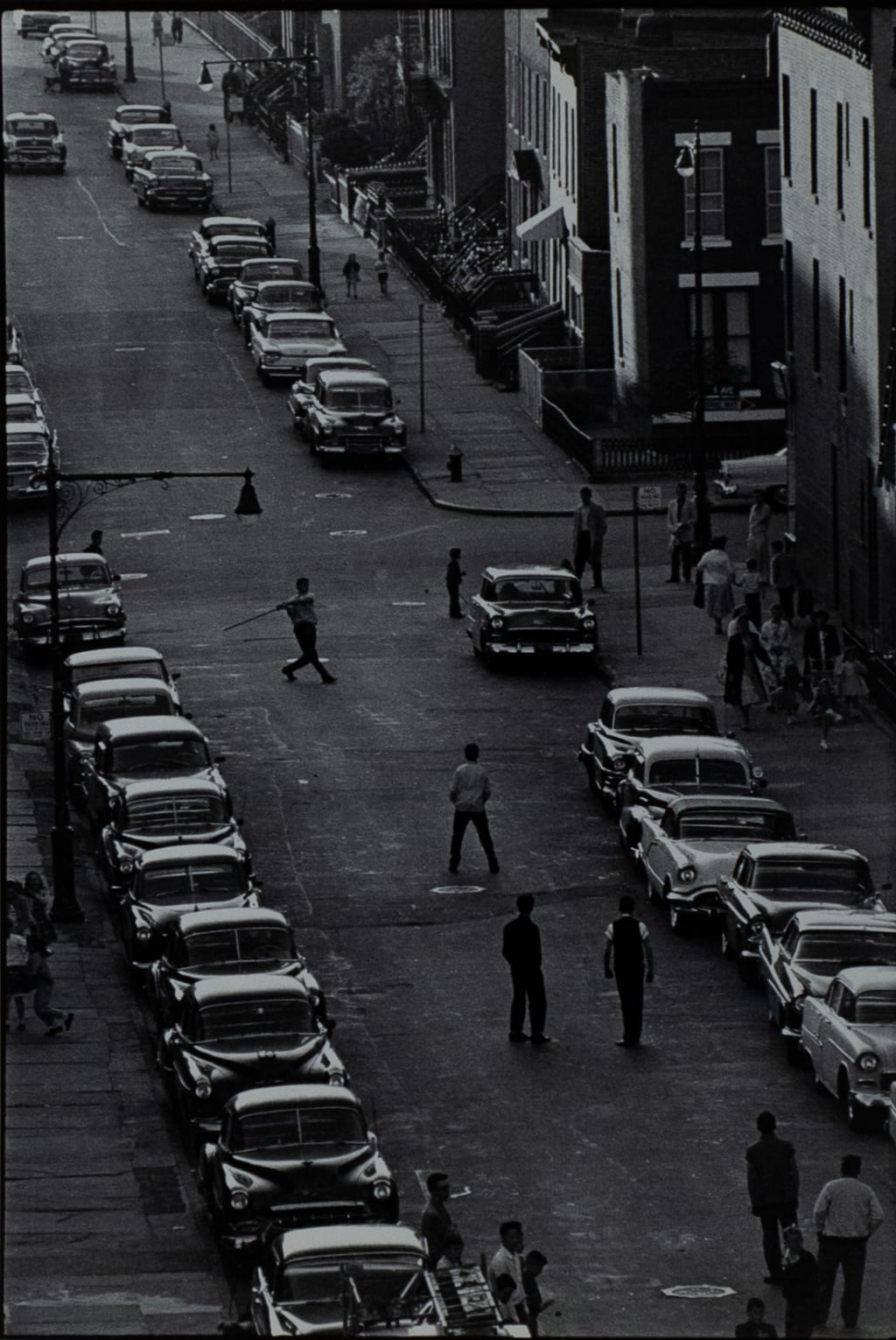
My father once told me that a man should avoid being stepped on by doing the stepping himself. My father, Antonio Giuseppe Dellafiore (or Tony Dellafiore as everyone from here to Queens knew him), was no rocket scientist, but he sure taught me a thing or two about life.
Every man in my family carried the middle name Giuseppe, which I was fortunate enough to have as a first name. Giuseppe (or Joey as everyone called me) is an Italian version of Joseph. My old man claimed it was the best way to be named after Christ without having a name like Jesus. He’d tell me only the spics up in Harlem are called Jesus. I wasn’t allowed to go to Harlem.
My parents came to Brooklyn from Italy sometime during the war. They were both from the town of Campo Basso in Molise. They knew each other since they were kids. I was born not too long after they got here. My father would always make jokes and remind me why my birthday was exactly nine months after they got to America. They came here with nothing but love for each other.
June 3rd meant more to me than just nine months after the day—the only day, when my parents schiaffed. It was, each year, my official start to another beautiful Brooklyn summer.
That year things were different. The summer of ’57 brought more changes to Brooklyn than the war. The Brooklyn Dodgers were moving to Los Angeles, leaving us with nothing but the goddamn Bronx Bombers. I couldn’t stand the Yankees. My father blamed the blacks for the loss of our beloved Dodgers. He said that Brooklyn had become too dangerous for a baseball team. Brooklyn, according to him, was taken by the blacks from hard working Italians like us. Moulignanes as he called them, or castagne brusciate as my nonna would say. I don’t even know what that one meant.
My best friend, Angelo Schiavone, lived in the apartment above ours. No matter how late at night, or even early morning, we could always hear his parents yelling at his older sister through our paper ceilings. His sister, Adriana, was seventeen and had already been dating boys since she was fourteen. Ange and I would see them come and go, each week, one after the other. There was Ricky Tuddesco, Luca Pagano, Sonny Marchese and his cousin Marco. Angelo’s parents ignored the fact that Adriana’s name was being tossed around Atlantic Avenue like some putana. All that mattered was that they were good Catholic Italian boys and not a “Reggie Jefferson Robinson Jr” if you know what I mean.
After a while, there were no more bruises on Adriana’s arms, no more boys coming around the apartment, no more arguments. It was just, quiet. We eventually found out that she had met a guy in the city and had been going with him for the past couple of months. Alvy Hoffman, a Wall Street banker from Manhattan, but most importantly a Morta Cristo. A Jew.
Mrs. Schiavone couldn’t stand the idea of her daughter not being with a good Catholic Italian boy. It didn’t matter how little respect the boys had for Adriana, or how much money Alvy possibly could have. He was Jewish, and it just wasn’t accepted. Our cousins said if they had kids, they’d be Pizzabagels. I never understood why. That summer, Adriana moved to the city with Alvy and never looked back.
That week, the morning of my birthday, I woke up to my father’s voice calling me from the street. My mother was in the kitchen baking lasagne as she yelled back at him through the window. One smell, and I immediately knew which of my nonna’s ancient recipes was filling the kitchen. I wasn’t sleeping. I was up all night waiting for my tenth birthday. I pretended being asleep so my old man wouldn’t remind me how sleeping makes you taller. He had me convinced that if I didn’t sleep, I’d never grow as tall as Gil Hodges and hit all them homeruns. I had seen him once, at Ebbets, in ’55. They had won the fourth game of the World Series, tying it with the Yankees at two a piece. Hodges hit a homerun that game, and I still swear to this day that he tipped his cap at me right after he did.
When I got downstairs, my father looked more excited than I was. It was my birthday, after all. He reached into his back pocket and took out a brand new deck of playing cards. The foil covering it was still sealed. He unwrapped it, opened the box, took out a card, and handed it to me. It was the king of hearts. As he wished me a happy birthday and began to walk away, I was confused and disappointed. Until he came right back from around the corner wheeling my present by his side. My bike. I couldn’t believe it, my first bike. She was candy-red and beautiful. I immediately knew what the card was for, as I jammed it between the wheel spokes, just like on my cousin Dino’s bike. It was amazing how a card wedged in your wheel could suddenly make your bike sound like a motorcycle.
As the days went by, riding around with nowhere to go, I quickly became the most popular kid on the block. I had also switched the card my father gave me for a Gil Hodges baseball card. I kept the king of hearts with me. I still hold it in my wallet. Having a bike in my circle was a real mark of status. Everybody wanted to be my friend. Everybody wanted to ride my bike.
One sunny afternoon, I decided to let some friends give her a test drive around the block. There were my friends, their friends, and even friends of friends of friends who took turns. I didn’t know everybody there. Then, one kid who was a little bit taller than me, he must’ve been thirteen or so, asked me to let him ride it. I helped him on, and he started pedaling. I knew right away, as he pedaled faster and faster, he wasn’t coming back. He passed the turn to make it around the block, passed St. Fortunata Church, all the way passed St. Bernadette. He pedaled so hard that the Gil Hodges baseball card flew right out of the wheel and onto the street. I ran after him for about a minute or two, and I stopped. It was hopeless. He was gone. I felt sick.
The rest of the summer without my bike felt longer than an entire school year. I missed my bike every day. All I had left was my Gil Hodges baseball card that I picked up off the street, after crying on the sidewalk that entire afternoon. Every bike that passed through the block caught my attention. Candy red or not, I would lift my eyes and hope to recognize my bike, only to be disappointed yet again. My father never forgave me for what happened. He told me it was my own fault, and that my irresponsibility gave me a kick in the ass. The hardest kick I ever took.
One August morning, I noticed a crowd of kids down my street from my window. I headed outside and over to see what was going on. Some kid’s cousin had come down from Queens to show him his new bike. He was letting some of his cousin’s friends take rides around the block. I didn’t know any of these guys. I hadn’t been around the park all summer. When the bike got back from its ride, I fell in love all over again. She was candy red and beautiful. I knew it couldn’t have been my bike because its handlebars and seat were both white. Mine were tan.
I needed to ride again, just to feel what I had been missing all summer. I asked the boy if I could try it and he let me. After he helped me on, I began to pedal. I had found what I had been missing. As I pedaled faster and faster, harder and harder, that kid knew it was too late. I wasn’t coming back. I flew past St. Fortunata Church, all the way past St. Bernadette. I now knew what my father meant. I was doing the stepping. Stepping all over Brooklyn, all over the pedals. My pedals. I could’ve pedaled that bike around Manhattan and right into Jersey if I hadn’t stopped. But I had to stop. Something didn’t feel right. I stood next to the bike for a minute, reached into my pocket and pulled out my Gil Hodges baseball card. I jammed it between the wheel spokes, got back on, and kept going. It didn’t matter where; I just wanted to ride my bicycle. I wanted to ride my bike.
About the Creator
Enjoyed the story? Support the Creator.
Subscribe for free to receive all their stories in your feed.
Comments
There are no comments for this story
Be the first to respond and start the conversation.