

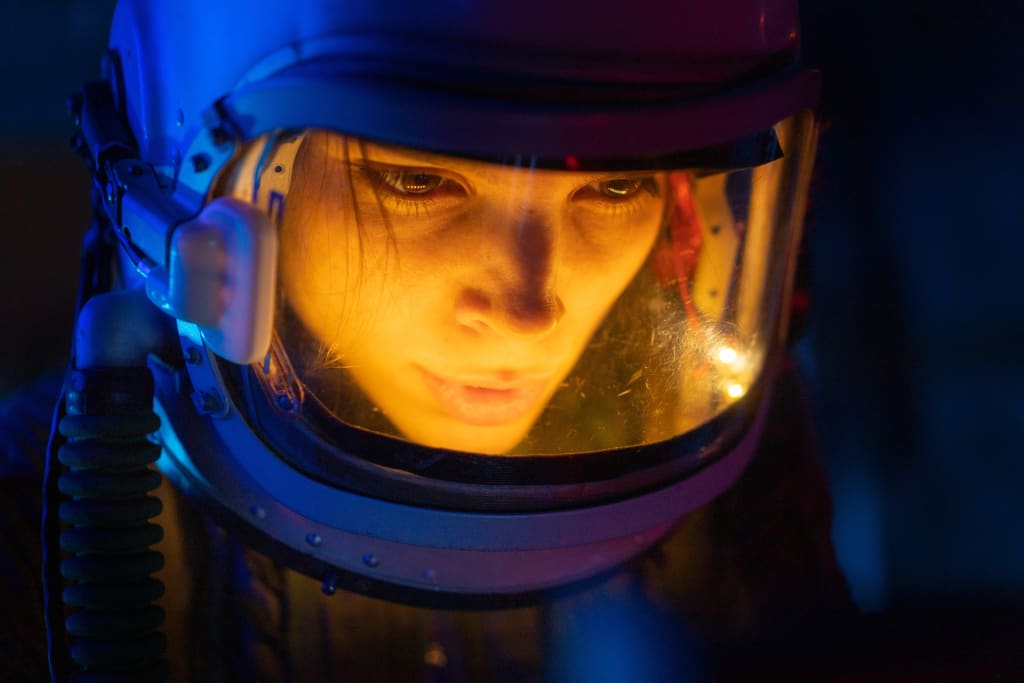
Nobody can hear a scream in the vacuum of space, or so they say. But what if it’s space itself that’s doing the screaming?
Janix Frey, chief of psych security for Space Station Firmament, braced herself for the next wave in an exhausting series she’d endured so far when space-time—or rather a disruption to it—would bleed sound over everyone present on the station.
Referring to the phenomenon as a sound was like calling the asteroid-caused tsunami that wiped out half of Africa, a whitecap.
She and the others didn’t just hear the tortured din coming from the center chamber within Firmament’s core, they experienced it with every cell in their bodies that it assaulted, every chemical reaction it disturbed in their brains. They heard the scream not just with their ears but with soft bellies and the vulnerable hollows at the bases of their throats and the hair follicles on the backs of their necks. They heard it with their skin and even their fingernails as fingers curled and dug into flesh to use pain to block it out.
The scream could not be blocked out. When that unbearable signal noise began again, it would become the whole of existence for them as long as it lasted. Nothing could shield them from it. Riddle Abraham, the station’s commander, claimed it originated from a dimension beyond their own.
At her side, Yolanda Segura, her second in command, huffed an irritated sigh.
“I can’t live through another of these,” the woman muttered to herself.
This was a sentiment Janix knew she and likely everyone else on the station except, perhaps, Riddle shared. The scream didn’t just grate on the nerves, it damaged them. According to Medical Division, anyone exposed to the signal, even for as short as a three-second interval, ended up with measurable damage to their limbic systems, a fact that spelled danger to Janix.
As Chief Psych Security Officer, her job involved keeping all onboard safe from the aberrant breakdowns that tended to plague humans in the isolation of space. History had taught them the disastrous consequences of not keeping watch. People outside Triple S, humanity’s Scientific Space Survey, wrongly assumed that she served as a glorified therapist, to whom people driven nuts by months or years of living in a metal torus could run for comfort and hugs.
She was there to offer neither. Medical Division handled therapy. Janix and her team had the responsibility of deciding if and when to shut down the project to prevent loss of life. Or worse.
Never once in her career had she had to make the call, but if she and her team did, not even Riddle could override their decision.
Janix’s right hand tingled or, more accurately, it vibrated. She and the station’s other residents were housed in the outer of the station’s two rings. According to engineers, they were supposed to be isolated from the Butler Accelerator’s effects. Clearly, that wasn’t true. She wasn’t even certain this was a standard Butler Accelerator or rather something else, something new and untested.
Her question, the one that impacted her job specifically was, how much danger did the experiment present to every soul onboard?
She’d been warned before accepting the mission that some parameters and rules would have to be fluid in comparison to previous assignments. After all, this was esoteric physics they were dealing with out here, a terrifying number of lightyears from any inhabited planet, auxiplanet, or other settlement.
“Super AI-human hybrid stuff,” her superior back at headquarters had told her.
“Can you give me a clue?” she asked the lieutenant commander.
He choked off a laugh.
“I wish,” he said. “But the scraperheads at the top let me know us lowly psychs don’t have the intellectual bandwidth to grasp it.”
“That makes it rather difficult to do my job, doesn’t it?” Janix said. “Not knowing the risks?”
“Yeah, well, that’s why everyone signs a waiver before they get on transport.”
Janix had already thumbed hers, letting the Service know that she was okay with the higher odds of not making it back. The Triple S wasn’t a military organization. No one was encouraged to give their life for the advancement of science. Still, she’d be receiving the maximum hazard pay allowed.
“And don’t bother trying to get mods to understand it,” he told her. “There’s nothing in the Brainpac catalog that even touches this. You’re going to have to go with your gut. You got me?”
Janix nodded.
“I do have an idea for you to chew on, though,” he said.
“Yes?”
“Consider scientific thought as a spot on a spectrum.”
“Okay,” she said.
“Slide that spot as far as you can to one end of the spectrum.”
Where was he going with this?
“Now place spirituality–”
“Spirituality!”
“Yes,” he said. “Spirituality, Religion. Belief. Whatever you want to call it. Slide it over to the other end. What happens when two opposing concepts go to the far fringes, their absolute extremes?”
Janix took a moment to consider.
“They start to resemble each other,” she finally said.
“Exactly.”
It was the only warning she’d received.
Now, almost two months since leaving HQ, the hint turned out to be grossly inadequate.
Janix watched the skin rippling with a will of its own along her forearm. Though the effect was subtle, one that others would hardly notice or differentiate from a quiver or nervous tic, it unnerved her no less than it had the first time it happened. Something at the cellular level reacted involuntarily to the energies inside the accelerator when the unit ramped up.
She hated being here.
“We do this one more time and I’m opening an airlock myself,” Segura whispered at her side.
“Careful,” Janix said, voice also low. “We've barely scabbed over the panic from last time. You don't want to touch it off again. I don't think we could contain it this go round.”
A head taller than Segura, Janix glanced down at her colleague, using her grim expression to drive home her point. She meant it. She feared for everyone onboard.
Segura looked up, met her superior's gaze, and nodded tightly. She had a full-body chameleon tattoo, which allowed her skin to meld with any background she chose. Depending on the light, the only giveaways to her presence in a room might be her uniform, a rare grin, and her orange eyes. Her white buzzcut took away little from the chameleon effect. That Yolanda desired to be visually indistinguishable from her surroundings, spoke volumes to the psychiatrist in Janix. However, the woman did her job and did it well, and that was all that counted.
In a gesture intended to self-soothe, Segura’s fingers traced the thin ridge of brainware that lay just below her scalp and wrapped her entire head in a subcutaneous halo.
Maybe the accelerator had the same discomforting effect on Yolanda’s circlet as it did Janix’s skin.
Unlike the others in the control center, Janix didn’t use technological implants. Her only enhancements were organically based, three microscopic filaments that kept her body healthy, constantly repairing itself, among other things.
“This is just a calibration run?” Segura asked again with uncharacteristic nervousness.
A calibration meant a shorter period during which the sound could traumatize them.
“We aren’t doing a full tracking attempt, right?” she said.
“No,” a dark, boyish voice interrupted their conversation.
Riddle.
Their attention jerked toward a dais where the station’s commander and research director stood with his back to them, silhouetted in front of a massive window. Lights in the control room were dimmed, scientists and technicians each working in quiet pools of light. It allowed the view of the moonlike sphere outside to dominate.
In addition to providing power generation and gravity to the station, the enormous sphere at Firmament’s center housed the AI-operated core that ran the project’s experiment. Its surface glowed darkly iridescent, the sheen that of rainbows on an oil slick.
“You’re right,” Riddle said and turned away from the awe-inspiring view. “This is a calibration.”
Though Janix and Segura stood at least ten meters away, at one of the curved chamber’s two exits, the commander had overheard their whispers.
Few selected hearing for enhancement. Of those that did, the majority ended up hating and uninstalling the mod. Still, it made sense for Riddle. Janix suspected he would register as a paranoid. In a worrisome violation of safety protocols, he hadn’t yet allowed her to make the customary assessment of his mental fitness since she’d boarded the station.
“Not now. We’re behind schedule,” was his excuse whenever she brought it up.
Nor had she been given access to the previous chief’s assessments, another departure from the norm.
This is so wrong. This whole thing.
Riddle stared her down, daring her to add objections to the ones she’d already made in the worrisome aftermath of the team’s latest try to slice open a doorway in space.
Commander Abraham’s file, what little she had of it, stated he’d celebrated his 172nd birthday days before she’d come aboard.
She could believe it. He possessed that strange physical combination of youth and advanced age common with the first generation to get rejuvenation treatments. His bone structure was a cross between spindly and gangly, between stooped geriatric and slack-spined twenty-year-old. Everything on him slumped and sunk inward. His shoulders drooped, the hollows under his collar bones deep enough to rest a fist inside. His slight paunch sagged while still appearing weirdly young. Cheeks hosted gaunt shadows beneath layers of dewy fresh skin.
He was also a scraperhead, a term most considered a pejorative. It described someone with so many AI and other inorganic mods permanently installed and integrated with their brain, that the top of their head resembled a cityscape.
“Comments, Chief Frey?” he asked her.
“You have my objections on record,” she said.
“And yet,” he said. “I don’t see you shutting me off.”
Shutting me off.
It was snide, inaccurate language, belittling her most critical duty, deciding if and when to activate the sleep-seed implanted at the base of his skull.
Pointedly, his gaze swept the control center, pausing briefly on each crew member she'd been forced to “downtime” on the previous run to avert disaster.
“Or flipping switches on anyone else,” he said. “What is it? Too afraid you might jeopardize your career by calling a halt this time? Or have you finally grasped the importance of what we’re doing here?”
Janix felt, rather than saw indignant gazes from many in the room shift her way, yet she refused to rise to the bait.
“I thought so,” Riddle answered his questions with incorrect assumptions about her motives.
He turned back toward the window.
“Calibration seventy-eight percent complete,” said a technician down in the operations pit.
“Screen,” Riddle ordered.
Their view of the giant sphere outside disappeared, replaced by the visual feed from a compartment at Firmament's core. So many cables, pipes, fittings, and instruments covered the spherical chamber's walls that it was nearly impossible to make out a hatch where anyone entered or exited.
Yet the chamber was not empty.
Someone on a stretcher hovered mid-air inside it.
Her stomach dropped at the unexpected, unwelcome sight. Segura hissed in surprise. At the other end of the control center the third member of their security detail, a private manning a second exit, shot Janix a concerned look.
They weren’t the only ones alarmed.
A gasp came from the pit behind and several steps below Riddle’s elevated perch. Zaki Dawoud, the one ethicist assigned to the project frowned in concern.
“You said this was a calibration only,” Dawoud said.
“It is,” Riddle said.
“If so, the patient’s presence in the chamber is a violation of ethics,” Dawoud said.
“A test subject is now required for calibration,” Riddle replied.
“Patient,” Dawoud corrected the callous label.
The commander shrugged. “Patient.” He then gestured at the image onscreen of the elderly man more aged and frailer in appearance than anyone outside the project was likely used to seeing. “You wonder why none of the previous attempts have been successful? There’s your answer. The AI needs to calibrate using the specific human who will be participating. We haven’t done that before, and each time we’ve failed.”
Dawoud objected. “You can’t simply rewrite the ethics protocols of an experiment when you feel like it.”
“Can’t I?” Riddle said. “These people are dying. They’re terminal. That’s what qualifies them to be here.”
“But they’re still living,” Janix said, siding with Dawoud.
Strictly speaking, by contract, the volunteers for Project Threshold fell under a completely different waiver than the rest of them had signed. They were here to serve as human pry bars holding open what Riddle—when theorizing in his proposal—termed the death horizon.
Except for one thing.
They needed to die first.
Project Threshold had been formed not simply to prove the existence of another dimension, the admission price for which was death, but to trace energies released by the body upon passing as they navigated the threshold to said dimension.
Was the goal to prove life after death? No. They only sought to prove that a stream of recently discovered particles traveled beyond an inter-dimensional boundary created by a human’s passing. To do that, the team would have to hold open the threshold long enough to track at least one particle beyond it. Not far. Just far enough to validate the theory. As to the potential consciousness of that stream, the notion of equating it with a deceased person’s soul wasn’t even considered.
Riddle despised the idea. Anyone foolish enough to bring up for discussion the concept of a human soul, faith, God, or anything related, instantly regretted it. More than one team member who’d hoped to make their career with Threshold had found themselves dismissed and on the next supply ship home.
Janix’s predecessor was the latest example.
“He’s still alive,” she reminded Riddle, indicating the elderly man in the chamber. “As such, he and every other patient in the hospice ward is under my watch.”
“And my watch,” Ethicist Dawoud said. His lip curled. He was competitive when it came to his territory.
Riddle turned to face them, irritation surfacing. “Don’t you get it?” Spittle flecked from his lips. “Their lives are over. His life is at an end. I know it. You know it. I guarantee you that he knows it. What does it matter if he suffers a brief moment of discomfort in his death throes?
“For–” Dawoud cut himself off before the next word left his mouth. Janix and everyone else in the room intuited he’d been about to say God, or perhaps Allah.
For God’s sake.
Instead, the ethicist changed course just in time. “For pity’s sake,” he said. “Show some respect.”
A soft voice, each word breathless with effort came over the control center speakers.
“It’s okay. I’m okay.”
All eyes went to the larger-than-life screen behind the commander and the person on the stretcher in the core chamber.
“Oh, my God.” Dawoud gave up on censoring himself over the G-word. “This is unbelievable,” he said. “You’ve had the audio open this whole time?”
Janix fought to follow the conversation, but her skin vibrations suddenly worsened. She massaged her right forearm. This did nothing to help, of course.
Segura rubbed the circular ridge on her scalp harder, as well. How did the others in the center, let alone the 145 souls in the rest of the facility handle the sensations? With the entire station on lockdown, she wasn’t concerned about someone randomly losing it and creating an emergency. Yet said lockdown was still controlled by the people in this room.
They have to be feeling it. They can’t be immune.
“An oversight,” Riddle said of the mistake that had let their patient overhear everything they’d just said.
Dawoud shook his head in disbelief. Janix’s training told her Riddle was lying. He’d done it on purpose.
Inside the chamber, the patient tried to lift his head but didn’t have the strength. That eerily thin voice came over the speakers again.
“He’s right. I asked for this. I want this. I…” Each word was a feat of absolute will, a full sentence a test of human endurance. “I was a physicist.”
Awed murmurs from team members in the pit ranged from incredulity to reverence. One of their own was sacrificing himself for science?
“Thank you, Mr. ….Pho.”
Janix found the commander’s infinitesimal pause while his mods accessed the records to be telling. He even didn’t know the volunteer’s name.
“Sorry,” he corrected himself. “Doctor Pho.”
Ironically, Pho needn't die. If at this very moment, he spoke up and asked for medical intervention, he would be given it. His life would be saved. People rarely died from disease or biological malfunction anymore. Deaths more likely occurred via catastrophic accidents or misadventures such as murder and suicide.
Pho was special. He belonged to a very small sect that believed humans should age out normally and life shouldn't be extended beyond its natural span. Not all members of the sect were religious. A large percentage were atheists. Yet, so tiny were their numbers, recruiting enough volunteers for Threshold wasn’t guaranteed.
Pho didn’t answer. He’d expended his energies and had nothing left.
“Calibration eighty-five percent," the same technician updated them.
An alert sounded in her ear. One of her team, a corporal she’d given a special assignment, needed her attention. Lifting her hand, a translucent screen appeared in front of her palm.
“Chief,” the corporal’s round face filled the screen, “you said you wanted to know if anything happened with the psychic?”
She heard someone, a man, screaming in the background of the corporal’s call, deafening, agonized cries.
Christ. The psychic. She’d forgotten. Riddle’s dirty little secret.
Riddle had contracted a real-life I-hear-the-dead psychic medium for the project. No one on his team knew about this unorthodox hire. If the man hadn’t come in on the same supply ship as Janix, she wouldn’t either.
She didn’t believe for one second that Riddle put any credence in the psychic’s abilities to “see beyond the veil,” but when she’d confronted him about it, he insisted he was curious if unique factors in the man’s biology might make him more sensitive to the death horizon.
They’d lost him to lunacy on the accelerator’s first attempt. He’d begun screaming and never stopped. Medical had used every device in their arsenal to calm him but failed. After he’d tried to pull his ears off his head, Janix had been forced to downtime him to relieve his suffering.
A person couldn’t be kept down for long without consequences. In the end, they’d gone with old-fashioned pharmacology, chemically sedating him.
It had worked.
Until now.
That this occurred just as the accelerator came online could not be a coincidence.
“I’m begging. Begging you," the man said. “Please, stop. Oh, God-God-God it has to stop.”
A shudder twitched down her spine. Janix didn’t handle torture well.
“I don’t know what’s going on up there,” the corporal said. “But as of seven minutes ago, he came out of it and won’t shut up no matter how much they give–”
Alarms sounded from the operations pit. Red warning lights flashed at nearly every workstation in the room.
“Later.” She cut the call. Then to Riddle, she said, "What is it? What's happening?"
“He’s dying,” a woman spoke up from a console displaying the patient’s stats. When no one responded, she said, “No, I mean he’s dying right now. Mr. …Dr. Pho!”
Janix studied the wasted body on the stretcher locked inside Firmament’s core, Pho had passed out.
“Pause the calibration,” Ethicist Dawoud shouted. “Get him out of there!”
“How long does he have?” Riddle asked the woman monitoring Pho.
“Estimate is minutes,” she said.
Riddle turned and glared at her. “Precision, Sarah. You're here because you're supposed to be the best at this. No one else better. Or do you need me to do it for you?”
The woman shrank under the commander’s withering tone, shaking her head vigorously. No.
Riddle put a hand to his chin, going deep in thought.
“I’m only saying this once more. Get the patient out of the chamber!” Dawoud told him.
“Okay,” Riddle said, “Stop calibration.”
Dawoud visibly relaxed, sure he was listened to at last. The patient would be removed from the core and given palliative care until he passed. If he lasted that long.
“Bring the accelerator online,” Riddle ordered.
“What!” Janix and Dawoud said simultaneously.
“These bodies are expensive,” Riddle said. “I’m not going to waste one.”
“This is insane,” Dawoud said.
“I’m not sanctioning this," Janix said. “Stop. You are to cease all experiments immediately.”
No one in the pit moved.
“What are you waiting for?” Riddle shouted at them. “I told you, bring it online.”
“Is there even time?” someone spoke up.
Riddle looked at Sarah at the medical console and tapped his foot impatiently.
“I’m going to say four minutes,” she stammered. “Before he’s gone. Five at the most. No, four. More like four.”
“See,” Riddle said. “Plenty of time.”
“I said stop,” Janix ordered. "This isn't safe."
“Oh, really?”
The commander strode down off the dais.
“A woman without a single real mod in her head,” he said, “not a line of AI informing her decisions suddenly knows my job? Understands my theories? Understands any of the historic discoveries that have led up to this?”
He strolled over to stand between two workstations, one of them the life support console.
“I know when people are disregarding the safety of others,” Janix said. “That is all I need to know.”
“Do it!” he ordered his team. “Now.”
“That’s it,” Janix said.
She raised and opened her hand. She felt Segura tense beside her.
Janix’s palm viewer reappeared. Eye trackers followed her gaze toward the button in the upper right corner of the screen.
Segura and the private on the other exit brought up their viewers.
She blinked to click the button on hers.
“Commander Riddle Abraham,” she recited.
Another screen opened, this one with the controls to the commander’s neck seed. They all had them, everyone onboard the Firmament, even her.
“Downtime,” she said.
She looked up, expecting Riddle to drop where he stood. Unharmed, but unconscious, beyond the reach of any AI or other mods he might have.
Nothing happened. Riddle’s seed didn’t activate.
“Oops,” he said.
“Downtime Commander Abraham,” she repeated to the viewer.
“Something wrong?” he said. “No time out for me?”
One after another, she heard Segura and the private using their viewers to call out names to downtime anyone in the pit who might follow his orders.
Again, nothing happened.
“I rewrote the seeds,” Riddle said. “Just last night.”
He stepped to one side, flicked aside a technician's hand hovering over a control button, and tapped it himself. With a thud that jolted the floor beneath their feet, additional machinery within the station came to life. The experiment was now live.
“You can’t turn us off,” he said.
“No one can rewrite the seeds,” Janix said. “It’s not physically possible.”
“You see,” he said, “That’s what happens when you aren’t too bright and don’t understand that limits are meant to be tested, exceeded. You don’t have a clue really as to what’s possible in this universe. Not a one.”
He moved behind Sarah and placed his hands on her shoulders.
“Sarah, here, can turn you off. All three of you. And Dawoud, too. Or you can stand by quietly and observe.”
Down in Hospital Deck, Corporal Brown choose that exact moment to ping her again. On reflex, she opened the call.
His cheeks were splashed with blood. Off-screen multiple people spoke over each other, frantically shouting orders. This, amid crying and mewling so alien it no longer sounded human. The psychic?
“Chief,” Brown said. “You gotta come down here.”
“Not now, corporal! Handle it!” She closed her hand, collapsing the screen so that it winked out.
Whatever violent drama currently played out on the ward, Riddle took priority. He was the greatest threat.
“Commander–” she began.
A grotesque wheeze came over the cabin speakers. New alarms blared from a half dozen other workstations in the pit.
Every gaze went to the window viewer. Onscreen, the volunteer’s body arched cruelly upward. So great and violent was the spasm, that she thought his back would snap. Breath rattling in his chest, Pho expelled air one last time and then his body relaxed, completely still.
Several seconds passed.
“Oh, no,” Sarah finally whispered. She looked up at Riddle. “He’s dead.”
“But you told me four minutes. A minimum of four minutes.”
“I know. I don’t understand.”
Riddle swung around toward a trio of scientists conferring excitedly around a single console.
“Tell me you got something,” Riddle said.
They were too engrossed. Didn’t hear him.
Riddle bellowed at them. “Tell me!”
“We did,” one of them said. “We captured it.”
“Or something, at least,” another of the scientists said. “We captured something.”
"My God," Riddle said, violating his prejudice against invoking the heavens. "We did it."
Cheers went up throughout the center. Clapping.
Janix frowned, puzzled. She didn’t understand. This hadn’t been anything like the previous runs. Even the sensations in her skin were gone.
Next to her, Segura said, “But the sound? That awful sound? Where was that? Why didn’t we hear–”
“Because, my dear Segura,” Riddle said with smug satisfaction, “This time it worked.”
Down in the pit, Zaki Dawoud abruptly tore a short strip of metal trim from the nearest workstation and drove it through his neck.
Arterial spray hit Riddle in the face.
Stunned silence filled the center, the only sound that of the body tumbling clumsily over an empty chair and landing on the deck.
Janix was stunned to the point of inaction.
No one spoke.
Finally, Riddle asked, “D-D-Did you see that?”
“Yes,” Sarah said, face pale with shock. “We all saw.”
“No.” Riddle looked up from the body. “No! Didn’t you see? You can’t just tear off a piece like that. His fingers went through the counter surface until they could get a grip around it.”
He paced in a tight circle, madness infecting his eyes.
“His hand passed through solid metal like it wasn’t even there!”
Janix had to do something. She had people to protect. Her mind balked.
“I don’t…” she said. “I don’t know what to…”
Blinding pain stabbed her head.
The scream.
Blowing out her eardrums, the universe's banshee wail shredded the fragile membranes inside her ears.
Yet, she still heard it, that horrifyingly beautiful shrieking.
Time stopped working. She felt and saw herself falling to the deck an infinite number of times, each instance a fraction different from the first while writing itself on top of the others. Light and matter failed as useful points of reference. She was everywhere and nowhere, simultaneously everything and nothing. Blasted by the unthinkable intensity of a thousand million stars, while her body was torn down to random molecules that clung together out of sheer desperation.
Possibly because she was closest to her, Janix saw Segura’s fingers dig for the circlet implanted under her skin, and rip her scalp right off her head to rid herself of the device. Yolanda next tore at her skull, removing great chunks of bone until she could get at the meat inside.
Out came Segura’s brain, her eyes yanked backward from their sockets with a wet pop so that she held the entire quivering mass in her hands.
Around her, Janix knew that the others were already dead. They'd been dead of self-inflicted wounds for a thousand generations, and would still be killing themselves and leaving lakes of blood on the control center deck for eons to come.
She could take no more. Mercifully, she didn’t have to.
White beyond excruciatingly white light washed over her, ferrying her to a place of silence so profound and empty she couldn’t comprehend it as anything other than peace.
About the Creator
Enjoyed the story? Support the Creator.
Subscribe for free to receive all their stories in your feed.
Comments
There are no comments for this story
Be the first to respond and start the conversation.