
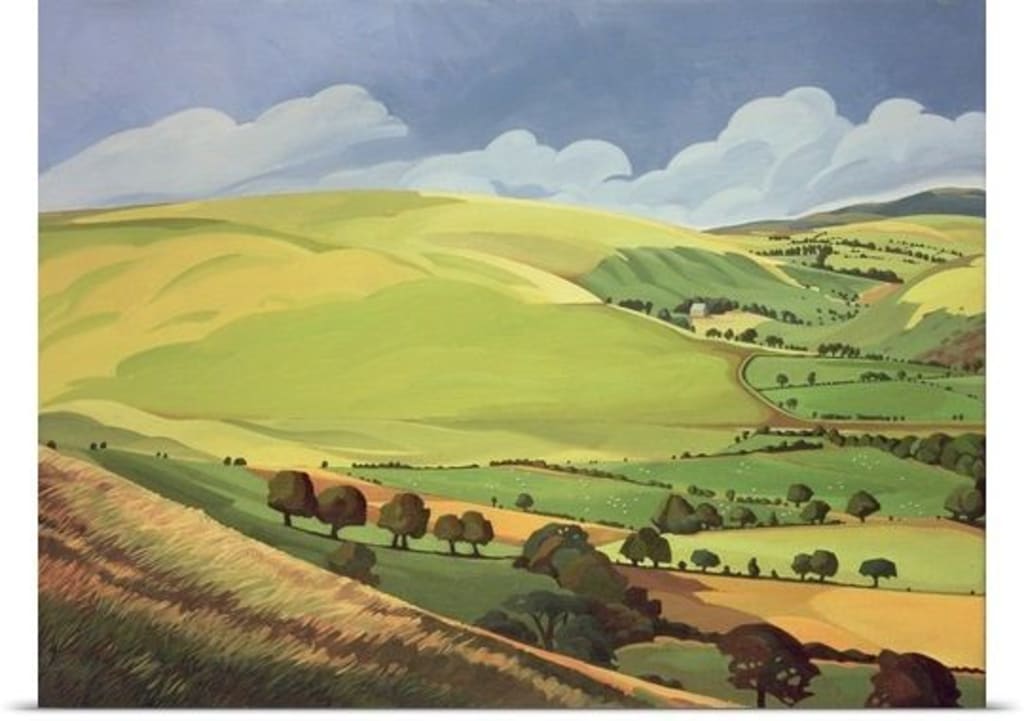
There weren’t always dragons in the valley. It was once a peaceful place. But then they came. They came from the hills, and from over the sea, and from the craggy sides of the grey mountain. And when they came, the men came too, all determined to bag themselves a dragon. For a dragon skull was the ultimate trophy, and many men, great hunters and great fools alike, came to the valley to make a name for themselves.
Most died, of course. Burned or torn limb from limb. But there were some, a brave few, who succeeded in their task, and became known as heroes, all throughout this world and the next.
One young hopeful, a prince of a far-off land, came to the valley, disguised as a peasant traveller. He carried a huge broadsword and the hopes of his small nation, for dragons were incredibly magical creatures, and it was said that he who drank the blood of the slain beast will be healed of all mortal wounds. The young prince sought to kill the dragon and drain it of blood. His father, the king, was dying, and the only way to save him was with a dragon’s magic.
The Prince travelled to the valley with a small retinue of men, for though he was in disguise, he was still a prince, and didn’t want to have to clean his own armour or carry his own bedroll. The sword he brought for the job was a giant ceremonial thing, wrought in blood and fire and magic, long ago, by a mage who worked for his father. The sword was the symbol of the nation, and the prince believed that there was no better weapon to bring upon the saving of the King. It didn’t matter that he was barely able to lift it. When it came to the killing of the dragon, he intended only to deliver the death blow. His men would shoot the beast from the sky with their crossbows. They would do the hunting and stalking while he waited by the fire. It was cold, after all, and he was a prince. What was a prince for if not for delegating uncomfortable tasks?
They set up camp and the men set out to hunt the beast. It took them many days and many nights, for this dragon was the last of the dragons, they’d been hunted near to extinction by man, and this beast was the last to remain in the valley.
They fired bolt after bolt at the beast, but it fought valiantly and killed many of the men. But there were too many and eventually it was downed. It lay, dying, in a field, and the prince approached. He dragged the sword along the ground behind him with arms that were more used to lifting a fork or a pen than a sword. But the dragon was nearly dead, and all it could do as he lifted the sword was look up at him with sorrowful eyes. It let out a final deep, shuddering breath, and curled up like a cat. It didn’t move as the prince plunged the sword deep into its chest.
The prince, exhausted from the effort of swinging the sword, fell to his knees, satisfied that he’d fulfilled his task, and hoping that it wouldn’t be long until he was home and able to sink into a hot bath. He ordered his men to bring the buckets, and to drain the dragon’s blood. The sword remained where he’d stuck it, jutting out of the dragon’s chest. As the lifeblood of the beast spilled from its body, it began to change. What was once flesh and scales became stone. Neither the prince nor his men realised what was happening, and by the time they became aware, it was too late, and the sword was encased in a vaguely dragon-shaped rock, huge and completely unmovable.
***
On the edge of a small village, itself of little to no note, and in the middle of a field, the sort usually used for the production of turnips, sat a rock. The rock had been sitting in the field longer than anybody remembered and remained completely unmovable, despite the efforts of generations of farmers to relocate it. It took up space that could be used for planting more turnips and forced the ploughman to deviate from a straight line across the field, and was generally considered to be an annoyance. But not so many years ago, people would come from across the land, princes and paupers alike, to visit the field, for the rock was reported to be from an old legend, and old legends often have a way of drawing in the hopeful and the helpless in equal measure.
The rock itself was nothing special to look at. It was about ten feet tall, a dull grey, and had a patch of orange lichen growing on the side that didn’t see much sunshine. It was oddly shaped, and children now and in the past fancied that it was the shape of some massive fallen beast. Scraggly grass grew up around it. It sat low in the earth, in a slight indentation in the field, which some thought was due to the mystical weight of the thing, but was in fact a result of many years of farmers trying to dig it from the ground.
Back in the time before the industrial revolution, when the land still belonged to legends and myths, the rock, and the village beside it, were something of a destination for those who saw themselves as potential heroes. For the rock was said to contain the Sword of Solihull, an ancient weapon used in the coronation of hundreds of kings and queens. Quite how it ended up in a stone in a turnip field had never been explained, but it didn’t matter. There was a rather complicated sounding quest attached to the myth of the sword, involving the restoration of the land, but that didn’t stop people from coming in their droves. They kicked, punched, chipped at, swung swords and axes at, and on one memorable occasion, shot a cannonball at the rock, but it simply sat there, resolutely not split in two.
Word crossed the land, and much to the consternation of the farmers, who watched their turnips trampled into the dirt, the people kept coming. Again and again, they tried, sure that they might have made a small crack, or perhaps felt just a little bit of give. Once, on a moonless night, a man in a dark cloak, his face hidden deep in the shadow of his hood, came to the field. He brought with him an ancient Nordic battle-axe, which he swung at the rock with all of his might, but the impact did little more than blunt the axe and send reverberations up his arms. He’d been so sure that he was the one destined to split the rock. Young men often were. Certain that they were the one, out of millions, who’d been touched by fate. But, just like the others, he left with his battle-axe blunt and his dreams broken.
As time passed and the steam engines and smoke stacks crossed the land, the legends and myths fell out of favour. Those in the village still remembered, of course, but they had better things to be doing than breaking plough blades and scythes on an old rock in the middle of a turnip field.
***
Elizabeth Albany was running late. Again. She hurried down the main street as fast as her feet could carry her. Young ladies should never run, her grandmother’s voice rang out in her mind.
Well, grandmother, old ladies shouldn’t drink sherry like its tea, but you don’t hear me complaining, do you?
As she ran, the bells of Saint Stephens began to toll, chastising her for her poor timekeeping. When she reached the edge of the village, she picked up her skirts and broke into a headlong dash. She’d wanted to appear composed and calm for the conversation ahead of her, but she supposed that Henry had already seen her at her worst a thousand times and knew that she was usually far from composed.
She pelted along the road, praying that she didn’t roll an ankle in the ridiculous silk slippers her grandmother insisted on. Clambering through a hedgerow, she spotted Henry across the field and breathed a sigh of relief.
He was waiting. Of course he was. Standing beside the horse, with his back to her and his hands in his pocket. He heard her approach and turned to smile at her, his nose pink from the morning sun and the exertion of his labours in the field.
“You’re late. You know I only have ten minutes or so before Mister Finch will be back to tell me off.”
“Sorry, I know,” she breathed, setting down the basket and pulling off her gloves, which were sweaty and bore traces of the hedgerow she’d climbed through. She’d hear about that when she got home, she knew. The horse snuffled her basket inquisitively and she gently shooed him away with a gentle pat. Bored, he closed his eyes and propped one back foot.
“How’s it going?” she asked, gesturing to the field around them.
“Well, it’s turnips. They’re not so complicated, really. What’ve you brought for lunch?” Henry asked eagerly. He didn’t wait for her to reply, delving into the basket in search of something good. He located a sandwich and a flask of ale, and, satisfied with this, sat down on the rock in the middle of the field and gestured for her to join him. She did, taking the other sandwich for herself. Elizabeth watched Henry as he ate and wondered if she could train herself to fall in love with him. She did love him, of course, but not in a romantic way, not in the way the poets wrote about. She swallowed and glanced back at him determinedly. There was nothing wrong with him, she knew that, but when she thought about kissing him, about him putting his hands on her, she had to fight off a small wave of displeasure.
“Henry, I think we should get married,” she said, her tone conversational. He choked on his sandwich and took a deep swig of ale before replying. She was unable to keep herself from rolling her eyes at his dramatic reaction.
“To… each other?” he asked, his voice hoarse.
“Yes, to each other,” she repeated, as though she were speaking to a simpleton.
“Why?”
“Because,” she began, glad that she’d practised her speech in the mirror, “I don’t want to marry Edgar Beckleberry, and you don’t seem to want to marry anybody. You’re going to be expected to pick one of the girls one day, and you know that. We could just marry each other, and be done with it, couldn’t we?”
“Well, that wasn’t the most romantic of proposals, Elizabeth,” he said slowly, “and I won’t pretend that I’m not flattered. But there is the small issue of the fact that I don’t love you.”
“And I don’t love you either, you complete moron!” she insisted. “But I find the idea of marrying you somewhat less loathsome than marrying Edgar, and I’m fast running out of time.”
Henry set down the sandwich on the rock beside him and took her hands, gently. “Lizzy, you’re a wonderful girl, and you’re my best friend in the world, but I don’t want to marry you. You’re just not the one for me.”
“I know I’m not the one for you,” Elizabeth insisted, “but by the looks of it, none of the girls in town are. I’ve seen both Amelia Dunne and Verity Smythe smiling at you during the Sunday sermon, and everybody says that they’re the most beautiful girls in town. If they’re not good enough for you, maybe you’re simply too picky. Look,” she said, desperate now, “I’m not saying that you have to love me, or even care about me. You can spend all of your days out here in Finch’s field if you like, or you can lock yourself away with your damned paints. I don’t care. But the only thing that can save me from marrying Edgar Beckleberry is marrying somebody else. And you’re the only person I could ask. Please Henry. You’re my best friend in the world.”
He stood and turned to face her, reaching out his hands. She was close to vibrating with anger and desperation and the only thing he could think to do was to wrap his arms around her and hold her tight to him, but she was having none of it, and fought her way out of his embrace, turning her gaze up to meet his with defiance.
“I can’t, I’m sorry Elizabeth. I can’t do that.”
Her lips became a hard line and all trace of sadness was gone, replaced with fiery anger.
“It might not be that bad, you know,” Henry began cautiously, “by all accounts, you’re lucky to have received such an advantageous offer. He’s one of the richest men in the village. And, I mean to say, Edgar Beckleberry isn’t a terrible fellow, not really. He might be a bit boring, but he’s always seemed nice enough to me.”
“Nice enough?” Elizabeth exclaimed, “Henry, he’s forty-six! He’s practically ancient. He’s got two sons who are older than me.”
“I know that too. And they’re not bad lads. I think you’re being overdramatic, really, Lizzy. Look at it this way. You’ll get to live in that big house and the end of Park Road. You’ll be the lady of the house. You’ll never have to do a thing for the rest of your life. And, as you said, Edgar isn’t the youngest of men. Who knows, in twenty or so years, he might die and then you’ll be a rich widow.”
Had Henry still been looking into his friend’s eyes, he might have seen the danger there, but as he had returned to his sandwich, he was none the wiser. Elizabeth resisted the urge to slap the sandwich from his hands.
“Is that really all I’m allowed to hope for?” she asked coldly, “the chance to one day be a rich widow?”
“Well, I just mean,” Henry began, finally sensing the danger, “that I wish I could have the opportunities that you have. You can take up any hobbies you want. You can paint all day long if you like, and nothing is expected of you. You don’t have to toil in the field all day long, under the sun. I don’t even like turnips. I don’t think anybody does,” he gestured disdainfully to the dark green crop around them, “but I have to work. I have to make something of myself.”
“You think you have it hard?” Elizabeth bit back, incredulous.
“I’m not blaming you for it at all, but I just think that maybe you don’t understand how hard it is to be a man in this world. Your life can be easy, if you just let it. All you have to do is be a good little wife and give Edgar another child or two, and you’ll be happy.”
At this, Elizabeth leapt down from the rock and placed her hands on Henry’s chest, shoving him backwards with all of her might. He toppled into the dirt, startled.
“What was that for?”
“You ignorant arse,” she muttered. Henry climbed back to his feet, dusting himself off, but was cautious to keep a few yards between them. She started forward again and he stepped behind the rock, using it as a shield. Elizabeth might not be very big, but the fire in her eyes would have been enough to frighten any sensible man, and Henry liked to think of himself as a sensible man.
“I have had my whole life planned out for me, since I was a child,” she explained, stalking closer to Henry as he moved to keep the rock between them. “Every single thing I’ve learned has been for the benefit of my future husband, not for me. I’m not allowed to make a single important decision about my own future, and I’m just expected to stand behind my husband and look pretty. Maybe I don’t want to look pretty.”
“Well, I wouldn’t worry about that right at this moment,” Henry joked, trying to break the tension. She usually was very pretty, he could objectively see that, but at the moment, with dirt on her skirt and a face like thunder, he wasn’t so sure. He was beginning to feel as though he wanted an exit from this uncomfortable conversation and it was obvious to him that Elizabeth wasn’t going to see that he was right.
“Argh!” she screamed in utter fury, “you just don’t understand. You’ll never understand.”
She aimed an almighty kick at the rock between them, putting all of her anger and frustration behind the kick. At first nothing happened. And then, two things happened at once. Elizabeth fell to the ground and clutched her toe, yowling like a wildcat. And a small crack appeared in the rock, right where her foot made contact.
Henry rushed to her side, kneeling in the dirt beside her. She had been wearing dainty dyed silk slippers, not at all suited to being in a field, and she tore the shoe from her right foot with a cry. The darkness of blood was already welling beneath her skin and he touched it as gently as he could manage.
“Oh, well done old girl, I think you might have managed to break your toe,” he said, not unkindly. She flinched somewhat at his touch but didn’t stop him. Henry was just thinking that he was going to have to carry her back to the village, or perhaps throw her in the wagon with the turnips, when something behind them took his breath away completely.
The rock, which had stood, stoic and silent for hundreds of years, was groaning.
It was an ancient and primordial sound, like something deep in the earth was moving, awakening. The tiny crack made by Elizabeth’s toe was spreading, spiderwebbing into a thousand little cracks. Tiny fragments of rock fell to the earth. As Henry and Elizabeth watched in gobsmacked silence, the rock split completely in two, each half falling away from the other and crashing onto the dirt.
Something large and metallic looking appeared in the centre, as though it’d been encased in the stone, waiting for them. From her position on the ground, she thought it might have been some kind of cross, the sort you’d find above a pulpit, or perhaps a staff, though she wasn’t sure.
Elizabeth rose, drawn to the object as though by a huge magnet, but the moment she put any weight onto her injured foot, she fell back to the ground like a sack of potatoes.
“What did you do?” Henry asked, awestruck. He was gazing from Elizabeth to the stone, his mouth hanging open stupidly.
“I don’t know, I didn’t mean –” she began, but was cut off by a yell from the gate in the hedgerow.
“Boy, the stone!” came the voice. It was Mister Finch, owner of the field, Henry’s boss, and possibly the angriest man in the whole village. He hobbled towards them as fast as his stick would allow, and certainly faster than he had travelled in years.
“Mister Finch, I didn’t do,” Henry began, anticipating a berating, “I’m sorry, I didn’t –”
“Boy, do you have any idea what it is that you’ve done?” Mister Finch asked, panting and leaning on his stick. He was pale and sweaty with exertion, but there was a light in his eyes that Henry had never seen before.
“I, erm, no sir.”
“You’ve done it, you’ve only bloody gone and done it, boy,” Mister Finch exclaimed, beaming ear to ear.
“Done, um, what?” Henry asked, baffled. He didn’t think he’d ever seen Mister Finch smile, and found it somewhat disconcerting.
“You’ve split the stone. You’re the one who’s destined to bring prosperity to the land, my god. And to think you didn’t know.”
“Well, it wasn’t actually me,” Henry began, but Mister Finch wasn’t listening. He counted on his arthritic old fingers, listing the people who’d need to be told. After a moment, he seemed to remember that he was standing in the field with two young people.
“Why do you have to tell people?” Elizabeth asked, somewhat miffed that neither of the men were paying any attention to her or helping her from the ground.
“Don’t you know anything girl?” Finch asked, staring at her as though she’d just fallen from the sky.
She simply stared back at him, refusing to break his gaze or feel bad about not having the foggiest idea of what the old fool was on about.
“This,” he exclaimed, gesturing wildly to the split stone, “is the Stone of Solihull. You know, famous stone containing the Sword of Solihull?”
“I think I might have heard something –” Henry muttered, wondering why that name was familiar to him.
“Might’ve heard,” Finch stammered. He was beginning to go red in the face at the utter uselessness of the two youths in front of him. “I don’t know what they’re teaching you down in that school, boy, but it seems to me as if you’ve a head full of sawdust. This Stone, and the Sword within it, are the reason the village is here in the first place. This is the place where the last of the dragons was killed, and his corpse turned to stone, forever encasing the sword that stuck the mortal blow!”
“Oh, I think I have heard of that,” Elizabeth interjected, “though I thought it was just a fairy story. There weren’t really dragons in the valley, where there?”
“All fairy stories began as history, girl. And this one was no different. It was said that whoever split the Stone and released the Sword would go on a great quest to return it to its rightful owners, and in doing so, would bring prosperity to the land. That’ll be you then, boy.”
It was strange to hear Finch speak like this, as though he was reading from a book. Elizabeth wasn’t even sure the crotchety old farmer knew how to read. But when he spoke of the Stone, or the quest that was apparently to follow, there was a sort of reverence in his voice that she’d never heard before.
“You want me to go on a quest?” Henry mumbled bemusedly.
“Of course. You have to. He who removes the sword from the stone, well, you get the general idea.”
“But it wasn’t him who –” Elizabeth began, but Finch ignored her.
“You’ll take the sword back to it’s rightful owners, and everything will be well with the world,” he said, thumping Henry none-too-gently on the shoulder.
“And who might its rightful owners be?” Henry asked warily.
“The King and Queen of Eimrith, of course.”
“Of Eimrith?” Elizabeth spluttered, “but Eimrith is on the other side of the veil. Humans aren’t allowed there, you know that.”
“Well, boy, you’re going to have to find a way to get there, because you’re going on a quest,” Finch said firmly, leaving no room for argument. Then he turned on his heel and marched away from them, muttering something about calling the council together to let them know. Henry and Elizabeth watched him go in silence. Finally, Henry pulled the Sword out of the rubble and laid it on the ground beside Elizabeth. It was a huge thing, almost as long as she was tall, and she reached out to touch it with trembling hands. She was expecting it to be warm to the touch, as though pulsing with some kind of ancient magic, but it felt just like an old sword would feel. Cold, dull, and ridiculously heavy.
“So, you’re going on a quest,” she said, staring up at Henry, who’d began nervously pacing, his hands on his hips. He glanced down at her as though she was mad and then resumed his pacing.
“No,” he said slowly, “I’m not going on a quest. We’re going on a quest.”
“You’re mad.”
“No, you’re mad if you think I’m going to go through the veil, and into the magical world without you. Besides, you were the one who split the stone, so it really should be you who goes on the quest. You’re always reading all of those adventure novels and talking about how you want to run away. Well, now’s your chance. Tomorrow morning, at dawn, we’re going to leave the village, and cross through the veil and into the magical world. Together.”
She stared at him for a moment, open mouthed. But then she began to think about what he was really saying. They’d be gone from the village. She wouldn’t have to answer to anybody, save for Henry, and it’s not like she ever answered to him in the first place. She wouldn’t have to attend etiquette lessons, or spend her days with mind-numbing needle point. She wouldn’t have to go to the fitting for the ridiculous wedding dress her grandmother had ordered.
“It can’t be any worse than marrying Edgar Beckleberry, can it?” she said with a sigh, but there was a small smile playing at the corners of her lips, and Henry caught it.
“I tell you that you have to leave the village, to follow me through the veil, to a place where dragons still exist, and where humans are routinely hunted, and all you can think about is getting out of your wedding?” he asked.
She simply nodded, sticking her chin out defiantly.
“That’s my girl,” he said, pulling her to her feet and slinging his arm around her waist to balance her, “now, let’s go and pack, because tomorrow, we’re going on a quest!”
About the Creator
Enjoyed the story? Support the Creator.
Subscribe for free to receive all their stories in your feed.
Comments
There are no comments for this story
Be the first to respond and start the conversation.