
Between Vision and Being
You are somewhere you cannot exist.

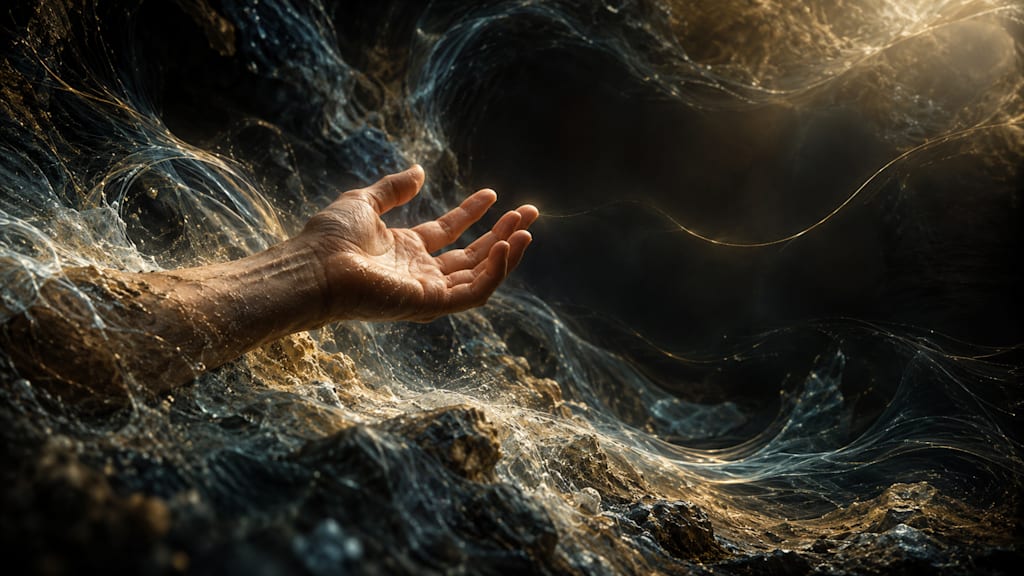
You arrive before there is a here. This is the first impossibility, though it will take time for you to understand it as such. Nothing is beneath your feet, yet you are not falling. Nothing moves against your skin, though your lungs continue the quiet habit of breathing, expanding and releasing as though somewhere around you there must still be air. Your heart beats. Blood moves warmly beneath your skin. Your tongue tastes faintly of salt. You lift one hand and turn it before you, expecting perhaps to see the familiar architecture of knuckle and vein, but seeing has not quite begun. What you perceive instead is the certainty of the hand itself: weight and warmth, bone held within flesh, the slight pull of an old injury when you spread your fingers too widely. Your body has arrived intact in a place that has not yet learned what a body is.
At first you mistake the Music for something remembered. It comes to you in the way forgotten things sometimes do, not as thought but as recognition, and for a while you search among the fragments of yourself for its source: a hymn heard in childhood, perhaps someone's voice in another room, the vibration of strings beneath fingertips. None of these is right. There are no voices here. There is not even sound as you have understood it, nothing struck or breathed or set trembling against the air. Yet the Music is everywhere—or what will someday mean everywhere—and your body receives it before your mind can make sense of what it has received. It passes along your bones. Your teeth ache faintly with its resonance. Something low and immense settles behind your sternum until your own heartbeat seems less a separate rhythm than a small, imperfect answer.
Only gradually do you become aware that you are not alone. You cannot see the singers. They are distinction without bodies, presence without location, each known somehow from the others and yet inseparable from what they are making together. Their Music moves outward, although there is no outward yet, gathering and opening upon something so vast that for one suspended moment you almost recognize it. There is a world within it, though not a world as you know worlds—not stone or water, leaf or wing, but the intention of one, whole and unfinished at once, waiting on the other side of some threshold you cannot perceive.
You should not be able to recognize it. The realization comes quietly, accompanied not by terror but by the awareness that something within the Music has turned toward you. You hold still, an instinct so old you obey it before understanding its absurdity. Your shoulders draw inward; your breath becomes shallow; your hands close against themselves. Somewhere in the immense unfolding around you, a movement changes. You feel it pass through the Music like attention crossing a crowded room, except there has never been a room and there has never been a crowd and, until this moment, perhaps there has never been anything here with reason to conceal itself. Your body knows concealment. The Music does not.
You open your hands and wait. When nothing happens, you allow yourself to follow one movement of the Music as it gathers from what seems at first to be nothing. There is brightness within it—not light, you understand, because light has not yet crossed whatever distance lies between intention and being. Still, you know brightness. You remember morning pressing through curtains, closing your eyes against the sun and seeing the blood-lit red of your own eyelids. The memory is scarcely formed before something opens within the Music, and you know at once that you have done this.
Fear follows the knowledge, and fear brings darkness—not darkness itself but every darkness your body has ever known, the moment after waking when a familiar room has not yet returned to itself. You try to stop the memories, but resistance gives them shape. Rain follows because you think desperately of something else, and suddenly you can smell wet stone, opened earth, leaves receiving water. A bird crosses your mind before you can prevent it, no particular bird, only the lift and hollowing of wings as a small body trusts itself to air. The Music receives each thing, but not as imitation. That would be easier to bear. It receives them as possibility.
Once you understand that memory is dangerous here, you begin the difficult work of becoming empty. You let images rise and refuse them. You turn away from faces before they resolve. When the curve of a coastline appears, you erase it before you can remember whether you have stood there. When a hand reaches toward yours, you refuse to see the face belonging to it. Gradually the Music settles, and whether moments or centuries pass while you learn this discipline, you cannot know. Time has not yet acquired the habits by which you once measured it. There is only the Music, the strange persistence of your body, and the growing conviction that stillness might be enough. If thought is what passes from you into this unfinished world, then thought can be guarded. Memory can be refused. You can close the doors one by one and leave Creation to become whatever it was becoming before you arrived.
Then your right hand opens.
You watch your fingers extend into the unmade space beside you. You have not told them to move. The gesture is small and strangely ordinary, the unconscious reaching of a hand accustomed to finding another hand waiting for it. Your palm turns slightly upward, your fingers remain open, and for the briefest instant your body waits with such certainty that you almost turn to see who is there.
Nothing meets them.
Something contracts beneath your ribs. You withdraw your hand at once, but the body does not withdraw with it. Your throat has tightened. Your jaw aches from the force with which you have suddenly closed it. Pressure gathers behind your eyes, and somewhere deep within your chest is the unmistakable sensation of having reached the end of a breath you do not remember holding. You search for the memory that belongs to the gesture and find nothing. There should be someone there; of this your body is certain. Your mind offers no face, no name, no room in which the absent hand once rested inside yours. When you reach carefully toward the emptiness again, you encounter only the knowledge that something has been removed from you so completely that even its outline has disappeared from conscious thought.
The body, however, has kept the outline, and the Music has heard it.
What moves through the singers now is unlike the attention you felt before. Their Music approaches the place beside you and changes around it, unable, perhaps, to understand how nothing can possess a shape. Until now, everything within their making has moved toward presence. Possibility gathers; distinction emerges; what is envisioned waits to become. But here, beside your outstretched hand, is evidence of another law: something can have been present and cease to be, and the place it occupied can remain. When the Music reaches toward the absence, your body recoils before your mind understands why. Across that immeasurable gathering of presences, something falters, not the Music itself but a movement within it, a hesitation so slight you might have missed it had your own body not recognized its shape. There should have been something there. There isn't. And for the first time, Creation knows the difference.
The knowledge does not remain beside you. You feel it move through the Music, carried not as sorrow—the singers possess no history from which sorrow might yet be made—but as an interval where none had existed before. A movement gathers toward completion and hesitates. Another rises to meet it and discovers the distance between anticipation and arrival. It is the pause before a door opens when you are waiting for someone on the other side. It is waking with one arm extended across a bed and knowing, for a moment before thought returns, that the cold sheet beneath your palm is wrong.
You fold your arms across your chest, holding yourself without thinking, and the Music changes again.
The gesture carries more than grief. It contains the body's knowledge of shelter, of enclosing what is vulnerable, of making a boundary between what must be protected and what lies beyond it. Your shoulders curve; your chin lowers; your hands settle against your ribs. Somewhere within the Music, vast movements answer—not with arms, not with walls, but with the first intimation of inwardness. There can be an inside. There can be an outside. Something may be held.
Your body continues to betray you in smaller ways. The sole of one foot anticipates ground and adjusts its weight against a surface that does not exist. Your spine remembers fatigue. Your stomach contracts with an old knowledge of hunger. Your skin knows the difference between touch and its absence. Flesh has learned things consciousness was never required to keep.
Moisture gathers at the corners of your eyes. You do not remember beginning to cry. The first tear moves slowly along your cheek, and because there is still no wind to cool its path, you feel its warmth until it reaches the corner of your mouth. Salt touches your tongue.
You know the sea.
Not a particular sea, though images attempt to gather: light broken across moving water, sand yielding beneath bare feet. You release them before they form. What remains is older. Salt in blood. Water held within cells. You stand within Creation, carrying Creation inside you, calcium in your bones, iron moving through your blood, water enclosed by skin, elements joined into a body whose very existence testifies to processes that have not yet occurred.
The Music recognizes what you carry.
For the first time, recognition travels in both directions.
Something immense turns toward the salt in you, and your blood seems to answer. Your heart stumbles once, then resumes. You become suddenly conscious of every hidden process keeping you alive: the exchange inside your lungs, the warmth generated in muscle, the electrical whisper along nerves, the old mineral strength of teeth and bone. You know almost nothing about how your body performs these things. It has never needed your understanding. It simply continues, bearing within itself a record more ancient than any memory you possess.
The thought frightens you enough that another follows before you can stop it. Perhaps you remembered wings because some possibility of flight was already moving through the Music. Perhaps rain entered your thoughts because water had always intended to fall. Perhaps the coastline you erased was never a contamination but recognition, your body answering the world from which it would one day be made. You try to locate a boundary between what Creation was becoming and what your presence has altered, but there is no longer a clean edge between them. If you have changed this place, then you came from a world already changed by your having been here.
Through all of this, the attention of the singers has remained upon you. You feel their questions gathering within the Music, approaching language without needing it. When the first question finally reaches you, you experience it less as speech than as the sensation of standing beneath a gaze.
“What are you?”
You hesitate. Every possible answer seems dangerous now. Your name is too particular, a small arrangement of sounds belonging to a world that may not yet possess mouths. Body describes only the vessel. Creature explains nothing in a place where all things wait on the edge of being. There is another word, though, one large enough to contain the contradiction of you, and you feel its weight before allowing yourself to speak.
“Human.”
The word leaves your mouth, though there is still no air through which it should travel. It has grain. Breath. A slight roughness in the throat. The Music receives not merely the word but the body required to make it, and what follows is the nearest thing to silence you have yet encountered.
The understanding moves slowly through the singers. This is not an anomaly without consequence. This body—this strange archive of hunger and touch, memory and forgetting—belongs to something the world they are making will one day contain.
The knowledge moves through the Music without judgment. That unsettles you more than horror would have. You want to explain that there is more, though you cannot say why explanation suddenly matters. You want to give them laughter before they mistake you for grief, warmth before they understand the cold sheet, the pleasure of bare feet against earth before they learn that feet can stumble. You want to think deliberately of every kindness you have ever received, but when you reach for them, they scatter beneath the urgency of being summoned. A hand against your forehead. A coat placed around your shoulders. A voice saying your name from another room. There. Again. You reach for the room, but it will not come. The voice disappears before you can follow it, and your body reaches toward what your mind cannot retrieve. The singers feel the movement.
Another question enters the Music, and this one is so gentle that you almost fail to recognize it as a question at all.
“What is missing from you?”
You turn toward the place beside you where your hand has reached again. The emptiness has become familiar now, though familiarity has not made it comprehensible. You search for the face, the name, the event that would explain the ache. Nothing returns. Your mind offers only closed doors. Behind them the body keeps its vigil, faithful to something consciousness has abandoned.
“I don't know,” you say.
The singers approach the absence again, but this time they do not recoil. You feel their attention move along its edges, encountering not what was lost—whatever that was remains inaccessible even here—but what the loss has made in you. Your reaching exists because there was once something worth reaching toward. The hollow beside you testifies to former presence. The ache cannot restore what is gone, but neither can forgetting erase the body's knowledge that it mattered.
Something begins within the Music.
At first you assume one of the singers has altered its part. The sound is slight enough to disappear within the immensity around it, yet it persists, and slowly you understand what is wrong. No presence has begun it. The note occupies the interval they discovered beside you, neither filling the absence nor leaving it untouched. It holds there, trembling between what is and what is not, and every movement of the Music must now pass around it.
Your chest tightens because you know this note, though when you search memory you find nothing. There is no melody attached to it, no voice, no room in which you once heard it. Still, your body answers with such certainty that your knees weaken. Your throat closes. Your right hand opens beside you. The same grief moves through you, but beneath it now is something you had failed to recognize because you had been looking only at what was gone.
Love had been there first.
The knowledge does not restore the memory. Whoever or whatever you lost remains beyond the closed door. You are unexpectedly grateful for this. To recover the face now would make the absence smaller, reduce it to one history when your body has been carrying something larger.
The note continues, and the Music gathers around it.
You listen as absence becomes interval, as interval makes anticipation possible, as distance leans toward return. None of these is the same as loss, though loss has opened the space in which they may exist. You feel then what you could not understand before: Creation has not mistaken your grief for the thing itself. It has encountered through you the possibility that one thing may matter to another.
The world within the Music begins again to move toward being. Something gathers beneath you. Your feet respond before your mind does, shifting slightly, preparing to receive weight. After so long without direction, the sensation frightens you. There is still no ground, but there is now the possibility of ground, and with it comes the possibility you have been spared since arriving: you might fall. The note sounds once more within the Music, and the fear passes through you differently this time. You think of the absent hand and let your own remain open.
The Music swells, carrying the strange note within it now, and for an instant you perceive the world not as it will look but as it will feel: weight beneath feet, rain against skin, warmth gathered on stone, the pull of hunger, the relief of shelter, another body beside one's own. You feel the terrible tenderness of things that can be touched precisely because they can also be taken away.
Then the Vision begins to cross whatever threshold separates imagining from existence.
You do not know whether you will cross with it.
Perhaps the moment Being arrives, the contradiction of your presence will resolve, and you will return to whatever life you came from. Perhaps you will remain as some impossible seam in the world. Perhaps you have always remained. The creation you remember may already contain traces of your trespass: in the body’s salt, in its instinct to shelter, in the hand that reaches while the mind sleeps, in the ache that survives the memory of its cause.
But as the first promise of weight rises to meet your feet, you hear the note again. It is no longer separate from the Music. You could not find where one ends and the other begins. Your body recognizes it. This time, you do not ask why.
About the Creator
Rebecca A Hyde Gonzales
I love to write. I have a deep love for words and language; a budding philologist (a late bloomer according to my father). I have been fascinated with the construction of sentences and how meaning is derived from the order of words.
Enjoyed the story? Support the Creator.
Subscribe for free to receive all their stories in your feed. You could also become a paid subscriber, letting them know you appreciate their work.
Comments
There are no comments for this story
Be the first to respond and start the conversation.