

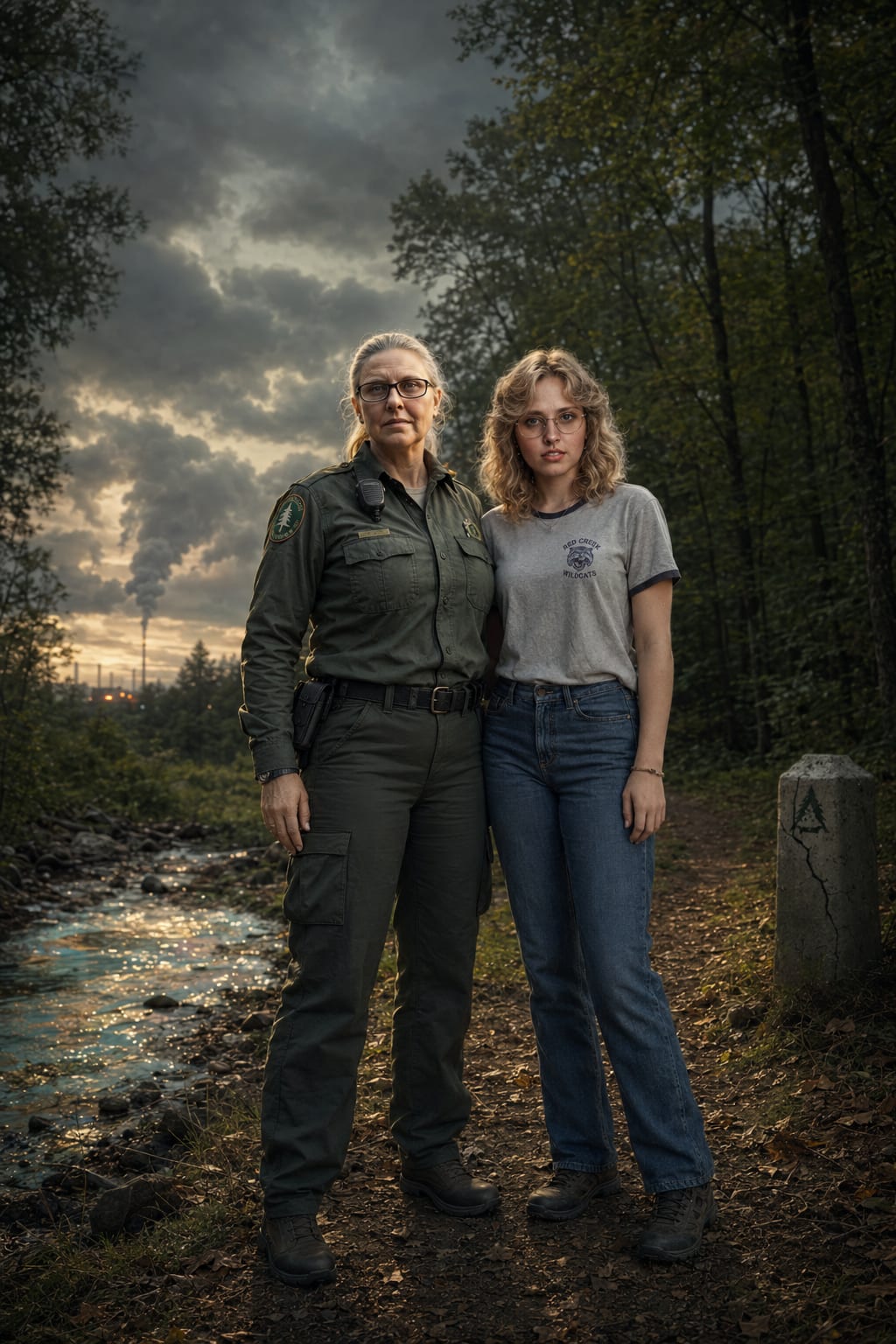
Chapter Three
What the Animals Knew
Mara
The child’s laughter came from beyond the trees.
Mara moved toward it before anyone else reacted.
“Ben?” she called.
She passed the edge of the Mercer campsite and entered a thick stand of cottonwoods. Low branches pulled at her uniform. Dry leaves cracked beneath her boots as she followed the direction of the sound.
A flash of red appeared ahead.
“Ben, this is Ranger Bennett. Stop where you are.”
Mara quickened her pace but forced herself not to run. A frightened child might mistake pursuit for danger and flee deeper into the forest.
Behind her, Lena ordered the others to remain at the campsite. A moment later, Mara heard the sheriff following her.
“Ben,” Mara called again. “Your family asked us to find you.”
It was not entirely true, but searchers sometimes borrowed the voices of missing people’s loved ones. A familiar connection could reach someone when reason could not.
Mara reached the place where she had seen the figure.
No one was there.
A strip of red fabric hung from a thornbush. She removed a clean evidence bag from her pack and examined the material without touching it.
It appeared to have been torn from a lightweight jacket.
Ben had been wearing a red jacket in the family’s most recent photograph.
Lena stopped beside her. “Did you see him?”
“I saw something.”
“Something?”
“It looked like a child.”
Mara sealed the fabric inside the bag. She searched the ground for tracks, but the dry soil revealed nothing distinct. Leaves had been disturbed in several directions, creating no clear trail.
Lena turned in a slow circle. “Where did the laughter come from?”
“Here.”
“I didn’t hear it after we left the campsite.”
“Neither did I.”
The mechanical hum continued beneath them. It was stronger near the restricted fence, a steady vibration that seemed to pass through the roots of the trees.
Mara crouched and pressed her gloved hand against the ground.
The soil pulsed beneath her palm.
Not randomly. Rhythmically.
Three seconds of vibration.
A brief pause.
Three more seconds.
“What kind of machinery does that?” Lena asked.
“I don’t know.”
A branch snapped somewhere behind them.
Both women turned.
Adam stood several yards away, breathing hard.
“I told you to remain at the campsite,” Lena said.
“I know, but you need to see this.”
“See what?”
“I found tracks near the creek.”
Mara and Lena followed him back through the trees.
The two volunteer firefighters remained beside the campsite. One had begun marking the area with bright survey flags while the other watched Ben’s personal radio resting on the folding chair. No additional voices had come through it. Lena’s official department radio continued carrying occasional updates from the search command post.
Adam led Mara upstream, keeping a safe distance from the water. Near a muddy patch beneath the bank, several footprints crossed the creek bed.
Mara crouched to inspect them.
There were at least three different sets.
One print appeared to have been made by an adult hiking boot. A second was smaller, possibly belonging to Sophie or Emily. The third came from a child’s athletic shoe.
“Three people crossed here,” Adam said.
“Possibly.”
“Then they’re together.”
Mara wished she could agree. The prints overlapped, but there was no reliable way to know whether they had been made at the same time.
She studied the far bank.
The tracks continued toward Northstar’s fence.
One print had filled with discolored water. A thin yellow residue marked its edges.
“We need proper protection before anyone gets closer,” Mara said.
“If Ben is over there, we can’t wait,” Adam replied.
“If the creek is contaminated, sending an unprotected search team through it creates more victims.”
Adam looked toward the fence. “Then how do we follow them?”
“We approach from higher ground and keep everyone out of the water.”
Through Lena’s department radio, Mara requested personal protective equipment—PPE—along with the park’s sealed environmental sampling kit. She also asked the command post to send additional teams to establish a perimeter around the campsite.
While they waited, she examined the tracks from the bank. Something else had disturbed the mud beside them.
Animal prints.
A doe and at least one fawn had approached the water. Their tracks ended near the edge, where they turned sharply and moved back toward the trees.
“The deer didn’t drink,” Mara said.
Lena looked at the dead fish. “Smart deer.”
“Maybe.”
Mara followed the animal tracks away from the creek. Thirty yards into the trees, she found the doe lying on its side.
Flies should have covered the body in the summer heat.
There were none.
The animal was still breathing. Its legs moved weakly against the ground, and foam collected around its mouth. Pale lesions marked the skin near its nose.
Mara stopped the others from approaching.
The fawn stood farther uphill, watching from between two trees. Its ribs showed beneath its coat. It did not run when Mara looked at it.
It only stared.
“There should be more animals around the water,” Mara said.
Adam glanced through the forest. “There aren’t any animals anywhere.”
That was not entirely true. The woods contained animals.
They were simply leaving.
Higher on the slope, narrow trails crossed one another through the grass. Deer, raccoons, coyotes, and smaller mammals had all moved in the same direction—south, away from the creek and Northstar.
Wild animals rarely agreed upon anything.
Now they appeared to agree that the northern forest was no longer safe.
The PPE and environmental sampling kit arrived forty minutes later.
Mara put on disposable chemical-resistant coveralls, nitrile gloves, splash goggles, and chemical-resistant rubber boots. Because the contaminant remained unidentified, she did not enter the creek or cross to the opposite bank.
Standing on stable ground several feet from the water, she extended the long-handled sampler over the bank. She collected three samples without allowing the creek water to touch her clothing or exposed skin: one from the surface, one from several inches below it, and one near the sediment.
She labeled each sterile container with the date, time, coordinates, and temperature.
The water measured nearly thirteen degrees warmer than it should have been.
Using the appropriate tools from the sealed kit, Mara collected soil from the yellow grass without stepping into the affected area. She also retrieved one dead fish from the bank and secured it in a specimen container. Farther upstream, she observed black residue clinging to exposed rocks. She sampled it from a safe distance using an extension tool.
The odor there was stronger.
“What does it smell like to you?” Adam asked from outside the collection area.
“Hot metal and plastic.”
“That’s what I thought.”
Mara photographed the area with the park’s evidence camera. Unlike her phone, it worked without interruption.
As she straightened, she noticed something beneath an exposed tree root.
A bumblebee lay on its back, its legs curled inward.
Beside it were dozens more.
She followed the scattered insects to a patch of wildflowers. Bees, beetles, and moths covered the ground beneath them.
The flowers remained upright, but their stems had turned translucent.
Mara photographed everything.
A sound came from the Northstar property.
It began as a metallic groan and rose into a deep vibration. The surface of the creek shuddered. Small stones moved along the bank, clicking against one another.
Adam stepped farther back. “Is that normal?”
“No.”
The noise stopped as abruptly as it had begun.
The forest remained silent afterward.
Mara sealed the samples inside a transport case and completed the chain-of-custody form. She signed her name, then asked Adam to witness it.
“These go directly to the state environmental laboratory,” she told him. “They do not stop at the county office, and they do not go anywhere near Northstar.”
“You think someone would interfere with them?”
“I think Daniel Mercer worked for Northstar, his family disappeared near its property, and something is poisoning this creek.”
“You didn’t answer my question.”
“Yes,” Mara said. “I think someone might interfere with them.”
The search continued until approaching storms made the northern trails unsafe.
Dark clouds gathered beyond the reservoir shortly after six, and thunder rolled across the distance. Lena assigned overnight deputies to guard the campsite while the search teams returned to command.
Mara drove the evidence samples to the Blackwood ranger station herself.
The station stood three miles south of the creek, beyond the park’s public campground. It was a low stone building constructed decades earlier, with an equipment garage on one side and a small administrative office on the other.
Rain began as Mara pulled into the parking lot.
At first, only a few drops struck the windshield. By the time she carried the transport case inside, water was falling hard enough to blur the trees.
Mara placed the samples inside a locked evidence refrigerator. The state courier could not reach the park until morning, so she documented the refrigerator’s temperature, checked its security seal, and locked the office.
Only then did she call Jesse.
Her daughter answered after the first ring.
“Mom, where are you?”
“At the ranger station. Are you home?”
“I just got here.”
Mara looked at the clock. “From where?”
“The diner. I was with Noah.”
Despite everything that had happened, Mara felt the familiar tug of parental irritation. “You should have told me you were leaving.”
“I’m eighteen.”
“You can be eighteen and still tell someone where you’re going.”
“Did you find the Mercers?”
The question stopped the argument before it began.
“We found their campsite.”
“But not them?”
“Not yet.”
Jesse was silent.
Mara removed her glasses and rubbed the bridge of her nose. Fatigue had settled behind her eyes.
“Jesse, did you know Sophie well?”
“We had classes together.”
“Did she ever mention problems at home or anything involving her father’s work?”
“No, but she sent me a message last night.”
Mara put her glasses back on. “What kind of message?”
“She said, ‘If my dad is right, the water isn’t the worst part.’ Then it stopped.”
Mara looked toward the locked evidence refrigerator.
“What time did she send it?”
“Around ten-thirty. My answer didn’t go through.”
“Do not delete it.”
“I won’t.”
“Take screenshots and turn off automatic cloud syncing.”
“That isn’t all.”
Mara waited.
Jesse described the emergency warning at the diner. She told Mara that it had ordered residents to avoid Haven Reservoir and municipal water. She explained how the warning disappeared and how the old camera captured words that had never appeared on her phone.
Then she told her about Sophie’s voice.
Mara sat slowly behind the desk.
“What exactly did Sophie say?”
“‘Jesse, don’t let it hear you.’”
Thunder shook the station windows.
Mara looked toward the official radio equipment mounted on the far wall. None of its indicator lights were on.
“Mom?”
“I’m here.”
“Do you believe me?”
Mara thought of Ben’s personal radio playing her own voice. She thought of the child-shaped figure in the red jacket and the whisper that had followed.
Too late, Mara.
“Yes,” she said. “I believe you.”
The answer seemed to frighten Jesse more than disbelief would have.
“What should I do?”
“Lock the doors. Close the curtains. Do not answer messages from Sophie unless you can verify they’re really from her.”
“How am I supposed to verify that?”
“Ask something only Sophie would know.”
“I don’t know her that well.”
“Then don’t respond.”
Mara heard movement through the call.
“Jesse?”
“I’m locking the back door.”
“Good. I’m leaving now.”
“Are you coming home?”
“Yes.”
Mara ended the call and stood.
Before leaving, she checked the evidence office one more time. The lock remained secure. The refrigerator hummed steadily, its temperature display glowing green.
She walked into the main hallway, turned off the lights, and locked the station behind her.
Rain covered the parking lot in silver sheets.
Mara ran to her truck.
As she pulled onto the park road, lightning flashed above Northstar. For an instant, its cooling towers appeared beyond the trees like enormous pale figures standing against the storm.
The hum followed her all the way home.
Mara slept for less than four hours.
At 2:17 in the morning, her work phone rang.
The park’s security system had detected movement inside the ranger station.
She dressed without turning on the bedroom light. Jesse’s door remained closed across the hallway. Mara considered waking her, then decided against it.
After confirming that every door was locked, she drove back to Blackwood.
The storm had passed. Fog drifted across the road, glowing in her headlights.
Lena’s patrol vehicle was already parked outside the station when Mara arrived. The front door stood open.
Mara stepped out of her truck.
“Lena?”
“Inside.”
Mara entered carefully.
The main office had been searched. Desk drawers hung open, papers covered the floor, and the park computer had been smashed. Muddy water formed a trail leading toward the evidence room.
The door had been forced from its frame.
The evidence refrigerator stood open.
Every container Mara had collected from Haven Creek was gone.
The water samples were missing. The soil sample was missing. The dead fish and the sealed jar of black residue had disappeared with them.
“Security footage?” Mara asked.
“Erased,” Lena said. “The backup failed at 2:09.”
Mara examined the damaged refrigerator. The thief had taken the transport documents as well, but the broken seal remained on the floor.
Something lay behind the open door.
One of her disposable gloves.
Mara remembered removing both outer gloves and placing them inside a hazardous-waste bag. This one should not have been there.
A dark stain spread across its fingertips.
She crouched without touching it.
“Evidence bag,” she said.
Lena handed her one.
Mara used forceps to lift the glove. As she turned it beneath the overhead light, she saw yellow crystals forming inside the plastic.
The glove had not contained crystals when she removed it.
A vibration traveled through the station floor.
The windows rattled in their frames.
On the desk, a glass jar rolled slowly toward the edge and shattered.
Mara stood completely still.
The low hum rose beneath the building.
For three seconds, the walls trembled.
Then everything stopped.
Lena looked at the cracks spreading through the mortar beside the evidence-room door.
“What is Northstar doing out there?”
Mara sealed the contaminated glove inside the bag.
“I don’t know,” she said. “But the animals already know enough to run.”
---
About the Creator
Ronna Curtis
Ronna Curtis, Ladybug, is the name I go by when publishing a book. For any books I write, I will show 2 to 4 chapters; the rest of the book or stories will be offered to subscribers. Contact information is [email protected]
Enjoyed the story? Support the Creator.
Subscribe for free to receive all their stories in your feed. You could also become a paid subscriber, letting them know you appreciate their work.
Comments
There are no comments for this story
Be the first to respond and start the conversation.