

Chapter Two
The Message That Vanished
Jesse
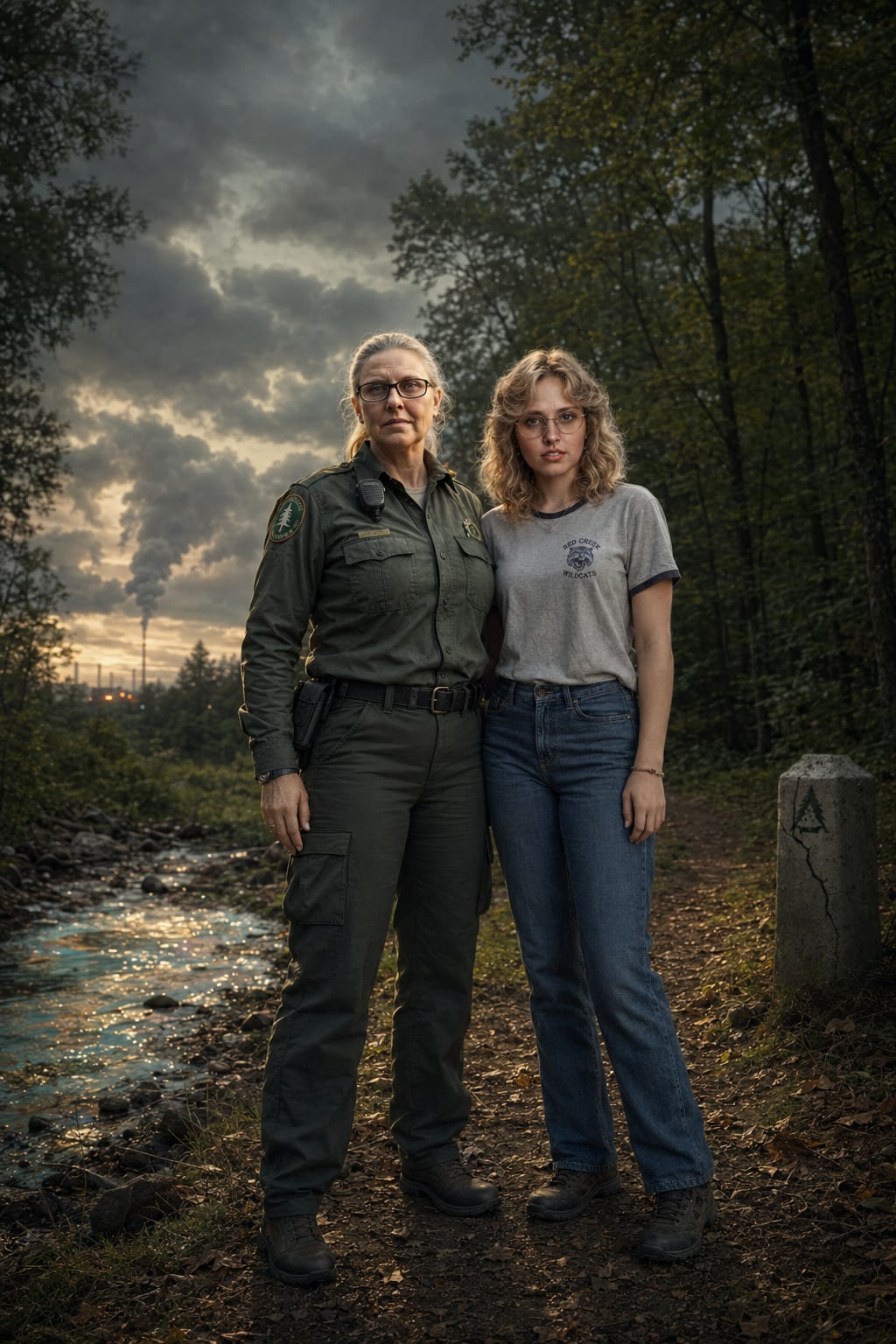
Jesse Bennett had spent most of her life preparing to leave Red Creek.
She had marked the distance to college on maps, compared dormitories, calculated tuition costs, and imagined waking in a place where nobody knew her as Ranger Bennett’s daughter. Her acceptance letter from Flint Hills University remained pinned above her desk, its lower corner curling in the July humidity.
In thirty-six days, she was supposed to leave.
That morning, thirty-six days had felt impossibly far away. Now, standing among half-filled boxes, she wondered whether it was enough time to prepare.
Jesse faced her bedroom mirror and pulled her light-blonde hair into a loose ponytail. Behind her glasses, her blue eyes revealed more uncertainty than she wanted to admit. She wore jeans and a comfortable cream-colored shirt, ordinary clothes for an ordinary afternoon.
Her senior portrait stood on the dresser beside her. In the photograph, she wore a formal dress in a soft, airy shade of pastel lavender. The light fabric fell in gentle layers, giving her an elegance she rarely saw when she looked at herself in the mirror. Mara had loved the photograph enough to order copies for nearly every relative they had.
She leaned closer to the mirror.
She looked prepared for a photograph.
She did not look prepared to leave home.
Her phone vibrated on the dresser. Jesse expected a message from her mother, but the screen displayed Noah Price’s name.
Noah: You still coming?
Jesse checked the time. She had promised to meet him at Bell’s Diner twenty minutes earlier. They were supposed to work on a website for his uncle’s repair shop, although she suspected Noah had invented the project to keep her from spending another afternoon packing and unpacking the same boxes.
Jesse: Leaving now.
Three dots appeared.
Noah: That’s what you said twenty minutes ago.
Jesse: This time I’m wearing shoes.
Noah: Progress.
Jesse slipped the phone into her pocket and looked around the room. Books filled one box. Winter clothing filled another. A third contained objects she could not justify taking but could not bring herself to leave behind: her graduation tassel, a ceramic owl Ben Mercer had made in art class, and the old digital camera her father had given her when she turned thirteen.
The camera had belonged to Thomas Bennett—to Tom, as nearly everyone had called him. Jesse's father had carried it on hiking trips, wildfire assignments, and almost every family vacation until he placed it in her hands on her thirteenth birthday. A year later, he died after the wind changed direction during a wildfire rescue. Four years had passed, but Jesse could still picture the camera strap looped securely around his wrist.
The camera was nearly obsolete. Its battery lasted less than an hour, and the lens cover stuck whenever the weather turned cold. Mara preferred equipment that did not depend on a network connection. According to her, a tool should continue functioning when the world stopped cooperating.
Jesse had teased her about that for years.
She placed the camera in her shoulder bag anyway.
She carried the bag downstairs and found the house unusually warm. The air conditioner had stopped during the latest rolling blackout and had not recovered. Two electric fans turned in opposite corners of the living room, pushing hot air from one side to the other.
A bottle of water stood on the kitchen table. Beneath it, Mara had left a handwritten note.
Search call. Mercer family. Don’t drink from the tap until I get home. Love you.
Jesse read it twice.
She already knew the Mercers were missing. Everyone in Red Creek knew. Their photographs had circulated online since the previous night.
Daniel Mercer looked uncomfortable in every photograph, as though he preferred standing behind the camera. His wife, Emily, had kind eyes and wore her dark hair in a practical shoulder-length cut. Nine-year-old Ben grinned while holding his green radio. Sophie stood beside him with the patient expression of an older sister who had been warned not to complain.
Jesse knew Sophie from school. They had shared three classes during their senior year and worked together on a science presentation about groundwater. They were friendly, although they did not normally exchange personal messages.
That made the message Jesse had received from Sophie the previous night more troubling.
She opened it again.
Sophie: If my dad is right, the water isn’t the worst part—
The sentence ended there.
Jesse had answered within a minute.
Jesse: What does that mean? Are you okay?
Her response had never been marked as delivered.
She considered calling Mara, but her mother would be coordinating a search. Jesse decided to show her the message when she returned.
She picked up the unopened bottle of water and left the house.
Outside, the heat settled over Red Creek like a heavy blanket. Lawns had faded from green to brown. Leaves curled on the trees lining the street, and the sky had the pale, dusty appearance that came before a storm that would never arrive.
Jesse locked the front door and began walking toward Main Street.
Bell’s Diner was six blocks away. The walk usually took less than fifteen minutes, but the afternoon heat made every block feel longer. As Jesse passed neighboring houses, she noticed more dried lawns, closed curtains, and air-conditioning units sitting silent in windows.
Somewhere beyond town, machinery produced a low, steady hum.
Jesse had heard it so often that she usually ignored it. People began complaining about the noise not long after Northstar opened its data campus near Haven Reservoir. The company claimed the sound remained within legal limits.
Today, however, Jesse felt the hum as much as she heard it. It seemed to vibrate through the pavement beneath her shoes.
A Northstar service truck approached from behind. Jesse moved closer to the curb as it passed. Its white body displayed a blue starburst and the words:
BUILDING TOMORROW’S CONNECTIONS
The driver did not look at her. The truck continued toward the northern edge of town, following the road that led to Haven Reservoir.
Jesse watched until it disappeared around the corner.
She resumed walking.
When she reached Main Street, the houses gave way to familiar businesses: a pharmacy, the post office, Noah’s uncle’s repair shop, and a grocery store with a handwritten sign limiting customers to two cases of bottled water.
Bell’s Diner stood at the intersection of Main and Alder, directly across from Red Creek High School. Graduation banners still hung from the streetlights.
CONGRATULATIONS, CLASS OF 2027!
Jesse’s name had been printed on a temporary sign outside the school with the names of eighty-three other graduates. For three days after graduation, Mara had driven past it whenever possible.
Jesse had complained every time.
Secretly, she had liked it.
She crossed Alder Street and entered the diner.
Cool air greeted her, although it was not as cool as usual. The ceiling fans turned slowly above red vinyl booths. Only a few customers occupied the tables.
Jesse paused inside the entrance until she spotted Noah sitting in their usual booth near the back. His laptop was open, and a glass of water rested beside it.
He looked up as she approached.
“You made it.”
“I said I would.”
“You said it twenty minutes before you actually left.”
Jesse slid into the booth across from him and placed her shoulder bag beside her. “Are we building a website or documenting my failures?”
“Both. The website will have a separate page for them.”
Noah turned the laptop toward her. His uncle’s repair-shop logo appeared at the top of a mostly blank screen.
Jesse reached for the water glass before remembering Mara’s note. She pulled her hand back.
Noah noticed. “What?”
“My mother told me not to drink tap water.”
“Why?”
“She didn’t explain.”
He lifted his glass. “I’ve already had two.”
Jesse studied him. Now that she was sitting nearby, she could see that he looked unusually pale. Shadows darkened the skin beneath his eyes, and his brown hair was damp against his forehead.
“Are you feeling all right?”
“I’m hot.”
“It’s hot outside.”
“It’s hot everywhere.”
He rubbed his temple.
“Do you have a headache?” Jesse asked.
“A little.”
“How long have you had it?”
Noah gave her a tired smile. “Please don’t become your mother.”
“I asked two questions.”
“You asked them exactly like she would.”
A waitress approached with a pitcher. Jesse placed her hand over the top of Noah’s glass before the woman could refill it.
“Could we have bottled water instead?” Jesse asked.
“We’re out,” the waitress said. “The delivery truck never came.”
“Then we’re fine.”
After she walked away, Noah raised an eyebrow. “You know bottled water often comes from municipal systems too.”
“Yes, but my mother specifically left a note.”
“Your mother also keeps an emergency blanket in her truck in July.”
“She once used it to help someone suffering from shock.”
“She keeps three compasses in her kitchen.”
“One is decorative.”
“It still works.”
Jesse smiled despite herself.
Mara’s caution was easy to mock because it usually seemed unnecessary—right until someone became lost, injured, stranded, or frightened. Then everyone wanted Mara Bennett nearby.
Noah’s expression became serious. “Is your mother searching for the Mercers?”
Jesse nodded.
She looked through the diner window. A missing-family notice had been taped to the glass beside the entrance.
“I received a message from Sophie last night,” she said.
She took out her phone and showed it to him.
Noah read the unfinished sentence.
“If my dad is right, the water isn’t the worst part,” he said. “What is the worst part?”
“That is what I would like to know.”
“Did you show this to the sheriff?”
“Not yet. I’m going to show Mom when she comes home.”
“What if Sophie sent it because she needed help?”
“She didn’t say where she was, and my response never reached her.”
Noah glanced at his laptop. “Maybe more of the message was saved somewhere.”
“Where?”
“In a cloud backup or the application’s temporary files.”
“It was sent through an encrypted app.”
“Everything leaves a trace.”
“That sounds like something printed on Northstar’s wall.”
Noah closed the laptop halfway. “My uncle did electrical work there during construction. He said they have entire server levels underground.”
“How far underground?”
“He didn’t know. Workers were only allowed into the section connected to their assignment.”
Jesse looked toward the missing-family notice again. Sophie smiled from the photograph, unaware that her face would soon be displayed in every store in Red Creek.
Before Jesse could respond, the diner’s lights went out.
The ceiling fans slowed to a stop. The refrigerator behind the counter became silent, and the jukebox near the entrance died in the middle of a song.
Someone near the kitchen groaned.
“Again?” the waitress called.
Noah held up his phone. “I don’t have service.”
Jesse checked hers. The signal indicator showed four bars, then none, and then four again.
A sharp emergency tone sounded from every phone in the diner.
Conversations stopped.
A warning filled Jesse’s screen.
EMERGENCY WARNING
HAZARDOUS MATERIALS RELEASE
AVOID HAVEN RESERVOIR AND CONNECTED WATERWAYS
DO NOT USE MUNICIPAL WATER
AWAIT EVACUATION INSTRUCTIONS
Voices erupted around the diner.
“What happened?”
“Is this about Northstar?”
“My children are at the pool.”
“Someone call the sheriff.”
Before Jesse could take a screenshot, the warning vanished.
Her ordinary home screen returned.
“What just happened?” Noah asked.
“The emergency warning.”
“What warning?”
“The one that appeared on everyone’s phone.”
Noah held up his screen. “I heard the alert, but my screen stayed black.”
Around them, customers compared their phones. Several had seen messages, but no one could agree about what they said. One man claimed it was a thunderstorm warning. The waitress thought it concerned an electrical outage. Others had heard the tone without seeing any text.
Jesse opened her notification history.
It was empty.
She checked the county emergency-management page. No warnings had been issued.
The lights flickered back on. The ceiling fans began turning, and the jukebox restarted the song from the beginning.
Noah reopened his laptop. “Maybe it was a system test.”
“Tests are labeled as tests.”
“Then someone sent it accidentally.”
“Accidental warnings don’t normally erase themselves from notification histories.”
Jesse opened her shoulder bag and removed the old digital camera.
Noah watched her. “What are you doing?”
“Waiting to see if it happens again.”
She set the camera on the table with the lens facing her phone.
Five minutes passed.
Nothing happened.
Noah returned to the website, but Jesse kept one hand near the camera.
After ten minutes, she began to wonder whether the warning would return. At twelve minutes, the emergency tone sounded again.
Jesse immediately pressed the camera’s record button.
The same warning appeared on her phone.
HAZARDOUS MATERIALS RELEASE
AVOID HAVEN RESERVOIR AND CONNECTED WATERWAYS
DO NOT USE MUNICIPAL WATER
She held the camera steady until the message vanished.
“Did you see it that time?” she asked.
Noah shook his head. “My screen stayed black again.”
“But you heard the alert?”
“Yes.”
This time, no one else in the diner reacted. A few customers glanced at their phones and continued eating.
Jesse stopped the camera and replayed the recording.
The image was grainy, but the warning was visible.
“Now we have proof,” Noah said.
Jesse rewound the video and played it again.
The warning appeared exactly as she remembered.
Then a new line formed beneath it.
JESSE BENNETT
Jesse froze the recording.
“That wasn’t on my phone,” she said.
The name disappeared, replaced by another sentence.
IT KNOWS YOU SAW THIS.
Noah leaned closer. “What does that mean?”
Jesse played the video from the beginning.
The warning appeared.
Her name followed.
Then came the final sentence.
IT KNOWS YOU SAW THIS.
The camera screen turned black.
A distorted voice emerged from its small speaker.
At first, Jesse heard only static. Then a girl whispered:
“Jesse, don’t let it hear you.”
Jesse recognized the voice. She had heard it every morning during senior English.
“Sophie?” she whispered.
The diner’s lights went out for the second time.
Across the table, Noah’s water began to tremble.
About the Creator
Ronna Curtis
Ronna Curtis, Ladybug, is the name I go by when publishing a book. For any books I write, I will show 2 to 4 chapters; the rest of the book or stories will be offered to subscribers. Contact information is [email protected]
Enjoyed the story? Support the Creator.
Subscribe for free to receive all their stories in your feed. You could also become a paid subscriber, letting them know you appreciate their work.
Comments
There are no comments for this story
Be the first to respond and start the conversation.