

Chapter Four
A Hum in the Walls
Jesse
Jesse woke to the sound of Mara’s truck leaving the driveway.
She reached for her glasses and looked at the clock beside her bed.
2:21 a.m.
For several seconds, she remained beneath the sheets, listening to the engine fade into the distance. Her mother had returned home less than four hours earlier. Jesse had heard her moving quietly through the hallway, checking the doors and windows before going to bed.
Now she was gone again.
Jesse picked up her phone and called her.
The call rang twice before going to voicemail.
“Mom, I heard you leave. Please tell me where you’re going.”
Jesse ended the call and waited.
No response appeared.
She got out of bed and crossed to the window. The street was empty. Fog drifted between the houses, and the wet pavement shone beneath the streetlights. The storm had lowered the temperature, but the air inside the house remained heavy and warm.
Jesse pressed her hand against the window.
The glass vibrated beneath her fingertips.
At first, she assumed it was thunder. Then she realized the storm had already passed.
The vibration continued.
Three seconds.
A pause.
Three more seconds.
Jesse stepped away from the window.
She had first noticed the vibration at Bell’s Diner, when Noah’s glass of water began to tremble. After returning home, she had detected a fainter version of it in her bedroom wall, but exhaustion had allowed her to dismiss it as distant machinery. She had gone to sleep several hours ago believing it would eventually stop.
Now, at 2:21 in the morning, the vibration was strong enough to shake the window beneath her fingertips.
The hum had not followed her home. It had already spread across Red Creek.
She moved into the hallway and stopped outside Mara’s bedroom. The door stood partially open. The bed was unmade, and the closet light remained on.
Mara had left quickly.
Jesse returned to her room and dressed in jeans and a sweatshirt. Before going downstairs, she picked up her father’s digital camera.
The screen lit when she pressed the power button.
She replayed the recording from the diner.
The emergency warning appeared first.
HAZARDOUS MATERIALS RELEASE
Then came her name.
JESSE BENNETT
Finally, the last message appeared.
IT KNOWS YOU SAW THIS.
Sophie’s distorted voice followed:
“Jesse, don’t let it hear you.”
Jesse paused the recording.
She remembered the way her father used to carry the camera with its strap wrapped around his wrist. Tom Bennett had taken photographs of everything—family vacations, unfamiliar birds, smoke rising over distant hills, and Mara pretending not to notice whenever he aimed the camera at her.
He had trusted what he could document.
People remember what they felt, he once told Jesse. A camera remembers what was there.
But the message on the recording had not been there. Jesse had watched her phone while filming it. She would have noticed her own name.
The camera was not remembering what had been there.
It was showing her something else.
A vibration passed through the floor.
Jesse turned toward the hallway.
The framed photographs along the wall shifted slightly. One corner of her graduation portrait tapped against the plaster.
Tap.
Pause.
Tap.
Jesse walked toward it.
Her senior photograph showed her in a soft pastel-lavender dress, the light fabric falling in gentle layers. Mara had placed the portrait beside an older family photograph taken months before Tom’s death.
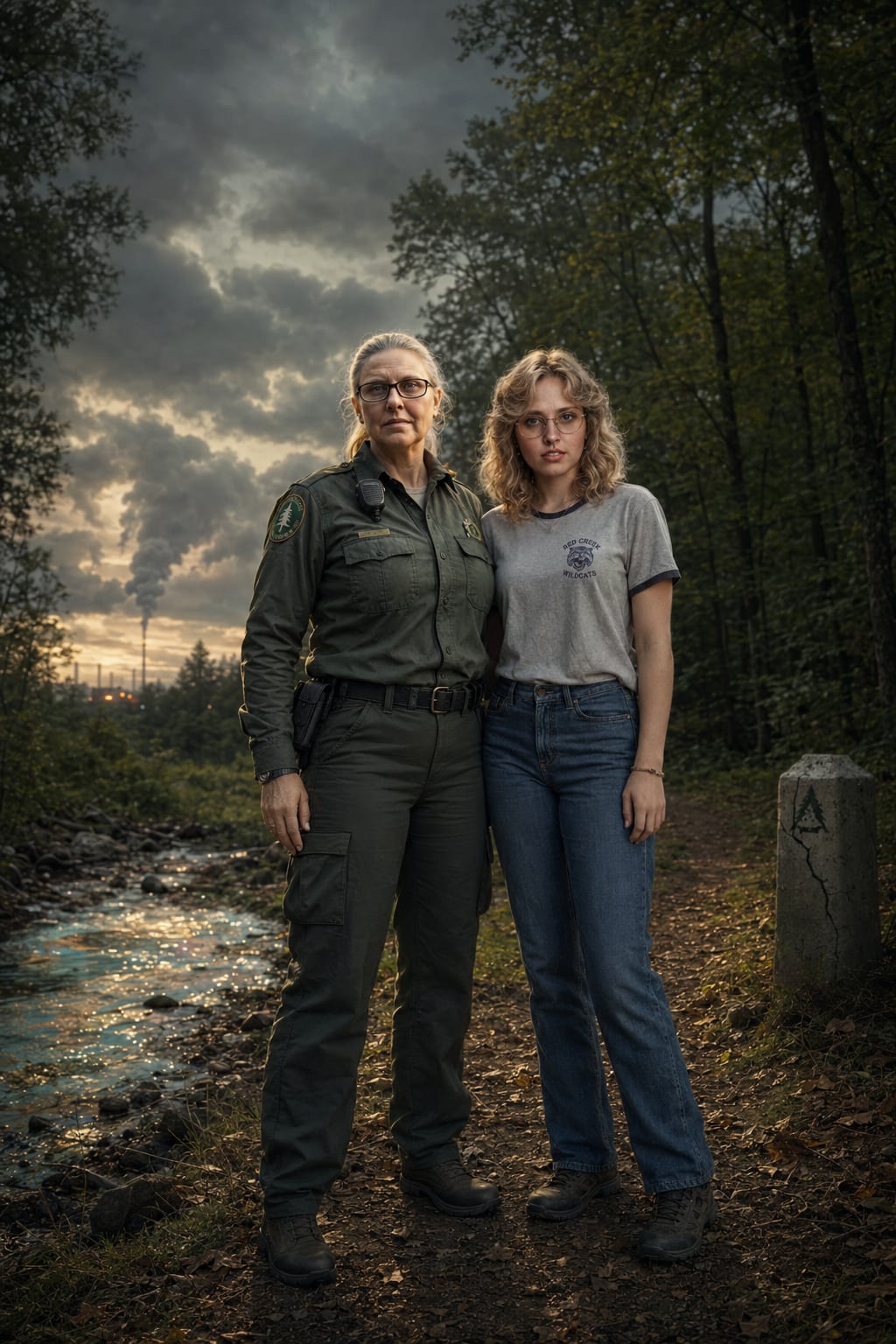
In that picture, Jesse stood between her parents at Haven Reservoir. Mara wore her ranger uniform. Tom had one arm around Jesse and the other around Mara. All three were laughing at something outside the frame.
The photograph trembled.
A thin crack appeared in the plaster behind it.
Jesse removed both frames from the wall.
The crack began near the ceiling and continued downward in a nearly straight line. It was narrow enough to have escaped notice before, but pale dust had collected on the baseboard beneath it.
She placed her fingertips against the wall.
The hum traveled through the plaster and into her hand.
Three seconds.
Pause.
Three seconds.
It was not simply noise. It had a pattern.
Jesse opened the camera and recorded the wall for nearly a minute. The microphone captured little more than a faint mechanical rumble, but the image shook whenever the vibration returned.
She saved the recording and went downstairs.
The kitchen clock had stopped at 2:09.
So had the clock on the microwave.
Jesse checked the living-room television. Its standby light was dark. The house had lost electricity, but the streetlights outside remained on.
The hum continued without it.
She stood in the center of the kitchen and listened. The sound seemed strongest near the sink.
Mara’s warning remained on the table.
Don’t drink from the tap.
Jesse opened the cabinet beneath the sink. Pipes ran into the wall behind cleaning supplies and a box of trash bags.
The hum became louder when she leaned closer.
Something knocked inside the pipe.
Once.
Twice.
Then three times in quick succession.
Jesse closed the cabinet.
Her phone vibrated in her pocket.
She flinched before checking the screen.
It was a message from Mara.
Security alarm at ranger station. Stay inside. Doors locked. I’ll call soon.
Jesse answered immediately.
The walls are vibrating. The clocks stopped at 2:09.
The message remained undelivered.
She looked toward the dark microwave.
2:09.
That was eight minutes before Mara’s work phone had awakened her, although Jesse did not yet know it was also the exact time the ranger station’s security backup had failed.
The hum stopped.
The sudden silence felt worse.
Mara returned shortly after sunrise.
Jesse was sitting at the kitchen table with the camera, both family photographs, and a page covered in recorded times. She stood when she heard the key turn in the front door.
Mara entered wearing the same clothes she had left in. Mud marked the bottoms of her boots. Her hair had escaped its ponytail, and exhaustion showed beneath her glasses.
“What happened?” Jesse asked.
“Someone broke into the ranger station.”
“Was anyone hurt?”
“No.”
“What did they take?”
Mara locked the door behind her before answering. “The environmental samples from the creek.”
“All of them?”
“Almost.”
Jesse waited for her to explain what almost meant, but Mara crossed to the kitchen window and closed the curtains.
“Mom?”
“A contaminated glove was left behind. Lena is sending it to a different laboratory.”
“Do you think Northstar took the samples?”
“I don’t know.”
“That usually means yes.”
“It means I don’t have evidence.”
“You had evidence. Someone stole it.”
Mara removed her glasses and cleaned them with the edge of her shirt. “For now, we are not drinking tap water, cooking with it, or using it to brush our teeth.”
“We don’t have enough bottled water.”
“I have emergency supplies in the garage.”
“Of course you do.”
Mara put her glasses back on. “This is not the day to make fun of my emergency supplies.”
“I’m not making fun of them.”
Jesse looked at how tired her mother appeared and softened her voice.
“I’m glad you have them.”
Mara glanced at the items on the table. “Why are those photographs down?”
Jesse showed her the crack in the hallway wall. Then she played the recording of the vibration.
Mara watched it twice.
“Three seconds,” Mara said.
Jesse looked at her notes. “What?”
“The vibration lasts for three seconds, stops, and then returns.”
“You heard it too?”
“Near the Mercer campsite.”
Neither spoke for a moment.
Jesse remembered Sophie’s unfinished message.
The water isn’t the worst part.
“Could the hum be what she meant?” she asked.
Mara looked toward the hallway. “Maybe.”
Jesse’s phone rang.
Noah’s name appeared on the screen.
She answered. “Are you okay?”
Noah’s voice sounded weak. “Not really.”
“What’s wrong?”
“I’ve been throwing up since I got home.”
Jesse stood. “Did you tell your mother?”
“She’s here.”
“Have her take you to the clinic.”
“She tried. The waiting room is full, and they’re sending people to the high-school gym.”
“Why the gym?”
“There are too many sick people.”
Jesse looked at Mara.
Her mother had heard enough of the conversation to understand.
“Ask what symptoms they have,” Mara said.
Jesse repeated the question.
“Headaches, vomiting, rashes,” Noah answered. “Some people are confused. Mrs. Taylor forgot her husband’s name.”
Jesse remembered the two glasses of water Noah drank at the diner.
“When was the last time you drank tap water?”
“At the diner.”
“What about at home?”
“My mom made coffee this morning.”
“Don’t drink anything else from the sink.”
“I know that now.”
A low vibration traveled through the phone.
Jesse pulled it away from her ear. “What was that?”
“What was what?”
“The hum.”
There was a pause.
Noah spoke more quietly when he answered.
“It’s inside our walls too.”
Mara drove Jesse to Noah’s house rather than allowing her to walk.
They loaded the truck with bottled water, first-aid supplies, two emergency blankets, and several containers of food that did not require cooking. Mara also brought masks and disposable gloves.
Noah lived on the northern edge of Red Creek, closer to Haven Reservoir and Northstar. As Mara drove, the signs of illness became harder to ignore.
Cars filled the parking lot outside the clinic. A line of people extended beyond its doors. Two ambulances waited near the high-school gym, where volunteers were setting up folding tables beneath a handwritten sign:
TEMPORARY MEDICAL ASSESSMENT CENTER
Several residents stood beside the road holding empty water containers.
A Northstar tanker passed them, traveling north.
“Is that carrying water?” Jesse asked.
Mara watched it through the mirror. “It looks like it.”
“They have water for Northstar but not for the town?”
“We don’t know where it’s going.”
“It says Northstar on the truck.”
“That tells us who owns it, not what is inside.”
Jesse crossed her arms. “You always say not to ignore the obvious.”
“I also say not to reach a conclusion before collecting facts.”
“Someone stole your facts.”
Mara did not respond.
They continued toward Noah’s neighborhood.
When they arrived, his mother met them at the door. Her face was pale with worry.
“He’s on the couch,” she said. “He can’t keep anything down.”
Noah lay beneath a thin blanket in the living room. His skin looked gray, and a rash had appeared along his neck.
Jesse placed the bottled water beside him.
“Small sips,” Mara instructed. “Not too much at once.”
She checked his pulse and asked him several questions. Noah knew his name, the date, and where he was, but he struggled to remember what he had eaten the previous evening.
“The diner,” Jesse reminded him.
“I know we were there.” He closed his eyes. “I don’t remember leaving.”
Mara looked at Noah’s mother. “If he becomes disoriented, has difficulty breathing, or stops responding normally, call emergency services again.”
“They told me not to call unless he loses consciousness.”
Mara’s expression tightened.
A vibration passed through the house.
The glasses inside a cabinet rattled. A framed picture shifted on a shelf, and something struck the plumbing beneath the floor.
Noah opened his eyes.
“It does that every few minutes,” he whispered.
Mara placed one hand against the wall.
Jesse watched her count silently.
Three seconds.
Pause.
Three seconds.
“It’s stronger here,” Mara said.
“Because we’re closer to Northstar?” Jesse asked.
“Possibly.”
Noah turned his head toward them. “My uncle said the underground servers needed special cooling lines.”
“The uncle who worked at Northstar?” Mara asked.
Noah nodded weakly. “He kept copies of the construction plans.”
“Where?”
“At the repair shop.”
“Does anyone else know he kept them?”
“I don’t think so.”
The television turned on.
Everyone looked toward it.
The house still had electricity, but no one had touched the remote. A local news presenter appeared on the screen.
“Red Creek officials have confirmed that today’s illnesses are associated with extreme heat,” she announced. “Residents should remain calm and continue drinking water to prevent dehydration. Municipal water is safe.”
Jesse stared at the message scrolling beneath the presenter.
NO CONTAMINATION DETECTED
Mara reached for the remote and muted the television.
“Do not follow that instruction,” she told Noah’s mother. “Use only sealed water until we know more.”
The presenter continued speaking silently.
For a fraction of a second, the picture changed.
Sophie Mercer appeared on the screen.
Her face was pale and frightened. Her mouth formed a single word.
Pipes.
Then the news presenter returned.
“Did you see that?” Jesse asked.
Mara moved closer to the television. “See what?”
“Sophie.”
Noah tried to sit up. “Where?”
“She was on the screen.”
Mara unmuted the television, but the news report had moved on to the weather.
Jesse took out her father’s camera and aimed it at the screen.
The camera powered on by itself.
A message appeared across its display:
THE WATER CARRIES THE POISON.
The words vanished.
A second message replaced them.
THE PIPES CARRY THE VOICE.
From somewhere inside Noah’s wall, Sophie began to whisper Jesse’s name.
About the Creator
Ronna Curtis
Ronna Curtis, Ladybug, is the name I go by when publishing a book. For any books I write, I will show 2 to 4 chapters; the rest of the book or stories will be offered to subscribers. Contact information is [email protected]
Enjoyed the story? Support the Creator.
Subscribe for free to receive all their stories in your feed. You could also become a paid subscriber, letting them know you appreciate their work.
Comments
There are no comments for this story
Be the first to respond and start the conversation.