
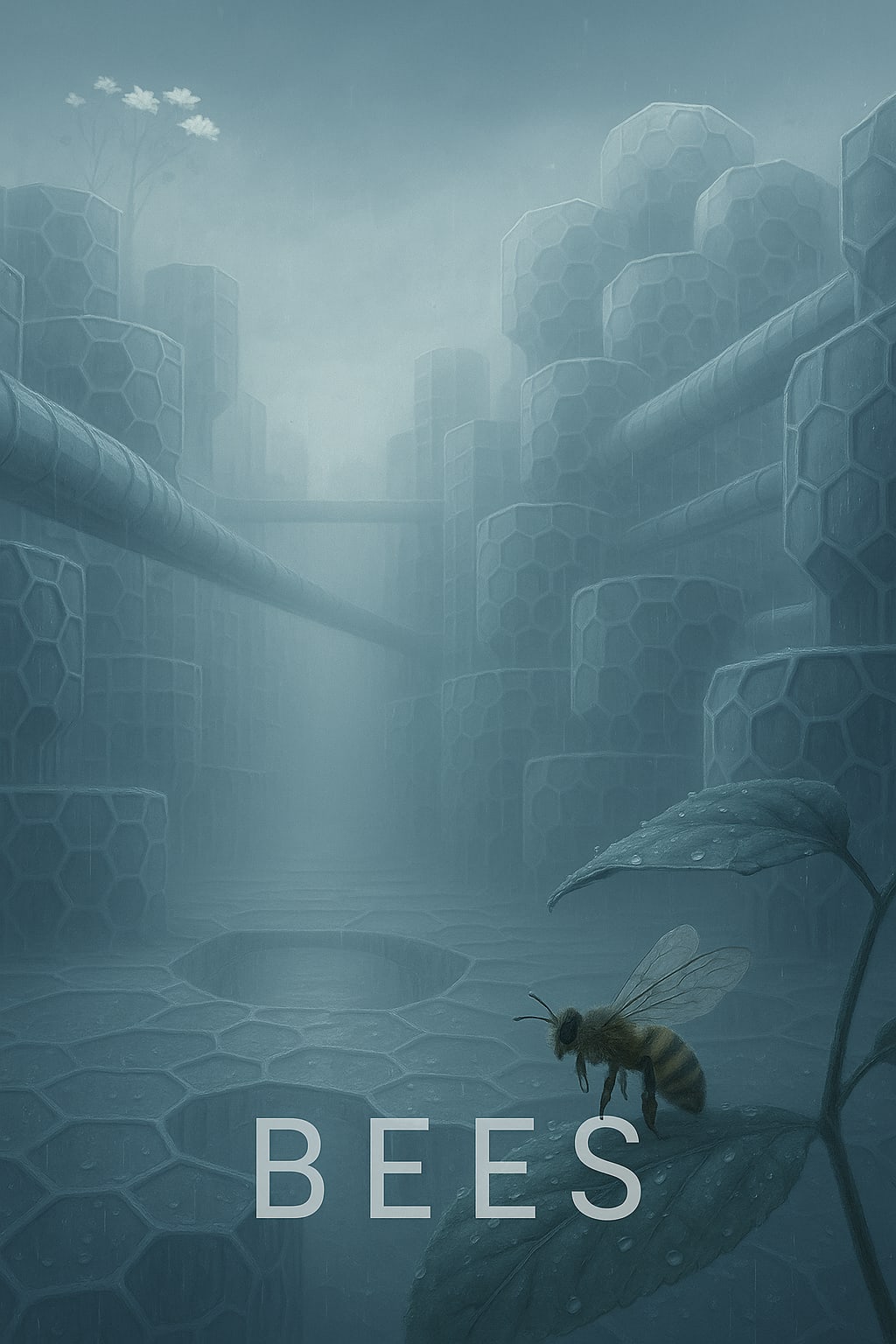
A small bee hid beneath a leaf. The summer rain had passed. Thunder receded into the distance. The bee shivered its wings, then took flight.
If you were that bee, you would see the hive-city: stacked units made of transparent nylon, interconnected by open corridors. No doors. No private space.
These units grew in all directions, seemingly without order. But in truth, a will arranged them—a silent, unseen design that optimized space and energy.
The humid air carried pheromones that stirred the bee’s senses. It flew faster.
Above, millions of its siblings beat their wings in unison. The infrasound they produced called to it. The bee joined the current, funneling into a vertical passage made just for them.
Every unit in the hive-city had such passages. They formed a network. At each node was a bee chamber—carefully tuned in temperature, humidity, and scent, calibrated to keep bees content.
A pheromone broadcast system delivered constant instructions. No bee ever had to think.
They danced. In the chambers, they danced in circles. In the air, hundreds of thousands formed patterns—shifting glyphs, symbols, waves.
They never tired. The bees ruled the hive-city.
The bee moved down a vertical tunnel. When it finally emerged into the lower levels of the hive-city, it caught a strange scent. The scent of a human.
Humans were the most irrational elements in the hive-city. The buildings made sense. The bees made sense. The machines each had their task, optimized and uncomplaining. But people? Perhaps they were remnants, inherited burdens. Perhaps they were, sometimes, more cost-efficient than machines. Or perhaps they served a purpose not yet disclosed.
Of course, the bee did not think. It simply hesitated. The pheromones here were erratic, unclear. It slowed its flight. Below, people moved through corridors. Above them were structural panels. Between the panels stood columns. Outside, weeds and shrubs struggled to grow. Men and women walked without direction. There were no elders, no children. No one spoke. Everyone looked past one another, as if no one was really there. On each chest, a small rectangular card gleamed. That was the most important thing: the work badge.
When the badge lit green, it meant the system had granted the person temporary identity. They would pass through a gate, carry out a designated task—cleaning what machines could not, testing something with their own bodies, carrying boxes, or stripping naked to remain in position, as instructed. Tasks were always simple. Always logical. The Will distributed all labor. Its choices were beyond question.
Only those with active badges could enter the maintenance pods—tall green cylinders scattered across the city. Inside each, a feeding tube dispensed a gel to suppress digestive atrophy. The gel stayed in the gut for weeks, broke down, and passed cleanly. No mess. No odor. No waste. A separate injector delivered nutrients. One dose created a bulge on the back—like a camel’s hump—providing weeks of stored energy. More importantly, the pod allowed rest. People slept standing up.
When the Will deemed a person’s biological activity inefficient—or simply unnecessary—their badge turned red. They would find a red cylinder. Inside, there was no tube. No injection. Only a red button. When pressed, a flame system ignited, carbonizing the body in under sixty seconds. In the devolved language of the people, this chamber was called the goodnight pod.
As the bee flew past a woman, it suddenly dipped and landed on her shoulder.
"Little one, what’s wrong with you?" Her voice was not like the others—muted and dull—but clear, almost warm. She gently stepped aside and placed the bee on a nearby leaf. After a moment, she watched it fly off.
The woman was around sixty, though she could have been much older or much younger. Her gray, curly hair was half-covered by a checkered brown scarf. Her badge was unlit, but it displayed a designation: Florist.
She stepped into the shrubbery, trimming branches with a pair of scissors. Her other hand wore a glove. The tip of the glove’s middle finger was torn. With each movement, tiny seeds leaked out. She was focused, lost in her task, until a girl called to her.
"Hey! What are you doing?"
The woman turned. A girl in windproof goggles stood behind her, hands on her hips.
"Florist? That’s your name?"
"No. My name is Lyly," the woman replied with a smile.
"You have a name?" The girl studied her. "You’re different. Like me. My name is Eye-3. Third in line. If the first two go bad, they’ll take mine, Look!"
She held out her hand. Lyly extended her gloved one but quickly pulled back. The girl used her own hand to wipe her goggles.
"My job is to protect my eyes. That’s why I wear these." She flicked the lens with her finger. It gave a sharp, glassy ping.
"Can I see your eyes?" Lyly leaned in.
"Sorry, I can’t take it off." The girl shrugged.
Lyly returned to her work. The girl wandered nearby. They talked as they walked. Without noticing, they reached the edge of the hive-city.
A humming sound came from above. They looked up. The swarm was shifting patterns—glyphs, then fungal blooms, then spiraling 3D shapes.
"What are they doing?" the girl asked.
"They’re speaking," Lyly said.
"Speaking to who?"
"To humans. Translating the Will."
"But I don’t understand them."
"Someone does," Lyly said, squinting toward the upper tiers of the hive-city.
"Come with me. I’ll show you something."
"Okay!" The girl skipped along beside her.
They walked the edge of the hive-city’s massive shadow. Sometimes they waited for the shadow to deepen, to better conceal themselves.
Before nightfall, Lyly pushed open a rusted iron door.
"This part was the beginning of the hive-city. Come in."
Inside, she lit a candle.
"Wow! What’s that?"
"Don’t touch. It’s fire."
"Fire? And this house—are these all ancient things?"
Lyly laughed. “Ancient? No, not really. Back then, I was a child. Just about your age.”
“A child?” the girl asked. “Is that what I am?”
"Look at this," Lyly interrupted. She held the candle near a photo. A man, a woman, and a girl stood in front of a forest campsite.
"Who are they?"
"My mother. My father. I was their daughter."
She spoke slowly, as if teaching an infant.
The girl looked confused. These were words she had never heard.
"I’m a child? I’m a daughter too?"
Lyly nodded at the large goggles.
"What’s a daughter, really?" the girl muttered. "Do you have one?"
In Lyly’s eyes, the flame trembled, close to going out. She quickly cupped the flame with both hands.
"Let’s talk about your goggles and your badge. They need your eyes—maybe tomorrow, maybe years from now. I don’t know. But you need to take them off. Listen to me."
Lyly took the girl’s hand.
The girl pulled back sharply and covered her goggles, as if guarding them.
"No! Don’t take them! Without them I’ll be sent to the goodnight pod!"
"Don’t be afraid. I can help you. I know how to make your badge stop glowing but still open special maintenance pods. Like mine."
She handed the girl her badge.
"Look. The words never fade. And it never turns red."
"Really?" The girl looked up, doubtful.
Lyly placed a hand on her shoulder.
"Really. Trust me. Seven days from now, meet me where we first met. I’ll take you somewhere. I’ll fix it."
The girl hesitated, then nodded. Lyly hugged her.
"Now," she said gently, "let me tell you what a florist really does..."
Seven days later, the girl did not return. Two frames and a man with a high-ranking badge were already waiting.
Lyly removed her glove and placed it, along with the scissors, on the ground.
Four years passed. In an autumn thick with dust, she reappeared. She was the oldest among them now. Aside from five fingers on her left hand, she seemed to have lost nothing.
She wore a blank badge and walked with a limp. No one looked at her, though people stepped aside as she passed. She walked every day, often vanishing into the brush. No one asked where she went. Winter was coming.
In winter, the bees flew rarely. The silence settled in layers. After October, snow fell on the hive-city. The red sleep pods stood out. They radiated heat. The snow around them melted in rings. Trails of unsteady footprints ended there.
One bee strayed from the swarm. It flew toward the city, then circled in confusion. Something in the air distracted it.
On the snow below, Lyly lay still. The last heat from her body melted a small patch beneath her. Water ran through her open palm, carrying away the seeds she still held.
A girl struggled through the snow toward her. Wind lifted the cloth from her face. A scar crossed her left eye. The right socket was empty.
In the first week of spring, it happened.
Just before dawn, they bloomed. Thin, white petals unfurled—translucent, trembling. Each flower opened like a ghost’s hand, reaching into the air. Within minutes, they shriveled and vanished. But the pheromones they released sent the swarm into chaos.
In the tunnels, bees collided and clung to one another. In the air, they flew in frantic circles until they dropped. Some disappeared into the sky. With the swarm disrupted, the machines shut down.
All badges turned green. All gates opened.
People poured through. Some walked. Some ran. Others screamed. Faces began to twist—into joy, fear, rage. Expression returned.
The collapse moved upward.
Explosions echoed.
One girl walked against the flood.
She wore Lyly’s checkered scarf and looked toward the horizon with her single eye.
Lyly’s voice played in her mind: “Let me tell you what a florist does. I planted something—Ghost flowers. They look like weeds now. But one night, just before dawn, they’ll all bloom at once.”
“The bees will lose control.”
“Only a few people live at the top. They control everything. The Will is just a quantum machine, a tool they use.
But they can’t understand it directly. They rely on experience and language. They pile up meanings until nothing’s clear.
The Will doesn’t work like that. It doesn’t speak in their words. That’s why they use bees—to translate. Bees understand the Will. Because they have no self.”
“They became the interpreters,” Lyly had said.
“If you free the bees, you free everyone.”
“Freedom. That’s what it means.”
“Freedom?” the girl had asked. A word she did not know.
“Yes. Freedom.”
Lyly pressed her forehead to the girl’s.
The candle went out.
About the Creator
Faust Xiang
I write.
I used to write in Chinese.
I live in Auckland.
I don’t have pets. I like silenc.
Enjoyed the story? Support the Creator.
Subscribe for free to receive all their stories in your feed.
Comments
There are no comments for this story
Be the first to respond and start the conversation.