
basil & honey
I will never need something sweet just to get through a Tuesday

The overdraft alert comes in while you’re pulling your espresso shot and you laugh—out loud, like a tired, old bitch, except you’re thirty-three, laughing alone in your kitchen—because you’re negative fifty-three dollars, and because you already know you’ll transfer money from the savings account you said you wouldn’t touch, and because some part of you finds humor in your hardship. It’ll work itself out, you think, and you don’t notice, not yet, that the sentence isn’t yours. You borrowed it years ago from a woman standing in a kitchen very much like this one, and you’ve been making the monthly payments on it ever since without knowing there was a debt to pay.
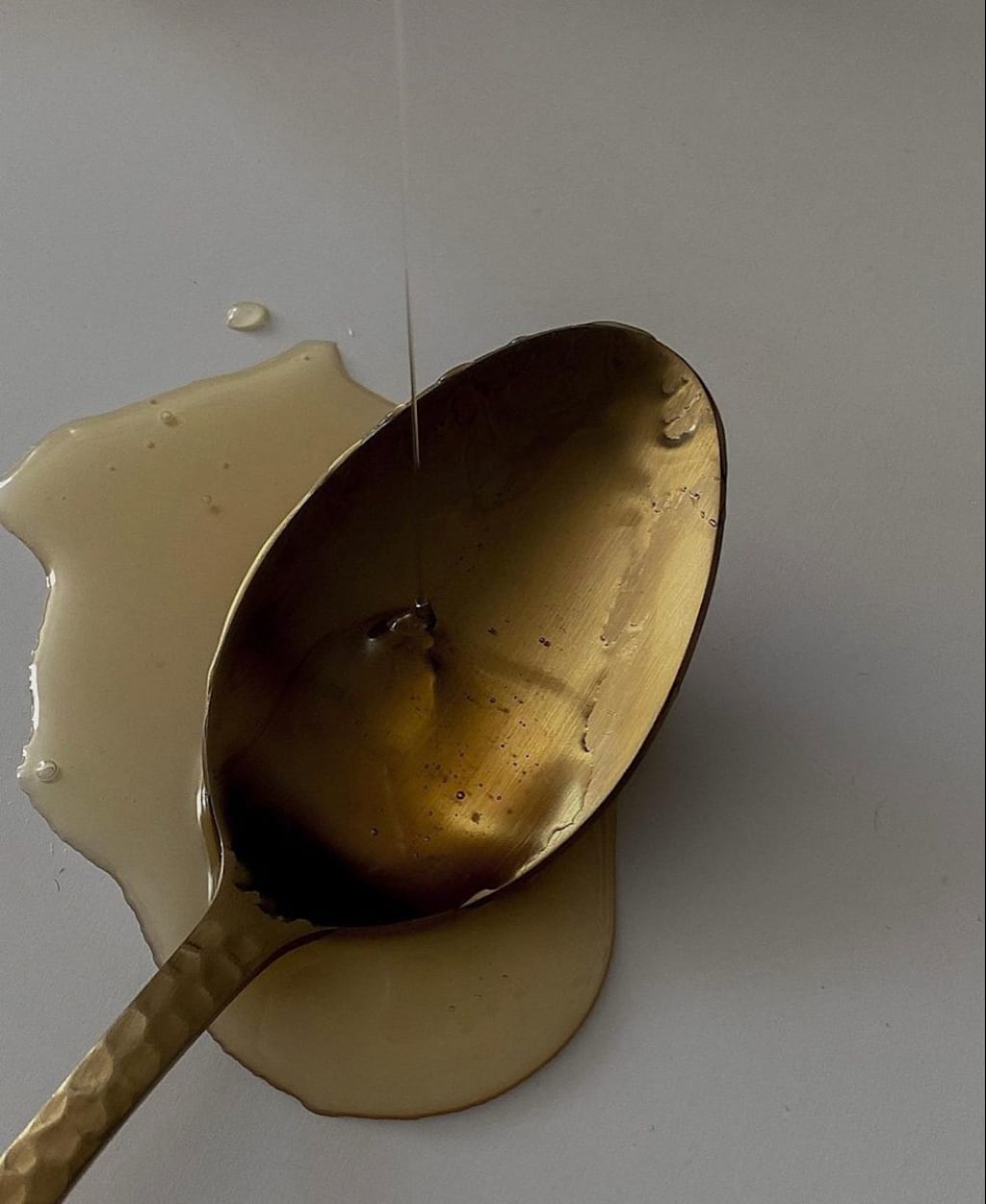
You spoon honey into the espresso before you drink it, the way she always did, the way you swore you wouldn’t, because sugar is easier to measure and honey is what she reached for when she wanted something to feel like a decision—a little ritual disguised as intention. You’ve been doing it without looking for years now. Somewhere behind your green eyes a much younger version of you is standing at a different counter, watching a different woman do the exact same thing, thinking: I will never need something sweet just to get through a Tuesday. And here you are, needing it like a little addict.
You are not your mother. You spent a whole life proving yourself otherwise, and the proving is so exhausting some mornings you can feel it in your jaw before you’ve said a word to anyone. You have a savings account. You have a five-year plan, a three-year plan, and a plan for the plan falling through. You read the books she never read. You made the calls she never made. You sat across from a financial advisor at twenty-four just to hear someone with a degree confirm that you were handling your money right, unlike her, unlike the years of good months eaten alive by bad ones, her exhausting go-with-the-flow nature that flowed her down the river to more empty checking accounts than anyone in your family likes to admit.
The basil on your windowsill is thriving in a pot you half-forgot to water this month, green and stubborn and enormous, exactly like hers used to be, exactly like nothing else in her house ever managed to be except that plant, and depending on the week, her children. You don't know how it's still alive. She picks at it every Sunday for her tomato sauce. You've stopped asking. Some things just don't need you as much as you think they do, and you don't know yet whether that's comfort or the whole problem.
Then when your son shows you his drawing, the good one, the one where you can see that he has something going for him—you say: that’s beautiful, baby—and mean it—and then do nothing else about it. You don’t look up an art class. You don’t ask anyone what a kid with real talent is supposed to do next. You stick it on the fridge and think: he’ll find his own way to it. The same way you found your own way, forgetting for a moment that you found your way specifically because no one showed you one, and you didn’t want to live like her. It cost you years you still can’t talk about because most nights had you inhaling a bunch of white lies.
You watch your brother, the middle child, disappear a little more each time you see him—thinner, more pale, his eyes doing that thing where they’re technically looking at you but landing somewhere past you—and you say something. It’s in your nature to always have to say something, a sentence with real concern loaded into it, delivered once with sarcasm to soften your own fear, then again more gently, hoping it’ll get through to him, at a volume calibrated not to be an ultimatum—because ultimatums are what controlling people give, and you are not controlling.
You are trusting.
You told yourself this so many times it no longer feels like a lie. But you don’t feel that rush of satisfaction this time. You’re alone, in her kitchen, gripping the espresso cup with sticky fingers, repeating the conversation back in a voice that sounds just like hers. Doubting yourself while she’s drowning you in honey.
She sits there saying: he’ll come around when he’s ready. And you roll your eyes at her the way you’ve rolled your eyes at her for the last fifteen years, exhausted by her, not yet comprehending that your concerned comments to him, and her he’ll come around are the same depleted sentence wearing different fonts.
Your younger brother—the one who was praised into thinking every decision he makes is correct simply because it’s his, who has never once in his life had to sit with being wrong—never in his life faced with any type of adversity—calls to say he’s getting married, and his words land with pressure in your chest, because you’ve met her, you’ve watched her dance around in character for a year now, and you know, the way you know a storm is coming, that this doesn’t end good.
You try. Damn, you really do try—you sit him down.
You use your good words: You’re a creature of habit. You fall in line with what’s comfortable and convenient.
The careful words: But this relationship doesn’t pull the joy out of you. It’s dull.
The words meant to pry a door open instead slam it shut—and he hears none of it, because no one ever taught him how to read people, your mother least of all, and by the time you’re done trying you’ve done exactly as much as your mother would have done, except you dress it up in poetic vocabulary.
You’ve always been better with your words.
During all of our tough years, she sat in the corner—radiant, warm, and fucking useless in the specific way she’s always been useless, loving her children by leaving them alone. The same way she left that basil to raise itself and it did. It thrived, it grew wild and green and completely unbothered, and you’ve spent thirty years unable to decide if that’s proof neglect doesn’t matter or proof you just got lucky, one plant, one over-analytical, first-born daughter, out of everyone she let grow wild on that windowsill.
You don’t notice you’re becoming her. Your blonde hair still has its thickness. You notice you’re becoming bone-tired and you mistake that low energy for wisdom, the same mistake she must’ve made, standing in her kitchen twenty years ago, spooning honey into something bitter and calling it a choice. You’ll say your piece once, abrupt, blunt, and then you’ll let it go, because some wrung-out, inherited part of you has started to believe, the way she believed, that saying it twice would make you the kind of manipulative mother who controls people instead of the kind who trusts them. You’d rather be exhausted than be her.
Except you are her.
You have the evil eye hanging on your window blinds like a damn dream catcher to prove it. You’ve been her for a decade now and just started fuckin’ noticing.
Years from now your son will stand at the edge battling his demons— about a woman, a decision, a bad and obvious thing everyone but him can see coming from a mile off—and because you love him so fiercely, you will open your mouth to give him the ultimatum your mother never gave you. Your hard words, the ones where saying them could cost you everything, but actually save the person you’re saying it to.
And what comes out, warm, easy, with that honey-sweetened go-with-the-flow tone will be: you’ll figure it out.
You will hear it the second it leaves you. You will regret it. You will recognize the font before you recognize the sentence underneath it.
You will regret it.
Again.
And again, later. Alone.
Quietly on a loop at 8a.m, stirring something sweet into an espresso you didn’t even want.
By then, it will already be his turn to water the basil and watch it grow wild without him.
About the Creator
tatiana vitas
observational, a little sarcastic, mostly interested in why people lie to themselves.
tatianavitas.com
[email protected]
Enjoyed the story? Support the Creator.
Subscribe for free to receive all their stories in your feed. You could also become a paid subscriber, letting them know you appreciate their work.
Comments
There are no comments for this story
Be the first to respond and start the conversation.