
Atlantis Explained: Myth, History, and the Enduring Search for a Lost Civilization
From Plato's ancient writings to modern archaeological theories, explore the mystery of Atlantis and discover why it remains one of history's most debated legends.

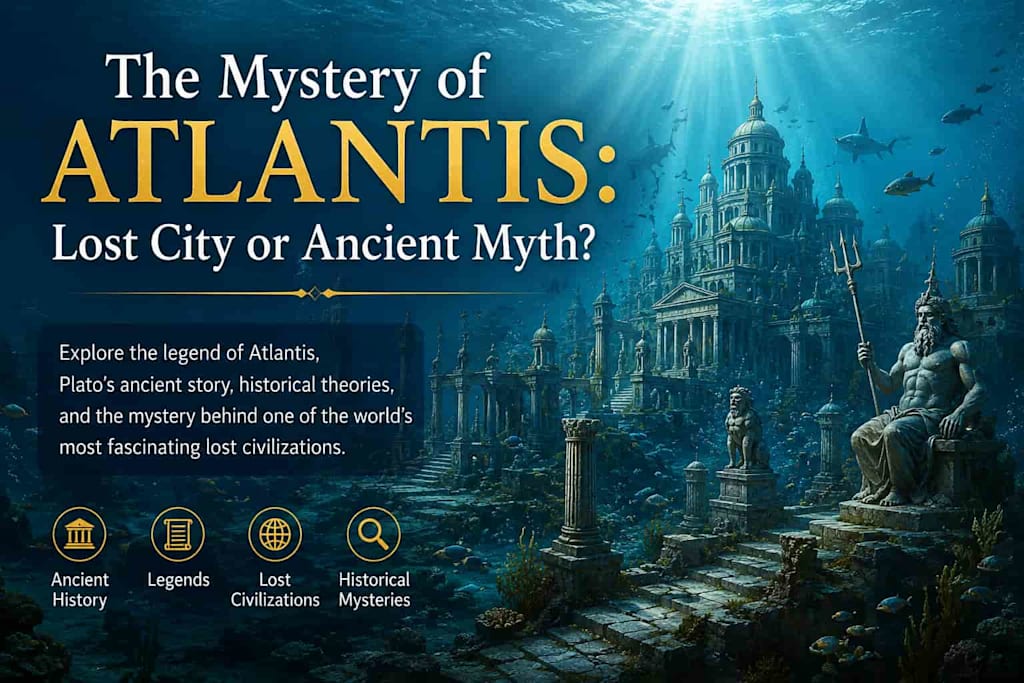
Few stories from the ancient world have captured human imagination as deeply as Atlantis. For centuries, historians, researchers, explorers, writers, and curious readers have debated whether Atlantis was a real civilization or a symbolic story created to teach important lessons.
Described as a wealthy and powerful island society that disappeared beneath the sea, Atlantis has become one of history's most enduring mysteries. The legend has inspired countless books, documentaries, academic discussions, and archaeological investigations.
Although there is no verified evidence proving that Atlantis existed, the story continues to raise fascinating questions about ancient civilizations, human achievement, and the possibility of forgotten chapters in history.
The mystery of Atlantis is not simply about finding a lost city. It is also about understanding how stories survive across generations and why certain legends continue to resonate with people around the world.
Plato's Story of Atlantis
The earliest known account of Atlantis comes from the ancient Greek philosopher Plato, who wrote about the civilization around 360 BC in two dialogues known as Timaeus and Critias.
According to Plato, Atlantis was a large and prosperous island located beyond the Pillars of Hercules, a term many historians associate with the Strait of Gibraltar. He described a civilization that possessed remarkable wealth, advanced engineering, strong military power, and extensive influence across surrounding regions.
In Plato's account, Atlantis was originally a prosperous society blessed with abundant natural resources and a sophisticated political system. Over time, however, its people became increasingly driven by greed and ambition.
Plato wrote that the gods eventually punished Atlantis, causing earthquakes and floods that submerged the island beneath the sea in a single day and night.
This dramatic ending has remained one of the most memorable aspects of the Atlantis legend and continues to inspire discussion among historians and researchers today.
Was Atlantis a Real Place?
One of the most important questions surrounding Atlantis is whether it actually existed.
Many scholars believe Atlantis was a fictional creation designed by Plato to illustrate philosophical and political ideas. According to this view, the story served as a warning about the dangers of excessive power, moral decline, and poor leadership.
Supporters of this interpretation argue that Plato often used fictional examples to explain complex concepts. They believe Atlantis was intended as a teaching tool rather than a historical record.
Others suggest that Plato may have drawn inspiration from real events. Ancient cultures frequently preserved memories through stories, and some researchers believe historical disasters could have influenced the Atlantis narrative.
Because no definitive evidence has been discovered, the debate remains open, allowing new theories and interpretations to emerge.
The Description of the Lost Civilization
One reason Atlantis continues to fascinate people is the detailed description provided by Plato.
According to his writings, Atlantis contained:
Grand temples and impressive architecture
Circular canals surrounding the central city
Rich deposits of valuable metals
Fertile agricultural lands
A powerful naval fleet
Advanced infrastructure and planning
The central area of Atlantis was said to contain a magnificent palace and sacred structures dedicated to Poseidon, the Greek god of the sea.
These descriptions created a vivid image of a thriving civilization that combined wealth, organization, and technological achievement.
Over the centuries, artists, writers, and filmmakers have expanded upon these descriptions, creating countless interpretations of what Atlantis might have looked like.
The Santorini Theory
Among the many theories about Atlantis, one of the most widely discussed connects the legend to the volcanic island of Santorini.
Approximately 3,600 years ago, a massive volcanic eruption occurred in the Aegean Sea. The event is considered one of the most significant natural disasters of the ancient world.
The eruption generated powerful tsunamis and caused widespread destruction across the region. Some historians believe the disaster may have contributed to the decline of the Minoan civilization, which flourished on nearby islands.
Supporters of the Santorini theory point out similarities between Plato's description and the effects of the eruption. Stories of flooding, destruction, and societal collapse may have survived through oral traditions before eventually influencing Plato's writings.
While the theory remains intriguing, no direct evidence confirms that Santorini was Atlantis.
The Search for Atlantis
The search for Atlantis has inspired explorers and researchers for centuries.
Numerous theories have proposed different locations for the lost civilization, including:
The Atlantic Ocean
The Mediterranean Sea
The Caribbean
The Canary Islands
Regions near Antarctica
Despite extensive exploration efforts, no archaeological discovery has definitively identified Atlantis.
Modern technology has transformed underwater research. Advanced mapping systems, deep-sea exploration equipment, and satellite imaging have allowed scientists to study areas that were previously inaccessible.
Even with these technological advancements, Atlantis remains undiscovered, adding to its enduring appeal.
Atlantis and Ancient Civilizations
The Atlantis story often intersects with discussions about ancient civilizations and lost knowledge.
Some theories suggest that highly developed societies may have existed in the distant past and later disappeared due to environmental or social changes. These ideas sometimes connect Atlantis with ancient Egypt, Mesoamerican cultures, or other civilizations known for impressive achievements.
Most historians, however, believe that human societies developed through gradual innovation, cultural exchange, and adaptation over long periods of time.
Archaeological evidence supports the view that technological and cultural progress occurred independently across different regions rather than originating from a single lost civilization.
Nevertheless, Atlantis continues to serve as a symbol of humanity's fascination with ancient achievements and unexplored possibilities.
The Broader Idea of Lost Civilizations
Part of Atlantis's appeal comes from a broader interest in civilizations that have changed dramatically or disappeared over time.
History contains many examples of societies that experienced major transformations, including:
The Maya Civilization
The Roman Empire
The Minoan Civilization
Ancient Mesopotamian Cultures
These civilizations left behind valuable knowledge, architecture, and cultural traditions. Their stories remind us that even the most powerful societies can face challenges related to environmental changes, political instability, and economic shifts.
Atlantis represents this larger theme of rise, achievement, and transformation.
Whether real or fictional, it reflects humanity's awareness that civilizations are constantly evolving.
Why Atlantis Continues to Capture Attention
Few ancient legends have maintained their popularity as successfully as Atlantis.
Several factors contribute to its lasting appeal:
A Lost Civilization
The idea of a vanished society naturally inspires curiosity and exploration.
Advanced Knowledge
Descriptions of Atlantis often portray a civilization that was highly organized and technologically impressive.
Natural Disasters
Stories involving earthquakes, floods, and environmental change continue to resonate with modern audiences.
Historical Mystery
The absence of definitive answers encourages ongoing research and debate.
Human Imagination
Atlantis invites people to imagine possibilities that extend beyond the limits of recorded history.
These elements combine to create a story that remains relevant across generations.
What Does Science Say About Atlantis?
From a scientific perspective, there is currently no verified archaeological evidence proving the existence of Atlantis as described by Plato.
Most researchers view Atlantis as a philosophical narrative rather than a historical account. However, this interpretation does not diminish the importance of the story.
Myths often preserve cultural memories, moral lessons, and observations about human societies. Throughout history, legends have helped communities understand their past and communicate important ideas across generations.
The Atlantis story may not provide definitive answers, but it continues to encourage exploration, critical thinking, and historical inquiry.
For many scholars, the true value of Atlantis lies not in proving its existence but in understanding why the story has remained meaningful for more than two thousand years.
Final Thoughts
Atlantis remains one of the most fascinating legends ever recorded. Although historians have not discovered evidence confirming the existence of a lost island civilization matching Plato's description, the story continues to inspire research, discussion, and exploration.
Whether Atlantis was a symbolic lesson, a story influenced by real historical events, or a combination of both, its impact on human culture is undeniable.
The enduring appeal of Atlantis comes from its ability to connect history, mythology, philosophy, and imagination in a single narrative. It challenges us to think about the rise and fall of civilizations, the preservation of knowledge, and the mysteries that still exist within our understanding of the ancient world.
Perhaps the greatest legacy of Atlantis is not the search for a lost city but the curiosity it inspires. As long as people continue asking questions about the past, the legend of Atlantis will remain an important part of humanity's shared imagination.
Personal Reflection
After exploring the many theories surrounding Atlantis, one idea stands out above all others: humanity has always been driven by a desire to understand its origins. Whether Atlantis was a real place or a powerful story, its enduring influence shows how deeply people value history, discovery, and the search for knowledge. Sometimes the most meaningful mysteries are not those we solve, but those that continue to inspire us to keep learning.
About the Creator
Kiya Verma1
✍️ Storyteller | 📚 Research Enthusiast | 🌍 Curious Mind
Sharing insights, practical knowledge, life lessons, and digital discoveries. Passionate about writing content that informs, inspires, and helps people solve real-world challenges.
Enjoyed the story? Support the Creator.
Subscribe for free to receive all their stories in your feed.
Comments
There are no comments for this story
Be the first to respond and start the conversation.