
Are The Kids Going to be Okay?
Submission to the unhappy ending challenge

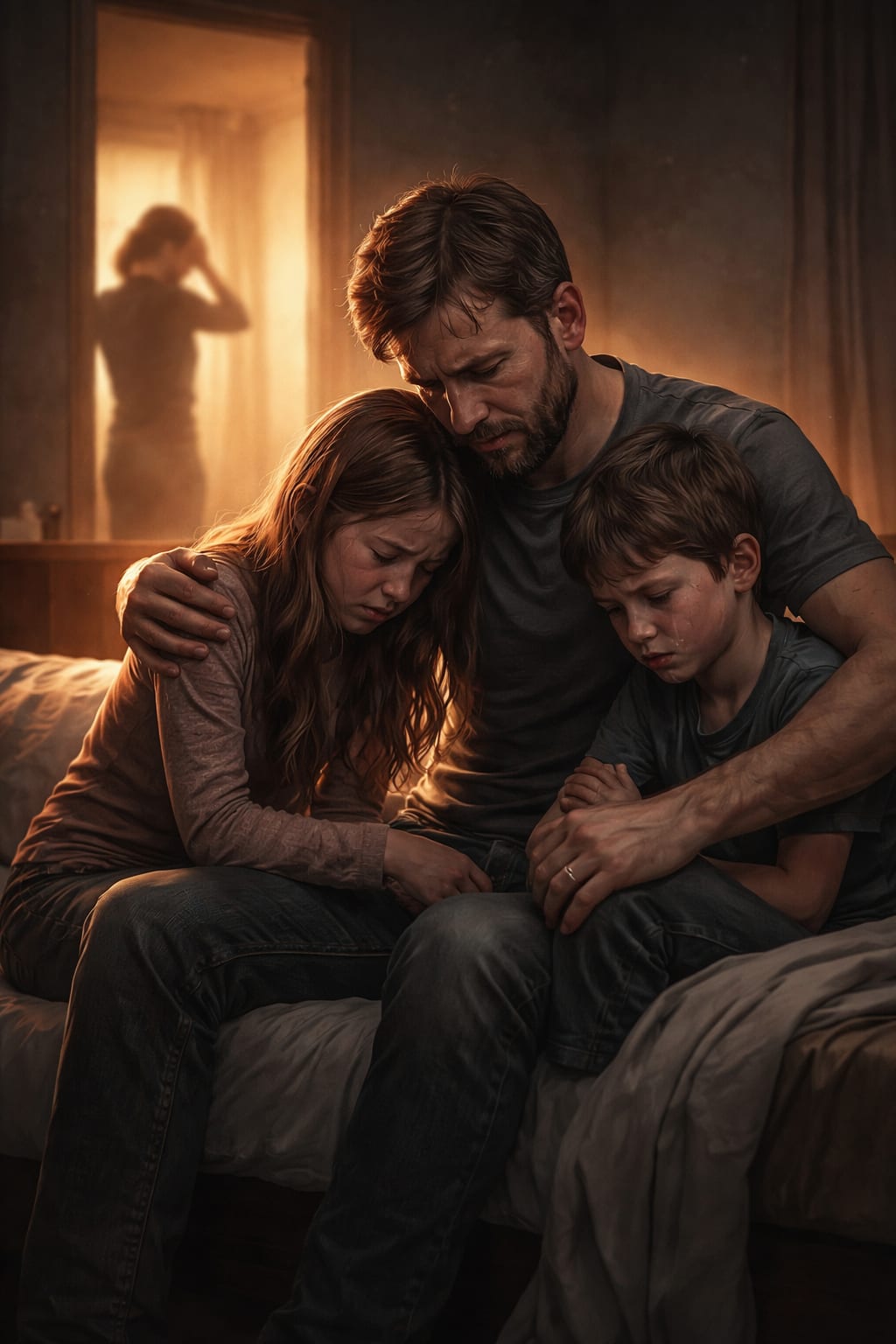
She made our lives a living hell. Every day was fresh chaos, based on the level of her dysregulated nervous system. Most days, it wasn’t good, so she would thrust her fabricated drama upon a home of otherwise peace-loving, drama-free residents. Two of whom were merely children, not even in their teen years yet, but quickly approaching.
We all knew the unspoken rules that required us to live our lives mitigating her moods. One of those rules was that we weren’t allowed to have a close relationship that didn’t directly have her at the center. That one was the sickest. Imagine believing it would not be healthy for a father to have a close, personal relationship with his own children, or them with him, because it would make her jealous.
Looking back, it was disgusting the way we tiptoed around her sensitivities in our daily decisions. But that’s life with a narcissist. Every conversation, every argument or debate, no matter the facts or evidence, would ultimately end the same way. Her asking, “What about me? What about my feelings?” It was an effective conclusion to every conversation because, ultimately, the matter had nothing to do with her or her feelings. They didn’t always need to be the deciding factor. She would continue, insulted by everything life had to offer that didn’t directly satisfy her need to be soothed, mentally, either way. There was no logical way to refute the illogical framing.
It soon became obvious how rotten things had gotten. My son started raging out in frustration more often. What used to be a once-a-year reaction, when he was especially tired and we were traveling while he was too young to process his feelings, became a daily occurrence.
My daughter was generally a content child who would grapple us with hugs every time we were within reach. Now she had become withdrawn and stopped wanting affection. Then, one day, I found out she had been self-harming for three years.
While there were signs of depression she shared with her mother, she was instructed that “Daddy doesn’t care,” so let’s keep this between us. The actual truth she needed to hear was that her father can’t imagine caring for anything more than his children’s well-being and happiness. It was my whole life’s mission.
But the danger that comes with being raised by a narcissistic and mentally unhealthy parent is that they don’t think twice about rewriting your reality. It ensures their false reality remains firmly intact in the minds of those who could upset the delusion. So she rewrote my role and history in the lives of my young children. We were the ones who suffered for it.
My mother did the same to me. Only with maturity and forty years of life experience was I able to look back and point out the atrocities of her lies about my father and the effect it had on my relationship with him—not to mention the toll it took on my confidence, my understanding of what makes a man good, and my sense of safety in my own life. My intuition screamed at me that something similar was happening to my children.
Living with a narcissist is tricky, though, because you don’t know, when you get together, what they are capable of. You think that you wouldn’t ever purposely hurt anyone. It pains you less to adjust to please others than it does to always be in conflict. Surely, any other healthy-minded person would feel the same. That’s what gets you—assuming the other person is, or wants to be, healthy.
Narcissists only thrive under constant conflict. It seems to quiet the voices in their head when they are able to dislodge others from their otherwise calm demeanors. Still, you can’t fathom that anyone would want to live like that on purpose, so you make excuses for their disruptive behavior. Then years go by, and this just becomes your life.
I might have stayed in that state of Stockholm syndrome if it hadn’t become so clear that my children were hurting. They were coming to me more often now, looking for me to end the chaos our lives had become.
My daughter would sit with me on the porch. The porch had become my respite from the yelling and crying that accompanied every one of her brother’s homeschool learning sessions with his mother as the self-appointed instructor. She would say, “I like sitting here with you, Dad. It’s peaceful.”
My son would come find me in the evenings, where I still hid away—only now because what was once family movie time had become: “No one wants to do anything as a family because if Dad doesn’t care about us, like Mom said, then clearly he doesn’t value this time together.”
He would come to me with tears in his eyes, asking, “Dad, why can’t you make Mom happy? She says it is your job to make her happy. You are the man. Isn’t that how that works?”
How do you explain to a child the unfavorable adult truths, such as: your mother is lying to you based on her own lack of emotional regulation? That each of us is responsible for our own happiness, and how our reactions affect others?
Give me the words to explain that to a ten-year-old who has his mother at the center of his universe. I couldn’t find the right ones.
So I was faced with a decision. How do I protect my children, as well as myself, from the damage being done to our mental and now physical health by someone who refuses to acknowledge and address her own illness? Will leaving this situation, in order to give them a place where peace can reign, be the best thing I can do for them? If I do leave her, am I unleashing a fresh, new level of chaos into our world—one I’ve only kept somewhat suppressed through my daily placation, though admittedly I had already lost even that little bit of influence over her volatility?
I made a move. Leaving quickly in the night under the guise of a camping trip. I only knew, consciously, that I needed to escape and take some time for myself to get my mind right. But the peace of separation was addictive. I couldn’t bring myself to go back. I think I just left my wife.
I started to fix up my rental project, making sure there were rooms for both of my children in what would become our new fortress of calm.
I made it clear to my children that Dad and Mom couldn’t live together anymore, and it had nothing to do with them. We love them. I expected they would spend half their time with me, but I wasn’t going to press it, because this was likely even more disruptive to their reality than it was to my own. I at least got to choose this for myself.
My son expressed that he wouldn’t mind spending weekends in his new second room. My daughter, who had been expressing her deepest concerns to me since I drew closer to her after learning about her self-harm, wanted to escape her mother as well. I wasn’t advocating for either of them to reject their mother. She is sick, but she is still their mother and always will be. I think that attitude is ultimately going to be healthiest for them.
I didn’t expect what the next few days—and years—would become, though if my brain hadn’t already been so damaged by the circumstances, I probably could have foreseen it.
My daughter confided in her mother that she didn’t feel safe with her, and that the advice she had been given over the past few years had hurt her mentally and emotionally. She now only felt safe with her father.
She wasn’t making a declaration or a decision. It was an appeal for her mother to change. To step outside herself long enough to acknowledge her daughter’s pain. Instead, her mother cried, ran away, and the next day woke our daughter up to boxes. They were going to pack her things, and she would have to go live with me now.
I had enough conversations with my daughter to know this would likely be the outcome, but we both wanted it to be on her terms. This was supposed to be an opportunity for her to take back her power by making healthy decisions—being honest and open so her voice could be heard. Instead, her mother made sure to take that from her.
What should have been a new sense of emancipation—a milestone toward a healthy adulthood—became a mother’s abandonment. Further proof, in her mind, that she was undeserving of unconditional love and natural familial affection. The full weight of her future self-respect was now clearly going to fall to me.
With my son, she went the opposite direction. He was younger, still wrapped in childlike naivety. She convinced him that I abandoned him, not her. That his sister was a rebel, and this is how rebels were dealt with. That she would have to suffer her unknown future alongside her father in exile.
She played on his survival instincts and made him the perfect weapon against me. Her most painful words would now come from his mouth. She used him to hurt me and to prove that if he didn’t love me, then that was an accurate reflection of my fatherhood. More than her dismissing our daughter from the home and bedroom I provided was a reflection of her unnatural lack of empathy as a mother.
For three years, I have kept one child alive while the other remains convinced I am unnecessary. She has managed to keep him from me and make him believe it is his idea. She has surrounded herself and my son with people who at least pretend to agree with her delusions. It will be years before he sees the truth.
I’ve missed out on his growth from age thirteen until now—prime years when a boy needs his father to show him, daily, how to be a man. The same years my mother stole from me and my father. I repeated the cycle of generational trauma when I married and had children with a woman exactly like her.
I’m left reeling with many unanswered questions: Did I make the right decision leaving how I did? Was I capable of good decision-making under those circumstances? Am I the one who is messed up mentally, or is it her?
These are the questions that linger in the quiet, albeit peaceful, moments. Questions that only time will answer. But none of them haunt me as much as my original—and biggest—concern:
Are the kids going to be okay?
Writers note: This was submitted to Fiction as a requirement of the challenge. If you ask my ex-wife she would tell you that it is fiction. However, for my daughter and myself this is exactly the way it happened.
About the Creator
Jesse Lee
Jesse Lee is a comedian and writer that investigates ordinary experiences until they reveal extraordinary truths about being human.
socials:
Enjoyed the story? Support the Creator.
Subscribe for free to receive all their stories in your feed. You could also become a paid subscriber, letting them know you appreciate their work.
Comments
There are no comments for this story
Be the first to respond and start the conversation.