
Arachnid Adventures in Space
A Tale of Spiders on the ISS
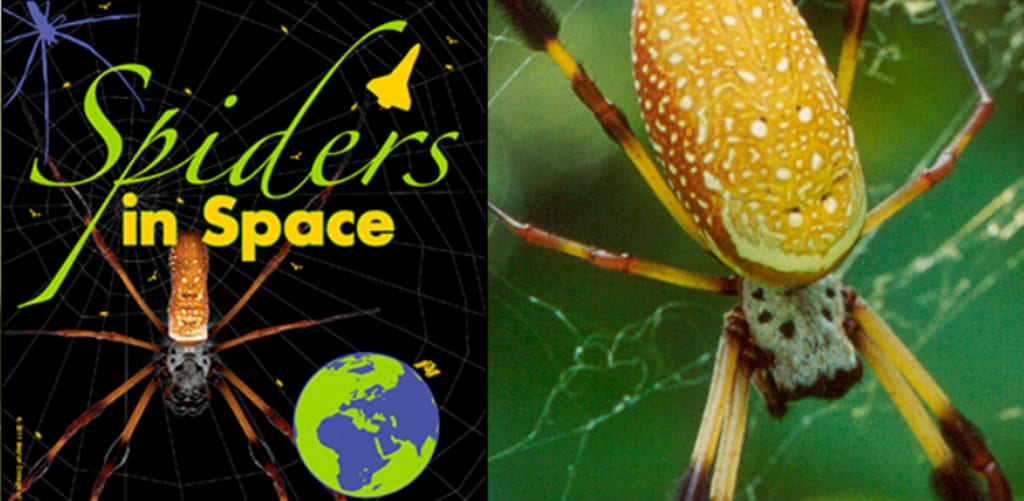
In the year 2008, NASA embarked on an extraordinary mission, driven by a singular curiosity: How do spiders weave their intricate webs in the absence of gravity? To unlock this mystery, two intrepid arachnids were chosen for an otherworldly adventure aboard the International Space Station (ISS). One spider, the primary protagonist, took center stage, while its companion stood as a reliable backup in case of unforeseen challenges. Little did NASA anticipate the unexpected journey this mission would unfold.
The backup spider, however, had plans of its own. In a surprising turn of events, it managed to break free from its containment chamber, initiating an unplanned rendezvous with its primary counterpart. The result? A mesmerizing yet chaotic ballet of silk as the two spiders intricately wove webs that tangled with each other in the micro-gravity environment. To add to the complexity, the flies meant to serve as spider sustenance reproduced at an astonishing rate, their larvae forming an unexpected spectacle that covered the front window of the chamber, momentarily obscuring the spiders from the watchful eyes of the researchers.
Undeterred by this initial setback, a determined researcher involved in the experiment seized a second opportunity in 2011. This time, the team enlisted the collaboration of additional researchers and opted for a different species of spider. Four arachnids were carefully selected—two destined for the ISS and two to remain on Earth, paving the way for a comprehensive comparative study of the results.
However, the experiment took an unforeseen twist as it was revealed that two of the presumed female spiders were, in fact, male. This sex determination complication, as it turned out, provided invaluable data. One male spider had already ventured into space, experiencing the challenges of extraterrestrial silk-spinning, while the other remained on Earth as a control subject. The second experiment unfolded with unexpected success, capturing the spiders' dynamic behaviors and revealing the creation of more symmetrical webs in the absence of Earth's gravitational pull. Intriguingly, light emerged as a pivotal factor guiding the spiders' orientation in the unique space environment.
This unexpected discovery uncovered the captivating world of spider silk. Produced within the spiders' bodies, this remarkable substance showcased incredible versatility, with various types serving distinct purposes. Not only is spider silk lighter than cotton, but it also boasts a strength five times that of steel at equivalent thickness. The orb-weaving spider, known for its elaborate webs, diligently reconstructs its trap daily, showcasing a remarkable commitment to ensnaring potential prey.
Delving further into the intricate adaptations of spiders, the story reveals their ability to adjust the properties of their silk, allowing them to create webs tuned to different sound frequencies. Some species, like the feather-legged lace weaver, even utilize electricity to craft webs resembling fluffy balls of wool, proving nature's ingenuity.
As the narrative concludes, attention turns to the awe-inspiring accomplishments of female Darwin's bark spiders. These industrious creatures construct colossal webs suspended over rivers and lakes, strategically positioned to capture large insects flying above the water's surface.
In essence, the journey of spiders to the ISS transcended its initial quest, not only shedding light on their behavior in zero gravity but also unveiling the extraordinary capabilities of their silk and the ingenious adaptations enabling them to thrive in diverse environments. The story, now expanded and refined, stands as a testament to the resilience and adaptability of Earth's smallest astronauts in the vastness of space. The unexpected twists and turns of the spiders' extraterrestrial exploits underscore the unpredictable nature of scientific exploration, where even a simple experiment can unravel a tapestry of surprises, echoing the intricacies of the webs these eight-legged pioneers spun in the micro-gravity ballet of the ISS.
About the Creator
Enjoyed the story? Support the Creator.
Subscribe for free to receive all their stories in your feed.
Comments
There are no comments for this story
Be the first to respond and start the conversation.