
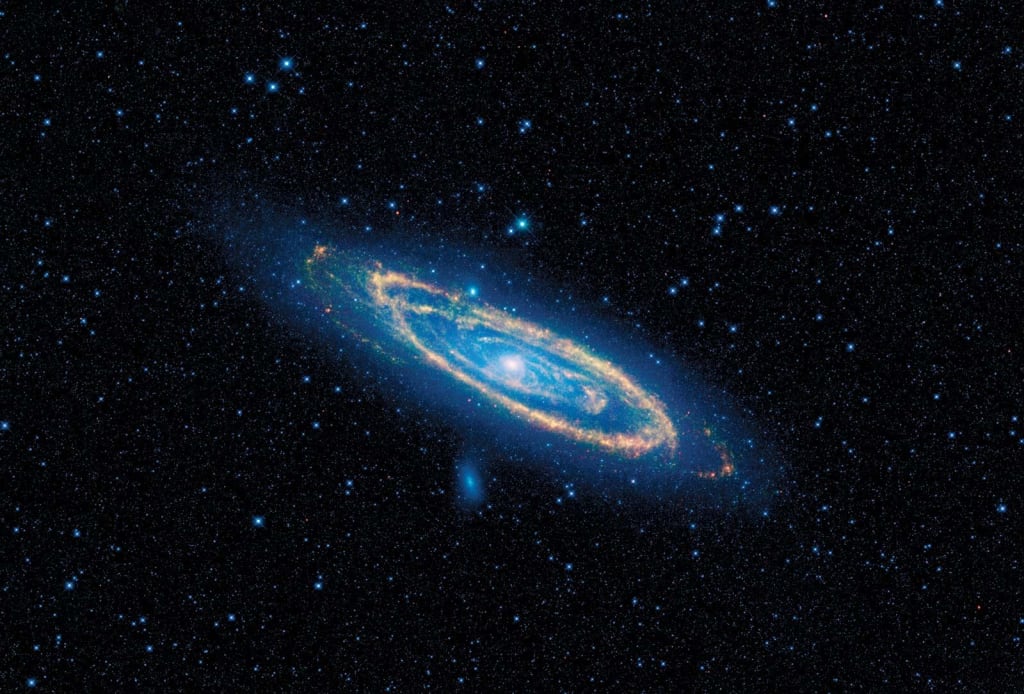
The Andromeda Galaxy, also known as Messier 31 or M31, is a spiral galaxy located in the Andromeda constellation. It is the closest spiral galaxy to our own Milky Way galaxy and is one of the most extensively studied celestial objects in the night sky. Here are some key facts about the Andromeda Galaxy:
1. Size and Distance:
The Andromeda Galaxy is approximately 220,000 light-years across, making it about 2.2 times the size of the Milky Way. It is located at a distance of about 2.537 million light-years from Earth.
2. Appearance and Classification:
Andromeda Galaxy is a spiral galaxy, similar to our Milky Way. It has a distinct nucleus surrounded by a bright central bulge and a prominent disk with spiral arms extending outward. The galaxy's overall shape is often described as a "double nucleus" due to the presence of two bright spots at its center.
3. Galactic Collision:
The Andromeda Galaxy is on a collision course with the Milky Way. In about 4 billion years, the two galaxies are projected to collide and merge, forming a new galaxy. This event will reshape both galaxies and have a significant impact on their stellar populations.
4. Mass and Number of Stars:
Andromeda is more massive than the Milky Way, with an estimated mass of around 1.23 trillion times that of the Sun. It is also believed to contain more stars, estimated at about 1 trillion compared to the Milky Way's 300 billion.
5. Satellite Galaxies:
Andromeda has numerous satellite galaxies orbiting around it. The most well-known are M32 and M110. M32 is a dwarf elliptical galaxy located close to Andromeda's nucleus, while M110 is a dwarf elliptical galaxy located farther out. These satellite galaxies provide insights into the gravitational interaction and evolution of the Andromeda system.
6. Halo and Stellar Streams:
Andromeda has an extensive halo of stars surrounding its central disk. This halo consists of older stars and globular clusters, which are dense, spherical collections of stars that orbit the galaxy. Additionally, stellar streams have been discovered around Andromeda, which are remnants of past interactions with smaller galaxies.
7. Spiral Arms and Star Formation:
The Andromeda Galaxy exhibits prominent spiral arms, which are regions of higher density and star formation. These arms are rich in young, massive stars, blue star clusters, and interstellar gas and dust. The active star formation within the spiral arms contributes to the galaxy's overall brightness.
8. Central Supermassive Black Hole:
Like most galaxies, Andromeda has a supermassive black hole at its center. This black hole, known as Messier 31* or M31*, has a mass estimated to be around 100 million times that of the Sun. It is actively accreting matter, emitting powerful jets of radiation and influencing the dynamics of its surrounding region.
9. Observational History:
The Andromeda Galaxy has been observed and documented for centuries. It was first cataloged by the Persian astronomer Abd al-Rahman al-Sufi in the 10th century. However, its true nature as a separate galaxy was not understood until the 20th century when Edwin Hubble identified it as an external galaxy.
10. Andromeda as a Cosmic Yardstick:
Due to its relatively close proximity to the Milky Way, the Andromeda Galaxy serves as an essential cosmic yardstick for astronomers. By studying its properties and dynamics, scientists gain valuable insights into galaxy formation, evolution, and the large-scale structure of the universe.
11. Halo of Hot Gas:
In addition to stars, the Andromeda Galaxy possesses a massive halo of hot gas. This halo extends beyond the galaxy
About the Creator
Enjoyed the story? Support the Creator.
Subscribe for free to receive all their stories in your feed.
Comments
There are no comments for this story
Be the first to respond and start the conversation.