
Again... Part Two
From the World of Distinction of Realms

JESS AT FIFTEEN
At fifteen, Jess wanted to know what was wrong with her.
She searched on her phone beneath the covers; the screen lit her face long after the rest of the house had gone dark. Aaron would find her scrolling through medical websites, watching videos with the sound turned low, reading accounts from strangers whose symptoms almost matched her own.
Almost.
He took the phone away at three one morning. Jess let him have it without an argument, which bothered him more than if she had shouted.
The next day, she handed him a notebook.
She had filled it with dates, symptoms, and questions. Some entries were neat enough to look like a school assignment. Others crowded the margins, words squeezed between lines, arrows connecting one episode to another. She had recorded things he hadn’t known about: fingers that wouldn’t straighten during class, waking with her tongue sore, losing several minutes while brushing her hair.
At the bottom of one page, she had pressed hard enough to mark the sheet beneath.
WHY DOES THE SONG WORK?
Aaron read the question twice. He turned back to the notebook, as though she might have written an answer somewhere he had missed.
The next incident happened during dinner.
Sandra asked whether Jess had finished her homework. Jess said yes, then continued speaking.
The sounds were soft and quick, almost conversational. Her eyes remained on the plate as Jess cut a piece of chicken. Aaron heard a particular sequence twice, the same clipped syllables separated by a faint clicking sound.
His fork stopped against his teeth.
Jess stopped cutting.
For a moment, all three of them listened.
Then Jess pressed her lips together. Something moved beneath them. Her jaw worked. The skin beneath her chin tightened as she shaped another sound. Jess clapped both hands over her mouth. Her eyes found Aaron’s.
Sandra pushed her chair back. “Aaron.”
He began the lullaby.
Jess’s shoulders lowered. Her hands dropped into her lap, and the movement in her throat stopped.
Nobody finished dinner.
Later, Jess sat beside her father on the couch. The television was off. From the kitchen came the sound of Sandra rinsing dishes that had already been rinsed.
“I wanted to stop,” Jess said, picking at a loose thread in the cuff of her sweatshirt. “I stopped trying to talk. My mouth kept doing it.”
Aaron looked at her hands.
Jess waited until he raised his eyes. “I could feel it,” she whispered. “Making the sounds.”
He remembered her voice at the table. How it continued after her answer, as though someone had been waiting for a pause in the conversation.
“What was speaking instead of you?” he asked.
Jess’s face crumpled.
He wished he could take back the question.
He pulled her close, and she cried against him, one hand gripping the front of his shirt. He rested his cheek on her hair and held her until Sandra came into the room.
During driving practice, Jess was careful.
She checked her mirrors too often and apologized whenever she braked. Before pulling away from a stop sign, she looked in both directions twice, then glanced at Aaron for permission.
He took her along the quiet road behind the industrial park. On Sundays, the warehouses stood empty, their loading bays shut. Weeds pushed through cracks in the pavement, and wind carried scraps of plastic along the chain-link fences.
“Doing fine,” he told her. “Loosen your grip a little.”
She tried to smile. Her right hand opened. Then her wrist turned.
Aaron watched it happen. Her palm rotated toward the ceiling while her fingers remained hooked around the wheel. The tendons stood out beneath her skin.
“Dad?” Concern filled her voice.
The car drifted across the center line. Aaron reached for the wheel.
Jess’s left arm snapped straight, locking at the elbow. He pulled, but she held on, her shoulder pressed hard into the seat.
A semi truck sounded its horn, blaring through the tense moment like a knife. It moved like a massive predator intent on barreling over its prey.
“Jess! Let go!”
“I’m trying!”
Aaron braced one foot against the floor and dragged the wheel toward him. The truck passed close enough to shake the car.
They lurched onto the shoulder. Gravel hammered the underside. Aaron grabbed the wheel with both hands, straightened it, and shoved the gear selector into neutral.
The engine screamed. The car rolled to a stop, and he pulled the parking brake.
Jess’s foot remained pressed to the accelerator; the engine revving like a rabid dog.
“Take your foot off,” Aaron said.
She stared down at her legs. Her mouth trembled.
He sang.
The engine’s roar dropped as she lifted her foot.
For several seconds, neither of them moved. Dust drifted past the windows. Somewhere behind them, the truck’s horn sounded once more, farther away now.
Jess reached across herself with her left hand. She turned her right wrist back into place.
After a few moments of silence, Aaron drove home.
That winter, he found her awake on the bedroom floor.
He heard something through the monitor, a dragging sound followed by a single dull knock. Her bedside lamp shone over an open textbook and a glass lying on its side. Water had soaked into the rug’s edge.
Jess’s shoulders rested against the bed. One knee was tucked beneath her chin. Her other leg stretched behind her, disappearing under the bed at an angle that made Aaron stop trying to figure out how she was sitting.
“Don’t sing yet.” Jess lifted her head. Wet hair clung to her cheek as she cried.
Her jaw shifted sideways. He heard her teeth scrape together. A low sound came from her throat. She swallowed hard, and for a moment her mouth settled back into place.
Aaron crouched beside her.
She caught her dad’s sleeve. “It’s getting older too.”
Aaron stared at her. Her fingers tightened. She said something in the other language. Her grip closed around his wrist through the fabric. Pain shot into his hand. He tried to ease her fingers apart, but they wouldn’t move.
Jess watched him, tears still running down her face. Her mouth moving with alien physics.
Aaron sang through the pain in his wrist and the sickening pressure of her fingers. He kept his face close to hers, waiting for some sign that she could hear him.
Her grip loosened. Aaron kept singing until his daughter let go.
JESS AT EIGHTEEN YEARS OLD
By eighteen, Jess and Sandra could turn an ordinary question into an argument before Aaron understood what had happened.
Where are you going?
Why didn’t you answer your phone?
Did you take your medication?
Jess heard suspicion in everything. A question about her afternoon became a demand to account for every hour. A reminder about an appointment meant her mother thought she was getting worse. Sometimes Aaron entered the room while they were still speaking calmly and felt the anger waiting beneath their voices.
Sandra asked from the doorway. She kept one hand on the frame, her body angled toward the hall, leaving herself room to step back.
Aaron noticed. Jess noticed too.
“You’re afraid of me,” Jess said one evening.
Jess stood beside the couch, phone in hand. Her voice held anger, but Aaron saw how she watched her mother’s face, waiting for Sandra to deny it.
Sandra looked toward him.
Jess let out a short laugh. “Right. Ask Dad before admitting you don’t want to be alone with me.”
“That isn’t fair,” Sandra said.
Jess waited a moment longer, then went upstairs. Sandra stayed in the doorway until they heard it latch.
“You always make me the one she has to fight,” she told Aaron.
“She’s frightened.”
“So am I.”
He reached for her. She stepped away and folded her arms, tucking her hands out of sight.
“You sing, and she comes back to you. I’m the one who calls doctors. I’m the one who says she can’t go somewhere alone.” Sandra’s voice tightened. “You get to make it stop. I get to tell her all the things she can’t do.”
“You’re trying to keep her safe.”
“Does she know that?”
“Of course she does.” He assured her.
Sandra looked toward the ceiling. “Sometimes I don’t know whether she loves me.”
“Sandra.”
“I know how that sounds.” She rubbed beneath one eye with the heel of her hand. “I know.”
Three quiet notes came from upstairs. They both looked toward the hallway.
Jess hummed them again. The beginning of the lullaby, soft enough that they might have missed it if they had still been talking.
Aaron waited for the next note.
It didn’t come.
He knew this part of the routine. Sometimes Jess called for him. Sometimes he heard her pacing. Sometimes there were only those three notes, repeated until he went upstairs.
Sandra lowered her arms.
Neither of them would speak to each other again.
The argument happened the next morning, at the top of the stairs. It started over the car keys.
Aaron stood in the kitchen rinsing a glass, bracing himself for the next round of shouting.
“I’m eighteen,” Jess said. Her voice carried down the stairwell.
Sandra answered too quietly for him to hear.
Aaron shut off the tap.
“You don’t have to keep pretending,” Jess said.
A pause followed.
“Pretending what?”
Then Jess spoke again. Aaron didn’t recognize the words. They were in that strange tongue. His hand tightened around the glass.
“Don’t!” Sandra yelled.
He set the glass in the sink and turned.
A sharp gasp came from the landing. Then a kaleidoscope of noise followed.
The first impact was heavy. Several more followed too quickly for him to separate: a thud, a scrape, the banister rattling. Something small struck the wall and kept falling.
By the time Aaron reached the hall, Sandra lay at the foot of the stairs. For an instant, he couldn’t make sense of how she’d ended up there.
One arm lay beneath her, contorted as if it were the arm of a cloth doll. Her other hand rested against the bottom step, fingers curled around nothing. A slipper had caught halfway down, its toe wedged between two spindles. Her keys lay on the hardwood near Aaron’s feet.
He knelt beside her. “Sandra?”
Her hair covered part of her face. He brushed it away, gently, the way he did when she fell asleep beside him on the couch.
“Sandra. Honey.” He touched her cheek.
He knew he was supposed to do things. Check Sandra’s breathing. Call someone. Don’t move her. The instructions crowded his head, and he couldn’t hold on to any of them.
Above him, Jess stood on the landing. She hadn’t moved.
“Call an ambulance!”
Jess’s arms hung at her sides. She seemed to study the scene below, her gaze moving from Sandra to Aaron and back.
“Jess?”
One corner of her mouth lifted.
Later, Aaron would try to remember whether it had already been that way when he looked up. He wondered whether he had mistaken a twitch for a smile. Whether her face had moved at all.
He would spend months returning to that moment.
He would spend the rest of his life wondering whether Sandra had fallen or was pushed.
“Call!” he shouted.
Jess tilted her head.
Aaron took out his own phone. His thumb slipped against the screen. He tried again, keeping his other hand against Sandra’s face.
The dispatcher answered. He gave the address. Said his wife had fallen down the stairs. Repeated the address when asked.
Above him, Jess remained still. Aaron looked from Sandra to the girl on the landing.
He began the lullaby.
His voice sounded thin in the stairwell. He heard the dispatcher in his ear, asking him something, but the words no longer made sense.
Jess blinked. Her face changed.
She looked down at her hands, then at the stairs beneath her feet. Her knees struck the landing.
“Mom?”
Aaron kept singing. Jess crawled to the edge.
“Mom?!”
The scream that followed cut through the lullaby.
Aaron flinched.
Jess folded over herself, one hand clamped around the banister. She tried to say Mom again, but the word broke apart. Her breath came in short, choking bursts.
“Sir?” the dispatcher said. “I need you to listen to me.”
Aaron pressed the phone harder to his ear.
He had wanted Jess to react. He had needed her to understand what lay at the bottom of the stairs.
Now she understood.
He stayed beside Sandra, listening to his daughter sob above them.
Later, Jess asked him what had happened.
They sat beneath a hospital clock in a corridor that smelled of disinfectant and coffee. Someone had left a folded blanket on the chair beside them. Aaron couldn’t remember who had brought it.
Sandra’s wedding ring lay in a small plastic bag in his hand. He kept turning it over. The ring slipped from one corner to the other, catching briefly on the sealed edge.
“What do you remember?” he asked.
“She had my keys.”
Jess stared down and noticed a red mark on her knee where it struck the landing.
“What else?”
Jess rubbed her palms against her jeans. “I wanted to tell her I hated when she looked at me like that.”
Aaron waited.
Jess swallowed. “But I didn’t say that.”
“What did you say?”
“I don’t know.” Her eyes moved to the bag.
Aaron closed his fingers around it.
“Dad.” Her voice grew smaller. “What did I say?”
He looked at her mouth.
He couldn’t stop seeing it at the top of the stairs. He couldn’t stop hearing the strange words.
Jess reached for his hand.
For the first time in his life, Aaron pulled away from his little girl.
Three weeks after the funeral, Jess put a notebook on the kitchen table.
Steam rose from Aaron’s coffee. He had measured the grounds, filled the machine, and taken his usual mug from the cupboard. He even opened the refrigerator for the creamer Sandra used, then remembered he drank his black.
Now the cup sat untouched.
He recognized the notebook. Jess had been writing in it since she was fifteen. The corners had softened, and a pale crease ran down the cover where she bent it back while she worked.
Across a fresh page, she had printed one word.
MAHR.
Aaron remained standing.
“I think I figured it out,” she pleaded.
Her chair scraped as she drew it closer to the table. She had gathered loose pages inside the notebook: printed articles, photographs of old books, scraps covered in handwriting so small he’d needed his glasses to read them.
Most of what she had found was useless.
Sleep paralysis forums. Lists of demons copied from one website to another. People selling protection charms who wanted her address and a photograph before they would tell her whether they could help.
She learned to search old phrases instead of symptoms. She followed footnotes through scanned books, enlarging faded pages until the letters dissolved into squares. Again and again, she found accounts of something entering a bedroom through a keyhole.
Sometimes it sat on the sleeper’s chest.
Sometimes it borrowed a familiar voice.
Sometimes the person who woke was never quite the same.
Then she found a private discussion group of eleven accounts. Four had stopped posting.
She went through their histories, looking for some sign that they had left deliberately. An argument. A goodbye. One woman’s final message ended halfway through an account of what her daughter had said at breakfast.
Jess read that one several times.
Another woman described her son answering questions in his sleep before anyone asked them. A man uploaded a recording of himself speaking in a room he swore he had never entered. He asked whether anyone recognized the room from the sounds behind his voice.
Jess listened once.
Beneath the man’s confused questions, someone was humming.
Her song.
The group called it a Mahr, borrowing the name from old nightmare accounts. They didn’t agree on everything. Some still called it a spirit. Others argued that the folklore described only a small part people had witnessed.
Their explanation went further than possession.
What people had once imagined squeezing through a keyhole was finding an opening between places that should never touch.
A keyhole between rooms, or a microphone attached to a baby monitor.
One member compared its relationship to time with a person’s relationship to a house. Each room contained a unique moment. The people inside could see only their own walls, but the Mahr could move between them. Between a human’s perception of time.
A voice in one room might reach a sleeper in another.
An answer might arrive years before the question.
None of them could prove it.
But the melody in the recording was the one her father had heard eighteen years earlier, sung by a man he had never identified.
Beneath the name, she had written:
IT DOESN’T HAVE TO WAIT THE WAY WE DO.
“It’s growing into me,” she told him.
Aaron stood at the sink with his back to her.
“I know what you think happened to Mom.”
Aaron turned.
Jess kept looking at the notebook. Her fingers held the edges of the page flat.
“I know because I think it too,” she said.
The refrigerator motor clicked on.
Aaron watched her thumb move back and forth over a stain on the paper. He remembered her hands reaching for him in the hospital.
Jess pulled a printed photograph from beneath the notebook and pushed it toward him. It showed a page from an old folklore collection. The paper had darkened around the edges, and part of the text disappeared into the binding.
One passage concerned a sleeper who could be freed when someone called her name. Below it was an account of trapping a nightmare spirit by closing the opening it entered through.
“You’ve done the first part,” she said. “You say my name during the song, and sometimes I can get back.”
Aaron drew out the chair. He sat.
“And the rest?”
Jess looked at him. “I think we have to give it somewhere to go.”
They found the monitor in a box beneath the Christmas decorations.
Aaron had put it away after the funeral. He couldn’t bear hearing static in an empty room, or waking at night with Sandra’s side of the bed cold beside him and his hand already reaching for the receiver.
He worked it free as Jess lifted the nursery microphone out.
A strip of faded tape still crossed the receiver’s back: JESS’S ROOM. The last letter curved upward where the tape had wrinkled beneath her pen. Sandra had labeled it years ago, before a weekend at her parents’ house, when they packed so much for Jess that they could barely close the trunk.
Aaron rubbed his thumb over the handwriting.
Beside him, Jess opened the battery compartment. The batteries were swollen, their ends crusted white. She eased them out and laid them on the cardboard flap.
The receiver hissed, with no discernible power source. Her hand stopped above the box.
Aaron looked at the empty compartment. Then at the plug lying loose beside his knee.
The static thinned.
A faint wooden creak came from the speaker.
A pause.
Another creak.
Aaron knew the rhythm. One runner of the nursery rocking chair had always complained when he leaned too far back. He used to shift his weight to keep it quiet while Jess slept against his chest.
They had given that chair away when she was four.
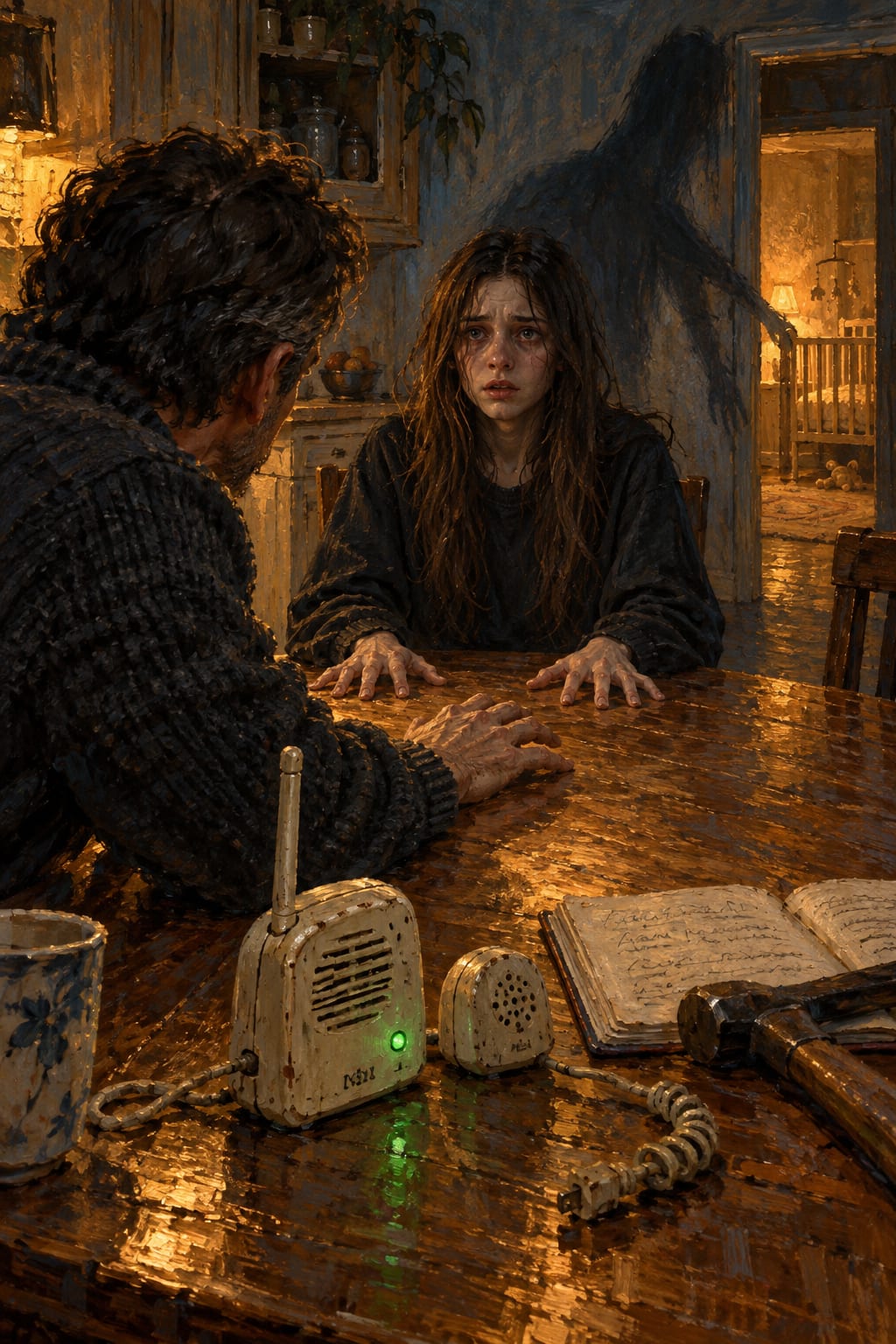
Father and daughter set up shop at the kitchen table.
Jess placed the nursery microphone near her chair and set the receiver between them. She kept her notes open beside her, though by then Aaron suspected she knew every line.
He laid a hammer on the table. Its weight made a dull sound against the wood.
Her plan was simple.
He would call her name. She would answer with memories: things she had done, things she loved, small details she could still claim as her own. They would keep her talking, keep her present, while the Mahr followed the connection through which it had first reached her.
Toward the monitor. Toward the sound of its own beginning.
“When my voice comes through there,” she said, pointing to the receiver, “you break them.”
Aaron looked at the hammer.
“Both,” she said.
He nodded.
“No song.”
His mouth had gone dry.
“Even if I ask.”
He looked up.
Jess sat with her hands clasped between her knees. She was trying to hold them still.
“Especially then,” she said.
At first, nothing happened.
The receiver sat between them, silent. Aaron could hear the refrigerator running and the faint scrape of Jess’s sleeve against the table.
“What did we name the rabbit behind the garage?” he asked.
“Mr. Pickles,” she answered.
“What did your mother call him?”
“The landlord.”
Jess smiled. It surprised them both. He laughed once. It hurt enough that he had to look down.
Then Jess’s shoulders pulled back.
Her hands flattened against the table, fingers spreading until the skin between them drew tight. The smile vanished. A tremor passed through her arms.
“Keep going,” she insisted.
“What did you put in my shoe when you were six?”
Her jaw quivered. She pressed her tongue against her lower teeth, struggling to shape the answer. “A frog.”
“A real one?”
His voice shook. “Plastic.”
The receiver crackled.
“Plastic,” it repeated.
The voice was hers, but it came through without the effort he saw on her face.
Aaron reached for the hammer.
“Not yet,” Jess said.
“Not yet,” the speaker said with her.
Her chair scraped backward.
Her body slid forward, her head still tipped toward the ceiling. Aaron lunged across the table and caught her beneath the arms. Under his palm, something in her shoulder shifted with a soft, deliberate click.
“Jess.”
Her lips moved. No sound came from them.
The receiver answered.
“Dad.”
Aaron tightened his grip on the hammer.
He had promised her. They had gone over this. When her voice came through the receiver instead of her mouth, he was supposed to break both units.
He raised it.
Jess caught his wrist.
The hammer stopped above the table.
Her eyes fixed on his. She shook her head so violently that her hair struck her cheeks, her fingers tightening until he felt the bones in his wrist press together.
“Jess, let go!”
She kept shaking her head. He couldn’t tell whether she was frightened of the hammer or begging him to use it.
Then she dragged in a breath and collapsed against his chest.
The receiver went silent.
The hammer slipped from his hand, crashing to the floor.
He lowered them both to the kitchen floor, cradling her head. They stayed there until dawn.
At some point, Aaron pulled a dish towel from the oven handle and folded it beneath her cheek. At another, Jess woke and asked for water. Neither suggested moving to the couch.
Pale light filled the window.
Jess sat beside him, knees drawn up. She examined the bruises forming around his wrist, touching the skin beside them with one finger.
“It knew,” she said.
Aaron said nothing. She looked toward the hammer beneath the table. He had never seen her look so tired.
Above them, the receiver clicked.
A woman spoke.
“Nothing’s working?”
Aaron stopped breathing.
Sandra.
Her voice was thin through the little speaker, but he knew it. Younger. Exhausted. Alive!
He reached for the table’s edge and pulled himself up.
Static stirred. Then his own voice answered.
“Cheap piece of shit…”
He remembered.
The bedroom. The speaker on the nightstand. Sandra in the faded blue shirt she wore while nursing, one sleeve stretched where she had pulled it over her shoulder.
He remembered being so tired that he resented walking across the room. That small, ordinary irritation came back with terrible clarity. His wife had been alive, and he had been annoyed about a few extra steps.
The speaker hissed against his palm. He pressed it closer, listening for her to breathe.
For years, he had remembered her voice asking about appointments, calling Jess down for dinner, whispering in the kitchen. He had forgotten this voice. The woman who had shared his bed before they learned to listen at doors.
He sobbed. Behind him, Jess got up.
Aaron looked at the nursery microphone lying on the table. Its little green light glowed.
The connection was open.
Somewhere on the other end, his younger self stood beside Sandra, listening.
Aaron seized the microphone. He could warn them. He could make himself run upstairs. Unplug the monitor. Smash it before the song began.
“Whatever happens, don’t sing—”
“Again,” Jess said behind him.
His breath caught. Unable to speak. His tongue shifted against his teeth.
He tried to close his mouth, but a note escaped through his nose. His chest expanded. Air filled him until his ribs ached, and when he could hold no more, his jaw opened. A few ribs broke from the struggle.
The song was released through the microphone.
He knew this voice. He had heard it almost eighteen years ago, standing beside his wife. He had been the man sobbing through the speaker.
The light brightened on the microphone and speaker, tethered to two different points in time.
He tried to turn toward Jess. His neck wouldn’t move. He could see only the microphone in his hand and the bruises around his wrist, darkening where her fingers had been.
The kitchen seemed to recede. The melody filled the space around his head, clear and beautiful, carrying all the tenderness he had felt beside Jess’s crib. He heard the nights at her bedside, the gravel ticking beneath the cooling car, his daughter pleading against his neck.
Every time he had sung to save her had prepared him to sing this moment with divine perfection.
He tried to force a warning between the notes.
There was no room.
His tongue formed each unfamiliar word with the ease of something practiced for a lifetime.
Eighteen years earlier, a younger man was listening. Learning.
Aaron understood what he was giving him. The song that would quiet his baby. The song that would bring her back. The song that would keep him singing while something grew inside her.
Tears ran into his open mouth.
The melody continued.
Then the last note faded.
Aaron dropped the microphone and doubled over, coughing. He braced his hands on his knees, dragging in breaths that were his again.
Behind him, Jess waited. He could hear her bare feet shift against the floor.
He remembered the first night. The song ending. The woman’s voice.
Again.
But Jess had already said it.
Through the receiver, faint and distant, he heard a movement in the old bedroom.
The connection was still open.
He turned toward her. For a moment, he searched her face, waiting for her eyes to find his.
She stepped close. One hand settled behind her father’s head. The other cupped his chin. He almost leaned into the touch. Then she turned her hands in opposite directions.
SNAP!
The crack rang through the quiet kitchen.
Aaron fell against the table, knocking the receiver to the floor. Its casing split at one corner. Static spat from the speaker, then cleared. From it came the sounds of another night.
Sandra drawing breath.
A foot shifting against bedroom carpet.
Their baby crying upstairs.
The woman wearing Jess’s face crouched beside Aaron. She watched him for a moment, then reached past his open hand and picked up the microphone.
The light held steady. She brought it to her mouth. And smiled.
“Again.”
About the Creator
Ben Soto
I’m Ben Soto, The Fit Writer—a Puerto Rican storyteller, filmmaker, and martial artist using lies to tell the truth. Through sci-fi, fantasy, horror, and thrillers, I explore who we become when forced to fight, change, or face the darkness.
Enjoyed the story? Support the Creator.
Subscribe for free to receive all their stories in your feed. You could also become a paid subscriber, letting them know you appreciate their work.
Comments
There are no comments for this story
Be the first to respond and start the conversation.