
Abolition at Gran Tierra
“Nobody can hear a scream in the vacuum of space, or so they say,” He read aloud, stooping to examine the placard hung strung by a worn chain from the lowermost stairwell baluster. “Never heard that,” He laughed and straightened himself. The superintendent turned with an expectant look, one foot already on the steps to the surface and body tilted gently forward. “Alright.”
At the CauseWell Co. Gran Tierra lithium mine there were a slew of vital concerns demanding constant vigilance from the hale squadron of three-hundred-and-forty well-compensated employees. Due to the mine’s remote location the workforce was by necessity of distant import, far from home, and not particularly attached to their current environs, unique as they were. At first glance one, or one executive officer responsible for the massive commercial undertaking, might question whether this contingent of human labour could remain in a state of reasonable satisfaction or otherwise harmonious living to lend the mandatory attention and severe adherence of safe-work protocols to successfully maintain the facility’s substantial forecasted output. There was reasonable suspicion that some formal oversight was necessary to ensure the persons responsible must be, minding the also reasonable need for the desired efficacious production, held precisely accountable and monitored to ensure the vital concerns of the mining operation were maintained and no asset, human, raw material or otherwise et alia was needlessly lost unceremoniously to some act of idle obliviousness exempli gratia crushed into pulp by the heavy machinery used to extract, process and package raw lithium ore in a usable form. Powerful state and global regulatory bodies ensured this type of safety protocol was in place prior to granting permission to mine. He shrugged at the superintendent, swatted the sign sending it spinning several times to end facing inward and began up the stairwell behind the escort. Even the most adroit bureaucrat could catch himself doing flips inside the Lithium Triangle.
The stairs led out from the western mine entrance security checkpoint and up to the surface. The unearthly contrast felt moving from the tight, dim-lit underground bunker out into the spreading expanse of the mining operation caused His eyes to widen. But the dank auburn light drifting down from the dusty sky didn’t require any muscular adjustment. It was the sheer scale of the manufactured industrial landscape hewn against the blasted mountain range that invoked a trance-like state. To His right past the sheet-metal clad living quarters were a series of bay doors etched into the five-story, oblong concrete processing facilities that occupied only a small portion of the operation. The concrete structure sloped like an ungulate up and down and blue-grey lines of phosphoric lighting panels stretched across the immense hump lending a smooth, calm fortitude. The entire site covered forty-two fully fenced square kilometers. It was a short distance walking to the bay doors on a gravel road running parallel to the worker’s accommodations adjacent to the stairwell exit. All vehicle traffic was limited to industrial vehicles originating from the facility – their ride would be waiting.
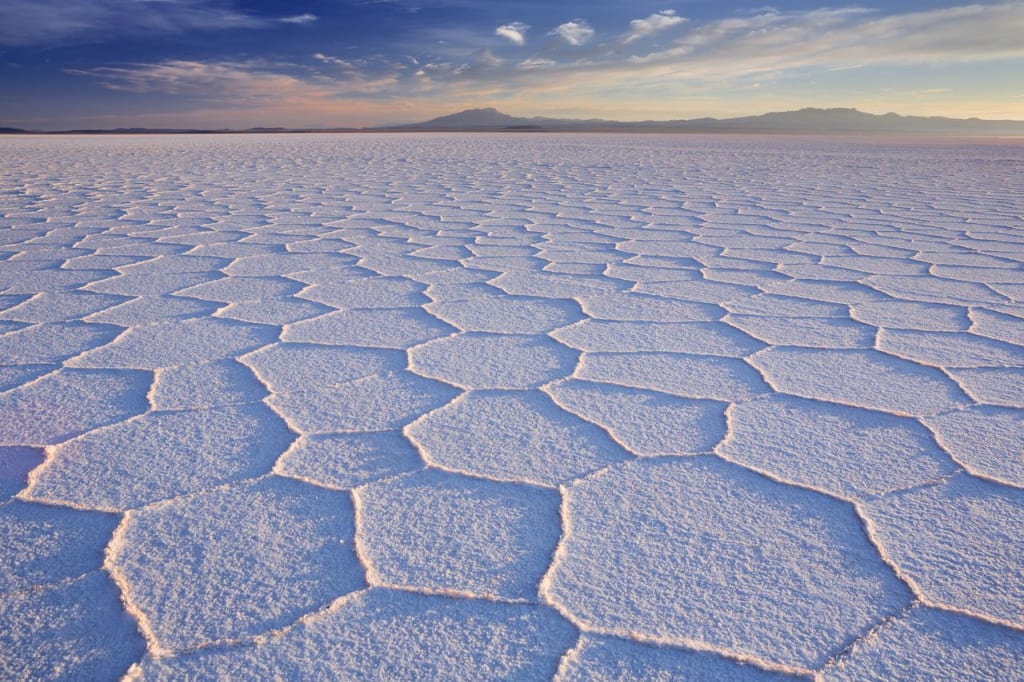
His gaze swung from the facility to the expanse of flat seafoam-green, picric brine ponds precisely arranged as far as He could see. The ponds occupied most of the fenced surface and were set into a depression affording an unbroken view from almost anywhere from the western entrance. He spotted a small number of labourers highlighted in shiny construction-yellow waders and insectoid respirators with goggles coated in a grey reflective substance that caused tiny bright lights to madly whir about their heads, doubling themselves as reflections in a show of isolated bits of action. There wasn’t enough light capable of penetrating the atmosphere to produce a natural sheen on the brine. As the technicians tended to the pumping apparatus snaking beneath the ponds no ripples or disturbances registered and the solution stretched out like taut tarpaulins passing as a solid state. The two-by-eight sequence of enormous rectangles was cradled on the blasted salt flat under a crooked line of buff-coloured mountains, an inhospitable horizon hundreds of kilometers by air from the nearest hub. Subtle whisps of steam rising off the edges, an alkali odour permeated and clung to the nasal passages eventually stinging the nostrils indicating a growing threat of toxic air exposure. The familiar sensation dawned, snapped Him out of the spectacle. He used a respirator to sleep, but they weren’t required on site unless traveling between the ponds themselves. “Which bay is the PPE supply in now?” “Farthest to the left, Number 6. We moved it so we could start each observation shift with the priority gear on this end and make our way subsurface from there.” Safety of the workforce was our primary concern. He’d been personally given the order by VP Ops. They turned and started down the maintenance road to the facility.
Lithium had incredible economic value, which was why anyone spent more than a few seconds to consider the Virgilian hellscape that was Gran Tierra. Batteries used to store energy produced on alternative celestial bodies were the spine of the southern hemisphere’s industrial economy and exploited in every interstellar, manufacturing, or otherwise commercial activity. Prosperity and influence for those who could control it. Mankind first developed its taste for energy in the twentieth century and the mass production of lithium ore had remained essentially unchanged for centuries. Lithium mining occurred in isolated regions due to the unique natural requirements for rare earth formation, and most CauseWell assets on this continent were located on the enormous Argentine Salinas Grandes. High demand for transportable energy meant high prices, and lithium miners also commanded incomprehensibly high wages especially when compared to other regional economic activities. People had to be drawn from hubs around the globe to meet corporation’s demands for labour. No one would argue it wasn’t dangerous. Which was why the company had so carefully hidden its safety violations. It was exceedingly difficult to find prospective employees… lithium mines were utterly counterintuitive to good living. Slipping beneath the radar of public or political perception had been key to maintaining a corporate image of pride and gritty work ethic that drew the few viable fortune-seekers to work outside of the few remaining hospitable hubs.
“It’s my fifth time out. No one’s happy about this back in Aires, trust me,” He tried. The super, an unfamiliar face that had quietly replaced the previous job holder, coolly explained the personal protective equipment inventory was in total order, inspected daily, and produced reamas of documentation for these activities from a hand-held as they walked. Ordinances of quantity, equipment testing dates, measurements and evaluation records of scuffs, scratches or any impairments were all included. “They know, Sir, as in we know, these instances are often a question of kit,” He eyed the super. “…Right.” Each workforce member was provided daily notifications to their corporate wearables including subject prompts, visual refreshers, audible pings to respirator speakers, and other positive reinforcement alerts related to best practices while on duty. These communications often included photographs related to real incidents. It was culture, norm, mandatory.
The super tapped the oversized, flashing orange “ENTRANCE” button at Number 6, lights flashed, whirring ensued. Gesturing Him over to observe the hand-held again, the super continued flicking an index finger through the air revealing examples from the past week of notifications electronically distributed and posted physically on site: “Operating In Low-light Environs”, “Your Kelting Respirator and You: A Match Made In SAFETY”, “Only You and I Can Prevent D.I.E. (drowning, infection, and electrocution)”, the last title referring to the most critical hazards to life faced at the mine – including the recent occurrence He’d been called out to investigate. “What about exhaustion?” The super shortly sucked in a breath through the nose, but stopping the prepared exposition before it started He crinkled his eyebrows sympathetically and stiffly shook His head, “That- that’s alright. Let’s head down, Vector X03. Everyone must be in by now.” His mouth was completely dry.
The fact any orders passed down were hopelessly impersonal may have been a factor. The management plans, safety protocols, obviously committee-tainted corporate communique, the super and their huddle of equally bought off and indifferent foremen. He traced the worthlessly dim LED walkway lighting lining the system of catwalk-covered scaffolding to the excavation site beneath the facility’s main production floor. Each light glowed imperceptibly at intervals of exactly two-point-seven-five inches in accordance with the VP Ops careful directions to ensure effective guidance in combination with the overhead floodlights (“We really need to check all our boxes, it’s apples and oranges anyways”). He’d worked as CauseWell’s Regional Head of Security over nineteen years at numerous lithium sites across South America and been privy to on average less than one loss of life instance per each hundred-thousand recorded work hours. Gran Tierra was a painful exception. It’s my fifth time out. Another drowning. Though it had occurred in a pond, an entire mine inspection was required to carefully document the apparent diligence paid by the company toward maintaining safety within each step of the mine’s production process. Initially, He’d considered the possibility each incident had been related to isolated cases of negatory psychological wellbeing. Fatigue related to a miscalculation in the nutrition index. Burnout. Not technically accidents in the true sense, but in the sense everyone intuitively knew.
He thought back to the placard, a rogue advertisement in clear violation of any number of internal policies related to publicly posted signage on site. He knew well how difficult it was to spend the few weeks on a normal crew rotation at any of CauseWell’s mines and was sensitive to the employees’ capability to withstand the work. Gran Tierra had been a fastidiously maintained catastrophe for the last thirteen months. Compounding safety risks to employee life and wellbeing that revealed themselves to be seemingly unpreventable, the mine’s operations themselves had been disrupted in a variety of unpredictable ways that a company with CauseWell’s excess of operational experience (“85 Years of Mining Excellence, Bringing the Power to You”. The corporate logo was a monochrome navy illustration of a colonial American lighthouse installed with the iconic rectangular lithium-ion battery casing instead of a bulb) should have swiftly implemented actionable resolutions. It seemed all the management team could implement was an increased volume of reporting alerts and requirements – which was seriously starting to affect morale. Occupational injury rates were nominal. The workforce performance was solid. Addictions were controlled. But equipment failures and the fatal incidence rate had been unprecedented. The most extreme case had been an undetected micro-sinkhole beneath Pond #4, sucking the unfortunate discoverer down a mere distance of two meters to suffocate under a sudden drift of toxic silt. How had the engineering design team years ago missed assessing this geological potential beneath the proposed pond? The worker’s two other crewmates also responsible for inspecting the segment of fifty-four-centimeter hose, never beyond each other’s direct field of vision, failed to identify and respond. His report turned up no meaningful or technical arguments, just that the other members of the crew seemed to have forgotten she were there. Management opted for pursuit of another layer to the iron curtain of workplace protocol in the absence of a tangible assessment. “Human accident” was the final note left on the report.
Within each brine pond was a remarkable machine representing a recent feat of human engineering. Open brine ponds utilized an evaporative process replete with myriad chemical input to produce lithium-phosphate, the raw form of lithium prior to manufacturing into lithium salts which were used as an electrolyte in battery cells. Brackish water was first pumped into the mined reservoir and diluted with lithium ore by chemical reaction, then pumped from the excavation site to fill the ponds to allow the water to evaporate on the arid salt flat leaving behind lithium compounds. The machines, placed like bullseyes in the center of each pond, provided an additional separation method to speed the evaporative process. By combining triboelectricity and reverse osmosis it was possible to condense lithium compounds without waiting on natural evaporation alone. Traditionally, filtration membranes were deemed as ineffective as they could only filter lithium in a chemical form that included magnesium, iron, salt and a variety of other undesirables that required further atomic separation before any extracted lithium could be processed. The innovation solved the limiting factor in the production process and revealed a ten-fold decrease in the time required. No other competitor could brag such a yield. The purification membrane was developed by a private firm founded in Israel and later bought by CauseWell in a multi-billion deal, nearly jeopardized by a mispronunciation during attendance at a regional religious event by a now forgotten CauseWell executive. The machine had an enormous impact on Argentine asset productivity, garnering significant attention from regional and state officials as the company sought to expand and take full advantage of the innovation before other mining entities could replicate it.
To Him it was science-fiction nonsense. It was His business to be informed of the general operation of the site but as far as He could tell most of the folks working at the mine had little concept of how costly lithium-ion battery production was, let alone how electricity worked. They knew the application: excavators, rock crushers, pump systems, how power “worked”. Really, He didn’t care to understand. He cared about the men and women who didn’t go home. The stress-fractured frowns struck permanently to coworker’s faces. Ridiculous, staged temper tantrums between board members to convince Him how much they “cared”. He cared about His time, time with His son. Whether anything was powered by lithium or helium or Christ flipping switches in an orbiting embryonic state, He didn’t care. These were His people, for nineteen years. He was far from home. From His people. And He was expected to investigate yet another incomprehensibly suspicious death of a technician He’d onboarded Himself to CauseWell’s Fifty-Two-Step WorkSafe~LiveSafe Program, without even a galactically remote shred of evidence that the cause could have been anything but some indescribable error in human capacity. Just so He could report back to the executive board, of whom none had even stepped foot onto the Salinas Grandes itself, and explain there was no reasonable explanation, actionable plan, or matrix He could produce to proactively mitigate a simulated version of the event. A carefully pressurized system, implemented in some cases up to twenty times over within every CauseWell mine site implemented in the Salinas Grandes, had without warning fractured nearly a meter in length when an experienced technician unclipped the pressure meter release to take a routine reading. The sensor mechanism hadn’t failed, according to the controller. It just didn’t go off.
He continued down the sloping catwalks behind the super, picturing the victim’s unmasked face blinded by toxic saltwater, a whorl of agony pinned beneath the immense pressure of the fractured pump release having only a few seconds of cognition left before the acid quickly ate through lung tissue and they starved of oxygen. At Gran Tierra, no one could hear Him.
About the Creator
Enjoyed the story? Support the Creator.
Subscribe for free to receive all their stories in your feed.
Comments
There are no comments for this story
Be the first to respond and start the conversation.