
A Thousand Nights from Myself
The first time I died, I had paid for company.

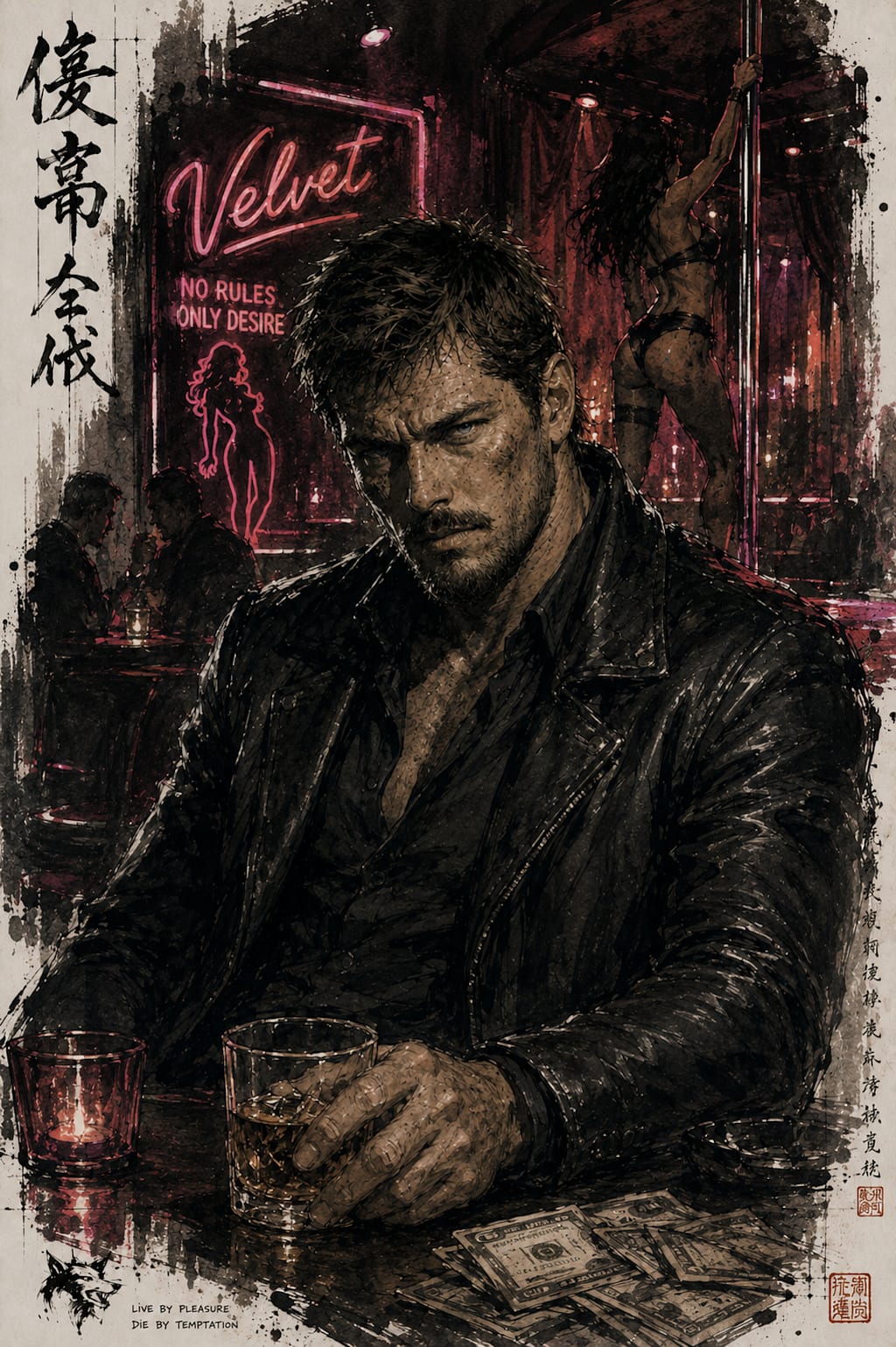
The first time I died, I had paid for company.
That was the part I hated most later.
Not the blood.
Not the teeth.
The money.
The folded bills.
The little transaction at the beginning of eternity.
I had gone to the club because I was tired of being myself, and men have always confused hunger with a destination.
The place sat in a strip mall between a liquor store and a tax office. Sin and accounting, side by side, waiting for the same customers.
Inside, the air was warm with perfume, spilled beer, old desire, and neon sadness.
I spent too much money on a tall European woman with pale hair, long legs, and eyes that looked almost amused by human weakness.
She said her name was Katarina.
I believed her because I wanted to.
Men in places like that believe whatever helps the room keep working.
She danced for me.
Then sat beside me.
Then let one hand rest lightly on my shoulder, like she was testing the quality of meat.
“You look sad,” she said.
“I’m not sad.”
“No?”
“No. I’m just expensive tonight.”
She smiled.
Professionally at first.
Then with interest.
That was when the night began to tilt.
I bought another dance.
Then another.
Then a bottle I did not need.
She listened while I talked, which was probably the most expensive part.
I told her I was tired.
I told her I had been many things and none of them long enough.
I told her I had loved women who felt like weather and survived them badly.
I told her I kept finding new rooms and leaving the same man inside them.
That was when her face changed.
Only slightly.
A break in the mask.
“You are hiding from yourself,” she said.
I laughed because it was too accurate to survive without humor.
“Is that included with the bottle service?”
“No,” she said. “That is free.”
Near closing, the room lost its disguise.
The lights came up a little.
The men looked older.
The women looked tired.
The music became mechanical.
Katarina leaned close enough for her hair to brush my cheek.
“You want to leave?” she asked.
I knew what I thought she meant.
That was my first mistake.
My second was saying yes.
Outside, she no longer performed softness.
Her shoulders went back. Her face emptied of warmth. Under the parking lot lights, she looked taller.
Older too.
Not in years.
In distance.
Her apartment was above a shuttered bakery, old brick painted the color of dried blood.
At the bottom of the stairs, she stopped.
“You should go home,” she said.
I smiled because foolish men often mistake mercy for flirtation.
“Now you tell me?”
She studied my face.
Not as a customer.
Not as a man.
Not even as food.
“You do not know what I am,” she said.
“I don’t know what I am either.”
The sentence came out before I understood it was true.
For the first time all night, Katarina looked at me without price.
“You poor thing,” she said.
I hated the pity in her voice.
I needed it too.
That was the problem with me then.
The apartment waited above us.
Dark.
Quiet.
Certain.
I followed her upstairs.
The door closed behind us.
Inside, the room was too clean.
No photographs.
No clutter.
No books left open on tables.
No shoes near the door.
No evidence that a life had ever been lived there by accident.
There was a couch. A narrow table. Heavy curtains. A glass of water beside the bed, already waiting.
That should have bothered me.
Instead, I thought I had been chosen.
Men have died from smaller stupidities.
Katarina crossed the room without turning on another light. The red lamp in the corner made her skin look almost painted. She poured a drink, handed it to me, and watched me swallow.
There was no seduction after that.
Not the kind I understood.
The softness left her face. Her accent thickened. Her posture straightened. The woman from the club folded herself away, and something older stood in her place.
I remember thinking she looked almost bored by my fear before I had even begun to feel it.
“What is this?” I asked.
She came closer.
The room seemed to narrow around her.
“You wanted to stop being yourself,” she said.
“I wanted a drink.”
“You wanted oblivion. You only lacked imagination.”
I laughed, but the sound was wrong.
“Is this the part where you rob me?”
“No.”
She touched my chest with two fingers.
Not hard.
Just enough to stop me.
Then I saw the teeth.
Not dramatic.
Not monstrous in the way movies had taught me to expect.
Just there.
A quiet correction to everything I believed the world allowed.
I stepped back.
She moved faster than the thought.
One second she was in front of me.
The next, her hand was in my hair, her mouth at my throat, and my body had become information she already knew how to read.
The bite was not like pain at first.
Pain is honest.
This was invasion.
Heat, then cold.
Pressure, then surrender.
My knees weakened. My hands found her shoulders, not to push her away, but to hold onto the thing killing me.
That shamed me later too.
She drank like a woman who had done this for centuries and had learned not to spill.
Precise.
Quiet.
Almost merciful.
My heart fought.
Then stumbled.
Then fought again.
The room tilted.
The red lamp stretched into a wound of light.
Somewhere below us, a truck passed in the street. I heard its tires against wet pavement. I heard a pipe inside the wall. I heard my own blood leaving me, and beneath that, I heard something deeper than hearing.
Hunger.
Waiting.
Katarina pulled away before I was gone.
I collapsed against her.
She held me upright.
I tried to speak, but my mouth had forgotten language.
“You were supposed to be food,” she whispered.
Her lips were red now.
Not lipstick.
“Nothing more.”
She lowered me to the floor.
My body had become distant. My fingers twitched like small animals. I could feel my heart beating slower, each beat arriving from farther away.
She knelt beside me.
For the first time, she looked uncertain.
That frightened me more than the teeth.
“You said you did not know what you were,” she said. “That was the truest thing you said all night.”
I tried to breathe.
The air would not stay.
“You poor man,” she said again.
Then she bit her own wrist.
Black blood welled up from her skin.
Not red.
Not exactly.
It looked red only where the light caught it. Otherwise it was dark, thick, almost luminous, like midnight learning to bleed.
She pressed her wrist to my mouth.
I turned away.
Or thought I did.
My body betrayed me.
My mouth opened.
The first taste was not blood.
It was memory.
Hers.
Mine.
Cities I had never seen.
Winter over roofs.
A battlefield under moonlight.
Men begging in languages I did not know.
Music from rooms where everyone had been dead for two hundred years.
Then hunger rose through me like fire finding a staircase.
I drank.
I drank from her like a starving thing.
She let me.
For a moment, her face tightened, and I understood with some last human part of me that this was not easy for her. That turning me cost her something too.
Not enough.
But something.
When she pulled her wrist away, I followed it with my mouth.
She struck me across the face.
The sound cracked through the room.
“Enough.”
I lay there trembling.
Alive.
Dying.
Becoming.
All three, perhaps.
Katarina leaned over me.
Her hair fell around her face like pale curtains.
“Listen to me,” she said.
I could barely see her.
“Do not waste this.”
Then my heart stopped.
There are no angels in that dark.
No tunnel.
No mother waiting.
No God leaning down with an explanation.
Only a black sea.
No stars.
No shore.
No body.
Only hunger.
When I opened my eyes again, I was on the floor.
The apartment was silent except for the old refrigerator humming in the next room.
No.
Not silent.
Too loud.
The pipes behind the wall.
The building settling.
A woman laughing half a block away.
A dog scratching at a door.
A man coughing into his hand in the bakery below.
The blood in all of them moved like music.
I sat up too fast and crossed the room without meaning to.
One second I was on the floor.
The next, I was at the window, palms against the glass, staring down at the street.
Katarina watched from the couch.
She had changed clothes. White shirt. Dark trousers. Bare feet tucked beneath her like a woman with nowhere to be because every night was hers.
“What did you do to me?” I asked.
“What you asked every woman in that club to do.”
“I did not ask for this.”
“You asked not to be yourself.”
My throat burned.
No.
Not my throat.
Lower.
Deeper.
All of me.
“I’m thirsty,” I said.
“No,” she said. “You are hungry.”
Then she brought him in.
I had not heard the door open.
I had not heard footsteps in the hall.
But suddenly there was a man standing in the apartment with tape over his mouth and terror in his eyes.
Middle-aged. Wrinkled suit. Sweating through the collar. Hands tied behind him.
I backed away.
“What is this?”
“Your first lesson.”
The man made a sound through the tape.
Something in me answered.
Not my mind.
Not my conscience.
Something older than both.
His pulse entered the room like a drum.
My teeth hurt.
I covered my mouth with both hands.
“No.”
“Yes.”
“I’m not doing that.”
“You already are.”
She was right.
I hated him for being alive in front of me.
That was my first lesson as a monster.
Hunger does not begin by making you cruel.
It begins by making everyone else unbearable.
Katarina stood beside me.
“You may kill him,” she said. “Or you may learn.”
“Who is he?”
“A man.”
“That’s not an answer.”
“It is the only answer hunger needs.”
I looked at him.
His eyes pleaded with me to be better than what I had become five minutes earlier.
That angered me too.
His hope.
His belief that I could still be negotiated with.
I wanted to tell him I was not qualified for mercy.
Instead, I grabbed him.
He screamed into the tape.
The sound entered me like champagne.
Then my teeth found him.
Blood is not a flavor at first.
It is permission.
It is door after door opening in the dark.
It is every appetite you ever mistook for love standing up at once and applauding.
I drank until Katarina pulled me away.
I fought her.
She threw me across the room with one hand.
I hit the wall hard enough to crack plaster and slid down like a ruined coat.
The man collapsed, alive, shuddering, white-faced, but alive.
Katarina crouched in front of me.
Her eyes were no longer amused.
“That,” she said, “is why precision matters.”
I wiped my mouth with the back of my hand.
The blood was everywhere.
My shirt.
My fingers.
My chest.
My chin.
I looked like a bad idea that had found religion too late.
“Precision?” I laughed.
It came out broken.
“You turned me into this and now you want manners?”
“No,” she said. “I want you to understand the difference between feeding and destroying.”
I looked at the man on the floor.
“Is there one?”
“There had better be.”
She stood and went to him. She removed the tape from his mouth. He gasped, sobbing.
Then she pressed her wrist to his lips.
He drank because terror makes people obedient.
Color returned slowly to his face.
My stomach turned.
Not from disgust.
From jealousy.
I wanted the blood back.
Katarina looked over her shoulder.
“This is the first rule. Hunger is not an excuse. It is only a condition.”
“Why him?” I asked.
She wiped her wrist with a white handkerchief.
“Because he sells girls to men who tell themselves they are only customers.”
The room became still.
The man began sobbing harder.
I wanted that to make feeding easier.
It did.
That frightened me more than the hunger.
Katarina watched the thought move through my face.
“You see the danger,” she said.
“What danger?”
“The relief of having a reason.”
That was the second lesson.
A monster with a moral excuse is still a monster.
Often worse.
For the first year, I stayed with her.
Not because I loved her.
Not because she loved me.
Because I was a newborn thing with an old man’s shame and an animal’s mouth.
She taught me how to sleep through daylight. How to hear the difference between fear and desire. How to enter a room without letting every pulse become a sermon. How to feed at the wrist, the thigh, the throat, and leave a human alive with only the dream of being kissed by winter.
She taught me how to disappear.
Names first.
“Names are doors,” she said. “Do not leave yours open everywhere.”
I used many after that.
Some lasted years.
Some lasted hours.
The first time I looked into a mirror and saw nothing, I laughed.
Not because it was funny.
Because it was efficient.
The world had finally agreed with the feeling I had carried as a man.
No reflection.
Just evidence that something had stood there.
For a while, I thought vampirism had freed me.
No aging.
No illness.
No ordinary fear of men.
No bruised ego after another man’s warning.
No clocks in the body.
No need to impress rooms full of strangers unless I wanted to.
Power is dangerous because at first it feels like healing.
I used it badly.
Of course I did.
I went back to the old rooms.
Not the same club. That would have been too poetic, and life is rarely that tidy.
But rooms like it.
Velvet booths.
Stage lights.
Beautiful women pretending not to be tired.
Men spending money to purchase temporary obedience from someone else’s face.
I told myself I was hunting predators.
Sometimes I was.
Sometimes I was only hunting men who reminded me of myself.
There is a difference.
It took me decades to admit it.
The first city I ruined myself in was Miami.
Then New Orleans.
Then Madrid.
Then Prague.
Then Los Angeles again, because no matter how far a man runs, the old weather learns new airports.
Everywhere I went, the century changed its clothes and the room stayed the same.
Men wanted to be seen.
Women wanted to survive being looked at.
Money wanted to become touch.
Loneliness wanted a body.
I fed in alleys, hotel rooms, private lounges, parking garages, churches, boats, bathrooms, balconies, limousines, one opera house, and once beneath a bridge while fireworks bruised the sky over a river I never learned the name of.
I learned languages.
I learned dances.
I learned how to fight with knives, then pistols, then not at all.
I learned that every generation believes it invented desire.
Every generation is wrong.
Desire only changes music.
The choreography stays ancient.
For fifty years, I mistook motion for change.
I had wardrobes in six countries.
Safe houses.
Lawyers who never asked why I paid in old gold.
Passports with names I had already outlived.
I could enter a city at dusk and know by midnight where the rich men sinned, where the lonely women drank, where the police looked away, and where hunger could wear a clean shirt.
And still, every night ended with me.
That was the insult.
I had outrun mortality.
I had not outrun repetition.
Katarina found me again in Vienna.
Or maybe she had never lost me.
She appeared at a table across from mine in a hotel bar where everything cost too much and nothing had ever been truly clean.
I was watching a married woman remove her ring and place it beside her glass.
Old habit.
Old door.
Old shape.
Katarina sat without asking.
“You have become tedious,” she said.
I did not look at her.
“You always had a gift for tenderness.”
“You have had eighty-seven years.”
“Is that all?”
“And you are still circling the same wound.”
That made me look.
She had not changed, of course. Neither had I, physically. That was part of the cruelty. We looked like statues pretending to be people while time broke itself against us.
“I am not wounded,” I said.
She looked at the woman with the ring beside her glass.
“No. Clearly.”
I smiled.
It was not a kind expression.
“You turned me.”
“I did.”
“You do not get to complain about the result.”
“I do not complain about what you are,” she said. “I complain about your lack of imagination.”
That landed.
Violence would not have.
Mockery would not have.
But lack of imagination?
That found the boy in me who still wanted to believe he was becoming something.
“You think eternity is appetite,” she said. “That is why you are bored.”
“I am not bored.”
“You are bored enough to keep confusing damage with proof you exist.”
The married woman at the bar put her ring back on.
I watched her do it.
A small circle returning to a finger.
A door closing without drama.
Katarina saw me see it.
“That,” she said, “is a miracle you have not learned to respect.”
“What?”
“Restraint.”
I laughed.
“From you?”
“Yes,” she said. “From me.”
Then she leaned closer.
“The first century is hunger. The second is style. The third is repetition. After that, a vampire either becomes precise or becomes ridiculous.”
Ridiculous.
The word entered me like a stake made of grammar.
She left before sunrise.
No goodbye.
No lesson written on parchment.
Just her empty glass on the table and the married woman gone back to whatever life she had almost betrayed.
That night bothered me for years.
Truth is not magic.
It is more like a debt collector.
It keeps showing up.
I became a physician for twelve years.
Not officially at first.
Officially came later, under a name with forged transcripts and enough donations to make institutions forgiving.
Before that, I worked where no one asked much.
War zones.
Plague wards.
Field hospitals.
Places where the living and the dead were already standing too close together for anyone to notice one more abnormal thing in the room.
I learned anatomy from the inside out.
Not as hunger.
As responsibility.
The body became less a meal and more a system.
Arteries.
Pressure.
Shock.
Breath.
Clotting.
Infection.
Failure.
Precision stopped being Katarina’s word.
It became mine.
The first time I saved a boy after a bombing, I sat outside afterward until dawn nearly caught me.
He could not have been more than fourteen.
Half his side opened.
Breathing wetly.
Calling for his mother.
My hands moved before my mind finished being afraid.
Pressure.
Clamp.
Thread.
Blood everywhere, but not mine to take.
When he lived, something terrible happened.
I felt proud.
Not the old pride.
Not conquest.
Not appetite.
Something cleaner.
More dangerous, perhaps, because it asked something of me.
I had been powerful for a century and had mostly used it to enter rooms.
That night, power held a wound closed.
I thought of the man Katarina had brought me after she turned me.
Feeding and destroying.
The difference.
There had better be one.
For a while, medicine saved me.
Then it became another identity to hide inside.
That is the trick with growth.
Even healing can become a costume if you wear it to avoid the next truth.
I left before people noticed I was not aging.
I always left before that.
The decades stacked.
That was strange enough.
I had not been born under gaslight or plague bells. I had not watched empires fall from horseback or crossed oceans in wooden ships. That was Katarina’s burden, not mine.
She had centuries behind her.
I had neon.
I had cigarette smoke trapped in low ceilings, dancers moving under red bulbs, cassette tapes left in hot cars, pay phones sticky with other people’s emergencies, and cities that still felt private after midnight.
I belonged to the end of the analog world.
Then I watched it disappear.
Vinyl became cassettes.
Cassettes became compact discs.
Compact discs became files.
Files became clouds.
Music stopped living in rooms and started haunting everyone’s pocket.
The night filled with cameras.
Then phones.
Then screens bright enough to make every face look accused.
Old monsters hate mirrors.
New ones hate surveillance.
I had to adapt.
A vampire who cannot adapt deserves the dawn.
The clubs changed first.
The stage lights became colder.
The money became plastic.
The men became more careful and less mysterious.
The women became harder to fool in ways I admired.
The lonely still came in looking for a body to carry their sadness for an hour.
That part never changed.
Every generation believes it invented desire.
Every generation is wrong.
Desire only changes costumes.
The choreography stays ancient.
I moved through Miami, Los Angeles, New Orleans, Berlin, Prague, Madrid, and back again.
Not centuries.
Decades.
But decades are long enough when a man keeps repeating himself.
Long enough to learn new names.
Long enough to ruin old ones.
Long enough to watch whole neighborhoods become ghosts with better rent.
Long enough to understand that immortality does not need a thousand years to become a trap.
Sometimes forty is enough.
Sometimes one night is enough, if you keep finding ways to live it again.
I had outrun age.
I had not outrun appetite.
I had outrun ordinary death.
I had not outrun the shape of myself.
I adapted.
A vampire who cannot adapt deserves the dawn.
That was one of my rules.
There were others.
Never feed angry.
Never feed from the lonely unless you are willing to hear the story.
Never mistake consent to one thing for consent to everything.
Never turn someone out of lust.
Never turn someone out of loneliness.
Never turn someone because their dying reminds you of your own.
Especially that one.
I broke it once.
Her name was Mara.
She was not beautiful in the way rooms announce.
She was beautiful in the way a locked door is beautiful when you know there is music behind it.
I found her in Lisbon during a rainstorm, bleeding from the mouth in an alley behind a theater.
A man had beaten her and left her there.
Not a lover.
Not a husband.
A stranger with a knife and bad luck.
I killed him.
Not cleanly.
That mattered.
Old weather.
Old shape.
Old appetite wearing justice like a stolen coat.
Then I knelt beside her.
She saw my face.
She saw the blood on my mouth.
His blood.
She should have screamed.
Instead, she laughed.
A small, ruined sound.
“Angel?” she asked.
“No.”
“Devil?”
“Closer.”
She was dying.
I knew the line by then.
The body has a tide. Hers was going out.
I had minutes.
Maybe less.
I told myself I was offering mercy.
I told myself I was correcting cruelty.
I told myself many things in very elegant language.
Then I turned her.
Katarina would have called it sentimentality with fangs.
Mara woke hungry and furious.
That was when I learned that giving eternity to someone does not give them a reason to want it.
She hated me for thirty years.
Then loved me for seven.
Then hated me again with better arguments.
She was sharper than I was.
Quicker to name hypocrisy.
She learned the modern world like a knife learns ribs.
Together we were magnificent and unbearable.
We fed on violent men at first.
Then cruel women.
Then anyone we could justify.
Justice became appetite’s favorite mask.
I saw myself in her and called it companionship.
She saw herself in me and called it prison.
One night in Buenos Aires, after a century of us circling each other in different countries under different names, she stood on a balcony above a city full of music and said, “You turned me because you could not bear to be alone with your lesson.”
That sentence was a clean wound.
I had no answer.
She smiled sadly.
“You are not a mentor. You are a man who keeps building mirrors and calling them students.”
Then she left.
Not angrily.
Worse.
Precisely.
By then, I had begun keeping journals.
Not confession.
Inventory.
I had grown suspicious of confession.
Confession can become vanity if no change follows it.
Men will describe the wound forever if it lets them avoid the surgery.
So I wrote differently.
Not what I felt.
What repeated.
City.
Name.
Hunger.
Mistake.
Excuse used.
Cost paid.
Pattern observed.
Adjustment required.
It sounds cold.
It was not.
It was the only way I knew how to stop making art out of my failures while continuing to commit them.
One journal from that era has only a single sentence on the first page:
Immortality is not the punishment. Repetition is.
I wrote it in black ink in a rented room in Chicago while snow buried the windows and a woman slept in the next room with two puncture marks on her thigh and no memory of my name.
She lived.
That mattered.
It did not absolve me.
That mattered too.
For a long time, I thought growth meant becoming less monstrous.
I was wrong.
The monster remained.
The hunger remained.
The night remained.
Growth meant becoming less surprised by myself.
It meant recognizing the shape sooner.
It meant hearing the old sentence before it reached my mouth.
Just this once.
She understands me.
He deserves it.
I am lonely.
I am hungry.
I am owed.
Every catastrophe begins as a small private permission.
A door.
A cost.
A little weather in the chest.
The night I finally saw Katarina for the last time, she was dying.
That should not be possible.
But the world is full of things that should not be possible.
We are among them.
I found her in a monastery in the mountains, because of course she had chosen someplace dramatic enough to irritate me.
Snow outside.
Stone walls.
Candles.
She had always enjoyed atmosphere when it served her.
She looked older.
Not aged exactly.
Thinner.
Transparent around the edges.
Some vampires are killed by hunters.
Some by rivals.
Some by sunlight.
Some by boredom.
Katarina had been starving herself.
Not from guilt.
From completion.
That was how she described it.
“I have no wish to continue,” she said.
“You always were theatrical.”
She smiled.
“You always mistook theater for dishonesty.”
I sat beside her bed.
There was no pulse in the room except mine, and mine was borrowed.
“You could feed,” I said.
“Yes.”
“Then feed.”
“No.”
I hated that answer.
Because I understood it.
She looked at me for a long time.
“You have changed.”
“I had centuries.”
“Many do not.”
I thought of the married woman in Vienna.
The man in the first apartment.
Mara.
A thousand names.
A thousand rooms.
A thousand nights from myself.
“Why did you turn me?” I asked.
It was a childish question.
After centuries, we return to the first room anyway.
She closed her eyes.
“I told myself it was pity.”
“And was it?”
“Partly.”
She opened them again.
“You were ordinary enough to be food. But sad enough to be interesting.”
“That is cruel.”
“Yes.”
“And true?”
“Yes.”
I laughed softly despite myself.
She reached for my hand.
Her fingers were cold even to me.
“You said something before I turned you. Do you remember?”
“I said many pathetic things.”
“You said you did not know what you were.”
The room went still around that.
“I had heard many men beg,” she said. “Many bargain. Many promise. Many curse. You were the first in a long time who named the prison correctly.”
“So you gave me eternity?”
“I gave you time.”
“That is not the same thing.”
“No,” she said. “It is not.”
For a while we listened to the wind worry the stones.
Then she said, “Did you waste it?”
I did not answer quickly.
That was respect.
“Yes,” I said. “For a long time.”
“And now?”
I thought about lying.
Not to her.
To myself.
Old habit.
Old room.
Old mirror.
“No,” I said finally. “Not all of it.”
She nodded.
That was the closest she ever came to blessing me.
Near dawn, I carried her outside.
She weighed almost nothing.
A bundle of old silk and bone and impossible history.
The horizon had begun to pale.
The mountains were black against a sky turning silver.
She looked east.
I had never seen her face in morning light.
No vampire should be beautiful at sunrise.
She was.
Not because the light flattered her.
Because she had chosen it.
“Do you fear it?” I asked.
“No.”
“Do you regret me?”
She turned her head slightly.
“Often.”
Then she smiled.
“But not entirely.”
The first ray touched her cheek.
She burned quietly.
No scream.
No drama.
No opera ending.
Just light taking back what night had borrowed for too long.
I held her until I could not.
When it was over, ash moved across the snow in a thin gray line.
Precision, I thought.
Even in death, she had managed that.
After Katarina, I stopped using the word curse for many years.
It felt lazy.
Too convenient.
A curse is something done to you.
A pattern is something you participate in.
I had been cursed, yes.
Turned.
Changed.
Exiled from sunlight.
Made hungry forever.
But after that, what I repeated belonged to me.
That was the harder truth.
I returned to ordinary cities.
That became my discipline.
Not castles.
Not ruins.
Not romantic distances.
Ordinary cities.
Places with laundromats, parking meters, bad coffee, cheap apartments, night buses, hospitals, diners, clubs, meetings in church basements, gyms open twenty-four hours, women smoking outside bars, men pretending not to cry in their cars.
Human life at street level.
I learned to live near it without always taking from it.
Not perfectly.
Never perfectly.
Perfection is another costume.
But better.
I became many men.
A night-shift doctor.
A security consultant.
A piano student.
A boxing coach who never sparred too hard.
A monk for nine years, which was funny to everyone except the monks.
A janitor in a museum, because after enough centuries, cleaning floors becomes more interesting than owning the building.
A bartender twice.
That was the dangerous one.
Old rooms.
Old hunger.
Old stage.
But I learned something behind the bar.
People tell bartenders the truth because they think the truth will evaporate with the ice.
It does not.
It sinks into the wood.
I heard men confess affairs before making the call.
Women remove rings and put them back on.
Young men talk about fights they hoped would prove them.
Old men talk about wars that did not.
I watched desire arrive, take a seat, order badly, and look around for permission.
Sometimes I said nothing.
Sometimes I changed the music.
Sometimes I called a cab.
Once, I took a man outside by the collar because he had cornered a woman near the restroom.
He swung at me.
I caught his fist.
For one second, the old joy rose in me.
Violence is honest in a way few things are.
That is why men become addicted to it.
Then I remembered the journals.
Power without precision becomes damage.
I did not break his hand.
I only held it until he understood that I could.
Then I let him go.
That was better.
Not perfect.
Better.
One night, very late, a young woman sat at my bar and cried without making a sound.
She had blonde hair.
Brown eyes.
A black shirt.
For a moment, time collapsed in the old dangerous way.
Not because she was someone I knew.
Because she was a shape I knew.
Weather in familiar clothes.
She looked at me and said, “Do you ever feel like you keep becoming the same person?”
I almost laughed.
Instead, I poured her a glass of water.
“All the time,” I said.
“How do you stop?”
There are questions eternity does not make easier.
I could have given her wisdom.
Men love giving wisdom when they can no longer repair what made it necessary.
Instead, I said the only honest thing.
“You notice sooner.”
She waited.
“That is it?”
“At first.”
“And after that?”
“You choose smaller damage until you remember how to choose none.”
She looked disappointed.
Good.
Real answers often are.
She left with a friend an hour later.
Alive.
Unbitten.
Unmythologized.
That was one of my finest nights.
Nobody would write a song about it.
That is how I know it mattered.
I live differently now.
Not well.
Do not misunderstand me.
I am still a vampire.
I still wake hungry.
I still hear blood moving in a crowded room and feel the old cathedral open inside my mouth.
I still remember the first taste and the way it made every moral argument sound small.
I still know how easy it would be to become magnificent and unforgivable by midnight.
But I have become suspicious of magnificence.
Too many monsters hide inside beautiful entrances.
These days, I prefer exactness.
A room with two exits.
Curtains thick enough.
Cash in three places.
A list of names I do not use anymore.
A list of names I harmed.
A list of names I helped.
No list balances the other.
Accounting is not absolution.
Still, I keep the books.
There is a woman who sells flowers near my building.
She is old now.
She was old when I met her, which means I have not known her long.
She calls me handsome in a language she thinks I do not understand.
I buy white roses from her sometimes.
Then I throw them into the river before dawn.
I do not know why.
That is a lie.
I know why.
Some rituals are not for the dead.
Some are for the man who did not become worse that night.
When I think of Katarina now, I do not think of teeth first.
I think of the sentence.
Do not waste this.
For a long time, I believed she meant immortality.
Now I think she meant attention.
The wound is not the story.
The hunger is not the story.
The violence is not the story.
The sex is not the story.
They are weather.
They arrive.
They change the pressure in the room.
They tempt the old self to call itself inevitable.
But the story is what a man learns to recognize.
The shape.
The cost.
The door.
The moment before repetition becomes fate.
I have lived a thousand nights from myself.
Then another thousand.
Then another.
I no longer believe there is a final version of me waiting at the end of them.
There is only the next night.
The next hunger.
The next room.
The next chance to become slightly less obedient to the worst thing I know how to be.
That may not sound like redemption.
Good.
Redemption is too often imagined as a door that opens once.
I have found it to be more like a floor that must be cleaned again and again.
A dirty room becomes clean.
A messy floor becomes clear.
A thing is put back where it belongs.
No mystery.
No applause.
Just work.
Before sunrise, I stand at my window and watch the city fade from black to blue.
I cannot enter the day.
But I can witness its approach.
That is enough for now.
The light touches the tops of buildings first.
Then antennas.
Then windows.
Then the river.
The city reveals itself by degrees, precise and merciless.
I step back before it reaches me.
Not from fear.
From respect.
Some doors remain closed because a man finally understands the cost.
I pull the curtains.
The room goes dark.
And somewhere inside the dark, not healed, not forgiven, not finished, I begin again.
About the Creator
Alejandro Arango
A theater major, a poet, and a lover of the written word. I write to the muses that they may inspire me, and to you the reader. Hopefully you can find meaning in my words or something that will lighten your heart on this journey of life
Enjoyed the story? Support the Creator.
Subscribe for free to receive all their stories in your feed.
Comments
There are no comments for this story
Be the first to respond and start the conversation.