
271 Terraforming Mars — Part 1
For SciFriday, September 27, Day 271 of the 2024 Story-a-Day Challenge

DIARY ENTRY SOL 4,100
My ears still ring.
Phobos and Deimos were scheduled for euthanasia, nudged below Roche limit, to be shot into the planet. For the few colonists here who would witness what normally would be an extinction event, it was a dramatic test for the PoroCement that housed us, observers huddled in utero.
We thought it'd be interesting to witness.
Both moons would impact within minutes of each other, offering a unique opportunity to observe seismic overlays of dual impacts, one at each pole. My team was hunkered down a half-kilometer below, under three meters of PoroCement. Holovideo above our location on the surface worked well until the fire/shock-wall arrived: a glowing barrage of immolation, all the burning dust carried along the shock-wave, like a sideways meteor shower. Speeding toward us at fifteen thousand kph, the sky was reddened with countless points of light, offset blue from the reverse redshift. In a way, it was breathtaking, until the video feed abruptly ended.
We never heard the sound of the impacts. Other surprises were coming.
A sonic juggernaut approached.
The thin Martian atmosphere bunched the frequencies together; at the height of the firestorm/shockwall pass, high-pitch sirens transmitted through tons of rock above—high-pitched, yet “full.”
And painful.
Lasting two minutes, I pressed my hands firmly over my ears, but bone conduction continued the torture. The high-pitch didn’t mitigate until the sound Dopplered lower with distance. Many of us passed out from the pain; there were several concussions.
The sonic attack circled Mars, serving us "seconds" several octaves lower—but no less painful. Every hour-and-a-half it returned. By the eighth time everyone was awake and cursing, and its ninth was its last strike at our acoustic nerves. The sound became a deep rumble bordering on subsonic, but still powerful enough to rattle bones.
Then came the noise of the tornadoes. Vaporized moon debris and Martian eject, carried with the shock wave, produced horrific tornadoes of 800 kmh. Even half a kilometer down, the cliché of the sound of freight trains remained accurate. Subsequently, we weathered unvaporized debris and ejecta rains, lasting weeks, as well as our PTSD, lasting considerably longer.
What the hell am I doing on Mars?
_________________
ABOUT THIS STORY
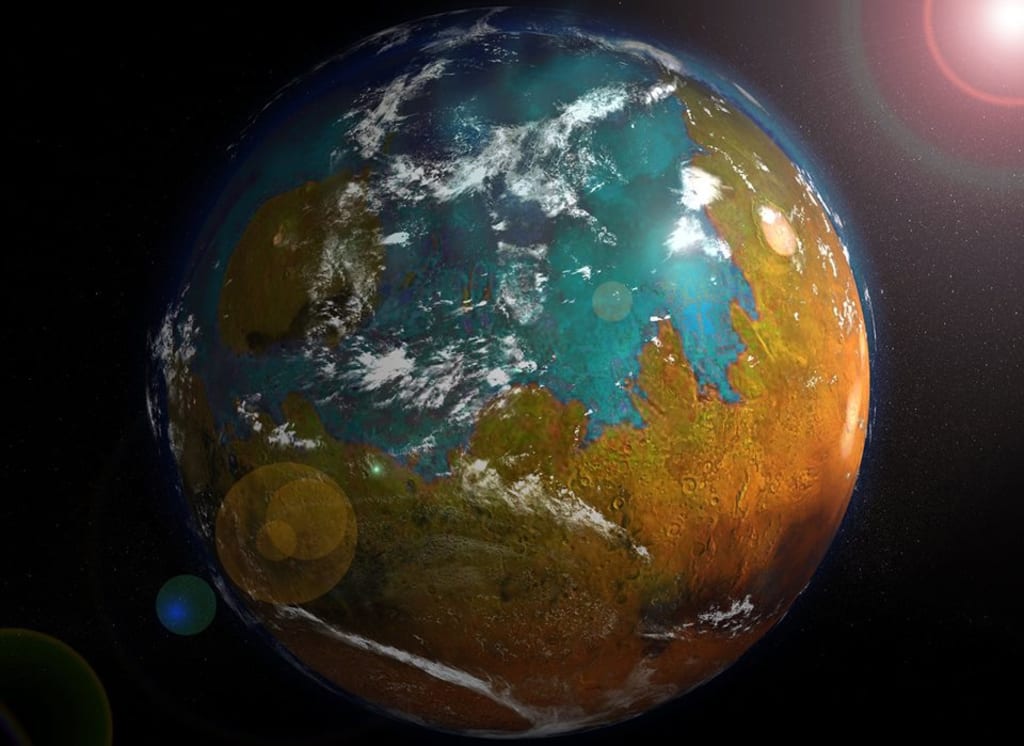
This is from one of my opening chapters of my novel, ♂: The Novel. Terraforming is a daunting geological concept. Yet, the science here was to create a debris canopy to trap heat by vaporizing Mars' two moons. In their place, a Kuiper Belt object would be shephered toward Mars orbit. It would be big enough to create the gravitational pull required to rekindle Mars' molten core. Without that, there would be no electromagnetic field to protect colonists from harmful solar radiation. Also, such manipulations would stabilize an atmosphere introduced by cyanobacteris in the waters delivered via shepherding comets into the planet.
But it wouldn't be pretty!
About the Creator
Gerard DiLeo
Retired, not tired. Hippocampus, behave!
Make me rich! https://www.amazon.com/Gerard-DiLeo/e/B00JE6LL2W/
My substrack at https://substack.com/@drdileo
Enjoyed the story? Support the Creator.
Subscribe for free to receive all their stories in your feed. You could also become a paid subscriber, letting them know you appreciate their work.
Comments
There are no comments for this story
Be the first to respond and start the conversation.