
Why Coloring Still Matters in a Digital World
The Lasting Benefits of Coloring Books for Children's Learning and Development

Walk into almost any home today, and you'll likely find children surrounded by digital devices. Tablets, smartphones, televisions, and educational apps have become a regular part of childhood. Technology has undoubtedly transformed the way children learn, offering instant access to information and interactive experiences that previous generations could only imagine.
Yet despite these advances, one of the oldest childhood activities continues to prove its value: coloring.
At first glance, coloring might appear to be nothing more than a relaxing pastime. Many adults remember spending hours with crayons and coloring books simply because it was enjoyable. However, educators and parents have long recognized that coloring offers benefits that extend far beyond entertainment.
One of the first skills children develop while coloring is fine motor control. Holding crayons, selecting colors, and carefully filling shapes require small hand movements that strengthen the muscles used later for writing, drawing, and many everyday tasks. These seemingly simple actions help children build coordination through repeated practice.
Coloring also supports hand-eye coordination. Every decision a child makes—whether to stay inside the lines or choose a particular color—involves communication between the eyes and the hands. As children continue coloring over time, these movements become smoother and more controlled.
Another often overlooked benefit is concentration. Modern entertainment is designed to move quickly, constantly changing scenes and capturing attention every few seconds. Coloring encourages the opposite. It asks children to slow down, focus on a single activity, and complete one picture at a time. Developing this ability to maintain attention can positively influence learning in many other areas.
Creativity is equally important. Unlike activities with only one correct answer, coloring allows children to make their own artistic decisions. A tree can have green leaves, purple leaves, or even rainbow-colored leaves. A car can be blue, red, or bright yellow. There are no strict rules, giving children the confidence to experiment without fear of making mistakes.
This freedom encourages imagination, one of the foundations of creative thinking. Children who regularly engage in creative activities often become more comfortable expressing their ideas and exploring new possibilities.
Coloring can also become an opportunity for conversation. Parents and caregivers frequently ask questions while children color: "What is this animal?" "What color is the apple?" "Can you tell me where airplanes fly?" These simple discussions naturally expand vocabulary while strengthening communication skills.
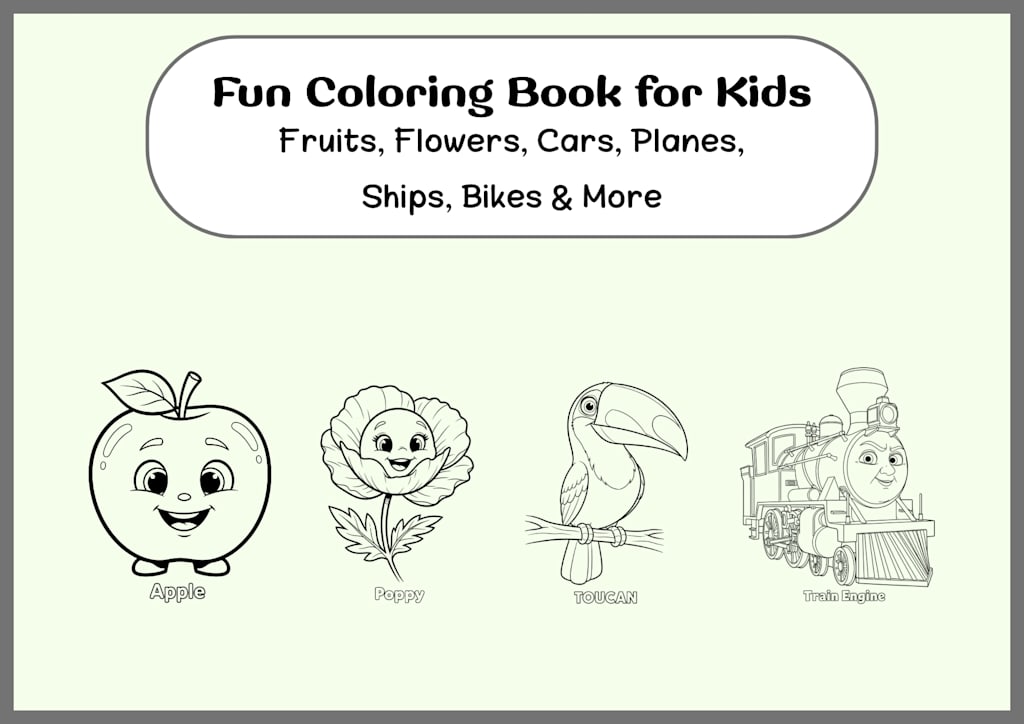
Educational coloring books take this concept one step further by pairing pictures with written words. When children repeatedly see an object together with its name, they begin recognizing letter patterns and connecting spoken language with printed text. Over time, this repeated exposure supports early literacy without requiring formal lessons.
Another advantage of coloring books is accessibility. They require no batteries, internet connection, or expensive equipment. A few crayons and a coloring book can provide meaningful entertainment almost anywhere. Families often use coloring books during travel, while waiting for appointments, on rainy afternoons, or during quiet time before bedtime.
Teachers also appreciate coloring activities because they can reinforce classroom topics while allowing students to work independently. Whether learning about animals, transportation, plants, shapes, or the alphabet, coloring can help children remember information through repetition and visual association.
Perhaps one of the greatest strengths of coloring is its ability to reduce screen time naturally. Rather than telling children to put away digital devices without offering an alternative, coloring provides an engaging activity that captures attention in a healthier way. It encourages children to interact with physical materials, practice patience, and enjoy the satisfaction of creating something with their own hands.
Parents often search for educational activities that balance learning with enjoyment. The most successful resources are those that do not feel like traditional lessons. When children are having fun, they become more willing to explore, ask questions, and continue practicing new skills.
Not every educational activity needs advanced technology or complicated instruction. Sometimes the simplest tools remain the most effective because they encourage active participation instead of passive observation.
For families interested in combining creativity with early learning, educational coloring books can be a practical addition to everyday routines. One example is Fun Coloring Book for Kids, which introduces children to familiar objects through simple illustrations and easy-to-read words, creating opportunities for both creative expression and vocabulary development.
As childhood continues to evolve alongside technology, traditional creative activities still deserve an important place. Coloring reminds us that learning does not always happen through screens. Sometimes it begins with curiosity, a handful of crayons, and the freedom to imagine something entirely new.
If you're looking for meaningful ways to support a child's creativity and early development, introducing regular coloring time can be a simple step with lasting benefits.
About the Creator
Meshal Sprout
Author of fun & educational kids books | Inspiring creativity & imagination
Enjoyed the story? Support the Creator.
Subscribe for free to receive all their stories in your feed.
Comments
There are no comments for this story
Be the first to respond and start the conversation.