
When Technology Becomes Too Much:
Why I Oppose Mandatory Laptops, Chromebooks, and Tablets in Schools

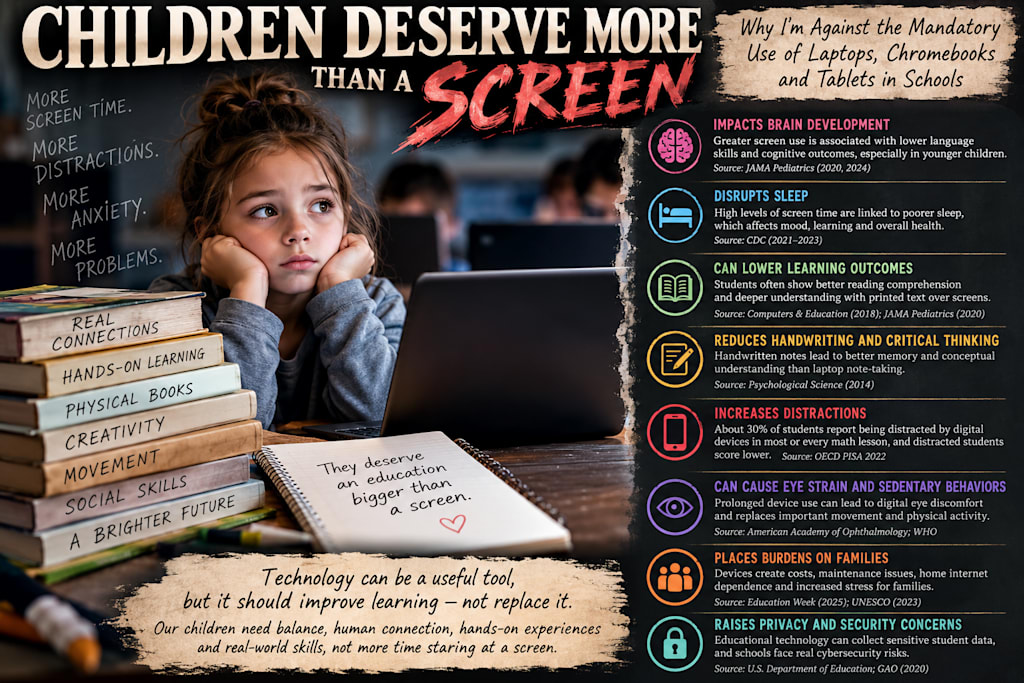
There is a strange assumption taking hold in education: if technology is available, then more technology must automatically mean better education.
I don't believe that.
Laptops, Chromebooks, and tablets can absolutely be useful educational tools. They can provide access to information, assist students with disabilities, make certain assignments easier, and teach legitimate digital skills. Technology itself is not the enemy.
But there is a significant difference between using technology when it improves learning and making a screen the center of a child's education.
I oppose the growing practice of requiring students to use laptops, Chromebooks, or tablets for large portions of the school day, particularly when digital devices replace books, handwriting, face-to-face discussion, hands-on activities, paper assignments, and traditional classroom instruction.
The question shouldn't be, "Can we put this assignment on a Chromebook?"
The question should be, "Is a Chromebook actually the best way for this child to learn this?"
Increasingly, the research suggests that the answer is not always yes.
Children are already surrounded by screens
Today's children don't need schools to introduce them to technology. They are already growing up surrounded by it.
According to the CDC's National Health Interview Survey, 50.4% of U.S. teenagers ages 12–17 reported at least four hours of daily screen time outside of schoolwork during 2021–2023. The CDC also found that higher levels of screen use were associated with poorer sleep, less physical activity, irregular sleep routines, weight concerns, and several measures of poorer mental and social well-being.
That matters because school is one of the few places where adults can deliberately create an environment that isn't dominated by glowing rectangles.
Instead, we increasingly send children into school with another screen.
Then we send them home with that same screen for homework.
At some point, we have to ask whether education should be helping children learn how to use technology responsibly or simply giving them more opportunities to use it.
Screen time isn't harmless simply because it is "educational"
One of the easiest arguments used to defend classroom devices is that school screen time is different because it is educational.
There is some truth to that. Educational technology can be useful. But calling something "educational" doesn't magically eliminate the effects associated with prolonged screen exposure.
The American Academy of Pediatrics emphasizes that children's digital-media use should be intentional and balanced with sleep, physical activity, family interaction, and other important developmental experiences. For school-aged children, the AAP identifies concerns associated with problematic or excessive digital-media use including poorer school performance, weaker attention control, difficulties with language and cognition, unhealthy sleep, reduced exercise, and less time with friends and family.
The CDC likewise states that too much screen time among young people is associated with poor sleep, weight gain, lower grades, and poorer mental health.
This doesn't prove that every child who uses a Chromebook will experience those problems.
It does demonstrate something much more important: screen exposure has consequences, and the amount and context of that exposure matter.
Schools should not pretend otherwise.
Development requires more than looking at a screen
Children develop through interaction with the world around them.
They talk.
They listen.
They write.
They draw.
They manipulate objects.
They move their bodies.
They play.
They read physical books.
They interact with teachers and classmates.
They solve problems without an algorithm holding their hand.
They learn to sit with a difficult problem instead of immediately searching for an answer.
Those experiences matter.
A 2020 systematic review and meta-analysis published in JAMA Pediatrics examined 42 studies involving 18,905 participants and found that greater quantities of screen use were associated with lower child language skills. Importantly, the researchers also found that quality matters: educational programming and co-viewing with caregivers were associated with better language outcomes.
A much larger 2024 systematic review and meta-analysis examined 100 studies involving more than 176,000 participants. Among children under six, greater program viewing and background television exposure were associated with poorer cognitive outcomes, while caregiver-child co-use was associated with better cognitive outcomes. The researchers emphasized that the context and purpose of screen use matter, rather than treating every minute of screen exposure as identical.
That distinction is critical.
A teacher sitting beside a child and interacting with an educational program is not equivalent to putting a child alone in front of a device for hours.
Yet many school technology programs effectively increase the amount of time children spend interacting with screens without necessarily increasing the amount of meaningful human interaction surrounding those screens.
Screens can displace the things children actually need
Perhaps the biggest problem isn't the screen itself.
It's what the screen replaces.
Every hour spent completing an assignment electronically is an hour that could potentially have been spent reading a physical book, writing by hand, conducting a science experiment, building something, drawing, discussing a problem with classmates, working with manipulatives, playing outside, or having a direct conversation with a teacher.
This is sometimes called a displacement effect.
The 2020 JAMA Pediatrics review specifically noted that screen use can displace opportunities for children to practice developmental skills, including language and motor skills, as well as displace sleep, book reading, active play, and family interaction.
Technology doesn't have to be inherently harmful to create this problem.
If you have only so many hours in a school day, replacing one activity with another necessarily means something gets pushed aside.
The issue isn't whether technology can teach.
It can.
The issue is whether technology is being allowed to crowd out better methods of teaching.
Even learning from a screen isn't always equivalent to learning from paper
There is also evidence that the medium itself can affect learning.
A meta-analysis published in Computers & Education examined 17 studies comparing reading on screens with reading on paper. It found an advantage for paper in reading comprehension, although the researchers noted that the difference has changed over time and that additional factors influence the effect.
Another large study involving 1,139 ten-year-old students compared paper and digital reading assessments. On average, students scored lower on the digital version, and almost one-third performed better on paper than on computer.
The evidence isn't perfectly uniform. A 2024 meta-analysis of 37 experimental studies found no significant overall difference between digital and paper reading comprehension, with results depending on factors such as the reader, text, and reading conditions.
That uncertainty is precisely why schools should not treat digital reading as automatically superior.
When evidence says that paper can sometimes produce better comprehension, there is little justification for eliminating paper simply because a school has purchased enough devices.
Handwriting still has a place in education
There is something else a keyboard can't completely replicate: handwriting.
A well-known study published in Psychological Science compared laptop note-taking with longhand note-taking. Across three studies, students taking notes by hand performed better on conceptual questions. The researchers argued that laptop users were more likely to transcribe information verbatim, while handwriting encouraged students to process and reframe information.
Again, this doesn't mean students should never type.
Typing is an important skill.
But handwriting is an important skill too.
Children shouldn't have to choose between the two.
Education should give them opportunities to develop both.
Technology can create distractions inside the classroom
Then there is the problem teachers see every day: the device being used for school is still a device.
A Chromebook doesn't know whether a student is researching a history assignment or looking at something completely unrelated.
The OECD's PISA 2022 data found that about 30% of students across OECD countries reported being distracted by digital devices in most or every mathematics lesson. Students who reported being distracted in most or every mathematics lesson scored 15 points lower in mathematics on average than those who reported that this almost never happened, after accounting for student and school socioeconomic characteristics.
The OECD does not conclude that digital devices are inherently bad. In fact, its data also found that moderate use of digital devices for learning can be associated with positive outcomes.
That is precisely the point.
Moderate, purposeful use is different from constant use.
The solution to excessive technology isn't necessarily banning every computer from every classroom.
It is learning when technology helps and when it gets in the way.
Children's eyes and bodies need a break too
There is also a physical component.
The American Academy of Ophthalmology notes that prolonged digital-device use can cause temporary digital eye discomfort, including symptoms associated with prolonged viewing and device overuse. It does not claim that ordinary screen use permanently damages children's eyes, which is an important distinction.
The larger concern is what prolonged sitting and screen use can replace.
The World Health Organization emphasizes that early childhood is a period of rapid physical and cognitive development and specifically recommends limiting sedentary screen-based activity for young children while protecting time for physical activity and sleep.
Children need to move.
They need to play.
They need to develop coordination.
They need to experience the physical world.
A classroom shouldn't become a room full of children sitting motionless behind identical screens simply because the devices are available.
And then there is the burden placed on families
This is the part that is often overlooked.
When a school says, "Every student needs a device," that requirement doesn't exist only inside the school building.
The device goes home.
Families suddenly have another piece of technology to charge, transport, protect, troubleshoot, update, monitor, and worry about.
What happens when it breaks?
What happens when it gets lost?
What happens when the charger disappears?
What happens when the internet goes down?
What happens when a child has five assignments due online at the same time?
What happens when the family already has multiple children and every child needs a separate device?
And what happens to parents who don't want their child's education dependent on another piece of technology inside their home?
These aren't imaginary concerns.
A 2025 nationally representative survey of 1,135 educators reported that one of the major challenges of one-to-one device programs is students damaging or destroying devices. About half of school and district administrators surveyed said the district or school was responsible for repair or replacement costs unless the damage was the student's fault.
That means schools aren't simply purchasing computers.
They are creating an ongoing infrastructure commitment involving repairs, replacement, technical support, software, internet access, cybersecurity, charging, storage and maintenance.
UNESCO's 2023 Global Education Monitoring Report similarly noted that technology infrastructure requires considerable capital investment, recurring expenditure, procurement skills, and ongoing operation and maintenance.
And ultimately, taxpayers and families are part of that system.
Not every family wants technology in their home
There is another issue that deserves to be discussed: parental choice.
Schools have enormous influence over children's lives. When schoolwork becomes dependent upon a device, parents may effectively have no choice but to bring that technology into the home.
A family might have deliberately limited screens.
They might not allow devices in bedrooms.
They might prefer physical books.
They might believe homework should be handwritten.
They might have younger children in the house and not want additional screens around them.
Or they might simply believe that children already spend enough time staring at screens.
Those families shouldn't be treated as technologically backward simply because they want boundaries.
The CDC itself recommends that families establish healthy digital behaviors and create opportunities for children to spend time away from screens.
Schools should be partners in that effort, not institutions that automatically add several more hours of screen exposure to a child's week.
There is also a privacy question
Every time education moves onto a digital platform, another question follows:
What happens to the information being collected about students?
School technology can involve learning platforms, educational applications, student accounts, browsing records, assignments, behavioral information, assessment results and other data.
The U.S. Department of Education specifically maintains guidance concerning student privacy and educational technology because online educational services can collect and process personally identifiable information.
The federal government has also documented the reality of cybersecurity risks. The U.S. Government Accountability Office found that thousands of K–12 students had personal information compromised in reported data breaches between 2016 and 2020, including grades, bullying reports and Social Security numbers.
That doesn't mean schools should abandon technology.
It means technology comes with responsibilities that a paper worksheet does not.
A worksheet doesn't need a password.
A textbook doesn't collect usage data.
A pencil doesn't have a privacy policy.
The more education moves online, the more carefully schools must consider privacy, cybersecurity and data governance.
Technology should be a tool, not the classroom
UNESCO's Global Education Monitoring Report makes an important point: technology has genuine potential in education, but technology should serve educational goals rather than becoming an objective in itself. UNESCO has also emphasized keeping in-person schools and human interaction at the center of teaching and learning.
That is the philosophy I believe schools should return to.
Use a computer when a computer makes the lesson better.
Use a tablet when a tablet provides something students genuinely cannot get another way.
Teach typing.
Teach digital literacy.
Teach students how to research information online and recognize misinformation.
Teach responsible technology use.
But don't assume that every worksheet needs to become a webpage.
Don't assume every textbook needs to become a PDF.
Don't assume every essay needs to be typed.
Don't assume every assignment improves because it contains an animated graphic.
And, most importantly, don't assume that giving every child a device automatically makes education better.
Give children balance instead of more screens
There is a middle ground between rejecting technology completely and putting a computer in front of every child for every subject.
That middle ground looks something like this:
Children should still have physical books.
They should still write by hand.
They should still use pencils, paper, art supplies, manipulatives and laboratory equipment.
They should have face-to-face conversations.
They should participate in hands-on science.
They should read without a screen.
They should spend time moving.
They should learn to solve problems without immediately turning to a search engine.
They should have classrooms where looking at the teacher matters more than looking at a display.
And when technology genuinely improves the lesson, teachers should absolutely use it.
The goal shouldn't be less technology at all costs.
The goal should be technology used intentionally.
Education should ask a better question
For years, schools have asked:
"How can we use more technology?"
Maybe the better question is:
"What does this child actually need to learn, and what is the most effective way to teach it?"
Sometimes the answer will be a Chromebook.
Sometimes it will be a tablet.
Sometimes it will be a computer.
But sometimes the answer will be a book.
Sometimes it will be a pencil.
Sometimes it will be a conversation.
Sometimes it will be a teacher standing at the front of the room explaining something while twenty children actually look up and listen.
Sometimes it will be recess.
Sometimes it will be a science experiment with something messy enough that nobody would dare bring a Chromebook near it.
And sometimes, the best educational technology is the technology that stays in the charging cart.
Children don't need schools to prepare them for a world without technology.
They need schools to prepare them for a world where technology is everywhere and knowing when not to use it is just as important as knowing how to use it.
That is why I oppose making laptops, Chromebooks and tablets the default delivery system for education.
Not because technology has no place in schools.
But because children deserve an education that is bigger than a screen.
About the Creator
Lilithea Adasia
I dig where others look away. 🖤 True crime, paranormal mysteries, uncomfortable truths, and the beautifully broken human experience. I chase the stories others bury and ask the questions others avoid. Come curious. Leave questioning.
Enjoyed the story? Support the Creator.
Subscribe for free to receive all their stories in your feed.
Comments