
The Red Light Was On, and My Child Asked Why We Didn’t Cross
I could have saved thirty seconds. I would have spent something else.
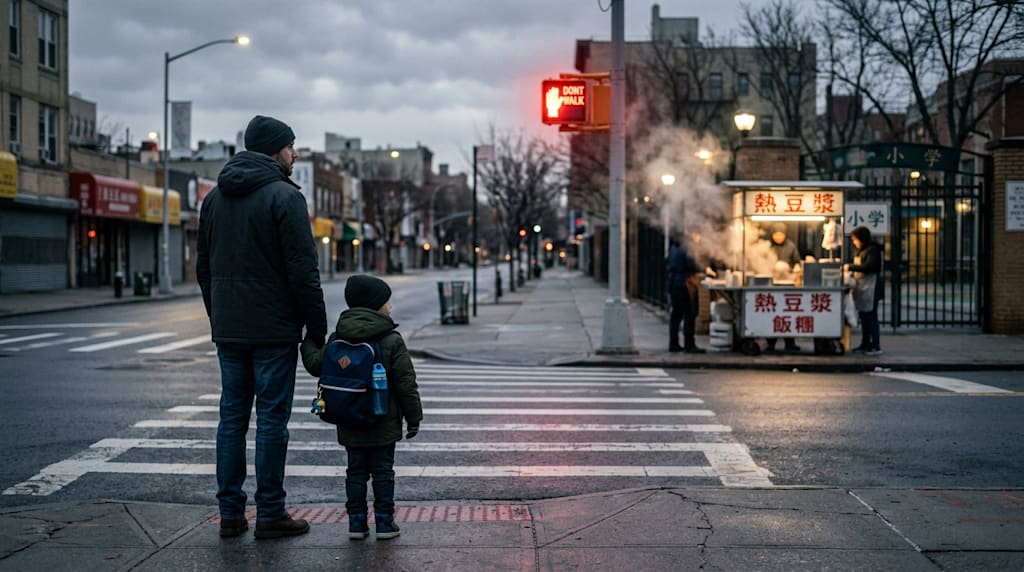
At 7:20 in the morning, at the intersection. Red light.
The child’s left hand is in my grip. His right hand carries the schoolbag. The water bottle in the side pocket sways back and forth. My phone buzzes in my pants pocket. The work group chat is demanding a clock-in. Eight hundred meters to school, three stops to work. The child looks up: “Dad, there’s no car. Why don’t we go?”
I don’t go.
My feet stop behind the white line. The white line is worn gray. A cigarette butt sits in a gap. The child’s toes press forward, then pull back. He looks at me. I look at the light. The red number counts down: nineteen, eighteen.
I remember when he was in kindergarten. Once I pulled him across a small intersection against the light. That day was empty too. He said nothing. The next day, at the gate of our compound, he ran forward on his own. I grabbed him. He asked, “Dad, yesterday we could go, right?” I forget what I answered. I only remember my palms sweating.
A child under ten listens with his ears and records with his eyes. You say red means stop. He hears it. You lift your foot and walk. He sees that too. He can’t tell the line between “no car” and “can go.” He only remembers: Dad went. So now, I don’t go. Those few dozen seconds don’t matter much. What matters is that beside him, I am not just someone rushing to work.
After he reaches the upper grades of primary school, he may ask harder questions. He’ll say the red light is ninety-nine seconds and the pedestrian green is only twenty. That’s unreasonable. I’ll tell him, you’re right. We can call the citizen hotline. We can speak up in the community group chat. We can write to the traffic management department. You can think about what’s wrong with the rule. But your feet stay behind the white line. Thinking and doing are separated by a road. You can discuss the rule. You can’t bypass it. Bypass it once, and next time you’ll feel that bypassing it is nothing.
Some people say rules serve people. I agree. But “people” isn’t just me. The intersection isn’t only me. There’s the child. There are drivers. There are delivery riders on electric bikes. There are elderly people who walk slowly. You look left, no car. Right, no car. A turning car might be crouching in the blind spot. The child is short. A driver might not see him. If you lead him across against the light, the risk isn’t just doubled. It’s placed on him.
I once saw a delivery rider shoot out from an alley. Brakes tore like cloth. He stopped before the crosswalk. Foot on the ground. He cursed. That was still a green light. If it had been red, if he came out of the blind spot while I was halfway across with my child, who could have stopped in time?
Clock in late. Lose money. Get scolded. Write an explanation. I can handle those. If a car hits my child, I can’t handle that. That math doesn’t take long.
Schools teach children to help an old person who has fallen. I add: first look around. Find an adult. Call 120. Record on your phone. Schools teach children to act bravely for a just cause. I add: if a friend falls into a river, first shout for help. Find a bamboo pole. Don’t jump in yourself. Kindness needs method. Rules need method too. The method at a red light is to stand and wait.
Of course there are exceptions. The child is scalded and needs to rush to the hospital. An earthquake. Fire coming up the stairwell. Someone with a knife chasing from behind. At times like that, never mind the red light. I’d climb the railing. But taking a child to school and clocking in at work are not exceptions. It just means I got up late. Pressing the cost of getting up late onto my child’s legs is not fair.
I will leave ten minutes early. I will tell my boss that I drop my child off in the morning and may be a few minutes late. Can we be flexible? I will take a route with an underground passage. I will use the footbridge. I will take a taxi. I will let him carry his own schoolbag so my hands are free to hold him. These solutions aren’t elegant. They’re cleaner than running a red light.
If I really can’t make it, I stand still. If the child asks, I answer. I say, the red light isn’t for cars. It’s for everyone. Today there’s no car. Tomorrow there may be. You can’t see them. They may not see you either. He may not understand all of it. He just needs to see me standing.
My phone buzzes again. Three seconds left on the red. The child pulls the water bottle from the side pocket. Takes a sip. Puts it back. He puts it in upside down, cap facing down. I reach over and turn it right. He asks, “Is it green?” I say, “It’s green.”
He steps forward with his left foot first. I follow. The crosswalk is a little sticky, left by the street sprinkler yesterday. Across the street, steam rises from the soy milk stand at the school gate. He lets go of my hand and runs toward the school gate. The schoolbag bounces on his back. I don’t call out for him to slow down.
The work group chat buzzes again. I take out my phone. Tap it open. Type: On my way, a few minutes late.
The green light turns red behind me. I don’t look back.
About the Creator
Jin
Writer of reamstories
https://reamstories.com/jin
Enjoyed the story? Support the Creator.
Subscribe for free to receive all their stories in your feed. You could also become a paid subscriber, letting them know you appreciate their work.
Comments
There are no comments for this story
Be the first to respond and start the conversation.