
The Nostalgia Tax: How Much Money Do You Actually Need to Live Like Your Parents Did in the 90s?
Behind the retro filters of the 1990s lies a harsh economic truth: buying the same 'American Dream' today requires a completely different financial playbook.

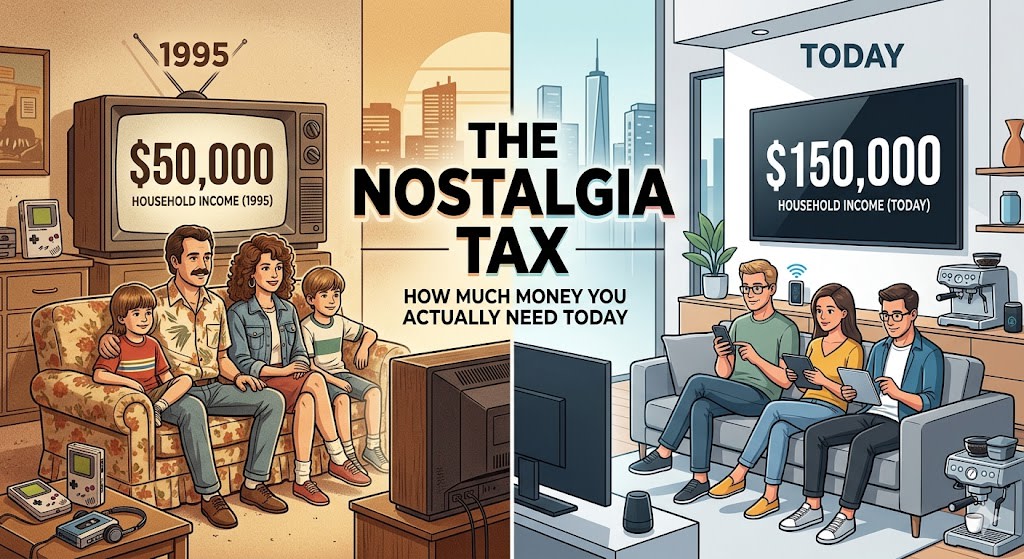
Behind the retro filters of the 1990s lies a harsh economic truth. Replicating a standard middle-class 90s lifestyle today requires a completely different financial playbook.
If you spend any time on social media, you’ve likely encountered the wave of 1990s nostalgia. We romanticize the fashion, the lack of smartphones, the music, and the seemingly effortless lifestyle depicted in sitcoms like Friends or Full House. In those shows, a part-time barista and an aspiring chef could somehow afford a massive, sun-drenched apartment in Greenwich Village. A single-income household could easily support a family of five in a sprawling suburban home.
While we know TV takes creative liberties, those fictional settings weren’t entirely divorced from reality. The 1990s represented a sweet spot for the global middle class—particularly in Western economies. Jobs felt more secure, housing felt within reach, and the cost of basic milestones didn’t require signing away your financial freedom for decades.
But what if you wanted to replicate that exact 90s lifestyle today? What is the true cost of the "Nostalgia Tax"? As it turns out, just matching the lifestyle of your parents’ generation requires a lot more than just adjusting your current income for standard inflation.
The Baseline: The Math of Cumulative Inflation
To understand how much money you need today, we first have to look at how much the purchasing power of fiat currency has eroded over the last three decades.
If your parents were making a combined household income of $50,000 in 1995, that felt like a solid, comfortable middle-class existence. If you simply run that number through a standard Consumer Price Index (CPI) model, you might think you only need around $100,000 to $105,000 today to feel just as wealthy.
However, standard inflation calculators often underreport the real-world friction of living expenses because they weigh heavily on a basket of goods that includes rapidly fluctuating items, while sometimes underplaying structural shifts in major life assets. To truly map out how your savings and salary stack up against historical purchasing power, it is vital to look beyond basic estimates. Utilizing advanced, interactive calculation tools can help you visualize the compounding effects of currency devaluation and determine the precise modern equivalent of legacy incomes.
When you dig into the data, you quickly realize that the standard CPI tells only half the story. The true cost of replicating a 1990s life lies in the dramatic price asymmetric shift of three core pillars: Housing, Education, and Healthcare.
Pillar 1: The Disappearing Affordable Home
In 1990, the median sales price of a home in the United States was around $122,000. By the mid-90s, it hovered around $135,000. For a young couple entering the workforce, saving up a 20% down payment meant putting aside roughly $25,000—a goal that could realistically be achieved in a few years of disciplined saving on average salaries.
Today, the median home price has soared past $410,000, outstripping wage growth by a staggering margin. In the 90s, the house-to-income ratio was roughly 3:1. Today, it routinely exceeds 6:1 or 7:1 in major metropolitan areas. To buy the exact same suburban home your parents bought in 1995, you don't just need a higher salary to cover the mortgage; you need a massive upfront capital injection just to get through the door.
Pillar 2: The Modern Cost of "Getting Ahead"
In the 90s, a college degree was highly valued and, crucially, affordable. You could realistically work a summer job to pay off a significant portion of your annual university tuition. Student loan debt existed, but it wasn't a generational crisis.
Fast forward to the present day: the cost of higher education has increased at more than double the rate of overall inflation. Replicating the 90s trajectory—where you graduate debt-free or with minimal liabilities—means you either need wealthy parents to bankroll your education or you need an incredibly high starting salary straight out of school just to service the interest on your student loans.
Pillar 3: The Connected-Life Surcharge
There is also a hidden line item in our modern budgets that our parents never had to contend with: the digital tax.
In 1995, your utility bills consisted of water, electricity, gas, and a basic landline telephone. Today, to participate in the modern economy, you are practically forced to pay for high-speed fiber internet, multiple smartphone data plans, cloud storage subscriptions, and a myriad of software-as-a-service (SaaS) tools for work and entertainment. While these technologies have made our lives infinitely more convenient, they represent a permanent, non-negotiable drain on our monthly cash flow that simply did not exist thirty years ago.
The Verdict: What is the Real Number?
If we factor in skyrocketing asset prices, the premium on healthcare, the burden of educational debt, and the mandatory cost of the modern digital infrastructure, the math changes drastically.
To achieve the exact same financial peace of mind, disposable income, and housing security that a $50,000 household income provided in the mid-1990s, a household today doesn't just need $100,000. In most major cities, you realistically need closer to $140,000 to $160,000 per year.
The "Nostalgia Tax" is real, and it is steep. It reminds us that looking at the past through a vintage, sepia-toned lens is fun, but navigating the financial realities of the present requires us to stop relying on our parents' financial advice. The rules of the game have changed, the math has evolved, and building wealth today requires a far more aggressive, tech-savvy approach to budgeting and investing than ever before.
About the Creator
Enjoyed the story? Support the Creator.
Subscribe for free to receive all their stories in your feed.
Comments
There are no comments for this story
Be the first to respond and start the conversation.