values
Humanitarian Crisis Deepens in Gaza as Ceasefires Allow Limited Aid Access
In a land where buildings collapse faster than hope, one figure stands firm — a first responder from the Palestinian Red Crescent. He isn’t holding a weapon. He’s holding courage, standing among the ruins of Gaza, where homes have turned to dust and lives are buried beneath broken concrete.
By Surakshya Sapkotaabout a year ago in Families
Truth Be Told: Letters to My Loved Ones Series. Content Warning.
them, Someday when I'm gone from here, I want my children and loved ones to know just how much I loved them and not only that, but I want the whole world to know. Not just words, of course my actions as well. My mother died suddenly when I was seven months pregnant with SJ (6, autism, loves donuts). I didn’t get a chance to tell her how much I really loved her. So, guess what... you get to read about Mama Lott right here (rapid blink). You will also read a letter to my daughter, who lived with my mother for a time, to my oldest son, who is my middle child and often reserved because of his disability. My two eldest (daughter 21, the K-pop guru, son 18, Mr. Tech). Those letters will really take time. I was a young mom and there is a lot of pain there for all of us, so bear with me. This letter though, this is SJ's and to be honest I feel somewhere down the road, maybe at graduation, God give me long life, I’ll write him another one. But for now, here it goes! (of course I cried... hush up).
By V Joyce Lottabout a year ago in Families
The Declaration of Parental Rights
“Children belong to their parents—not to the government.” That shouldn’t be a radical statement—but in 2025, it is. We are living through a silent revolution—one where government agents, unelected bureaucrats, and activist judges have increasingly inserted themselves into the sacred space between parent and child. Under the guise of “safety,” “equity,” or “best interest,” the state is taking more control while parents are being treated as threats, not protectors.
By Michael Phillipsabout a year ago in Families
When They Steal Your Children
They took your child. Not in the way most people think. There was no dramatic kidnapping, no amber alert, no frantic media coverage. No — your child was taken with a gavel. With the silent nod of a judge. With the signature of a bureaucrat who didn’t care to hear your side. And just like that, you became the ghost of a parent. A name on a piece of paper. An afterthought.
By Michael Phillipsabout a year ago in Families
The Year the Sky Never Stopped Crying
The rain hadn’t stopped for 17 days when the river swallowed our street. I’d memorized the cracks in our living room ceiling—each one a lightning bolt frozen in plaster—while rain drummed its fists against the roof. Outside, the Willamette River crept past "historic highs" into something feral. Neighbors stacked sandbags like frantic castle walls. My daughter Lily drew smiling suns on the fogged-up window. "When’s the water going home, Mama?"
By Ziafat Ullahabout a year ago in Families
A Silent Tear at Midnight
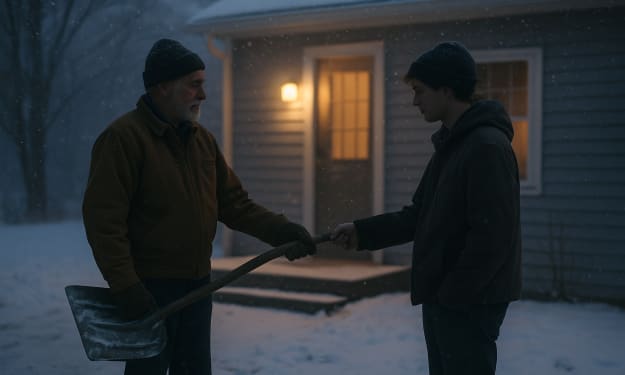
The day was hot. The sun burned everything. Even the air felt heavy. But inside, I felt cold. My grandfather, Papa, was gone. We stood near his grave. Dad was using a shovel, covering Papa with dirt. The sound of the shovel scraping against the earth echoed in my mind. I didn’t cry. I didn’t know why. Maybe my heart was too full. Or maybe it was too empty. I remembered when Papa used to take me fishing. He always smiled. His old hands felt strong when he held mine. Now, those hands were still, forever. People said I should be strong. I stood there, silent. My body felt weak, but no tears came. Why couldn’t I cry? Was something wrong with me? Around me, people whispered. Some hugged. Some cried. I just watched the dirt cover Papa, bit by bit, until he was gone from sight. At night, I lay awake in my bed. I thought about him. His voice. His laughter. The way he smelled like old wood and soap. I missed him. I wanted to cry. But still, no tears. Days passed. I went back to school. My friends played and laughed. I tried to smile, but it felt fake. Inside, I felt alone. Like I was carrying a sack of stones in my chest. One day, my teacher asked me to write about family. I picked up my pencil, but my hand shook. Words didn’t come. So I sat quietly. After class, she asked me if I was okay. I nodded, but I wasn’t. At home, I saw Dad sitting alone. He wasn’t talking much these days. His eyes looked tired. I wanted to ask him if he felt cold inside too. But I stayed silent. Maybe he wouldn’t understand. Maybe he would say, “Be strong.” Then, something changed. One morning, Mom found me sitting near Papa’s old chair. I was just sitting, not thinking. She sat next to me. She didn’t speak. Just held my hand. We sat together in silence. And in that silence, I felt something warm. Not outside. Inside. That night, tears came. Soft at first. Then stronger. I cried for Papa. For myself. For all the silent pain inside me. It felt like letting go of a heavy bag I’d been carrying for too long. Mom hugged me. She didn’t tell me to stop. She let me cry. And slowly, the cold feeling inside me began to fade. I started writing letters to Papa. I wrote about my day, my feelings, the things I couldn’t say to anyone else. I placed those letters in his old chair. With time, I smiled more. Real smiles. My sack of stones turned lighter. Now, when I remember Papa, I still feel sad. But it’s okay. Sadness is part of love. I learned that it’s okay not to cry right away. Grief has its own time. Papa is gone. But his love stays. In my heart. In my memories. And when I sit by his chair, I know I’m not alone. Grief is not a weakness. It’s just love that has nowhere to go. And love never dies. I stood there quietly, watching the sun fade behind the hills. The silence felt heavy, like it wanted to say something but didn’t know how. I looked down at my hands, small and trembling, yet somehow steady enough to hold memories I wasn’t ready to face. The wind touched my hair softly, as if trying to comfort me. I closed my eyes, hoping the breeze could carry away the weight in my heart. But some weights aren’t meant to leave; they settle quietly, like a shadow that stays even when the light changes. That night, I didn’t speak much. Words felt too loud for feelings this gentle. I simply sat by the window, holding my knees close, letting the stars tell stories I couldn’t. And maybe, just maybe, tomorrow would feel a little lighter.
By Leya kirsan official about a year ago in Families
What My Father Never Said, and What I Heard Anyway
He never gave big speeches. There were no long-winded father-son talks over a campfire, no final words of wisdom before I moved out, no dramatic pronouncements about life, women, or work. He wasn’t the kind of man who offered advice — at least not in the traditional sense.
By Kamran Zebabout a year ago in Families
The Day I Lost Him (And Found Everything Else)
The world didn’t end with a bang. It ended with the absence of a small, sticky hand. One moment, Benji’s fingers were wrapped around mine, his grip warm and slightly damp from the grape juice he’d spilled on himself earlier. The next—nothing. Just the hum of supermarket fluorescents and the too-loud rustle of plastic bags in someone else’s cart.
By Ziafat Ullahabout a year ago in Families
Ink and Fire
Maya Brooks had two rules in life: Never miss a deadline. Never trust Liam Carter. As the star reporter for The Daily Press, Maya had carved a name for herself with fierce tenacity, sharp wit, and bold headlines. Liam Carter, her counterpart at the rival paper The Sentinel, was everything she despised—cold, calculated, and far too smug for someone who wore ties like armor.
By MANZOOR KHANabout a year ago in Families
Grandfather’s Final Wish: A Journey Back to Where It All Began
I always thought my grandfather would live forever. He was one of those people whose presence filled every room, whose laughter made even the bitterest tea taste sweet. His hands were always stained with earth from the garden, and his words always carried stories from a world that seemed older than time. But age, as it does, crept in silently. His memory started to blur, and his steps grew uncertain. And yet, his spirit never faded. It was in his final days, lying on the hospital bed with a tired smile, that he called me close and said, > “There’s one thing I need you to do for me, beta. Please… take me home. One last time.” I didn’t know what he meant at first. We were already home, weren’t we? But then he whispered, "Not this home. I mean my home—our ancestral village, where your Dadi and I planted our first sapling, where your father was born… where I buried my mother with my own hands." His voice cracked, and a tear slid from the corner of his eye. “I want to rest beside her. That’s all I ask.” --- A Promise Made That night, I sat beside him holding his weathered hand, promising him I would take him back. “Even if I have to carry you myself, Dada. You’ll go home.” He smiled faintly. “Good boy,” he said. He passed away two nights later. His death left a hole in our family no words could fill. The house felt colder, quieter. But I remembered the promise, and I knew that this wasn’t the end of his journey. It was only a transition. The family, at first, was resistant. “It’s too far,” they said. “The village is deserted now.” “There’s no one left there.” But my father, usually a man of silence, placed a hand on my shoulder. “If your Dada trusted you with this… then do it.” --- The Journey Begins We hired a private vehicle, placed his ashes in a small handcrafted wooden urn, and began our journey—over 700 kilometers to a village that no longer appeared on digital maps. The roads were rough. Some paths had been consumed by forests, others by floods. Yet, with every passing tree, I felt closer to him. The stories he had once told me came alive. “That tree,” I whispered, recognizing the crooked mango trunk he once said he carved his and Dadi’s initials into. “That well,” he told me, “is where I nearly fell in chasing a kite.” We reached just before sunset. The village was no more than scattered bricks and moss-covered walls. But the banyan tree in the center still stood tall—as if time had bowed in reverence. --- A Place to Rest I found the spot near the old tree, just as he had described it. “Under the banyan,” he once said. “That’s where Amma lies.” There was no headstone, just a pile of stones barely holding form. But I knew. I sat there in silence, holding the urn to my chest. I could almost hear his voice in the breeze. “I’m home now,” I whispered. We laid him to rest beside his mother, fulfilling a promise and completing a circle. I planted a sapling between the two mounds. It was his favorite—a guava tree. > “So that even in death, I’ll give fruit,” he had once joked. --- Closure, Not Goodbye As we prepared to leave, I took one last walk around the ruins of the village. I found a rusted swing in the backyard of what used to be his house. The seat was broken, the chains half-buried in mud, but I could still imagine him pushing my father on it as a child. I took photos—not to share on social media, but to preserve memories. As we drove away, I looked back one last time. The sun had begun to dip, casting golden light over the grave, the tree, the swing, the house. He was home. Finally. --- Epilogue: His Legacy Lives On When I returned, I started compiling all his stories into a journal. My siblings and cousins helped. Every chapter began with “My Dada once said…” I realized then: some people don’t truly die. They simply live on… in stories, in trees, in promises kept.
By Muhammad Usamaabout a year ago in Families