pop culture
Some pop-culture families incite envy with their picture-perfection, while others make you acutely grateful for the one you're stuck with.
The Silent Killer of Love and Respect
The Silent Killer of Love and Respect. Marriage is meant to be a partnership built on mutual trust, respect, and emotional safety. But what happens when one partner brings in not just emotional immaturity, but a toxic, narcissistic personality?
By Sayed Zewayedabout a year ago in Families
Life Is Like a River: Its Nature Is to Keep Flowing
Life, in its essence, is a continuous journey — ever-changing, ever-evolving, and ever-flowing like a river. The comparison between life and a river is both poetic and profound. Just as a river begins as a small stream and gradually grows, meandering through various terrains, so does life start from infancy, flowing through childhood, youth, adulthood, and eventually old age. It encounters challenges, obstacles, and beautiful moments along the way, but the most important thing is motion—the flow.
By Niranjon Chandra Royabout a year ago in Families
The Cultural Exchange
In the heart of Amsterdam, nestled between tulip gardens and centuries-old canals, stood the prestigious Lyra International School. Known for its academic excellence, the school was also famous for its annual “Cultural Exchange Week”—a time when students from across the world came together to celebrate heritage, identity, and unity. For sixteen-year-old Noor Fatima from Pakistan, this was her first time outside of her country. Shy but observant, she had grown up hearing her grandfather’s stories about Europe, but no story had quite prepared her for the melting pot that was Lyra. The moment she stepped into the school courtyard, she was surrounded by students who looked, sounded, and dressed differently. She clutched her small diary and felt invisible, like ink on white paper—present but unnoticed. The week began with introductions. Students were encouraged to pair up with someone from a different country to learn about each other’s culture. Noor was paired with Sasha, a bold and bubbly girl from Ukraine who wore combat boots with her school uniform and spoke four languages fluently. Noor thought their pairing was a mistake. Sasha thought it was fate. “Want to hear how I almost burned my kitchen trying to make paratha?” Sasha asked during their first lunch together. Noor blinked in surprise, then laughed—a soft, reluctant chuckle that surprised even herself. From that moment on, a friendship bloomed. Noor shared recipes passed down from her grandmother, braided Sasha’s hair the traditional way, and taught her a few lines of Urdu. In return, Sasha introduced her to borscht, street art, and the joy of dancing like nobody’s watching. The school had planned a grand event for the end of the week—a cultural exhibition where each pair would present a performance or artifact that represented the spirit of their bond. Noor was nervous. She didn’t speak in front of crowds. “I freeze,” she confessed to Sasha, “like literal ice.” “Then we’ll thaw together,” Sasha said with a wink. They decided to write a spoken-word piece called “From Lahore to Lviv,” chronicling their stories, struggles, and shared laughter. The poem wove together two lives separated by geography but joined by a desire to belong. On the night of the performance, the auditorium buzzed with energy. Flags of over thirty nations lined the walls. Students wore their traditional clothes—Norwegian bunads, Japanese yukatas, Nigerian ankaras, and everything in between. Noor wore a deep green shalwar kameez embroidered with gold thread. She looked into the mirror backstage and hardly recognized herself—not because of her outfit, but because of the confidence in her eyes. As they took the stage, Noor’s hands trembled, but Sasha gave her a quick nod. They began their performance. > “From the spice of Lahore to the salt of the Black Sea, We speak in different tongues but tell the same story.” The audience fell silent, pulled into their rhythm. They spoke of language barriers, of food and festivals, of longing for home, and the strange joy of discovering a new one. Noor’s voice started quiet, then grew louder, steadier, stronger. > “I learned her name means ‘defender.’ She learned mine means ‘light.’ And together, we made a bridge— Between moonlight and firelight.” When they finished, the room erupted into applause. Some students stood. A few teachers wiped away tears. The next day, Noor’s photo was featured on the school’s homepage with the headline: “Bridging Worlds—Students Redefine Belonging.” But the story didn’t end there. The cultural exchange led to the creation of the “Shared Stories Project”—a new student initiative where every month, two students from different backgrounds would collaborate on something meaningful: a poem, a podcast, a recipe book, or even a community garden. Noor and Sasha became its first ambassadors. By the end of the semester, Noor had made friends from six different countries. She no longer feared her accent. She didn’t hide her food at lunch. She volunteered to lead a panel discussion on intercultural empathy. Years later, when Noor returned to Pakistan, she brought home more than souvenirs. She brought a new worldview. She started a nonprofit that connected students across borders through digital storytelling. Its motto: “Different roots. One sky.” The cultural exchange had changed her. And in turn, she changed the world—one story at a time.
By Syed Kashif about a year ago in Families
Sterling Chandler: Age, Facts & Bio.
Sterling Chandler (born November 23, 2003) is a British photographer and creative director who has gained widespread recognition for his work across fashion, music, and editorial photography. From a young age, Chandler demonstrated a passion for visual storytelling and creativity, which ultimately led him to become one of the most promising young talents in the creative industry.
By Ellie Hollandabout a year ago in Families
When Motherhood Dies.
When Motherhood Dies: The Tragedy of Cruelty and the Loss of Humanity. Have you ever wondered: Can a mother really kill her own child? Not by accident. Not out of desperation. But by a cold, conscious decision. If the question alone moves you, the answer will haunt you. This is not fiction. It is not an exaggerated drama. It is a true story set in a lush, green village in one of Africa's most vibrant and contrasting countries, where the beauty of nature often masks the brutality of the people. A story in which motherhood was not celebrated, but rather suppressed.
By Sayed Zewayedabout a year ago in Families
Crumbs of Courage
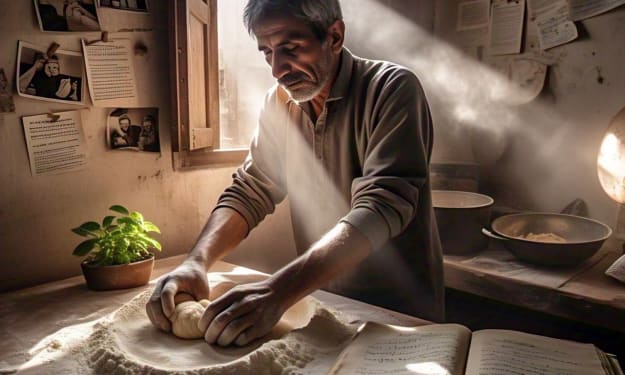
The first time Amir baked bread in the new country, his hands trembled. Not from the cold—though the small, tiled kitchen in the shelter was icy that morning—but from memory. The flour on his fingers reminded him of home: of sunlit mornings, of his wife humming as she rolled dough, of the faint smell of cumin and rosewater drifting through open windows. Now, everything smelled like sterilized metal and worry. Back in Aleppo, Amir had owned a small but beloved bakery named Khobz wa Salaam—Bread and Peace. His baklava was legendary. Locals said his hands were guided by angels, that his sweet dough could mend broken hearts. Then the war came. Missiles replaced music. He buried his wife beneath rubble and fled with nothing but a tin box of recipe cards, most smudged by blood or soot. His son, barely nine, held his hand as they crossed borders, nights filled with hunger, silence, and fear. When they finally reached Europe, the camp was crowded and gray, but it offered a roof, food, and school for his boy. That should’ve been enough. But something was missing. It wasn’t until the camp coordinator mentioned a community kitchen project that Amir offered, hesitantly, to bake. That first morning, he shaped the dough carefully, hands remembering what the heart had tried to forget. He baked small, soft flatbreads—khubz taboon—brushed with oil and scattered with thyme. He placed them on a tray, heart pounding. When the other refugees tasted them, something shifted. Eyes widened. A woman began to cry. A teenage boy whispered, “This tastes like my grandmother’s house.” People lined up not just for bread, but for something they had forgotten they craved: connection. Word spread. The shelter gave him a corner of the kitchen and old ingredients nobody wanted. He worked magic with them—cardamom buns, date cookies, fragrant rice-stuffed flatbreads. Every bite told a story. Every spice whispered of a lost city, a loved one, a street that no longer existed. And then, one day, he began writing again. He took out his old recipe cards, rewritten now in three languages—Arabic, English, and French. On each card, beneath the ingredients, he added a story. A memory. “My wife, Leila, made this when I asked her to marry me.” “My son laughed so hard, he dropped the whole tray of these.” “My bakery was bombed the day after I made these for the town festival.” People didn’t just eat. They read. And wept. And hugged him. And stayed. Months passed. His son began smiling again. Local volunteers noticed. One of them, an elderly French chef named Bernard, asked Amir to teach a weekly class. At first, Amir refused. He didn’t want to speak. But Bernard insisted: “People need to taste your story.” The class became a sensation. Every Thursday, Amir taught a new dish and shared the memory behind it. Students weren’t just refugees—they were locals, too: curious, kind, hungry to understand. One girl asked, “How do you bake when you feel broken?” Amir paused, then said, “I bake because I’m broken. The dough listens better than most people.” They wrote that on the chalkboard and never erased it. Soon, Amir’s recipes were compiled into a small, illustrated book titled Crumbs of Courage. Each chapter was a dish, each dish a moment of his life. The last page had no recipe—just a photograph of Amir and his son planting mint in a clay pot by their shelter window. “Fresh things can grow,” the caption read. “Even in foreign soil.” Years later, his son would run a café called Khobz wa Salaam in a sunlit corner of the city. Tourists came for the baklava, but stayed for the walls—covered in Amir’s recipes, written in his careful script, each signed with a simple line: “Made with memory.” By then, Amir no longer trembled when he baked. He stood tall in the kitchen, his apron dusty, his heart light. For in every crumb he left behind, there lived a quiet kind of courage. The kind that survives bombs, borders, and language barriers. The kind that says: “I am still here. And I am still feeding hope.”
By Syed Kashif about a year ago in Families
The Power of Social Touch
In a world increasingly shaped by technology and virtual interaction, social touch remains one of the most profound and essential forms of human communication. Whether it's a warm hug, a pat on the back, or a friendly handshake, these small gestures carry immense emotional and psychological weight. But what exactly is social touch, and why does it matter so much?
By its_ishfaq_ahmadabout a year ago in Families
The Wonderful Things That Make Life Magical
There’s magic in the world—not the kind that involves wands or spells, but something quieter, subtler, and more powerful. It’s the kind of magic that flickers in the corner of your eye when a butterfly passes by, or when the scent of a childhood memory drifts into your afternoon. This magic lives in the ordinary moments, the hidden marvels we pass by without a second glance.
By Muhammad Faizullahabout a year ago in Families