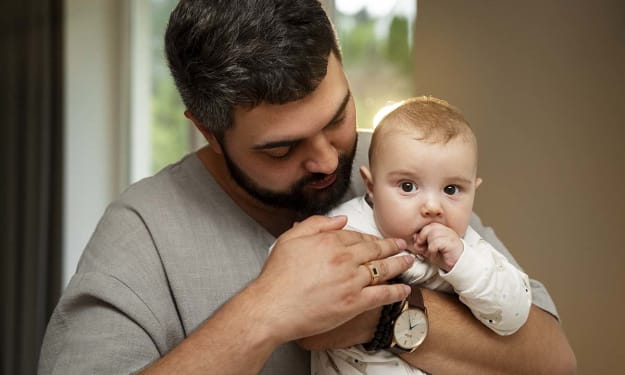
parents
The boundless love a parent has for their child is matched only by their capacity to embarrass them.
How to Talk to Your Kids About Money
Teaching kids about money can feel tricky, but financial literacy is a powerful skill they’ll carry through life. Kids who learn money basics early grow into adults who make wiser financial decisions, understand the value of saving, and appreciate responsible spending. Here’s how to turn your conversations about money into valuable life lessons.
By Katina Banks2 years ago in Families
The Impact of Paternity Leave on Child Development: Why Father’s Time Matters
Paternity Leave has gathered increasing attention as a critical component of family policy, significantly influencing the early development of children. A study Lidia Farre et al. (2024) highlights that extending paternity leave leads to longer periods of fatherly engagement during the crucial first year of a child’s life. This article explores the implications of paternity leave on child development, family dynamics and workplace culture.
By iDigitize Infotech LLP2 years ago in Families
How to Find Private Nursing Care In Home: Sonoma & Marin County - Kizuna
This Blog was Originally Published at: How to Find Private Nursing Care In Home: Sonoma & Marin County — Kizuna Finding the right private nursing care in home is a priority for many families in Sonoma and Marin County who want to ensure their loved ones receive compassionate, high-quality care in the comfort of their own homes. This level of care can range from basic assistance with daily activities to advanced medical support. Knowing where to start and what to look for can make the search easier and more effective.
By Kizuna Care Blogs2 years ago in Families
How Does the FTD (Frontotemporal Dementia) Affect the Eyes?
Frontotemporal dementia is a complex neurological condition involving multiple areas of brain function. Mainly affecting the frontal and temporal lobes, which determine personality, behavior, and speech, FTD has broad effects on cognitive and behavioral changes but also significantly influences eye health and visual perception. This article will give insight into the specific ocular symptoms induced by frontotemporal dementia and possible interventions available for patients with this challenging condition.
By Jane Rockwell2 years ago in Families
10 Parenting Tips
In a world that values resilience, empathy, and self-awareness, raising emotionally intelligent kids has never been more essential. Emotional intelligence (EI) equips children with the skills to navigate life’s ups and downs, understand their own emotions, and empathize with others. This isn’t a skill they’ll necessarily learn in school, so parents play a crucial role in developing their child’s EI. Here are ten practical tips to help raise emotionally intelligent kids who will grow up to be kind, resilient, and self-aware adults.
By Katina Banks2 years ago in Families
How to Create a Chore Chart
Getting kids to do chores can feel like a constant battle, but a well-designed chore chart can change that! A chore chart doesn’t just organize household tasks—it helps instill responsibility, independence, and a sense of accomplishment in children. However, to make it truly effective, it’s essential to design a chart that kids actually want to follow. Here’s a step-by-step guide to creating a chore chart that will motivate, engage, and empower your kids while keeping your home running smoothly.
By Katina Banks2 years ago in Families
DIY Family Bonding Activities
In a world where life often feels fast-paced and costly, creating time for family bonding is priceless. You don’t need expensive gadgets or fancy trips to build unforgettable memories with your loved ones. In fact, some of the most meaningful family activities are the ones that cost absolutely nothing! If you’re looking to strengthen family connections and make memories without breaking the bank, here are some DIY family bonding activities that are tons of fun and completely free.
By Katina Banks2 years ago in Families
Co-Parenting After Divorce
Divorce can be one of the most challenging experiences for any family, but co-parenting effectively after separation is essential for your children’s well-being and for building a healthy, balanced family dynamic. Even when parents decide to go their separate ways, their role as partners in parenting remains—and making this partnership work can have a profoundly positive impact on the kids involved. Here are eight practical, life-changing tips to help you navigate co-parenting with a healthy approach, ensuring that your family thrives post-divorce.
By Katina Banks2 years ago in Families
Life-Changing Tips
Tantrums and meltdowns: they can make any parent feel overwhelmed, frustrated, and sometimes helpless. Every parent knows the unique challenge of managing these intense moments, and while it’s easy to feel that a meltdown has taken over, it’s important to remember that these episodes are not just “bad behavior.” They’re often a form of communication from children, who are learning to cope with big emotions. So, how can we as parents guide them through these intense feelings in a way that’s beneficial for both child and parent? Here are some life-changing strategies that can make a difference in your parenting journey.
By Katina Banks2 years ago in Families
Personalized Calendar Printing in Japan: Perfect for Children, Couples, Parents, and Travel Memories
Creating a personalized calendar is a wonderful way to keep cherished memories close all year round. In Japan, personalized calendars are becoming popular for their unique touch and ability to reflect individual stories. Whether it’s capturing the smiles of children, the shared moments of couples, family highlights, or the stunning scenery from travels, a custom calendar can transform ordinary days into special moments. Here’s a comprehensive guide to the different types of personalized calendars and tips on how to make the perfect one for yourself or as a gift in Japan.
By Photojaanic2 years ago in Families
Learn to Recognize the Language of Sight
Learn to Recognize the Language of Sight There is a language spoken not with words, but with a gaze, a gesture, or a mere glimpse. This is the language of sight—a powerful form of communication that bridges gaps and connects people in ways that spoken words cannot always achieve. Learning to recognize this language can enrich our lives, helping us empathize with others, understand unspoken emotions, and respond to the needs of those around us. When we look closely into someone’s eyes, we often see a reflection of their soul, their struggles, and their hopes. Our eyes are storytellers. They reveal our deepest emotions—joy, sorrow, longing, love, and even despair—without uttering a single word. Learning to recognize this language of sight is about developing the sensitivity to perceive what lies beneath a person’s outward expression. Consider, for instance, the glance of a child looking up at their parent. There is often a trust, a dependency that needs no verbal affirmation. Their wide-eyed gaze speaks of innocence, love, and a craving for security. For the parent, understanding this silent message means more than just taking care of the child’s physical needs—it means comforting them, offering emotional warmth, and a feeling of safety. The language of sight can be seen in the elderly as well. In their eyes, we often find stories of resilience, nostalgia, and a lifetime of memories. Sometimes, an elderly person may sit quietly in a room, surrounded by family but feeling unseen or unheard. Yet, with a single look—perhaps a softened gaze directed toward a family photo or a brief, wistful glance—they communicate a lifetime of love and loss. Those who can read this language of sight will know that what the elder person truly seeks is connection, a recognition of the life they have lived and the love they still hold. In our busy lives, we often pass by strangers on the street without truly noticing them. But if we take a moment to look, we might see an entire world within them. Imagine seeing someone sitting alone on a bench, their eyes cast down, shoulders slumped. Their posture and the faint sadness in their eyes tell a story of loneliness. Perhaps they have lost a loved one, or they feel isolated in a city full of people. Recognizing this silent message allows us to respond with compassion. A simple smile or a nod can acknowledge their existence and, in a small way, ease their burden. Even in relationships, the language of sight plays an essential role. In romantic partnerships, a glance exchanged across a crowded room can convey love and understanding more profoundly than words ever could. For instance, when a partner sees their loved one struggling, they might silently communicate their support through a steady, reassuring look. That gaze tells the other person, “I am here with you; you are not alone.” In friendships, too, the language of sight bridges gaps. A friend’s knowing look can be a balm in moments of self-doubt, giving assurance without a single word spoken. The language of sight also extends to understanding ourselves. When we look in the mirror, we sometimes avoid making direct eye contact with our reflection. There may be fears, regrets, or unprocessed emotions staring back at us, and looking away feels easier. But learning to face ourselves and read our own eyes with honesty and compassion can be a transformative experience. By recognizing our own silent language, we cultivate self-acceptance and acknowledge our journey, with all its highs and lows. The ability to recognize the language of sight can be particularly powerful in professions like healthcare. Doctors, nurses, and therapists are often trained to observe their patients beyond mere physical symptoms. A doctor who notices the apprehension in a patient’s eyes may sense fear about an impending diagnosis. This awareness allows the doctor to address the patient’s emotional state, offering reassurance and a comforting presence. Learning to read this language takes practice and patience. It requires an openness to observe without judgment, to allow ourselves to be present with others, and to care genuinely. In our increasingly digital world, where conversations are often reduced to text on a screen, it becomes even more crucial to preserve and cherish this form of human connection. Meeting someone's gaze and truly seeing them is a simple act, yet it can carry an incredible weight. It affirms a shared humanity and reminds us that, beyond our differences, we all seek the same sense of recognition and connection. Ultimately, to learn the language of sight is to embrace the beauty of silence, to find meaning in the space between words. When we listen with our eyes, we open ourselves to a world rich with unspoken emotion, fostering compassion and understanding that transcend verbal communication. In every fleeting glance and every unspoken exchange, there lies a profound opportunity—to understand, to connect, and to care.
By Dipak Pawar2 years ago in Families