literature
Families and literature go hand in hand; fictional families to entertain, reflect and inspire.
What’s Really on Your Plate? The Truth About Healthy Food
Have you ever wondered if the food you eat daily truly fuels your body or quietly harms it? Healthy food isn’t just about eating more greens or avoiding sweets—it’s a life-changing choice that can reshape your health, mood, and even how long you live. This article will help you understand what healthy food really means, why it matters, and how to make it part of your life.
By miloud ferhi2 years ago in Families
How to Hit Peak Fitness After 40
not prolonged within the beyond, 40 become considered over the hill in sports. but we are increasingly seeing athletes, just like the skier Lindsey Vonn, 40, and the climber Chris Sharma, forty three, staging midlife comebacks. top performance remains internal attain for the rest parents, too. simply observe Ken Rideout, a father of 4 from Nashville who've turn out to be crucial approximately distance walking in his mid-40s after which one of the world’s fastest marathoners his age thru his early 50s.
By John William2 years ago in Families
Can a meat-only diet cover all your nutritional needs?
A meat-based diet may provide advantages in the treatment of certain chronic illnesses, but it remains unclear whether it leads to micronutrient shortages or lessens the demand for specific nutrients. A recent research study published in Nutrients investigated the micronutrient makeup and sufficiency of four variations of a meat-based diet, compared to National Nutrient Reference Values (NRVs).
By Pedro Wilson2 years ago in Families
Why Do We Stay Silent in the Face of Injustice?
Silence can be powerful. It can be a tool for reflection, a moment to gather strength, or a gesture of solidarity. But silence can also weigh heavy when it becomes a shield we use to avoid conflict, discomfort, or fear. When faced with injustice, why do so many of us remain quiet, choosing to turn away rather than speak up? The reasons are complex, layered with personal history, cultural expectations, and the dynamics of power. Yet, if we don’t take the time to understand this silence, to interrogate where it comes from, we risk letting it define us in ways that diminish our humanity. One reason we stay silent is fear—fear of standing out, fear of retaliation, fear of being judged. Speaking up against injustice often comes with consequences. It can disrupt relationships, challenge authority, or expose us to criticism. For many, the cost feels too high. So, instead, we retreat into ourselves, convincing ourselves that staying quiet is safer. But fear isn’t the only thing that holds us back. There’s also the weight of doubt. How many times have we questioned ourselves, wondering, “Is this really my place? Am I sure this is wrong?” In moments like these, we may hesitate, unsure whether our voice will make a difference or whether we even have the right to intervene. Another piece of the puzzle lies in the influence of the crowd. When we’re part of a group, it’s easy to assume someone else will step up. Psychologists call this the “bystander effect,” and it’s a powerful force. The larger the group, the more likely we are to blend into the background, waiting for someone else to take the lead. Cultural norms play a role, too. Many of us are raised in environments that prioritize harmony over confrontation. We’re taught to avoid “making waves” or drawing attention to ourselves. This conditioning can make speaking up feel not just uncomfortable but fundamentally wrong. Yet, there’s something deeper we need to confront. Sometimes, silence comes from a place of resignation. We’ve seen injustice so often that it starts to feel inevitable. We tell ourselves, “This is just how the world works,” and we choose to adapt rather than resist. But let’s be clear about what’s at stake. Every time we stay silent in the face of injustice, we send a message—not just to others, but to ourselves. We tell ourselves that our voice doesn’t matter, that change is impossible, that the status quo is unshakable. Over time, this silence doesn’t just protect us; it also confines us, shrinking the space where courage and empathy can thrive. So how do we break free? How do we find the strength to speak when everything inside us is telling us to stay quiet? It starts with self-awareness. We need to recognize the moments when fear or doubt is holding us back. We need to ask ourselves, “What am I afraid of? What’s the cost of staying silent?” Sometimes, just naming the barriers can help us begin to overcome them. Next, we have to redefine what it means to take a stand. Speaking up doesn’t always mean shouting from the rooftops. It can be a quiet conversation, a question posed at the right moment, or a gesture of support to someone who’s been wronged. Every act, no matter how small, carries weight. We also need to remind ourselves that we’re not alone. While it may feel like stepping up isolates us, the truth is that courage is contagious. When one person breaks the silence, it creates space for others to do the same. It reminds us that our voices have power—not because they’re perfect, but because they’re human. And finally, we have to embrace the discomfort that comes with challenging injustice. Growth is never easy. It requires us to sit with difficult truths, to confront our own biases and limitations. But that discomfort is where change begins. Choosing to speak up doesn’t mean we’ll always get it right. There will be moments when we stumble, when our words fall short, when the outcome isn’t what we hoped for. But what matters is that we tried, that we didn’t let fear or doubt silence the parts of us that long for a better world. Because here’s the truth: silence may feel safe, but it’s also heavy. It keeps us from living fully, from connecting deeply, from honoring the values we hold dear. When we break that silence, when we let our voices rise, we do more than resist injustice—we reclaim our humanity. The next time you find yourself on the edge of speaking out, take a breath. Feel the weight of your silence, but also the possibility of your voice. Remember that even in the face of injustice, you have a choice. And that choice has the power to change everything.
By Laney Matthews2 years ago in Families
Why Fear of Change Holds Us
Change is one of life’s constants, yet it has a remarkable ability to unsettle even the strongest among us. The fear of change runs deep. It’s a quiet whisper that tells us to stay where we are, to hold tight to what we know. This hesitation, this reluctance, often stems from the stories we tell ourselves about what change represents. These stories are rooted in fear—fear of the unknown, of failure, and sometimes even of success. At its core, fear of change is a fear of uncertainty. It’s natural to crave stability, to want the ground beneath our feet to feel solid and predictable. But change shakes that foundation. It asks us to step into the unknown, to navigate paths we’ve never walked before. And that unknown? It can feel like a dark forest, full of shadows and unfamiliar sounds. Our minds, ever vigilant, imagine every worst-case scenario. What if I make the wrong choice? What if things don’t work out? What if I’m not good enough? This fear isn’t just in our heads; it lives in our bodies too. Change triggers a stress response, a flood of hormones that signal danger. Even when there’s no real threat, our brains react as though there is. This is why change can feel so overwhelming. It’s not just about learning a new routine or adjusting to a new environment—it’s about calming the storm inside us that says, something’s not right here. But why do we hold on so tightly to what’s familiar, even when it no longer serves us? Often, it’s because familiarity feels safe. We know the rules, the patterns, the outcomes. Even when those outcomes aren’t what we want, they’re predictable. Change, on the other hand, requires us to let go of that safety net. It demands trust—trust in ourselves, in the process, and in the possibility of a brighter future. Then there’s the fear of failure. Change is a risk, and risks come with the chance of falling short. No one wants to stumble, to feel exposed or vulnerable. So, we stay in our comfort zones, convincing ourselves that staying put is the smarter, safer choice. But deep down, there’s often a quiet yearning—a voice that says, What if you tried? What if you dared to believe in more? There’s also a surprising element to the fear of change: the fear of success. Success brings its own set of challenges. It demands growth, responsibility, and often a reevaluation of who we are. People may resist change because they’re not just afraid of failing—they’re afraid of what success might ask of them. It’s important to acknowledge these fears, to name them and sit with them. Pretending they don’t exist only gives them more power. Fear, after all, thrives in the dark. But when we shine a light on it, when we examine it with curiosity and compassion, we start to see it for what it truly is: a protector, trying to keep us safe in its own misguided way. The beauty of change is that it’s a teacher. It stretches us, challenges us, and shows us what we’re capable of. Yes, it’s uncomfortable—sometimes even painful. But discomfort is often where growth begins. It’s where we discover our resilience, our creativity, our strength. To move past the fear of change, we need to embrace a new story—a story that sees change not as an enemy, but as an ally. Change is what allows us to evolve, to break free from patterns that no longer serve us. It’s what helps us uncover parts of ourselves we never knew existed. This journey isn’t about erasing fear. Fear is a part of the human experience, and it will always be there in some form. But we can learn to hold it differently. Instead of letting it steer the ship, we can let it ride alongside us, a reminder that we’re stepping into something new and important. What if, instead of fearing change, we leaned into it? What if we trusted that even when the path is unclear, we’re capable of navigating it? The fear might not go away entirely, but it doesn’t have to stop us. It can be the thing that keeps us grounded, that reminds us how much courage it takes to grow. Change isn’t easy, and it isn’t always welcome. But it’s necessary. It’s how we become more of who we’re meant to be. And that’s a journey worth taking—one brave step at a time.
By Laney Matthews2 years ago in Families
The Pure Fun of Acting Like a Kid Again. AI-Generated.
I didn’t plan for it to happen. In fact, if you’d asked me that morning how my day would go, I would have predicted a boring one. My weekend itinerary was uninspiring: laundry, grocery shopping, and a long list of mundane tasks. The idea of “fun” wasn’t even on my radar. But life has a way of surprising you when you least expect it.
By Barry Fourie2 years ago in Families
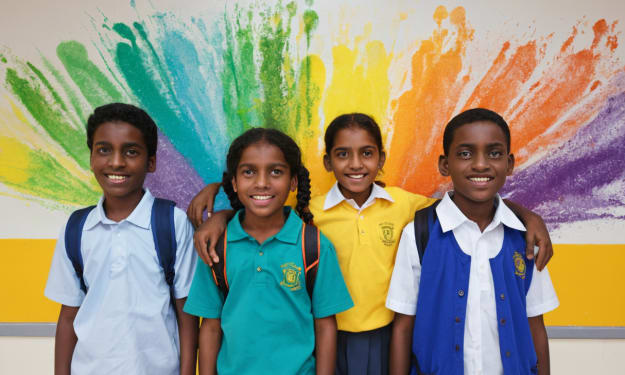
The Painting Day: A Moment of Expression and Connection. AI-Generated.
The week had passed slowly, a mixture of small, unfamiliar moments and growing confidence. Each day Kiswa returned home with a new word, a new game, a new song, her mother eagerly awaiting her stories. Though the weight of her initial fears had lifted, they hadn’t disappeared entirely. There were still times when she felt like an outsider, moments when her feet didn’t quite touch the ground. Yet, as the days passed, the sensation of being lost was replaced with the quiet excitement of discovery.
By Syed Ali Shah2 years ago in Families