grandparents
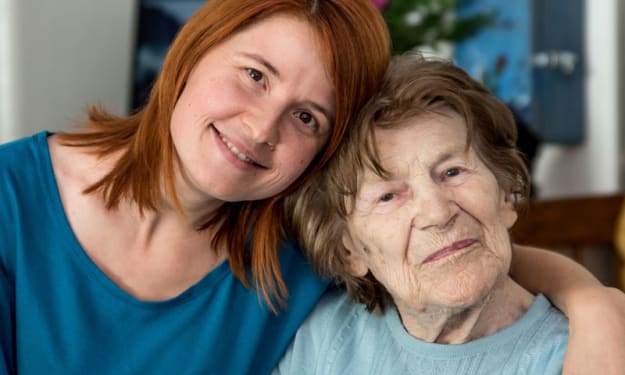
Becoming a grandparent makes getting older something to look forward to - all the fun of parenting, without the hassle.
How to Find Private Nursing Care In Home: Sonoma & Marin County - Kizuna
This Blog was Originally Published at: How to Find Private Nursing Care In Home: Sonoma & Marin County — Kizuna Finding the right private nursing care in home is a priority for many families in Sonoma and Marin County who want to ensure their loved ones receive compassionate, high-quality care in the comfort of their own homes. This level of care can range from basic assistance with daily activities to advanced medical support. Knowing where to start and what to look for can make the search easier and more effective.
By Kizuna Care Blogs2 years ago in Families
How Does the FTD (Frontotemporal Dementia) Affect the Eyes?
Frontotemporal dementia is a complex neurological condition involving multiple areas of brain function. Mainly affecting the frontal and temporal lobes, which determine personality, behavior, and speech, FTD has broad effects on cognitive and behavioral changes but also significantly influences eye health and visual perception. This article will give insight into the specific ocular symptoms induced by frontotemporal dementia and possible interventions available for patients with this challenging condition.
By Jane Rockwell2 years ago in Families
Learn to Recognize the Language of Sight
Learn to Recognize the Language of Sight There is a language spoken not with words, but with a gaze, a gesture, or a mere glimpse. This is the language of sight—a powerful form of communication that bridges gaps and connects people in ways that spoken words cannot always achieve. Learning to recognize this language can enrich our lives, helping us empathize with others, understand unspoken emotions, and respond to the needs of those around us. When we look closely into someone’s eyes, we often see a reflection of their soul, their struggles, and their hopes. Our eyes are storytellers. They reveal our deepest emotions—joy, sorrow, longing, love, and even despair—without uttering a single word. Learning to recognize this language of sight is about developing the sensitivity to perceive what lies beneath a person’s outward expression. Consider, for instance, the glance of a child looking up at their parent. There is often a trust, a dependency that needs no verbal affirmation. Their wide-eyed gaze speaks of innocence, love, and a craving for security. For the parent, understanding this silent message means more than just taking care of the child’s physical needs—it means comforting them, offering emotional warmth, and a feeling of safety. The language of sight can be seen in the elderly as well. In their eyes, we often find stories of resilience, nostalgia, and a lifetime of memories. Sometimes, an elderly person may sit quietly in a room, surrounded by family but feeling unseen or unheard. Yet, with a single look—perhaps a softened gaze directed toward a family photo or a brief, wistful glance—they communicate a lifetime of love and loss. Those who can read this language of sight will know that what the elder person truly seeks is connection, a recognition of the life they have lived and the love they still hold. In our busy lives, we often pass by strangers on the street without truly noticing them. But if we take a moment to look, we might see an entire world within them. Imagine seeing someone sitting alone on a bench, their eyes cast down, shoulders slumped. Their posture and the faint sadness in their eyes tell a story of loneliness. Perhaps they have lost a loved one, or they feel isolated in a city full of people. Recognizing this silent message allows us to respond with compassion. A simple smile or a nod can acknowledge their existence and, in a small way, ease their burden. Even in relationships, the language of sight plays an essential role. In romantic partnerships, a glance exchanged across a crowded room can convey love and understanding more profoundly than words ever could. For instance, when a partner sees their loved one struggling, they might silently communicate their support through a steady, reassuring look. That gaze tells the other person, “I am here with you; you are not alone.” In friendships, too, the language of sight bridges gaps. A friend’s knowing look can be a balm in moments of self-doubt, giving assurance without a single word spoken. The language of sight also extends to understanding ourselves. When we look in the mirror, we sometimes avoid making direct eye contact with our reflection. There may be fears, regrets, or unprocessed emotions staring back at us, and looking away feels easier. But learning to face ourselves and read our own eyes with honesty and compassion can be a transformative experience. By recognizing our own silent language, we cultivate self-acceptance and acknowledge our journey, with all its highs and lows. The ability to recognize the language of sight can be particularly powerful in professions like healthcare. Doctors, nurses, and therapists are often trained to observe their patients beyond mere physical symptoms. A doctor who notices the apprehension in a patient’s eyes may sense fear about an impending diagnosis. This awareness allows the doctor to address the patient’s emotional state, offering reassurance and a comforting presence. Learning to read this language takes practice and patience. It requires an openness to observe without judgment, to allow ourselves to be present with others, and to care genuinely. In our increasingly digital world, where conversations are often reduced to text on a screen, it becomes even more crucial to preserve and cherish this form of human connection. Meeting someone's gaze and truly seeing them is a simple act, yet it can carry an incredible weight. It affirms a shared humanity and reminds us that, beyond our differences, we all seek the same sense of recognition and connection. Ultimately, to learn the language of sight is to embrace the beauty of silence, to find meaning in the space between words. When we listen with our eyes, we open ourselves to a world rich with unspoken emotion, fostering compassion and understanding that transcend verbal communication. In every fleeting glance and every unspoken exchange, there lies a profound opportunity—to understand, to connect, and to care.
By Dipak Pawar2 years ago in Families
Grandchildren And Great-grandchildren
Together my husband and I have seven children and from those children, we have twenty-seven grandchildren with a little boy due in February. We have twelve great- grandchildren. I have been known to mention that it is even more fun having grands than children!
By Denise E Lindquist2 years ago in Families
The Brave Little Firefly's Adventure. AI-Generated.
Once upon a time, in a beautiful green forest, there lived a small firefly named Flicker. Flicker was different from the other fireflies that shone brightly at night. His light was small and weak, hardly lighting up the area around him. While other fireflies danced happily, Flicker often felt lonely, sitting quietly on the branches of tall trees.
By Muhammad Bin Ali2 years ago in Families
The Greatest Baker And The B+ Foundation. Content Warning.
You Don't Have To Be A Parent To Imagine The Pain Of Losing A Child. It's a straightforward thing that even the cruelest, most selfish of humans can imagine. Even people who loathe the thought of children with the entirety of their existence know that when a parent does lose a child it's the most devastating thing in the world. I'm confident when I say that almost everyone (save for sociopaths and psychopaths) could empathize or sympathize with the mere thought of losing a child, to anything.
By Hope Martin2 years ago in Families
Cycles of Inheritance
I found myself lying in a nearly pitch-dark room, surrounded by shadows of conversations I wasn’t part of, conversations that seemed to move around me in a cycle I could neither claim nor escape. It was as if I had been placed in the middle of a story already in progress, a narrative as old as time and as familiar as the air I breathe. In that dim light, I overheard two women speaking—a woman, perhaps an employer, congratulated another woman, acknowledging her rise within the workplace. I murmured just enough to prove my relevance, hoping to claim my own place in the world they had carved out. Yet, I felt like an outsider, as if there was a barrier between me and that congratulatory moment, one that was both impenetrable and rooted in history, shaped by generations of the same cycle.
By T. E. Door2 years ago in Families
The Ayurveda Treatments and Best Ayurvedic Hospital for Arthritis. AI-Generated.
Ayurveda, an ancient Indian healing science, offers unique treatments that address not only the symptoms but also the root causes of many ailments. In particular, Ayurveda has shown promising results in managing arthritis, a condition characterized by joint pain, swelling, and stiffness. This article delves into how Ayurveda approaches arthritis, the types of Ayurvedic treatments available, and the best Ayurvedic hospitals for arthritis treatment in India.
By Neeraj Arthritis Treatment2 years ago in Families
Supporting Seniors’ Mental Health: The Role of Geriatric Psychiatric Services
In recent years, awareness of mental health needs in older adults has grown significantly, shedding light on the unique challenges seniors face. Aging often brings complex mental health concerns such as depression, anxiety, cognitive decline, and mood disorders, all of which require specialized support. Geriatric psychiatric services focus specifically on these needs, providing seniors with the mental health care they deserve. By addressing the psychological and cognitive changes associated with aging, geriatric services empower seniors to maintain dignity, independence, and a high quality of life.
By Hearts for Dementia2 years ago in Families
New traditions, a dia de los muertos story
Carolina stood in the middle of her Florida apartment, surrounded by shopping bags from Michael's and Publix. She felt both nervous and excited, wondering if she was doing the right thing and if she would get it right. The late October Doral heat pressed against her windows as the sound of airplanes destined for Miami International airport breezed by. A YouTube tutorial on creating ofrendas played on her phone. The phone, propped on her dining room table by sugar skulls and stacks of old photos she had selected for the occasion. Growing up, her mother had always kept their Colombian traditions alive - masses, novenas, black dress and black coffee and prayers, many prayers. Now, at twenty-eight, she found herself drawn to a different way of remembering. A new way, from a familiar but foreign tradition.
By G. A. Botero2 years ago in Families
10 Productive Morning Routine Habits to Skyrocket Your Success. AI-Generated.
10 Productive Morning Routine Habits to Skyrocket Your Success Image Source: AI Generated A productive morning routine can set the tone for a successful day. Many high achievers credit their accomplishments to the habits they cultivate in the early hours. These routines help boost productivity, increase focus, and promote overall well-being.
By Ahmad Amer2 years ago in Families