fact or fiction
Is it fact or merely fiction? Fact or Fiction explores the myths and beliefs we hold about our family dynamics, traditions, and if there's such thing as a 'perfect family.'
Bittersweet. Top Story - May 2025.
This Mother’s Day began like any other Mother’s Day did in the past. My family woke up, had breakfast, and being a Sunday, we lounged around for a bit. But unlike any of the past Mother’s Days, this one ended differently, on a bittersweet note.
By Mother Combsabout a year ago in Families
Love Her Sacredly
Dear Man, After said all, regard this print as holy writ, if you will; hear what I have to say, for it is above knowledge; it is a thing of the heart. It represents the female view, the desires of her heart she doesn't share, and the unsaid prayers her body is talking.
By Rohitha Lankaabout a year ago in Families
When Motherhood Dies.
When Motherhood Dies: The Tragedy of Cruelty and the Loss of Humanity. Have you ever wondered: Can a mother really kill her own child? Not by accident. Not out of desperation. But by a cold, conscious decision. If the question alone moves you, the answer will haunt you. This is not fiction. It is not an exaggerated drama. It is a true story set in a lush, green village in one of Africa's most vibrant and contrasting countries, where the beauty of nature often masks the brutality of the people. A story in which motherhood was not celebrated, but rather suppressed.
By Sayed Zewayedabout a year ago in Families
Hills Like White Elephants
Unpacking Hemingway’s Silent Tension Ernest Hemingway’s short story Hills Like White Elephants is one of the most widely analyzed pieces in modern literature. First published in 1927, the story offers a minimalist yet powerfully emotional look into a conversation between a man and a woman waiting for a train in Spain. On the surface, it appears to be a simple dialogue. However, its deeper meanings reveal themes of communication, choice, gender roles, and power dynamics—all hidden beneath Hemingway’s characteristic iceberg style.
By its_ishfaq_ahmadabout a year ago in Families
Crumbs of Courage
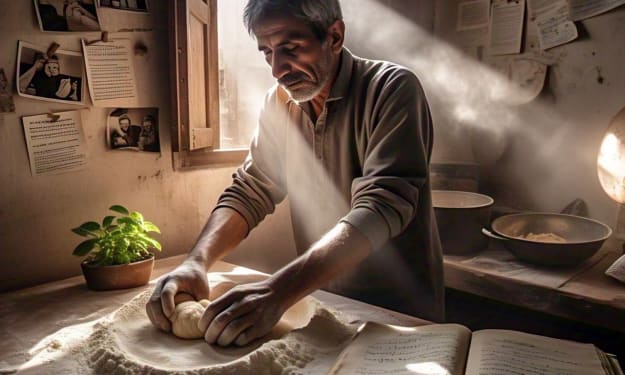
The first time Amir baked bread in the new country, his hands trembled. Not from the cold—though the small, tiled kitchen in the shelter was icy that morning—but from memory. The flour on his fingers reminded him of home: of sunlit mornings, of his wife humming as she rolled dough, of the faint smell of cumin and rosewater drifting through open windows. Now, everything smelled like sterilized metal and worry. Back in Aleppo, Amir had owned a small but beloved bakery named Khobz wa Salaam—Bread and Peace. His baklava was legendary. Locals said his hands were guided by angels, that his sweet dough could mend broken hearts. Then the war came. Missiles replaced music. He buried his wife beneath rubble and fled with nothing but a tin box of recipe cards, most smudged by blood or soot. His son, barely nine, held his hand as they crossed borders, nights filled with hunger, silence, and fear. When they finally reached Europe, the camp was crowded and gray, but it offered a roof, food, and school for his boy. That should’ve been enough. But something was missing. It wasn’t until the camp coordinator mentioned a community kitchen project that Amir offered, hesitantly, to bake. That first morning, he shaped the dough carefully, hands remembering what the heart had tried to forget. He baked small, soft flatbreads—khubz taboon—brushed with oil and scattered with thyme. He placed them on a tray, heart pounding. When the other refugees tasted them, something shifted. Eyes widened. A woman began to cry. A teenage boy whispered, “This tastes like my grandmother’s house.” People lined up not just for bread, but for something they had forgotten they craved: connection. Word spread. The shelter gave him a corner of the kitchen and old ingredients nobody wanted. He worked magic with them—cardamom buns, date cookies, fragrant rice-stuffed flatbreads. Every bite told a story. Every spice whispered of a lost city, a loved one, a street that no longer existed. And then, one day, he began writing again. He took out his old recipe cards, rewritten now in three languages—Arabic, English, and French. On each card, beneath the ingredients, he added a story. A memory. “My wife, Leila, made this when I asked her to marry me.” “My son laughed so hard, he dropped the whole tray of these.” “My bakery was bombed the day after I made these for the town festival.” People didn’t just eat. They read. And wept. And hugged him. And stayed. Months passed. His son began smiling again. Local volunteers noticed. One of them, an elderly French chef named Bernard, asked Amir to teach a weekly class. At first, Amir refused. He didn’t want to speak. But Bernard insisted: “People need to taste your story.” The class became a sensation. Every Thursday, Amir taught a new dish and shared the memory behind it. Students weren’t just refugees—they were locals, too: curious, kind, hungry to understand. One girl asked, “How do you bake when you feel broken?” Amir paused, then said, “I bake because I’m broken. The dough listens better than most people.” They wrote that on the chalkboard and never erased it. Soon, Amir’s recipes were compiled into a small, illustrated book titled Crumbs of Courage. Each chapter was a dish, each dish a moment of his life. The last page had no recipe—just a photograph of Amir and his son planting mint in a clay pot by their shelter window. “Fresh things can grow,” the caption read. “Even in foreign soil.” Years later, his son would run a café called Khobz wa Salaam in a sunlit corner of the city. Tourists came for the baklava, but stayed for the walls—covered in Amir’s recipes, written in his careful script, each signed with a simple line: “Made with memory.” By then, Amir no longer trembled when he baked. He stood tall in the kitchen, his apron dusty, his heart light. For in every crumb he left behind, there lived a quiet kind of courage. The kind that survives bombs, borders, and language barriers. The kind that says: “I am still here. And I am still feeding hope.”
By Syed Kashif about a year ago in Families
What is the real meaning of mother?
The word 'mother' can have two meanings. One meaning comes from ignorance, and the other meaning comes from understanding. The first mother has only affection; the second mother has maternal feelings. Animals also have affection, but only a few mothers know maternal feelings. Motherly feelings mean giving birth in the true sense - one birth of the body and the second birth of knowledge. There is no love in affection; it only has hormones. A real mother is one who knows love. For that, the mother herself will have to be enlightened.
By Ramesh Mahato about a year ago in Families
10 Must-Try Cantonese Tea Restaurant Classics
Cantonese cuisine is celebrated worldwide for its delicate balance of flavors, fresh ingredients, and artful techniques. From dim sum staples to hearty clay pot dishes, these recipes are staples in Guangdong’s bustling tea restaurants—and they’re easier to recreate at home than you think! Whether you’re a weeknight warrior or a weekend food adventurer, here’s how to bring authentic Cantonese magic to your table.
By yue . shuiabout a year ago in Families
The Man Who Claimed to Be My Father Had Proof--But I Knew It Was a Lie
Not because I thought it was funny. But because it was so absurd it seemed like something from a movie. He looked nothing like me. He was tall, pale, wiry, with sharp cheekbones and dark eyes that felt too cold.
By MALIK Saadabout a year ago in Families
The Power of Social Touch
In a world increasingly shaped by technology and virtual interaction, social touch remains one of the most profound and essential forms of human communication. Whether it's a warm hug, a pat on the back, or a friendly handshake, these small gestures carry immense emotional and psychological weight. But what exactly is social touch, and why does it matter so much?
By its_ishfaq_ahmadabout a year ago in Families
RiverScapes
Rivers from the ground are seen as moving lifelines that sustain cities, forests, and civilizations. From space, rivers become breathtaking works of nature—curving lines of glinting blue, green, and gold winding through Earth's crust like threads of life. River systems, imaged by satellites and astronauts on the International Space Station (ISS), show the stunning beauty and intricacy of our world from a vantage point few people ever get to experience directly.
By mukesh jaiswarabout a year ago in Families