extended family
All about how to stay connected, strengthen ties and talk politics with your big, happy extended family.
Six Things Women like More In Men Than Good looks
Physical attraction may spark interest, but it rarely sustains a meaningful relationship. While good looks can draw attention, they are not what build trust, emotional security, or long-term happiness. Many women value deeper qualities that make a man reliable, emotionally safe, and inspiring to be with. Here are six things women often like more in men than physical appearance.
By Ibrahim Shah 8 months ago in Families
Six Things Men like More In Women Than Good looks
Physical attraction often gets most of the attention in conversations about relationships, but in reality, long-term connection is built on much deeper qualities. While good looks may catch someone’s eye, they rarely hold someone’s heart. Here are six things many men value in women even more than physical beauty.
By Ibrahim Shah 8 months ago in Families
How Family Mediation Helped Us Talk When Everything Else Failed
We Found a Way to Talk Again The last proper conversation we had before mediation was about a school jumper. Our youngest had lost his, and somehow that turned into forty minutes of accusations about who was supposed to be keeping track of what, who had dropped the ball again, and whether this was yet another example of the other person not paying attention to the things that actually mattered.
By Jess Knauf8 months ago in Families
The Empty Mansion and the Small Hut: A Lesson in True Wealth
By Hazrat Umer Why having everything money can buy might still leave you with nothing. I once knew a man named Sameer. Sameer was a very successful businessman in 2020. He had everything a person could dream of: a giant mansion with marble floors, three expensive cars, and a bank account that never ended. He was always busy, moving from one meeting to another, his phone ringing every second. People looked at him and said, "He is the luckiest man in the world."
By Hazrat Umer8 months ago in Families
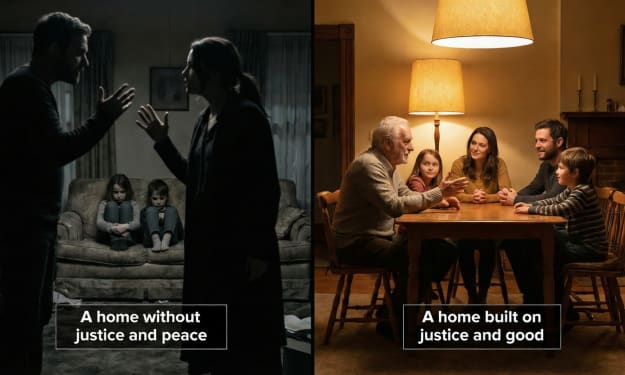
The Cracks in Our Walls: Why Our Homes Have Lost Their Peace
By Hazrat Umer The Secret to a Happy Family: Why Justice and Character Matter More Than Money Today, if you look at almost any house, you will see a sad reality. On the outside, the house looks beautiful. But on the inside, there is no peace. In almost every home, people are fighting. Parents are arguing with children, brothers are fighting with sisters, and married couples are struggling to stay together.
By Hazrat Umer8 months ago in Families
Family Struggles
Growing up in a household filled with constant tension, I often found myself grappling with family struggles that deeply affected my emotional well-being. My parents’ arguments, whether over trivial matters or deeper issues, created an environment where peace felt out of reach. As a child, I didn’t understand why love and conflict were so closely tied and why tranquility was always interrupted by discord. During these turbulent times, I sought refuge in solitude. I would retreat to a quiet corner of the house, away from the shouting and confusion, and find comfort in books or simply in my own thoughts. I didn’t dislike my family, but I longed for peace—an escape from the emotional turmoil around me. Little did I know, I was learning to rely on solitude as a source of strength. As I matured, I realized that solitude wasn’t just a way to escape; it was a way to understand myself better. In these quiet moments, I could reflect on my feelings, dreams, and desires. Solitude gave me the clarity to understand that peace didn’t come from external sources—it had to be cultivated from within. I also realized that solitude provided me with space to think about my life choices, to reflect on the kind of person I wanted to become, and the kind of life I wanted to build. Through years of reflection, I learned that emotional peace was something I needed to nurture. I began to understand that no external circumstance could provide lasting peace. It was my internal state of mind that mattered most. The peace I sought was not something that could be found in a perfect world, but something I had to create for myself. I also realized the importance of choosing the right life partner. After seeing the effects of unresolved conflict in my family, I knew that a relationship built on love alone wasn’t enough. It needed to be built on mutual respect, understanding, and open communication. Having witnessed my parents’ struggles firsthand, I knew how essential emotional compatibility was in a relationship. I understood that love alone wasn’t enough; a relationship needed respect, understanding, and the ability to navigate difficulties together without falling into destructive patterns. The childhood I experienced taught me that emotional harmony is more important than anything else in a relationship. Without it, no relationship could thrive, no matter how strong the initial feelings of love were. I became more intentional in my relationships, seeking emotional harmony rather than just attraction. I knew that I wanted a partner who could bring peace into my life, not more struggles. I was no longer willing to settle for a relationship that might lead to additional turmoil. Instead, I desired a partner who valued open communication, emotional stability, and mutual respect. These were qualities that, to me, represented the foundation of a healthy and fulfilling relationship. As I entered adulthood, I began applying these lessons. I carefully chose who I allowed into my life, ensuring they shared my values of respect, understanding, and emotional balance. I came to understand that no relationship is free from conflict, but it’s how you manage conflicts that truly makes a difference. The way two people communicate, how they address disagreements, and their ability to listen to each other are the true markers of a successful relationship. I also realized that true peace in a relationship doesn’t mean the absence of disagreement. It means approaching disagreements with empathy, kindness, and understanding. When both partners can communicate openly and work together to resolve issues, the relationship grows stronger. Emotional maturity is the foundation of a healthy relationship, and it’s something I’ve learned to prioritize. Relationships that lack this emotional depth will always struggle, but relationships that prioritize growth, understanding, and mutual care will thrive, no matter the challenges they face. Today, I cherish my moments of solitude more than ever. They are no longer an escape, but a space where I can reconnect with myself and reflect on my growth. These moments remind me of how far I’ve come in my journey towards emotional peace and how important it is to preserve that peace in every aspect of my life. Solitude allows me to stay centered, to focus on my goals, and to connect with my inner self. The struggles I faced growing up taught me invaluable lessons about personal growth, emotional peace, and the importance of choosing relationships that enhance my life. Although childhood struggles were difficult, they also provided me with the tools to live a life of purpose and emotional balance. I’m grateful for the lessons they’ve taught me, and I now approach life with a sense of clarity and direction that I never had before. Now, I continue to prioritize inner peace in my life. I’ve learned that happiness doesn’t come from external sources—it comes from within. By surrounding myself with people who respect my boundaries and share my values, I create a supportive environment. I also nurture my peace through introspection, self-care, and mindful living. These practices have helped me maintain my balance and focus, allowing me to live with intention and joy. The challenges I faced growing up did not define me, but they shaped who I am today. They taught me the importance of emotional peace and the value of choosing the right life partner. My journey has been one of healing, growth, and finding inner peace. I hope my story serves as a reminder that despite any challenges we face, we all have the power to create a life filled with peace, love, and joy.
By Gowhar ali Khan8 months ago in Families
Wait, is it okay not to go home for the Holidays?
Kids these days are choosing to stay home rather than see their parents or their other family members for the holidays. I found it a bit absurd and tried to explain that it is important to bond with family, because you don’t know when you'll see them again, until someone called me out for not having visited my family in over 20 years.
By stephanie borges8 months ago in Families
How Positive Discipline Transformed My Child’s Emotional World. AI-Generated.
Parenting is often described as a journey of love, patience, and learning. For me, however, it felt more like a constant emotional test. I remember days filled with tension, misunderstandings, and moments where I questioned whether I was truly helping my child grow emotionally—or unintentionally causing harm. Like many parents, I once believed that discipline meant control. I relied on firm rules, consequences, and raised voices when things went wrong. My intention was never to hurt, but to teach. Yet the more I tried to “correct” my child’s behavior, the more distant and reactive they became. Something was clearly missing. That missing piece turned out to be positive discipline. Understanding Behavior as Communication One of the most important lessons I learned is that children don’t misbehave without reason. Behavior is often a form of communication, especially when children lack the language to express complex emotions. Instead of asking, “How do I stop this behavior?” I began asking, “What is my child trying to tell me?” This shift completely changed my parenting approach. I started observing patterns rather than reacting emotionally. I noticed that outbursts often followed moments of overwhelm, tiredness, or frustration. My child wasn’t being difficult—they were struggling. Replacing Punishment with Connection Positive discipline does not mean the absence of rules. It means enforcing boundaries with empathy instead of fear. Here are some changes I implemented: I acknowledged emotions before correcting behavior I spoke calmly, even during emotional moments I explained expectations instead of assuming understanding I focused on problem-solving rather than blame For example, instead of saying, “Stop crying right now,” I learned to say, “I see that you’re upset. Let’s talk about what happened.” This small change had a powerful effect. My child felt seen instead of judged. The Impact on Mental Health Before positive discipline, our home environment felt tense. Emotional reactions escalated quickly, and both of us carried stress long after conflicts ended. Over time, I noticed signs of emotional strain—not just in my child, but in myself. Positive discipline created emotional safety. When children feel safe, their nervous systems can relax. This allowed my child to: express emotions more clearly calm down faster after frustration build confidence in handling challenges For me, it reduced anxiety and parental guilt. I stopped feeling like every mistake was a failure and started viewing them as learning opportunities. Teaching Emotional Regulation, Not Fear Traditional discipline often relies on fear-based compliance. Positive discipline focuses on skill-building. Through everyday interactions, my child learned: how to name emotions how to pause before reacting how to repair mistakes through communication Instead of avoiding punishment, my child began developing genuine self-awareness. This was a major emotional breakthrough. Strengthening the Parent–Child Bond One of the most unexpected outcomes was how much our relationship improved. Trust replaced tension. Conversations became easier. Even difficult moments felt manageable because they no longer threatened our emotional connection. Positive discipline taught me that authority and compassion can coexist. Respect doesn’t come from control—it grows from consistency, empathy, and presence. What I Wish I Had Known Earlier If I could speak to my past self, I would say this: Parenting is not about perfection Children need guidance, not domination Emotional intelligence is just as important as obedience Positive discipline didn’t just change my child’s behavior—it changed how we relate to each other on a deeper emotional level. Final Thoughts for Parents Every child deserves to feel understood. Every parent deserves tools that support both discipline and emotional well-being. Positive discipline offered us a path where growth replaced guilt, and connection replaced conflict. The transformation wasn’t instant, but it was real—and it continues to shape our emotional world every day.
By Zia Djamel8 months ago in Families
What Fathers Uniquely Provide
The Error of Treating Parenting Roles as Functionally Identical Modern parenting theory often begins with the assumption that mothers and fathers are largely interchangeable, differing only in style or temperament. From this view, any deficits in one parent can be compensated for by the other through increased emotional effort, sensitivity, or presence. Parenting becomes a question of intention and quantity rather than function and role. This assumption is appealing because it aligns with cultural preferences for symmetry and fairness, but it collapses under closer examination of developmental outcomes.
By Peter Thwing - Host of the FST Podcast8 months ago in Families