divorced
Sometimes a good divorce is better than a bad marriage.
The Declaration of Parental Rights
“Children belong to their parents—not to the government.” That shouldn’t be a radical statement—but in 2025, it is. We are living through a silent revolution—one where government agents, unelected bureaucrats, and activist judges have increasingly inserted themselves into the sacred space between parent and child. Under the guise of “safety,” “equity,” or “best interest,” the state is taking more control while parents are being treated as threats, not protectors.
By Michael Phillipsabout a year ago in Families
She Deserves a Break Too – What Every Husband Needs to Hear
Husbands, have you ever asked yourself why your wife enjoys going out, even for a short while? The answer, dear gentlemen, is quite simple. Every day, you go to work, usually for 8 hours. You work hard, deal with pressure, deadlines, and people. And when you return home, you expect peace, rest, and a chance to relax — and that’s completely fair. You absolutely deserve it. But now, take a moment and imagine this: 🌿 What if your workplace expected you to work not just 8 hours, but 16 hours a day? 🌿 And what if your boss expected you to stay available and active 24/7, with no defined time for rest or personal space? Sounds exhausting, right? Well, welcome to your wife’s world — the world of a stay-at-home mother, a homemaker, or even a working mom who also manages the home. For her, home is not a place to rest — it is her workplace. From the moment she opens her eyes in the morning to the moment she finally lays down at night — sometimes even beyond that — she is working, managing, caring, thinking, planning, and organizing. The Daily Reality of a Wife and Mother Whether she’s a full-time homemaker or also working a job outside the home, her day is packed: Cleaning Cooking Laundry Grocery planning Helping kids with school and homework Managing emotional meltdowns Feeding babies, changing diapers Solving problems, big and small Taking care of her husband’s needs Managing guests or relatives Scheduling doctor’s appointments, play dates, school meetings And countless unseen emotional and mental tasks And these are not occasional tasks — they are daily, non-stop, and mostly thankless. Even if she sits for a few minutes to watch TV, or scrolls her phone, her mind remains alert. She’s ready to get up at the slightest cry, call, or spill. When the kids are young, she is on-call 24/7 — no shifts, no breaks, no weekends. When you come home and relax on the couch, that is your “off-time.” But for her, home is never an off-place. It’s a never-ending job with zero pay, zero holidays, and often very little recognition. So when she says, “I want to go out,” it’s not because she wants to escape the family — it’s because she wants to breathe. The Need for Mental Freedom When a woman asks to go out — whether with friends, to the mall, a café, even just to walk around — she’s not being irresponsible. She’s seeking a break, a moment to remember who she is outside of being a mother and a wife. She is simply trying to feel human again — to be in a space where she is not constantly needed, not being pulled in a hundred directions. Even if she takes the kids with her, it's often a different kind of space — the change of environment can refresh her mind. But here’s a beautiful suggestion: Take her out — without the kids. Even if it’s for an hour a week, or half an hour when the kids are asleep. You’d be surprised how much difference this makes. Bring her an ice cream, sit beside her in the balcony, go to the rooftop and just talk, or walk hand-in-hand. And during that time, please don’t ask her, “Where’s the tea?” or “Did you bring the peanuts?” or “Can you grab the snacks?” No tasks. No demands. Just her, and you. Even machines can’t run non-stop. Even computers “hang” and need to be restarted. Your wife is not a robot. She is a human — a woman who gives endlessly, often at the cost of her own self. The Weight of Responsibility She carries the weight of: The kids' education Their meals and moods Your happiness The home’s cleanliness The family’s reputation Social responsibilities Religious or cultural duties Budgeting and managing with limited means When does she ever really rest? Have you ever thought what happens when you never give her a break? She begins to feel: Drained Irritated Emotionally neglected Mentally exhausted Disconnected from her identity And then you say, “Why is she always angry?” or “Why is she moody?” But have you paused to ask, “When was the last time she felt loved without being expected to do something in return?” Sometimes, all she needs is to feel seen. Not just as the mother of your children or the caretaker of your house, but as a woman — with dreams, emotions, exhaustion, and desires. Be Her Partner, Not Just Her Provider You work hard, yes. You provide, yes. But love and partnership go far beyond paying bills. Here’s how you can help: 1. Acknowledge her work. Tell her, “I see how much you do. Thank you.” 2. Give her breaks. Let her sleep in sometimes, or take the kids out yourself. 3. Plan a surprise. A coffee date, a short walk, even a heartfelt note. 4. Share responsibilities. Even small efforts like helping set the table or bathing the kids means a lot. 5. Listen. Just hear her out without offering solutions. Sometimes she just wants to vent. 6. Protect her time. Help her find time for herself, even if it’s 30 minutes of quiet every day. These are not grand things — but their impact is enormous. You don’t need to be rich or have a luxurious lifestyle to show love. It’s about small, meaningful gestures that say, “You’re not alone in this.” A Thought to Remember Your home is a place of comfort for you — a sanctuary after a long day at work. But for her, home is her never-ending workplace. So unless you make a conscious effort to give her a break, acknowledge her effort, and help lift the emotional weight, she may never truly rest — even in her own home. And when a woman is overworked and under-appreciated for too long, she doesn’t just get “moody” — she burns out. She becomes a shadow of the joyful, vibrant woman she once was. You married her for who she was — so help her stay that woman. Final Words Your wife is not asking for luxury. She’s not even asking for freedom from responsibility — she’s simply asking for balance. So next time she says she wants to go out — smile and say: “Go ahead, love. You deserve it.” Or better yet: “Let’s go together.” Because when you help a woman rest, recharge, and reconnect with herself — you don’t just get a happier wife — you get a happier home. So, dear husbands, if you truly want peace at home, start with kindness, time, and understanding. It’s not just love — it’s partnership. 💖
By Muhammad Ilyasabout a year ago in Families
Don’t Want a Divorce: I’m Taking My Case Back
The divorce was almost finalized. A woman, determined and hurt, had taken the final steps toward separating from her husband. The paperwork was complete, every legal detail accounted for. Only one thing remained — her husband’s signature.
By Awais Ahmadabout a year ago in Families
When They Steal Your Children
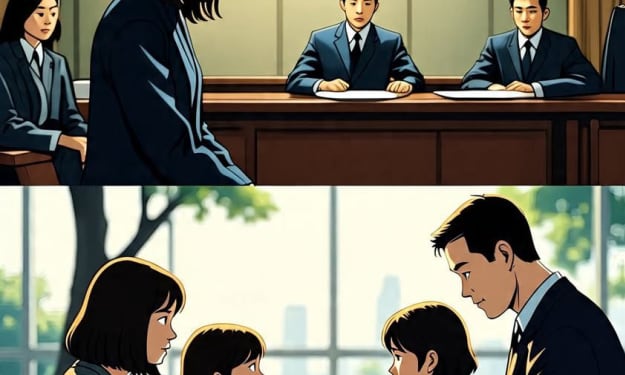
They took your child. Not in the way most people think. There was no dramatic kidnapping, no amber alert, no frantic media coverage. No — your child was taken with a gavel. With the silent nod of a judge. With the signature of a bureaucrat who didn’t care to hear your side. And just like that, you became the ghost of a parent. A name on a piece of paper. An afterthought.
By Michael Phillipsabout a year ago in Families
When Silence Fell Between Us . Content Warning. AI-Generated.
The first thing Leila noticed was that Daniel stopped asking how her day was. It didn’t happen overnight. At first, it was just once or twice—he’d come home late, kiss her on the cheek absently, and head straight to the couch. She told herself he was tired, stressed, distracted. Work had been rough. Life was just busy. But then it became a pattern. A new routine. Quiet replaced curiosity.
By FAWAD KOKOabout a year ago in Families
Why Some Relationships Don’t Last Long
In the beginning, everything feels perfect. The texts, the calls, the laughs, the smiles — it all seems like a dream. But with time, something changes. Small fights turn into big arguments. Smiles turn into silent nights. You begin to ask yourself, “What happened to us?”
By Umar Khattakabout a year ago in Families
The Day I Lost My Best Friend — And My Innocence
I still remember the sound of her laughter. It was wild, unfiltered, and filled with the kind of joy only children carry in their hearts. Her name was Alina — my classmate, my secret-keeper, and the first real friend I ever had. We met in the second grade, two quiet girls who found each other in the corner of a loud, unfamiliar classroom. I had just moved schools. Everything felt new and strange. During lunch, Alina offered me half her sandwich without saying a word. That was her way — quiet, kind, and full of heart. That small gesture changed my life. --- From that day forward, we were inseparable. We walked to school together. Shared snacks. Giggled over boys we didn’t even like. Built entire kingdoms under the old neem tree behind the schoolyard. We had our own imaginary world, our own code words, and even our own pinky promise: “No lies. Ever.” We meant it. I meant it. Or at least, I thought I did. --- Things began to change in the fourth grade, slowly and quietly — the way most endings begin. A new girl joined our class. Zara. Zara was everything we weren’t. Loud. Stylish. Confident. She wore glittery shoes, had polished nails, and always had a new story to tell. Alina was fascinated by her. And, if I’m being honest, so was I. But fascination turned into something darker. I started noticing how Alina would laugh a little harder when Zara joked. How she began walking beside her more than me. How their notebooks matched. Their pencils too. Suddenly, I was the third one in a pair. The extra. The leftover. I felt it in my chest — a heaviness I couldn’t name then, but now know was jealousy. --- One afternoon, I did something I wish I could take back. I pulled Zara aside during recess and whispered, “Alina said your handwriting looks like a baby’s.” Zara frowned. “She did?” “Yeah. I didn’t want to tell you, but I thought you should know. You deserve to.” It was a lie. A stupid, pointless lie. I just wanted her to drift away from Alina. I wanted things to go back to how they were before Zara came along. When I was enough. I didn’t think the lie would travel. I didn’t think Zara would tell. But she did. --- The next morning, Alina didn’t sit next to me in class. Her eyes were red. She had been crying. At lunch, she handed me a folded piece of paper. It said only four words: “You broke the promise.” I still have that note. --- I tried to explain, but she didn’t speak to me. Not that day. Not the next week. Not the next year. In the hallways, I saw her laughing with Zara. They were close now — really close. And even though I was surrounded by other classmates, none of them were Alina. None of them knew I hated chocolate but loved Nutella. None of them understood the way I used to sing under my breath when I was nervous. None of them looked at me the way Alina used to — like I was enough, just as I was. I had lost her. --- At first, I told myself she overreacted. That it was just a lie, a small one. But deep down, I knew better. I hadn’t just betrayed her trust. I had betrayed her kindness. I had hurt someone who never once tried to hurt me. --- Years passed. We grew older. Changed schools. Got new friends. Life moved on — as it always does. But sometimes, even now, I find myself thinking of that little girl with the bright eyes and untied shoelaces. The girl who gave without asking, loved without limits, and trusted without doubt. I wonder if she still remembers me. I wonder if she ever forgave me. --- It took me a long time to understand what really happened that day. I didn’t lose Alina because Zara was better. I didn’t lose her because she moved on. I lost her because I let fear and insecurity win. I let a moment of weakness destroy years of love. I traded honesty for attention. And I paid for it with a friendship I still miss. --- Now, as an adult, I see children with their arms around each other, whispering secrets and making promises under trees — and I smile. But there’s a part of me that aches. A part that knows how fragile childhood can be. How quickly it can slip away — not because of growing up, but because of growing apart. If I could go back, I wouldn’t just undo the lie. I’d hold her hand tighter. Tell her she was enough. That no new girl could replace her. That I was scared, not of her leaving, but of being left behind. But childhood doesn't give second chances. Only lessons. --- And this was mine: Sometimes, the most painful goodbyes come from mistakes we make too young to understand — and remember for the rest of our lives. ---
By The Pen of Farooq about a year ago in Families
The Last Letter and a Tiny Promise
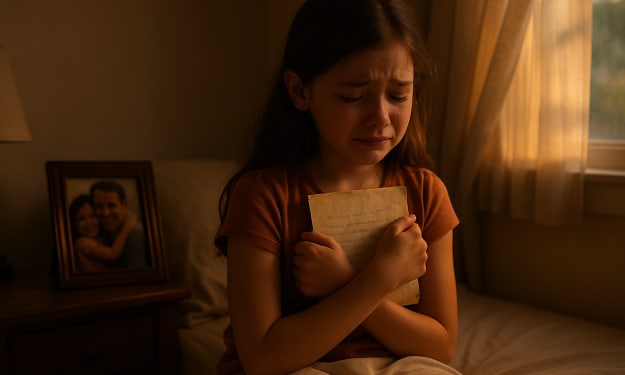
The Last Letter and a Tiny Promise In a modest home nestled amidst the bustling lanes of a small town, lived Ahmed—a man whose entire universe revolved around the sparkling eyes and infectious laughter of his little daughter, Aima. She was not just his child, but the very essence of his being, the reason behind every breath he took. Aima, with her boundless curiosity and uncontainable energy, was pure joy incarnate—a tiny burst of sunshine who saw her father as nothing short of a superhero. Their lives were painted with the hues of simple yet priceless routines. Every morning, Ahmed would gently wake her up, her sleepy smile enough to dissolve his exhaustion. He had mastered the art of braiding her hair with fatherly care, listening intently as she shared her dreams and school adventures. Come evening, the roles reversed as he became dragons, knights, and fairies in her imaginative bedtime stories. Ahmed worked tirelessly—double shifts, long journeys, calloused hands—yet his heart remained light, buoyed by Aima’s dreams. To him, she was his “princess,” a word he’d softly breathe into her hair during their quietest moments. And Aima adored him with the unfiltered love only a child can offer—clinging to him, trusting him, needing only his smile to feel safe. But life is often cruel in its silence. One day, a shadow began to creep into their bright world. Ahmed, once vibrant and strong, began feeling an unrelenting fatigue, an ache he brushed off as overwork. When he finally saw a doctor, the verdict was swift and merciless: advanced cancer. Aggressive. Irreversible. The news shattered him—not for himself, but for Aima. How could he tell her that her invincible hero was crumbling? He chose silence, determined to protect her innocence. Time slowed. Every shared moment became sacred. He watched her play, his heart aching with the knowledge that these seconds were numbered. His laughter became a mask, his strength a crumbling wall. Aima noticed. Papa didn’t play the same. His hugs weren’t as strong. Sometimes he just stared, lost in thought, smiling softly at nothing. She responded in the only way she knew—more drawings, more cookies, more kisses. Small hands trying to light a fading flame. The illness advanced with merciless pace. His body weakened, and smiles grew harder to fake. In those final, painful days, all he could think of was Aima. He wanted to leave behind something more than memories—something she could hold, read, and remember. With trembling hands and a breaking heart, he wrote her a letter. A birthday gift for her tenth year—a piece of his soul wrapped in paper and ink. He poured into it every dream, every ounce of love, and a simple, eternal promise: that he would always be watching. Then the day came. Quietly, in his sleep, Ahmed slipped away. A peaceful departure that left a storm behind. Aima, too young to fully grasp the permanence of death, watched silently as unfamiliar sorrow swept through her home. She saw people cry. She noticed the silence. And she asked, with a whisper that shattered hearts: “Papa will come back, won’t he?” The house that once echoed with laughter now stood heavy with stillness. Years passed. Aima grew. Her laughter returned—but so did a silent void that never truly left. Then came her tenth birthday. Among balloons and quiet celebration, her mother handed her an old, sealed envelope. “Your papa wanted you to have this today,” she whispered, her voice trembling. Aima opened it slowly, her fingers trembling. The familiar handwriting hit her like a warm breeze from the past. As she read, a flood of memories rushed over her—his voice, his warmth, his love. The letter spoke of his pride in her, his hopes for her, his unshakable belief in her dreams. He urged her to be brave, kind, and to never give up—just like he never gave up on her. He promised his love would always be with her, a guiding star from afar. Tears streamed down her cheeks. Every word felt like a hug, every line a whisper of comfort. In that moment, she truly understood the depth of his sacrifice and the eternal reach of his love. From that day on, Aima lived with new strength. She excelled in school, pursued her dreams, and faced life’s challenges with the quiet determination that mirrored her father’s spirit. The letter remained with her always—a sacred promise folded close to her heart. And with every step forward, she felt him—like a gentle wind, a quiet whisper in her soul—reminding her that love like his never fades. It becomes a promise. A legacy. A guiding light. Forever.
By Noman Afridiabout a year ago in Families