children
Children: Our most valuable natural resource.
Important tips that new parents need
When you have your first child, your life will change dramatically, and you will find yourself in need of advice and guidance so that you can fulfill your obligations towards the new baby. Therefore, we present to you in the following lines 23 educational tips that every new parent needs.
By Mohamed Abd Elrasheedabout a year ago in Families
Important tips that new parents need
When you have your first child, your life will change dramatically, and you will find yourself in need of advice and guidance so that you can fulfill your obligations towards the new baby. Therefore, we present to you in the following lines 23 educational tips that every new parent needs.
By Mohamed Abd Elrasheedabout a year ago in Families
The Birthday I Never Forgot
When I turned 18, I received a gift that would become the most painful and beautiful memory of my life. Let me take you back. I was always a quiet, introverted kid. My father was the complete opposite—loud, full of laughter, and always the center of attention. People loved him instantly. I, on the other hand, always felt invisible next to him. Not because he made me feel small, but because he was so radiant. Still, we weren’t close. My father loved me, I know that now, but he wasn’t good at showing it in the ways I needed. He never said, “I’m proud of you.” He never hugged me just because. And for most of my childhood, I resented him for that. On the morning of my 18th birthday, I woke up to silence. My mom was crying softly in the kitchen. I thought maybe she had burned breakfast or was watching some emotional soap. But she handed me an envelope—just an old brown envelope with my name in my father's handwriting. He had died during the night. A heart attack in his sleep. No warnings. No signs. I don’t remember much of that day, except holding that envelope like it was something sacred. I didn’t open it until the funeral was over. I couldn’t. It felt like opening it would make it all too real. When I finally did, I found a letter. Four handwritten pages. The last words I’d ever hear from him. He had written it the week before, knowing he might not be around. He started by saying he was sorry—for not saying the right things, for not being the kind of father who knew how to talk about feelings. He wrote: "I may not have said it, but I watched you. I saw you grow from a curious boy into a strong young man. I saw you win, I saw you fall. And every time, I was proud. Even when I didn’t say it, I was." I cried until I couldn’t breathe. But that wasn’t all. Inside the envelope was also a small, crumpled receipt. A booking confirmation for a train ticket—dated exactly one month after my birthday, to a city I had always dreamed of visiting. And a handwritten note: "Go find yourself. I couldn't teach you how, but I believe you’ll learn." I took that trip. Alone. It was terrifying, and beautiful, and full of the kind of quiet growth that no textbook or school could ever offer. I walked unfamiliar streets, I spoke to strangers, I wrote in a journal every night. And for the first time in my life, I started to understand myself. I understood that my father didn’t fail me. He just loved in a language I didn't speak. And sometimes love isn't loud. Sometimes it's a quiet hand on your back, pushing you forward, even after they’re gone. That trip changed my life. But it was the letter—the final gift—that gave me the courage to take it. Today, I keep that letter in a frame on my desk. Every time I feel lost or uncertain, I read his words. And I remember that sometimes, the people who love us the most don’t always know how to say it. But they find their way. Somehow. So if you’ve ever felt unseen, or unloved, or misunderstood—remember: love doesn’t always come the way we expect it. But that doesn’t mean it isn’t there. Sometimes, the quietest goodbyes leave behind the loudest echoes. After that journey, I made it a tradition to take the same train ride every year on my birthday. It became my ritual, a sacred passage. I would pack the same small bag, wear the same jacket, and carry the same letter in my pocket. The fifth year I took that trip, something unexpected happened. I met an old man who sat across from me on the train. He had a similar envelope in his hand. We shared stories. He had lost his daughter to an illness and had been writing her letters every year. That moment—two strangers, connected through loss, traveling to heal—felt like magic. He asked me if I’d ever written my father back. I hadn’t. The idea stunned me. That night, I wrote back for the first time. I wrote about the city, about the old man, about how the world had softened me. I tucked the letter in a bottle and left it by the sea the next morning. Since then, I’ve written to him every year. And somehow, it keeps him alive—not just in memory, but in growth, in change, in the little pieces of me that he helped build. I am no longer the quiet, invisible boy. I am the man who walks with his father’s voice in his chest. And I will carry him with me—always.
By Muhammad Usamaabout a year ago in Families
A Tale of Fate and Fortune: The Unexpected Reunion at a Suzhou Wredding
A Tale of Fate and Fortune: The Unexpected Reunion at a Suzhou Wredding In the picturesque city of Suzhou, China, a wedding unfolded with a twist that would rival any fictional narrative. The ceremony, a joyous celebration of love and commitment, took an unexpected turn when a birthmark sparked a revelation that would change the lives of the bride, groom, and the groom's mother forever. This remarkable story of fate, family, and fortune has captivated the hearts of millions, sending shockwaves of emotion and intrigue across the internet. The wedding day began like any other, with the bride and groom preparing to exchange their vows in the presence of friends, family, and loved ones. However, as the groom's mother gazed upon the bride's hand, a sudden jolt of recognition washed over her. On the bride's hand was a birthmark that bore an uncanny resemblance to one her missing daughter had years ago. The similarity was striking, and the groom's mother's curiosity was piqued. Without hesitation, she approached the bride's family and inquired about the birthmark. The bride's family, sensing the gravity of the situation, revealed a long-held secret: the bride was adopted. This revelation set off a chain of events that would lead to a stunning discovery. As the groom's mother listened intently, the bride's family shared the details of her adoption. The pieces began to fall into place, and the groom's mother's intuition grew stronger. She realized that the bride might, in fact, be her long-lost daughter. The emotions that swirled within her were a mix of excitement, trepidation, and hope. The moment of truth arrived when the groom's mother confirmed that the bride was indeed her biological daughter, lost to her years ago. The reunion was nothing short of miraculous. Both the bride and her long-lost mother were overcome with emotion, tears of joy streaming down their faces as they finally found each other. In a remarkable twist, the wedding proceeded as planned, with the newly discovered mother-daughter duo embracing their newfound relationship. But what made this reunion even more extraordinary was the connection between the bride and groom. It turned out that the groom's mother had adopted a boy – the groom – after losing her daughter. This meant that the bride and groom, though now revealed to be biological mother and daughter in relation to the groom's mother, were not related by blood to each other. Under Chinese law, this distinction is crucial. Since the bride and groom are not biologically related, their marriage is legally recognized. The wedding, therefore, was valid and celebrated with the same joy and festivity as any other. The story of the unexpected reunion at the Suzhou wedding has gone viral on Chinese social media platforms, captivating the hearts of millions. Netizens have been quick to share their reactions, with some joking that the groom has now become both a son and a son-in-law to his adoptive mother. Others have marveled at the coincidence, likening the story to a plotline from a popular TV drama. The tale has sparked conversations about fate, family, and the unexpected twists life can take. It highlights the complexities of family relationships and the power of love and acceptance. Despite the surprise revelation, the bride, groom, and the groom's mother (now also the bride's mother) have chosen to focus on the joy of their reunion and the strength of their family bonds. As the news spread, many took to social media to share their thoughts and well-wishes for the family. The story serves as a reminder that life is full of surprises, and sometimes, those surprises can be the most extraordinary and wonderful. The Suzhou wedding story also underscores the importance of adoption and the complexities surrounding it. Adoption can bring families together, providing loving homes for children in need. However, it can also lead to unexpected reunions, as seen in this remarkable case. In the end, the bride and groom's love prevailed, and their wedding day became a celebration not only of their union but also of the miraculous reunion of a mother and daughter. As they embark on their new life together, they do so with the knowledge that family is not just about blood ties but about the love and support that binds them. This extraordinary story will undoubtedly be etched in the memories of those who witnessed it, a testament to the power of fate and the enduring bonds of family. As the bride, groom, and their families move forward, they carry with them a tale of love, loss, and ultimately, reunion – a reminder that sometimes, the most unexpected twists can lead to the greatest joys. The story of the Suzhou wedding will continue to inspire and captivate audiences, a shining example of the complexities and wonders of human relationships. As we reflect on this remarkable tale, we are reminded that family is a mosaic of relationships, woven together by threads of love, fate, and fortune.
By Ikram Ullahabout a year ago in Families
The Lie I Told Myself to Survive
The Lie I Told Myself to Survive By [waseem khan] I used to believe that my father loved me. Not just loved me in the obligatory, biological way — but truly saw me. That he stayed up at night thinking about the things I said at dinner. That my drawings on the fridge meant more to him than the labels on his beer bottles. That he missed me when I was at school, and that he came to my soccer games because he wanted to, not because my mom forced him to.
By waseem khanabout a year ago in Families
The Lost Treasure of Rainbow Island
Once upon a time, in a little village by the sea, there lived two adventurous children, Emma and Max. They were inseparable, and their days were filled with excitement and imagination. The village was known for its lush gardens, sandy shores, and a mysterious legend that had been passed down for generations: the story of the Lost Treasure of Rainbow Island.
By Sana Ullahabout a year ago in Families
Simple Habits That Make Families Stronger and Happier
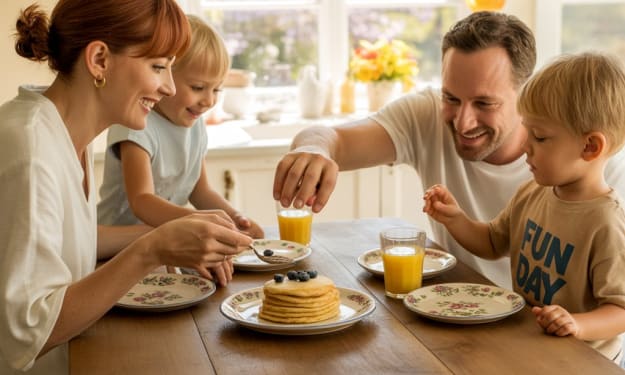
SIMPLE HABITS THAT MAKE FAMILIES STRONGER AND HAPPIER Family life, in its purest form, is about connection, love, and the shared moments that bind us together. While grand gestures or perfect vacations might seem like the key to family happiness, the truth is that it’s often the smallest, most everyday habits that make the biggest impact. From the way we communicate to the moments we share over breakfast, these little things nurture the strength and joy of a family over time.
By Zubair Ullah Khanabout a year ago in Families
The Eldest. AI-Generated.
In many Asian families, there is a quiet, unspoken truth: the eldest child does not get to be tired. They do not get to complain, break down, or fall apart. They are the torchbearers, expected to be strong, responsible, and endlessly self-sacrificing.
By Arun Cleetusabout a year ago in Families
Threads of Midnight. AI-Generated.
Grandma Lian always swore that black brought only sorrow. “Funeral color,” she’d mutter, pushing the ebony scarf to the back of the cupboard whenever Mei tried to wear it. Traditions, she’d say, kept the family safe, just as they had in her Hakka village, long before planes and phones stitched continents together.
By Arun Cleetusabout a year ago in Families