children
Children: Our most valuable natural resource.
The Quiet Strength of My Father. AI-Generated.
I never saw my father cry—not when his small business collapsed, not when the doctors handed down a prognosis like a heavy stone, and not even when we said goodbye to loved ones too soon. His strength wasn't loud. It wasn’t the kind you associate with grand gestures or dramatic speeches. It lived quietly in the corners of our home, in the steady rhythm of his footsteps each morning, in the way he always checked the locks twice at night—not out of fear, but out of responsibility.
By Taimoor Khanabout a year ago in Families
The Day I Lost My Best Friend — And My Innocence
I still remember the sound of her laughter. It was wild, unfiltered, and filled with the kind of joy only children carry in their hearts. Her name was Alina — my classmate, my secret-keeper, and the first real friend I ever had. We met in the second grade, two quiet girls who found each other in the corner of a loud, unfamiliar classroom. I had just moved schools. Everything felt new and strange. During lunch, Alina offered me half her sandwich without saying a word. That was her way — quiet, kind, and full of heart. That small gesture changed my life. --- From that day forward, we were inseparable. We walked to school together. Shared snacks. Giggled over boys we didn’t even like. Built entire kingdoms under the old neem tree behind the schoolyard. We had our own imaginary world, our own code words, and even our own pinky promise: “No lies. Ever.” We meant it. I meant it. Or at least, I thought I did. --- Things began to change in the fourth grade, slowly and quietly — the way most endings begin. A new girl joined our class. Zara. Zara was everything we weren’t. Loud. Stylish. Confident. She wore glittery shoes, had polished nails, and always had a new story to tell. Alina was fascinated by her. And, if I’m being honest, so was I. But fascination turned into something darker. I started noticing how Alina would laugh a little harder when Zara joked. How she began walking beside her more than me. How their notebooks matched. Their pencils too. Suddenly, I was the third one in a pair. The extra. The leftover. I felt it in my chest — a heaviness I couldn’t name then, but now know was jealousy. --- One afternoon, I did something I wish I could take back. I pulled Zara aside during recess and whispered, “Alina said your handwriting looks like a baby’s.” Zara frowned. “She did?” “Yeah. I didn’t want to tell you, but I thought you should know. You deserve to.” It was a lie. A stupid, pointless lie. I just wanted her to drift away from Alina. I wanted things to go back to how they were before Zara came along. When I was enough. I didn’t think the lie would travel. I didn’t think Zara would tell. But she did. --- The next morning, Alina didn’t sit next to me in class. Her eyes were red. She had been crying. At lunch, she handed me a folded piece of paper. It said only four words: “You broke the promise.” I still have that note. --- I tried to explain, but she didn’t speak to me. Not that day. Not the next week. Not the next year. In the hallways, I saw her laughing with Zara. They were close now — really close. And even though I was surrounded by other classmates, none of them were Alina. None of them knew I hated chocolate but loved Nutella. None of them understood the way I used to sing under my breath when I was nervous. None of them looked at me the way Alina used to — like I was enough, just as I was. I had lost her. --- At first, I told myself she overreacted. That it was just a lie, a small one. But deep down, I knew better. I hadn’t just betrayed her trust. I had betrayed her kindness. I had hurt someone who never once tried to hurt me. --- Years passed. We grew older. Changed schools. Got new friends. Life moved on — as it always does. But sometimes, even now, I find myself thinking of that little girl with the bright eyes and untied shoelaces. The girl who gave without asking, loved without limits, and trusted without doubt. I wonder if she still remembers me. I wonder if she ever forgave me. --- It took me a long time to understand what really happened that day. I didn’t lose Alina because Zara was better. I didn’t lose her because she moved on. I lost her because I let fear and insecurity win. I let a moment of weakness destroy years of love. I traded honesty for attention. And I paid for it with a friendship I still miss. --- Now, as an adult, I see children with their arms around each other, whispering secrets and making promises under trees — and I smile. But there’s a part of me that aches. A part that knows how fragile childhood can be. How quickly it can slip away — not because of growing up, but because of growing apart. If I could go back, I wouldn’t just undo the lie. I’d hold her hand tighter. Tell her she was enough. That no new girl could replace her. That I was scared, not of her leaving, but of being left behind. But childhood doesn't give second chances. Only lessons. --- And this was mine: Sometimes, the most painful goodbyes come from mistakes we make too young to understand — and remember for the rest of our lives. ---
By The Pen of Farooq about a year ago in Families
Grandfather’s Final Wish: A Journey Back to Where It All Began
I always thought my grandfather would live forever. He was one of those people whose presence filled every room, whose laughter made even the bitterest tea taste sweet. His hands were always stained with earth from the garden, and his words always carried stories from a world that seemed older than time. But age, as it does, crept in silently. His memory started to blur, and his steps grew uncertain. And yet, his spirit never faded. It was in his final days, lying on the hospital bed with a tired smile, that he called me close and said, > “There’s one thing I need you to do for me, beta. Please… take me home. One last time.” I didn’t know what he meant at first. We were already home, weren’t we? But then he whispered, "Not this home. I mean my home—our ancestral village, where your Dadi and I planted our first sapling, where your father was born… where I buried my mother with my own hands." His voice cracked, and a tear slid from the corner of his eye. “I want to rest beside her. That’s all I ask.” --- A Promise Made That night, I sat beside him holding his weathered hand, promising him I would take him back. “Even if I have to carry you myself, Dada. You’ll go home.” He smiled faintly. “Good boy,” he said. He passed away two nights later. His death left a hole in our family no words could fill. The house felt colder, quieter. But I remembered the promise, and I knew that this wasn’t the end of his journey. It was only a transition. The family, at first, was resistant. “It’s too far,” they said. “The village is deserted now.” “There’s no one left there.” But my father, usually a man of silence, placed a hand on my shoulder. “If your Dada trusted you with this… then do it.” --- The Journey Begins We hired a private vehicle, placed his ashes in a small handcrafted wooden urn, and began our journey—over 700 kilometers to a village that no longer appeared on digital maps. The roads were rough. Some paths had been consumed by forests, others by floods. Yet, with every passing tree, I felt closer to him. The stories he had once told me came alive. “That tree,” I whispered, recognizing the crooked mango trunk he once said he carved his and Dadi’s initials into. “That well,” he told me, “is where I nearly fell in chasing a kite.” We reached just before sunset. The village was no more than scattered bricks and moss-covered walls. But the banyan tree in the center still stood tall—as if time had bowed in reverence. --- A Place to Rest I found the spot near the old tree, just as he had described it. “Under the banyan,” he once said. “That’s where Amma lies.” There was no headstone, just a pile of stones barely holding form. But I knew. I sat there in silence, holding the urn to my chest. I could almost hear his voice in the breeze. “I’m home now,” I whispered. We laid him to rest beside his mother, fulfilling a promise and completing a circle. I planted a sapling between the two mounds. It was his favorite—a guava tree. > “So that even in death, I’ll give fruit,” he had once joked. --- Closure, Not Goodbye As we prepared to leave, I took one last walk around the ruins of the village. I found a rusted swing in the backyard of what used to be his house. The seat was broken, the chains half-buried in mud, but I could still imagine him pushing my father on it as a child. I took photos—not to share on social media, but to preserve memories. As we drove away, I looked back one last time. The sun had begun to dip, casting golden light over the grave, the tree, the swing, the house. He was home. Finally. --- Epilogue: His Legacy Lives On When I returned, I started compiling all his stories into a journal. My siblings and cousins helped. Every chapter began with “My Dada once said…” I realized then: some people don’t truly die. They simply live on… in stories, in trees, in promises kept.
By Muhammad Usamaabout a year ago in Families
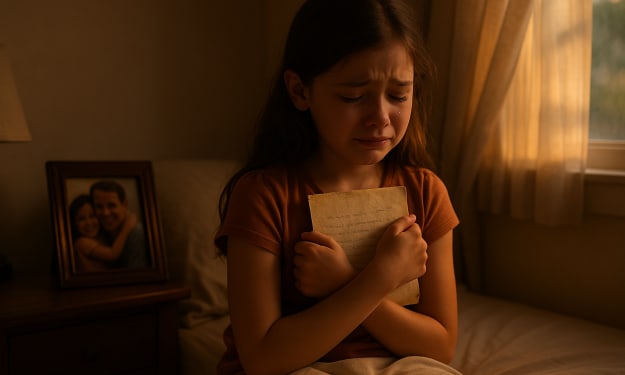
The Last Letter and a Tiny Promise
The Last Letter and a Tiny Promise In a modest home nestled amidst the bustling lanes of a small town, lived Ahmed—a man whose entire universe revolved around the sparkling eyes and infectious laughter of his little daughter, Aima. She was not just his child, but the very essence of his being, the reason behind every breath he took. Aima, with her boundless curiosity and uncontainable energy, was pure joy incarnate—a tiny burst of sunshine who saw her father as nothing short of a superhero. Their lives were painted with the hues of simple yet priceless routines. Every morning, Ahmed would gently wake her up, her sleepy smile enough to dissolve his exhaustion. He had mastered the art of braiding her hair with fatherly care, listening intently as she shared her dreams and school adventures. Come evening, the roles reversed as he became dragons, knights, and fairies in her imaginative bedtime stories. Ahmed worked tirelessly—double shifts, long journeys, calloused hands—yet his heart remained light, buoyed by Aima’s dreams. To him, she was his “princess,” a word he’d softly breathe into her hair during their quietest moments. And Aima adored him with the unfiltered love only a child can offer—clinging to him, trusting him, needing only his smile to feel safe. But life is often cruel in its silence. One day, a shadow began to creep into their bright world. Ahmed, once vibrant and strong, began feeling an unrelenting fatigue, an ache he brushed off as overwork. When he finally saw a doctor, the verdict was swift and merciless: advanced cancer. Aggressive. Irreversible. The news shattered him—not for himself, but for Aima. How could he tell her that her invincible hero was crumbling? He chose silence, determined to protect her innocence. Time slowed. Every shared moment became sacred. He watched her play, his heart aching with the knowledge that these seconds were numbered. His laughter became a mask, his strength a crumbling wall. Aima noticed. Papa didn’t play the same. His hugs weren’t as strong. Sometimes he just stared, lost in thought, smiling softly at nothing. She responded in the only way she knew—more drawings, more cookies, more kisses. Small hands trying to light a fading flame. The illness advanced with merciless pace. His body weakened, and smiles grew harder to fake. In those final, painful days, all he could think of was Aima. He wanted to leave behind something more than memories—something she could hold, read, and remember. With trembling hands and a breaking heart, he wrote her a letter. A birthday gift for her tenth year—a piece of his soul wrapped in paper and ink. He poured into it every dream, every ounce of love, and a simple, eternal promise: that he would always be watching. Then the day came. Quietly, in his sleep, Ahmed slipped away. A peaceful departure that left a storm behind. Aima, too young to fully grasp the permanence of death, watched silently as unfamiliar sorrow swept through her home. She saw people cry. She noticed the silence. And she asked, with a whisper that shattered hearts: “Papa will come back, won’t he?” The house that once echoed with laughter now stood heavy with stillness. Years passed. Aima grew. Her laughter returned—but so did a silent void that never truly left. Then came her tenth birthday. Among balloons and quiet celebration, her mother handed her an old, sealed envelope. “Your papa wanted you to have this today,” she whispered, her voice trembling. Aima opened it slowly, her fingers trembling. The familiar handwriting hit her like a warm breeze from the past. As she read, a flood of memories rushed over her—his voice, his warmth, his love. The letter spoke of his pride in her, his hopes for her, his unshakable belief in her dreams. He urged her to be brave, kind, and to never give up—just like he never gave up on her. He promised his love would always be with her, a guiding star from afar. Tears streamed down her cheeks. Every word felt like a hug, every line a whisper of comfort. In that moment, she truly understood the depth of his sacrifice and the eternal reach of his love. From that day on, Aima lived with new strength. She excelled in school, pursued her dreams, and faced life’s challenges with the quiet determination that mirrored her father’s spirit. The letter remained with her always—a sacred promise folded close to her heart. And with every step forward, she felt him—like a gentle wind, a quiet whisper in her soul—reminding her that love like his never fades. It becomes a promise. A legacy. A guiding light. Forever.
By Noman Afridiabout a year ago in Families
Kids Backyard Party Fun: The Ultimate Guide to Making Memories in 2025. AI-Generated.
There’s something magical about a kids backyard party. The fresh air, the laughter echoing down the block, and the joy on children's faces as they jump, slide, race, and snack—it’s a recipe for unforgettable memories. As parents and event planners continue to look for unique and safe ways to entertain kids, backyard parties have taken the spotlight in 2025.
By amazingjumpswekickthepartyoffabout a year ago in Families
DAD, I STILL NEED YOU
The gate squeaked the same way it always had. He paused before pushing it open, staring at the rusted bars like they might hold him back. The yard was overgrown, the grass taller than he remembered, and the old neem tree had lost half its leaves. It had been twelve years since he walked through this place as a son. Now, he walked in as a stranger — and an orphan.
By IHTISHAM UL HAQabout a year ago in Families
The love that broke me also built me
The Love That Broke Me Also Built Me By= Baily khan It began like all beautiful things do—quietly. A brush of hands, a stolen glance, the kind of laughter that makes you forget your pain for just long enough to wonder if maybe, just maybe, you’ve found the right person. Her name was Elise. She walked into my life during the grayest winter I can remember. The sky seemed to mourn with me that year—my father had just passed, and the silence he left in our home was deafening. Then came Elise, with coffee-colored eyes and a voice like hope, and everything changed. At first, she didn’t try to fix me. She just sat in the quiet with me. We'd lie on the carpet and watch the ceiling fan spin, talking about our dreams like they were just around the corner. She made life feel light. Her love wrapped around me like a warm coat, and I wore it proudly. But love, I would learn, isn’t always kind. What started as comfort slowly turned to codependence. She became the center of my gravity, the one thing I couldn’t imagine losing. And in that kind of desperation, I lost pieces of myself. I gave too much, hoping to keep the warmth. She took what I gave without realizing how empty it was making me. Our arguments became routine, like bad weather patterns we could predict but not stop. I wanted more from her—more words, more time, more understanding. She wanted freedom, space, breath. And somehow, both our needs felt like betrayals to the other. The love that had once held me began to crack. She left in the spring. I remember because the cherry blossoms were blooming along the riverbank where we used to walk. She didn’t yell. There were no tears, not from her. Just a quiet, final “I can’t do this anymore.” And she was gone. I shattered. The days after felt like surviving an earthquake while standing still. Every place reminded me of her. The bookstore on 5th Street, the café with the crooked tables, the park bench where we once danced in the rain. My world became a gallery of ghosts. I was angry—at her, at myself, at the love that betrayed me. I told myself I would never fall again, that I was done with vulnerability. But pain, I’ve learned, has a funny way of teaching you what joy never can. Alone, I had to rebuild. I took long walks with no destination. I journaled until the pages bled truth. I reconnected with friends I’d neglected. I started going to therapy—not for her, but for me. I learned to sit with my own silence again. It was different this time—not empty, but full of possibility. And in that silence, I found the truth: Elise didn’t break me. My expectations did. My fear of being alone did. My belief that love had to consume me to be real—that broke me. But from the ruins, something stronger began to rise. I started to understand myself better. What I wanted, what I needed, what I would never compromise on again. I stopped chasing love and started building a life that could hold it, should it return. Months passed. Then a year. And one autumn afternoon, as golden leaves fell like slow confetti, I smiled at a stranger in a bookstore. We talked about poetry. Nothing more. But I didn’t feel fear. I didn’t feel desperation. I felt open. It was in that moment I realized: the love that broke me also built me. It taught me boundaries. It taught me self-respect. It carved out the hollow places that I needed to fill with my own strength. I no longer look at love as a rescue, but as a companion. Someone who walks beside you, not someone you lean on so heavily that they buckle. I’m still healing, always will be. But I’m proud of my scars. They remind me that I survived. That I grew. That I learned to choose myself. Elise is part of my story, a chapter etched deep. But the story didn’t end with her. It began. So now, when people ask me about love, I don’t say it’s only beautiful. I say it’s transformative. I say it’s a mirror. I say it’s fire—capable of warmth or ruin, depending on how you hold it. And I say this: The love that broke me also built me. And I wouldn’t trade that for anything.
By Bilal Ahmadabout a year ago in Families