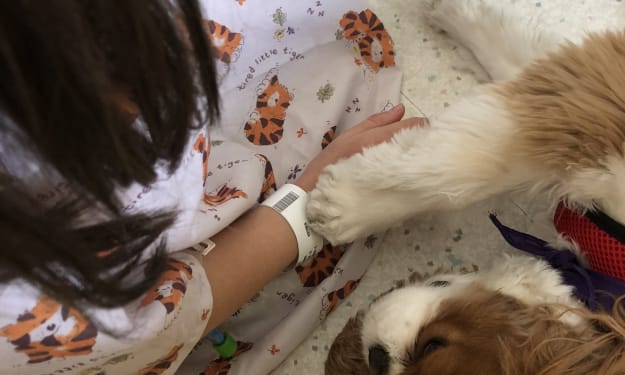
children
Children: Our most valuable natural resource.
The Unexpected Road Trip
The old minivan, affectionately nicknamed "The Wanderer" by the Peterson family, was packed to the brim. Suitcases, snacks, games, and a healthy dose of anticipation filled every nook and cranny. The Petersons were embarking on an unexpected road trip, a spontaneous adventure that had been sparked by a simple suggestion from their youngest, eight-year-old Leo.
By Lovely Jingle2 years ago in Families
Whispers of the Forgotten: A Journey Through Time and Memory
Beneath the dust of centuries and the shadows of forgotten stories, the past never truly fades. It lingers—a quiet hum in the walls of abandoned homes, a faint scent clinging to yellowed letters, or a name etched into a tombstone weathered by rain. This is a tale of how the whispers of those forgotten can reshape our understanding of time, memory, and what it means to be human. The Attic’s Secret It began with a key. Not a metaphorical key, but a rusted iron skeleton key tucked inside a cigar box labeled “Do Not Open – 1932.” My grandmother’s attic was a labyrinth of trunks, moth-eaten coats, and stacks of National Geographic magazines dating back to the Kennedy administration. I’d climbed up there to escape the July heat, but curiosity led me deeper into the clutter. The box was hidden beneath a quilt stitched with fraying daisies. Inside, the key rested atop a bundle of letters tied with twine. The paper was brittle, the ink faded to sepia. The first line of the top letter read: “Dearest Clara, If you’re reading this, I’ve already joined the stars…” A shiver prickled my neck. Clara was my great-grandmother, a woman I knew only from a single photograph where she scowled in a high-collared dress. But the key? It didn’t match any lock in the house. Then I noticed the floorboard. Near the attic’s lone window, warped oak planks creaked underfoot—except one. It lifted with a groan, revealing a compartment no larger than a shoebox. Inside lay a leather-bound journal, its pages filled with hurried script, sketches of constellations, and a dried sprig of lavender. The first entry was dated April 12, 1918: “The influenza took Mama today. Papa says we mustn’t speak her name, lest grief poison us too. But I hear her. In the wind through the willow trees. In the clock’s ticking when the house sleeps. She whispers, ‘Remember.’” The author was Eleanor Hartwell—a name I’d never heard. Yet her words felt like a hand reaching across time, gripping mine. The Girl Who Spoke to Ghosts Eleanor’s journal unraveled a life steeped in quiet rebellion. At 16, she’d been deemed “too peculiar” by her small Pennsylvania town. She collected feathers, talked to gravestones, and insisted the dead visited her dreams. After her mother’s death, her father burned all traces of her—clothes, letters, even her perfume. But Eleanor defied him. She hid her mother’s wedding ring in a hollowed-out book. She memorized recipes her mother had sung while cooking: “A pinch of sage for wisdom, rosemary for remembrance.” Most hauntingly, she wrote of a ritual—placing handwritten notes beneath her pillow, asking the dead to share their stories. “They answer in riddles,” she wrote. “Last night, a soldier showed me a pocket watch stopped at 3:15. A woman in a blue dress hummed a lullaby in French. They want to be known. But how?” Eleanor’s entries grew frantic as the pandemic worsened. She described carts piled with bodies, churches converted into morgues, and neighbors who vanished overnight. Yet amid the despair, she documented lives the world rushed to forget: the baker who gave bread to orphans, the teacher who read poetry to the dying, the orphaned girl who sang at funerals to earn pennies. “We bury them, but their stories linger like smoke,” Eleanor wrote. “What if memory is a kind of resurrection?” The journal ended abruptly on November 1, 1918. The final page held a sketch of a willow tree, under which she’d scribbled: “Find me here.” Beneath the Willow The old Hartwell property had been a parking lot since the 1970s, but the willow tree still stood in a scrapyard on the outskirts of town. Its branches sagged, leaves choked with dust, roots clawing through cracked concrete. I almost turned back—until I spotted the carving. Near the base of the trunk, hidden by ivy, initials were gouged into the bark: E.H. & C.H. 1917. Eleanor and Clara. My great-grandmother. I pressed my palm to the carving. A breeze stirred, carrying the scent of lavender. For a heartbeat, the world blurred—the hum of traffic faded, replaced by the crunch of gravel under boots. A girl in a white lace dress knelt beside me, tucking a note into the tree’s crevice. “Tell them I remember,” she whispered. Then the vision snapped like a thread. In the crevice lay a tin box, green with age. Inside were photographs: Eleanor, sharp-eyed and grinning, arm-in-arm with Clara. A theater program for A Midsummer Night’s Dream. A faded ribbon. And a letter addressed to “Whoever Finds This.” “I’ve left pieces of us here,” Eleanor wrote. “Not for pity, but proof—we existed. We laughed. We loved. We grieved. When you forget your own name, dig up the earth. The past will remind you.” The Stories We Carry History books chronicle wars, inventions, and presidents. But humanity’s true mosaic is made of smaller, fragile shards: a recipe scribbled in a margin, a lullaby hummed to a feverish child, a secret buried beneath a willow. Eleanor Hartwell was never famous. She died days after her last journal entry, one of millions lost to the 1918 pandemic. But her words survived. They remind us that to be forgotten is a second death—and remembrance is an act of defiance. In the years since finding that journal, I’ve started collecting stories. The Vietnamese refugee who sewed her dreams into quilts. The Navajo code talker’s grandson teaching his language to toddlers. The diner waitress who writes novels on napkins. They are whispers in the wind, insisting: I was here. I mattered. A Call to Listen We live in an age of noise, addicted to the next trend, the next crisis. But pause. Listen. In your grandmother’s recipe box, the postcards from places you’ve never visited, the scarred oak desk in the basement—there are echoes. Pick up the thread. Follow it. Every artifact of the past is a message in a bottle, waiting for someone brave enough to say: “I hear you.” The forgotten are not gone. They’re hiding in plain sight, waiting to breathe again through our voices, our curiosity, our willingness to remember. So ask the questions. Open the box. Unearth the letters. And let the whispers guide you home.
By Rehan Mozzam2 years ago in Families
The Girl Who Raised Her Voice. Content Warning. AI-Generated.
The Power of One Voice There was once a small village, nestled in between green rolling hills and silver rivers, and within this village lived a girl named Maya. She was just like any ordinary child in a lot of respects—curious about the world, full of hopes and aspirations, and passionate about learning. But Maya was different from an ordinary child: she believed that her voice held power.
By kalu ram meena2 years ago in Families
The Modern Love Story
In second’s presto- paced global, connections are evolving, and the bond between a hubby and female is not any exception. Love, agree with, and information stay the foundation, but ultramodern love has taken on new confines. A success marriage is not pretty much coexisting; it’s about thriving collectively, kindling passion, and growing as a platoon. A romantic and fulfilling dating calls for problem, however when nurtured, it becomes the most stunning journey of all.
By Sameer Chandavarkar2 years ago in Families
5 Proven Potty Training Methods for Every Child
The process of potty training often extends over a prolonged period. Each child possesses unique characteristics which make different approaches suitable for them. Children learn potty training at different speeds because some adapt quickly but others require additional time. Parents need to discover training methods that match their child's personality and developmental stage. These five tested potty training approaches have successfully guided numerous parents as their children reached this developmental milestone.
By Lizzie Howard2 years ago in Families
The Whispering Willow Tree
The willow tree stood sentinel at the edge of the Thompson family's sprawling backyard, its long, graceful branches cascading down like a curtain of emerald green. It was an old tree, its trunk gnarled and weathered, its roots reaching deep into the earth, a silent witness to generations of Thompsons. For Emily and her younger brother, Sam, the willow tree was more than just a tree; it was their sanctuary, their confidante, their secret haven.
By Lovely Jingle2 years ago in Families
Turning Tides
Chapter 1: The Life of Struggle In the bustling city of New Haven, the sun rose slowly, casting a golden hue over the weathered streets. Among the streets cluttered with honking cars and pedestrians rushing to work, there was Raju, a simple auto-driver with weathered hands and a heart full of dreams. Every morning, he would polish his three-wheeler affectionately called “Babu,” a name that evoked a sense of nostalgia and comfort. Raju was a hardworking man, dedicating his life to providing for his beloved family—his wife, Nisha, and their two children, Aarav and Meera.
By MOHAMMED NAZIM HOSSAIN2 years ago in Families
Unlucky
Kamau has been the sole provider for his family for as long as he can remember. His mother died two years after he was born, and no one really talks about her. His father had met her while traveling to the large market a hundred kilometers from home. She was selling arrowroots, and she was the most beautiful girl he had ever seen—her skin was lighter than anyone he had ever encountered.
By ESTHER MAINA2 years ago in Families
A Mother's Light in Darkness
The streets were alive with the sounds of the evening rush—cars honking vendors calling out their last sales of the day and children laughing as they played in narrow alleys Among the crowd a small family walked together a mother with clouded eyes and two little hands guiding her through the chaos of the world she could not see Ayesha had lost her vision in a tragic accident years ago Life had been merciless taking away her sight when she needed it the most But she had never let darkness steal her spirit She had two bright stars in her life—her children Zayan and Alina who were just seven and nine They lived in a modest one-room house at the end of a quiet street Every morning before the world woke up Ayesha would rise to prepare breakfast by memory feeling each ingredient carefully She would then pack a small lunch for her children ensuring they had enough to eat at school Zayan and Alina never complained about their simple meals They knew their mother worked harder than anyone else just to see them smile Ayesha made handicrafts weaving intricate patterns into fabrics her fingers replacing the eyes she had lost A kind shopkeeper Mr Sharma bought her work and sold it at his store making sure she received a fair price Though she never saw his face she felt his kindness in his voice One evening as the sky turned golden Zayan and Alina came running home with excitement in their voices Ammi our school is organizing a competition If we win we get a scholarship Ayesha smiled and ran her fingers through their hair Then you must try your best my loves I believe in you Days turned into weeks and the children worked hard Alina wrote a heartfelt poem about a mother’s love while Zayan painted a picture inspired by their life They poured their emotions into their work knowing that this was more than just a competition—it was a chance to create a better future for their mother who had sacrificed so much for them On the day of the competition they stood on stage with nervous hearts but hopeful spirits Alina took a deep breath before reciting her poem her voice trembling at first but growing stronger with each word The audience listened in silence moved by the depth of her words Zayan’s painting was unveiled next It was a breathtaking image of a mother and her children walking hand in hand into the light The judges exchanged glances whispering among themselves before making their final decision When the results were announced their names echoed through the hall—first place Cheers filled the air but for Zayan and Alina the real joy was rushing home to tell their mother They found Ayesha sitting by the window her hands gently weaving a shawl The moment she heard their footsteps she turned her face towards them sensing their excitement before they even spoke We won Ammi A full scholarship for both of us Tears welled up in her unseeing eyes She pulled them close feeling their warmth You have always been my light she whispered her voice breaking with emotion From that day life changed Education opened doors for Zayan and Alina and as they grew they worked hard to give their mother the life she had once dreamed of for them Years later when Zayan became a successful artist and Alina a celebrated writer they stood beside their mother on a grand stage dedicating their achievements to the woman who had raised them in darkness yet filled their lives with light Ayesha could not see their success but she felt it in the pride in their voices in the strength of their hugs and in the love that had never needed sight to flourish On that stage Alina held her mother’s hand and spoke into the microphone My mother taught us that vision is not just about what we see but about the dreams we dare to chase She may have lost her sight but she gave us the clearest vision of life—one filled with love resilience and hope The audience rose to their feet clapping with admiration Ayesha smiled as she felt the energy around her She could not see the standing ovation but she could feel it in her heart Because some bonds are stronger than vision some love brighter than the sun itself
By Mohammad Abdul munawar2 years ago in Families