children
Children: Our most valuable natural resource.
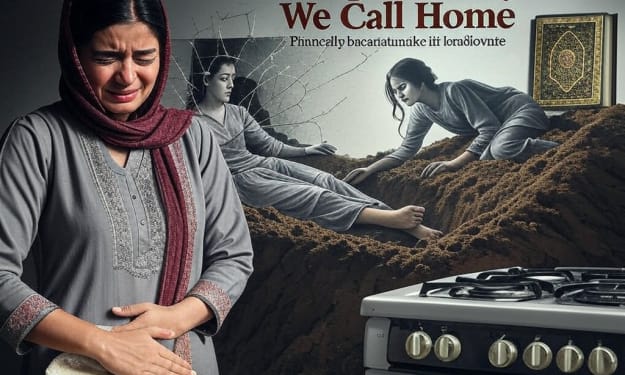
Joint Family or Legal Graveyard?
The question isn’t how that woman survived. The real question is—why didn’t she die? But then, an even more haunting question arises: why are we still alive? Because each of us has either witnessed a woman like her, lived her story, or silently watched someone else endure it. And we continue breathing, not out of strength—but because we’ve grown numb enough to keep living. This isn’t a story written on a woman’s body; it’s carved from within her soul. It speaks for the woman who, despite bowing to her husband’s every command, slaving for her in-laws, swallowing her sisters-in-law’s poison, bearing the hungry stares of her brothers-in-law, and being crucified by society—still somehow manages to “save the family.” But save it for whom? For everyone but herself. She dies a little every day, is buried a little every day, only to rise each morning—rolling out parathas for her mother-in-law—as if nothing ever broke her. Who is this woman? She is our mother, our wife, our sister. She’s the one whose hands are adorned with henna but whose lips are sealed. Her eyes hold truth, but her world—only lies. We’re told that marriage gives a woman a new home. What they don’t tell us is that waiting in that home are: suggestive looks from her brother-in-law, taunts from her sister-in-law, and burning glares from her mother-in-law. It’s not a home—it’s a trial. If she endures it, she’s righteous. If she speaks up, she’s disrespectful. If she dies, she’s pitied. But if she survives—she's condemned. This is our joint family system—not a family, not a system, but a collective madness where the individual matters as much as a corpse in a grave: unable to speak, capable of hearing, and ultimately silenced without a sound. A woman suffering from blood cancer attributed her illness to the toxic environment of her in-laws. And believe it—it’s not a fabricated story. It’s horrifyingly real. Wounds inflicted on the soul fester like infections in the bloodstream. What the modern world calls mental health, our society condemns as ingratitude, rudeness, and rebellion. Especially when the woman is left alone in the house, and her brother-in-law’s eyes are itching to tear her dignity apart. The phrase “no one believed her” might just be society’s greatest cruelty. Because society desires her body—but refuses to acknowledge her spirit. Her voice is strangled, and then she’s asked—why she doesn’t speak. Her will is disregarded, and then she's expected to obey. This is the same woman who handed over 22 years of her life’s reins to others. Her son’s wedding is now being planned by her sister-in-law, while she just watches. She’s the woman who rolled 50 rotis a day, managed the entire household in her husband’s absence, spent her youth burning her bones over the stove. And in return? Just one title—ungrateful. And had she died? Her father-in-law would have said, “She was a good daughter-in-law.” Her sister-in-law would mourn, “We loved her dearly.” Her brother-in-law would arrange a Qur’an recitation in the mosque. Then everyone would eat, drink, and return to their homes. Because this system is not a joint family—it is a collective hypocrisy. Here, a man’s anger is his right, a woman’s tears are drama, his absence is a compulsion, her need for protection—shamelessness. To that sister who has lost the war while still breathing—I offer my heartfelt salute. The pain of her cancer might not be eased by medicine, but her silence must not go unheard. Because if we again dismiss this pain as fate, then tomorrow, our own daughters will be praying in such homes to simply—die. A joint family system, if built on justice and respect, can be a blessing—but that exists only in dreams. In reality, it is a poison that slowly seeps into a woman’s blood. And by the time it's diagnosed, the woman has either already died—or chosen to stop living. Society must ask itself: If a daughter-in-law can be like a daughter— Why can’t the sister-in-law be like a sister? Why can’t the father-in-law act like a father? Why can’t the brother-in-law be like a brother? And if they cannot—why is it solely a woman’s responsibility to save the home? If she is expected to protect the home, then she has every right to stand against those turning it into a living hell. This story might end—but that woman hasn’t. She still stands in front of the stove, cancer burning within her, preparing a meal for the very sister-in-law who plans to marry off her daughter to her son—without even asking her. And society? Still says: “It’s fate…” No, it’s not fate. It’s injustice. And giving injustice a name, exposing it, and speaking against it—is the first cure. Because if we still stay silent today, Tomorrow, our own sisters and daughters may be rolling 50 rotis a day… …whispering the same prayer: “O Allah, please let me die…” And that—would be a curse, Not on her life, But on this entire system. So ask yourself— Is a joint family really a family? Or just a legal graveyard? Decide. Today. Now.
By Muhammad Ilyasabout a year ago in Families
The Silent Killer of Love and Respect
The Silent Killer of Love and Respect. Marriage is meant to be a partnership built on mutual trust, respect, and emotional safety. But what happens when one partner brings in not just emotional immaturity, but a toxic, narcissistic personality?
By Sayed Zewayedabout a year ago in Families
Tears will flow 😭
She was lying in the hospital, battling cancer and was going towards death moment by moment, but I was still carefree as if I had been unaware and carefree about her every happiness and sorrow all my life, I was thinking, what should happen to her
By Nikita Angelabout a year ago in Families
i'm 13 , took a pregnancy test, and it come out positive (my parents don't know yet). what do i do?
I sat on the closed toilet seat, my knees pulled up to my chest, staring at the thin white stick lying on the edge of the sink. Two pink lines. It was positive.
By Tahir khanabout a year ago in Families
The Last Train at Autumn’s End: A Tale of Time, Loss, and Longing
The cold autumn wind swept through the empty countryside, sending dry leaves tumbling across the cracked stone platform of a long-forgotten train station. The wooden bench where Edward sat creaked under his frail weight, its weathered slats worn smooth by years of waiting. He gazed up at the clock tower perched atop the station’s roof — its face cracked, hands frozen in different times — a silent testament to the years that had passed here without mercy.
By Muhammad Sabeelabout a year ago in Families
Missing You, Father
Missing You, Father Holding On to the Heart That’s Gone It has been nearly a year since you left us, Father. Yet, the emptiness you left behind feels as fresh as the day I heard the news. Sometimes, I catch myself reaching for the phone to call you, only to remember that your voice is now just a memory—one I cling to like a fragile thread, afraid it might slip away forever.
By muhammad khalilabout a year ago in Families