children
Children: Our most valuable natural resource.
Helping Both You and Your Baby Get Rest By Benjamin Todd Eller
MEDITATION: Some believe that meditation is a touch feely bunch of nonsense, but there is real evidence that it works. According to Harvard Medical School, meditation can be quite helpful. Forty-nine adults who had trouble sleeping participated in their study. Half completed a meditation program. The other half completed a sleep education class that taught them ways to improve their sleep habits. The meditation group had less insomnia, fatigue, and depression at the end of the six sessions. There are many meditation tapes and exercises on the web including one at UCLA http://marc.ucla.edu/body.cfm?id=22.
By Benjamin Todd Ellerabout a year ago in Families
The Window That Cried
In a quiet town wrapped in mist, stood an old wooden house on the corner of Hollow Street. It wasn’t the biggest house, nor the brightest, but something about it made people slow down as they walked by. Maybe it was the strange ivy that grew only on one side. Or perhaps it was the small window on the second floor the one everyone called The Window That Cried.
By Muhammad Hayatabout a year ago in Families
Protecting Your Kids in the Digital Age: Top iOS Spy Apps for Parents. AI-Generated.
In an era where smartphones are as common as backpacks for kids, keeping them safe online has become a top priority for parents. The average child spends hours daily on their iPhone, navigating social media, texting friends, and exploring the vast digital world. While this connectivity offers incredible opportunities, it also exposes them to risks like cyberbullying, inappropriate content, and even online predators. Fortunately, the best iOS spy apps for parental control and monitoring can help. These tools empower parents to safeguard their children without feeling like they’re hovering over their every move. In this guide, we’ll explore the top options to help you find the perfect fit for your family.
By StartDigitalabout a year ago in Families
The girl who wanted to collect stars
In a quiet village surrounded by silent hills and a sky that always seemed too big, lived a little boy named Ibrahim. He was nine—quiet, thoughtful, and often lost in dreams. The villagers found him strange. He talked to the moon, made toys from leaves, and once tried to “trap the wind” in a glass bottle. But Ibrahim never minded, because he had Zoya, his six-year-old sister, the only person who truly believed in him. Zoya was sunshine in human form. She had wild curls, eyes that glittered like morning dew, and a voice that made even the grumpiest rooster in the village stop to listen. But more than anything, Zoya believed in magic. She believed trees could talk, shadows were shy creatures, and—most importantly—that stars were tiny wishes scattered across the sky. “Bhai,” she whispered one night as they lay on their rooftop, staring at the stars, “I want to collect them. One by one.” Ibrahim chuckled. “You’ll need wings, you know. And a jar big enough to carry the sky.” So the next day, he built her wings from cardboard and silver foil. Then he took an old jam jar and filled it with fireflies. “Until you reach the stars, this will hold your light,” he said proudly. Zoya wore her wings all day. She ran through the fields, climbed trees, chased butterflies, and told every bird she met, “I’m coming to the stars soon. Save me a spot!” But dreams have a way of floating just out of reach. One bitter winter, the wind changed. Zoya caught a fever—nothing unusual at first. But this fever didn’t go away. She grew weaker each day. Her laugh faded, her steps slowed. The village clinic did its best, but the doctor finally said the words no brother should hear: “She has a condition we can’t treat here.The family had no money for a hospital in the city.The wings lay untouched by the window. The fireflies in the jar dimmed. Doctors came, whispered things. Medicines arrived, prayers were whispered. But Ibrahim could see it in her eyes—she was slipping away. One night, when the moon was low and the stars unusually bright, Zoya turned to her brother with a tired smile. “Bhai... promise me you’ll still look at the stars.” “No,” he said, holding back tears. “You’re not going. You haven’t even collected one yet.” “I will,” she whispered. “Just… not from here.” She closed her eyes. The jar by her side glowed for the last time. --- After her funeral, the world seemed dim. Ibrahim stopped speaking. He stopped smiling. He sat on the roof every night, clutching the jar and her broken wings. The villagers tried to console him, but he only said: “She went to collect stars. I’m just waiting for her to come back.” Weeks passed. Then months. Some say they saw a strange light in the sky once—like a falling star that stopped mid-air, paused above Ibrahim’s roof, and then vanished. One old woman swore she heard laughter—faint, like the sound of a dream—from the neem tree near the house. Years passed. Ibrahim never left the rooftop. Then one morning, as dawn broke softly over the hills, the villagers found him lying on the roof, eyes closed, a peaceful smile on his face. In his hand was the same golden jar. It was warm. And inside, resting gently, was a single silver feather—too small to be from any bird, too perfect to be from this world. The villagers buried him next to Zoya, under the big neem tree. And some nights, if the wind is just right, and the sky is clear enough, people say you can see two stars dancing, circling each other just above the village. One shines silver. The other, gold. And the sky has never felt closer.
By Meer kalsoomabout a year ago in Families
Make Your Next Party Unforgettable with Fun-Filled Inflatable Rentals and Party Essentials!. AI-Generated.
Planning a memorable event—whether it’s a birthday party, school carnival, company picnic, or community celebration—means keeping guests entertained and happy. And nothing says “fun” quite like inflatable rentals and party equipment! From a Spiderman bounce house to a Lime Green Obstacle Course, there's a perfect party setup waiting to make your event a hit.
By amazingjumpswekickthepartyoffabout a year ago in Families
8 Neurotypical Social Norms That Baffle Your Autistic Loved One
If you have an autistic person in your life, you may be confused about some of their traits. Whether it’s something they said, a tone of voice they used, or a non-verbal cue they seemed to ignore, it can be frustrating to try to communicate with someone who appears to be behaving like a jerk, and that’s understandable!
By The Articulate Autisticabout a year ago in Families
THREE CHILDREN IN THE SCHOOL . AI-Generated.
Meet the Children: A Trio of budding Storytellers Our story revolves around three bright and imaginative children: Leo, Maya, and Sam. Each child brings a unique personality and set of strengths to the classroom, and through their experiences with dynamic storytelling, they discover new facets of their potential.
By Sixmund Salmon Kombaabout a year ago in Families
7 Road Trip Tips for Families
If you want to explore the world's wonders with your family without breaking the bank, a road trip is undoubtedly the most cost-effective and enjoyable way to do so. Whether traveling to celebrate the holidays in another state or embarking on a road trip full of famous stops, this adventure is a great opportunity to create priceless memories with your family.
By Rocio Espinosaabout a year ago in Families
From a Father’s Hands to a Son’s Chains
In the dusty streets of a small village in Punjab, a man named Kareem labored from sunrise to sunset. His hands, thick with calluses, spoke of decades of bricklaying, harvesting, and doing whatever work came his way. He was not a wealthy man, but what he lacked in money, he made up for in dignity and love for his only son, Adeel. Kareem had one dream — that his son would never have to know the pain of poverty. Every coin he earned, every torn note he saved, was for Adeel’s future. He envisioned a life for Adeel where the boy would wear clean clothes, speak fluent English, and sit in air-conditioned offices, far from the heat and hardship that had defined Kareem’s own life. “A man’s hands should build his son’s future,” Kareem would often say, his cracked palms resting heavily on Adeel’s shoulder. Adeel was a bright child. Curious, intelligent, and full of potential. He excelled in school and spoke of becoming an engineer. Kareem beamed with pride whenever the neighbors asked about his boy. “My Adeel will one day fly far,” he would say, eyes gleaming. But time is not always kind to the dreams of the poor. When Adeel entered his teenage years, things began to change. Influences from the city seeped into the village. New friendships brought shiny phones, fast bikes, and the illusion of easy money. Kareem noticed the shift — the late nights, the silence, the sudden expenses. But he trusted his son, perhaps too much. “I work so you don’t have to suffer,” he reminded Adeel, handing over his savings when the boy said he needed tuition money. Unbeknownst to Kareem, Adeel had begun to drift into darker paths. It started with small errands for a local gangster — delivering packages, running messages. The money was fast, the praise intoxicating. And soon, Adeel was no longer running errands. He was making deals. Kareem remained blind, until one fateful evening. It was just after sunset when the police came. They barged into the humble house, guns raised, shouting orders. Kareem stood frozen as they handcuffed Adeel, who barely resisted. Cocaine, illegal weapons, gang affiliation — the words fell like stones from the officer’s mouth. As the jeep drove away with Adeel in the back, Kareem fell to his knees, his hands trembling. The same hands that had lifted Adeel as a baby, that had built homes for others, now covered his face in shame. Days passed. Then weeks. The village whispered. Kareem stopped going to the market. He sat on the old charpai in his courtyard, staring at his hands. He wondered what had gone wrong. “I built with these hands,” he whispered. “Why did they lead my son to chains?” Adeel was sentenced to seven years in prison. Kareem visited him only once. In that cold, steel-furnished room, father and son sat silently, separated by a scratched glass pane. “I failed you, Abba,” Adeel said finally, tears streaming down his face. “No,” Kareem said softly, placing his hand on the glass. “You failed yourself. But you are still my son.” After that day, Kareem began writing letters to Adeel. Every week. Pages filled with stories from the village, advice, and sometimes just silence in written form. He told Adeel about the trees blooming again, about a neighbor’s wedding, about how he still cooked Adeel’s favorite lentils on Fridays. And Adeel, behind bars, began to change. He read books, earned a diploma in electrical repair, and wrote back with remorse and hope. Seven years later, when Adeel walked out of prison, a little thinner, a little older, Kareem was there, holding a new kurta and warm food. “You came to collect your son’s chains?” Adeel asked, half-smiling. “No,” Kareem said, eyes moist. “I came to give him my hands again — to help him rebuild.” From that day forward, father and son started a small electrical repair shop. It wasn’t much, but it was honest work. Adeel labored alongside his father, learning not just trade but patience, responsibility, and redemption. Kareem passed away a few years later, peacefully in his sleep. His hands, once rough and worn, were finally at rest. And Adeel, now a father himself, held his own son in those same hands, vowing that the chain would break with him — and that from his hands, no more chains would ever begin.
By Muhammad musababout a year ago in Families
A Mother's Prayer and Her Poor Son: A Tale of Sacrifice, Love, and Struggle"
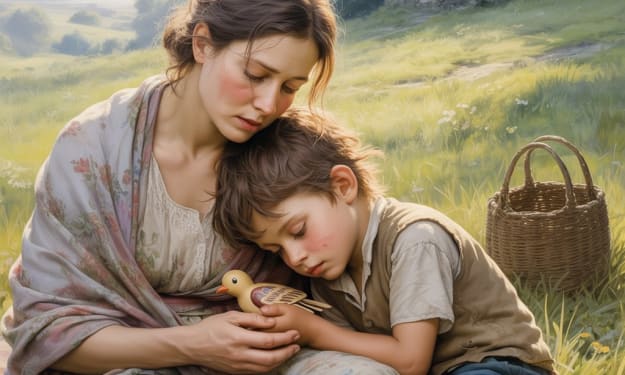
The morning sun rose gently over the rolling hills of the English countryside, casting golden rays across the dew-kissed meadow. Wildflowers swayed in the breeze, and birds chirped softly in the distance. Amid this calm beauty, a woman knelt on the grass, her hands raised to the sky in silent prayer. Her name was Elena, a widow in her early forties, with lines of hardship etched into her sun-worn face. Her simple dress, patched and faded, fluttered slightly in the wind. But her eyes—closed in prayer—held the weight of countless sleepless nights and silent tears. Beside her sat her eight-year-old son, Jacob, his small hands holding a wooden toy his late father had carved. His clothes were old, his shoes too tight, but his face glowed with the soft wonder of a child who still believed the world could be kind. He looked up at his mother, then at the sky, quietly waiting for her to finish. They had come to the meadow at dawn, as they often did. It was a sacred place for Elena—a place where she felt closer to her husband and where she poured out her heart, not in front of people, but before God. Every morning, she asked for the same thing: not riches, not comfort, but a future for Jacob. A chance. Their cottage had burned down three winters ago. Since then, they had moved from shelter to shelter, sometimes sleeping beneath trees or in barns offered by kind strangers. Elena took whatever work she could find—cleaning homes, picking fruit, even stitching clothes late into the night—but the money was barely enough for food. Still, she never begged. She believed in dignity. And she taught Jacob the same: "We may be poor," she told him, "but we will never be small." Jacob was different from other boys. Quiet, thoughtful. He read old books they found or borrowed, and asked questions far beyond his years. He wanted to go to school, but every time they tried, life pulled them elsewhere. Fees, clothes, papers—there was always something missing. But today felt different. As Elena lowered her hands, a soft voice called out from the nearby path. An older man stood there, with kind eyes and a worn leather bag. He was a schoolteacher, visiting relatives in the countryside. He had been walking the meadow trail when he saw the mother and child. “I hope I’m not interrupting,” he said gently. “I couldn’t help but notice you.” Elena stood slowly, shielding Jacob behind her, cautious but polite. “Good morning, sir,” she said. They spoke for a few minutes. The man, Mr. Whitmore, asked about their lives—why they were out here so early, where they were staying. Elena hesitated, but something in his voice was warm and trustworthy. When Jacob mentioned his love of books, Mr. Whitmore’s eyes lit up. He asked Jacob a few questions—math, reading, history—and was stunned by his intelligence. “This boy,” he said quietly to Elena, “has a gift.” Elena’s eyes welled with tears. No one had ever said that before—not a teacher, not a stranger. “But we have no way to send him to school,” she whispered. “No papers, no money, nothing.” Mr. Whitmore knelt in front of Jacob. “Would you like to learn?” he asked. Jacob nodded. And so began a new chapter. Mr. Whitmore didn’t just walk away. He returned the next day, and the day after. He spoke with local schools and arranged for Jacob’s admission. He helped Elena find a small cottage nearby, offered tutoring materials, and even found her sewing work through friends. For the first time in years, Elena felt hope bloom like the wildflowers around them. Months passed. Jacob began school, excelling in every subject. His teachers marveled at his hunger to learn. Elena’s health improved, her laughter returned, and every evening, she still prayed—but now her prayers were filled with gratitude, not just longing. One autumn afternoon, as the sun dipped below the horizon, Elena and Jacob returned to the meadow. She sat on the same patch of grass, her hands folded in her lap. Jacob stood beside her, taller now, his schoolbooks in his hand. “Do you still pray for me, Mama?” he asked. Elena smiled. “Every day, my son. Even now.” Jacob looked out at the meadow. “Then maybe your prayers worked.” She looked up at him, her eyes filled with tears and pride. “No,” she said softly. “God just finally let someone hear them.” ---
By Muhammad musababout a year ago in Families
7 Smart Ways a Pediatrician guide families Through an Autism Diagnosis
When a child receives an autism diagnosis, families often face a flood of new information, unclear next steps, and emotional stress. Your Pediatrician becomes an essential guide, translating clinical details into practical decisions that make sense. A child’s developmental care moves into a more focused phase—where timing, coordination, and reliable support shape future progress. Families don’t need more confusion. They need direction and clear answers.
By Piper Burchabout a year ago in Families